Forbes: These Investors Stand To Lose The Most From FTX’s Implosion

ForbesPublicado a 2022-11-11Actualizado a 2022-11-11

Resumen

o one is set to lose more from FTX’s implosion than Sam Bankman-Fried, the crypto wunderkind who founded the exchange and then drove it into the ground this week. His net worth, once as high as $26.5 billion, has plummeted to less than a billion dollars–one of the fastest falls from the billionaires ranks ever. FTX users and employees may be in for big losses too, with Bankman-Fried now trying to cobble together emergency funding to cover a shortfall of up to $8 billion as customers demand their money back. “I can't make any promises,” he tweeted Thursday. “But I'm going to try.”

No one is set to lose more from FTX’s implosion than Sam Bankman-Fried, the crypto wunderkind who founded the exchange and then drove it into the ground this week. His net worth, once as high as $26.5 billion, has plummeted to less than a billion dollars–one of the fastest falls from the billionaires ranks ever. FTX users and employees may be in for big losses too, with Bankman-Fried now trying to cobble together emergency funding to cover a shortfall of up to $8 billion as customers demand their money back. “I can't make any promises,” he tweeted Thursday. “But I'm going to try.”

Then there are FTX’s investors.

As the crypto exchange ballooned in size, it became a huge draw for venture capitalists eager to get in on the Bitcoin boom. In June 2021, FTX raised $1 billion at an $18 billion valuation from venture investors such as Paradigm, SoftBank and Sequoia Capital. Three months later, FTX brought in a $421 million haul, pushing its valuation to $25 billion, from investors like Singapore-government owned investment firm Temasek, Tiger Global Management and the Ontario Teachers’ Pension Plan. By January of this year, crypto prices were on the decline, but FTX charged ahead. Investors, many of whom had also pumped money into the earlier rounds, put another $400 million into FTX–at a $32 billion valuation.

That $32 billion figure has gone up in smoke. So has the $1.8 billion-plus of capital that investors pumped into FTX over the course of three years: At least two major shareholders are marking their investment in FTX down to $0: venture capital firm Sequoia and, reportedly, crypto-focused firm Paradigm. Forbes did the same, dropping Bankman-Fried and cofounder Gary Wang from our billionaire’s list Wednesday, based on the collapse of both FTX and the pair’s trading firm, Alameda Research.

In a strict sense, FTX’s investors’ losses are limited to the $1.8 billion or so they put into the business. But their paper losses are much, much higher. If any of these investors had cashed out in January, when FTX peaked at the $32 billion valuation, they’d be tens or even hundreds of millions dollars richer. Instead, they could well end up with nothing.

Who will lose the most? Forbes has a list of FTX shareholders, sent to us by Sam Bankman-Fried in August during our reporting for The Forbes 400 list. Here are the venture capital firms, the pension plan–and two celebrity endorsers–who have a lot to lose if FTX can’t be saved.

(This analysis does not include shares of FTX U.S., the exchange’s American operations, which raised $400 million at an $8 billion valuation concurrent with FTX’s series C round in January. It remains unclear how the troubles facing FTX will impact the value of FTX U.S.. It’s possible that losses from FTX U.S. will push some investors’ total investment in Sam Bankman-Fried’s empire even higher.)
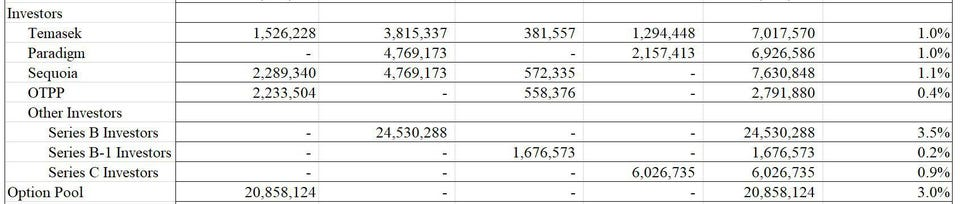
According to the capitalization table Sam Bankman-Fried sent Forbes in August, investors who stand to lose big if FTX goes to zero include employees, investment firms and Ontario teachers'' pensions.FORBES

SEQUOIA CAPITAL

Stake in FTX: 1.1%

Estimated amount invested (FTX only): $200 million

Value at January 2022 peak: $350 million

The Silicon Valley VC fund–famed for its investments in tech giants like Apple, Google and Airbnb–bought into FTX’s series B and B-1 rounds alongside Sequoia Capital Global Equities, a separate entity–to the tune of more than $200 million, according to a letter Sequoia shared on Twitter Wednesday. “FTX is the high-quality, global crypto exchange the world needs,” Sequoia partner Alfred Lin said in June 2021, after the series B round. “Sam is the perfect founder to build this business, and the team's execution is extraordinary.”

The warm feelings were mutual: According to a report published by The Information on Thursday, Alameda Research and Bankman-Fried-backed VC fund FTX Ventures committed “hundreds of millions of dollars” to funds run by Sequoia and two other firms.

The value of Sequoia’s investments in FTX peaked at $350 million earlier this year, marking what is the largest likely loss for an outside investor in the exchange. Sequoia said in its letter to its investors that its FTX stake represented less than 3% of the committed capital of one fund, and the fund’s $150 million loss is offset by about $7.5 billion in realized and unrealized gains.

TEMASEK

Stake in FTX: 1%

Est. amount invested: $205 million

Value at January 2022 peak: $320 million

An investment company owned by the government of Singapore, Temasek is the second-largest outside investor on the capitalization table, with 7 million shares. The $297 billion (assets) business, which owns big stakes in Singapore’s DBS Group and Singapore Airlines, invested in all three of FTX’s major funding rounds. With its $320 million stake on the brink of being worthless, a Temasek spokesperson told Reuters on Wednesday that they were “aware of the developments” and were “engaging FTX in our capacity as shareholder."

PARADIGM

Stake in FTX: 1%

Est. amount invested: $215 million

Value at January 2022 peak: $315 million

Paradigm, an investment firm “focused on supporting the crypto/Web3 companies and protocols of tomorrow,” invested in the exchange’s series B and C rounds and owned nearly 7 million shares of FTX as of August. “There's a bright future ahead for Sam and FTX,” Paradigm cofounder Matt Huang said in July 2021, “and Paradigm is excited to be a part of it."

According to The Information, Alameda Research also invested at least $20 million in Paradigm.

ONTARIO TEACHERS’ PENSION PLAN

Stake in FTX: 0.4%

Est. amount invested: $80 million

Value at January 2022 peak: $125 million

The Ontario Teachers' Pension Plan, which manages the retirement funds of 333,000 teachers in the Canadian province, invested a total of $95 million between FTX and FTX U.S. in late 2021 and early 2022. The FTX portion of that investment alone was worth an estimated $130 million following FTX’s series C round–before the crypto winter and current crisis. “While there is uncertainty about the future of FTX,” Ontario Teachers’ wrote in a statement, “any financial loss on this investment will have limited impact on the plan, given this investment represents less than 0.05% of our total net assets.”


Lecturas Relacionadas

Welcome to the New Crypto World: Only This Time, The Place Where You Lose Money Is Called the Stock Market

Welcome to the New Crypto World: Only This Time, the Place to Lose Money is Called the Stock Market. The article depicts a future (2026) where global stock markets, particularly tech stocks, are exhibiting behaviors and risks reminiscent of the cryptocurrency world. The narrative centers on a sharp crash in South Korea's KOSPI index and leading stocks like SK Hynix, highlighting widespread retail losses, leverage-induced liquidations, and extreme volatility. It argues that a significant shift in market dynamics is underway: pricing is increasingly driven by narratives (like the AI boom) over fundamental valuation, amplified by high leverage and the rapid, emotion-fueled consensus formed on social media. Former crypto traders, seeking new opportunities, brought their high-risk strategies—chasing narratives, using leverage—into equity markets, focusing on sectors like AI and semiconductors. Ironically, data suggests some major tech stocks have recently shown greater volatility and faster crashes than Bitcoin, which is becoming relatively more stable and "stock-like" through institutional adoption. The piece details how leveraged ETFs in Korea, particularly those tied to single stocks, created a vicious cycle of forced selling that exacerbated the market plunge. It concludes that while stocks retain underlying fundamentals, the *trading* of them has undergone a "de-rationalization": markets now prioritize themes, social media sentiment, and leveraged bets over traditional analysis. In a paradoxical twist, Bitcoin is striving to become more like a traditional asset, while a segment of the stock market is becoming more like crypto—a cycle of grand stories, crowded trades, easy leverage, and the pervasive, often misplaced, belief that one can exit before everyone else. The final, poignant wish from a Korean retail investor—to go back to life before trading and get their money back—underscores that markets offer no refunds.

marsbitHace 4 min(s)

Welcome to the New Crypto World: Only This Time, The Place Where You Lose Money Is Called the Stock Market

marsbitHace 4 min(s)

Feishu Has Become Doubao

This may be the most important day in the ten-year history of Feishu. On July 30, ByteDance announced a major restructuring via internal email. Feishu, an independent operation for a decade, will no longer function separately and will lose its independent sales and marketing teams. Its product team is being integrated into Doubao AI, and its Go-to-Market strategy merges into the Volcano Engine's To B system. This move signals a strategic pivot, not a failure of Feishu. The era where Feishu sought to be an all-encompassing super-app for productivity is ending. AI has become the dominant logic. Industry trends show a shift from building platform "entrances" to embedding AI directly into workflows, as seen with Microsoft Copilot and Google's Gemini. Data reveals the driver: over 90% of Feishu's new clients in Q2 2026 purchased its AI products. Enterprises are now buying integrated AI solutions, not standalone software. By integrating Feishu's deep enterprise workflow scenarios, Doubao evolves from a consumer-facing chatbot into a powerful enterprise productivity engine. This gives Doubao a critical asset: real-world business application. Concurrently, ByteDance established the "Creative Services Platform," unifying its previously fragmented sales fronts (Feishu, Doubao, Volcano Engine) into a single customer-facing entity. This represents ByteDance's first genuine shift to thinking like a true To B company, organizing around client needs rather than internal product silos. The restructuring underscores that AI is no longer just a business line but foundational infrastructure. Doubao is becoming the new organizational core, mirroring TikTok's past ascendancy. This demonstrates a profound shift: AI is beginning to reshape corporate structures, determining resource allocation and strategic priorities. ByteDance is likely just the first of many companies to undergo such an AI-driven reorganization.

marsbitHace 15 min(s)

Feishu Has Become Doubao

marsbitHace 15 min(s)

The Second Half of the RWA Issuance Race: Amidst the Utilization Dilemma, Trillions Worth of On-Chain Assets Awaken

RWA (Real-World Asset) tokenization has surged to a record $32 billion in on-chain value. However, a structural challenge has emerged: approximately 87% of these tokenized assets are inactive, not participating in DeFi lending or trading activities. This "utilization gap" highlights a key question: what happens after assets are brought on-chain? Data shows a stark contrast among major platforms. While Securitize leads in scale ($4.9B), it has a DeFi utilization rate of only 0.7%. Similarly, Ondo Finance ($3.5B) sees about 2.7% utilization. In contrast, Maple Finance, with a smaller $2.3B in assets, achieves a 62% utilization rate by embedding its assets directly into lending activities from the outset. Three primary factors contribute to low utilization: 1) **Asset Nature**: Tokenized treasuries are often held for yield, not traded. 2) **Regulatory Barriers**: Securities laws and KYC requirements restrict free movement into permissionless DeFi pools. 3) **Infrastructure Gaps**: A lack of deep secondary markets, real-time pricing, and mature clearing mechanisms hinders liquidity. The RWA narrative is now shifting from a "race to issue" to a "battle for application." While native lending protocols like Maple have inherent advantages, distribution channels are becoming critical. The success of products like SyrupUSDG on platforms like Robinhood Crypto demonstrates that access to existing user bases can accelerate adoption far more effectively than protocol-led efforts alone. The $32 billion milestone validates the feasibility of tokenization, but low utilization underscores that bringing assets on-chain is just the first step. The true test for the sector is enabling these assets to circulate, be utilized, and create new economic value within the DeFi ecosystem.

marsbitHace 15 min(s)

The Second Half of the RWA Issuance Race: Amidst the Utilization Dilemma, Trillions Worth of On-Chain Assets Awaken

marsbitHace 15 min(s)

Trading

Spot
活动图片