$6 Trillion in Assets On-Chain: Why Canton Network is Wall Street's New Darling

比推Publicado a 2026-01-09Actualizado a 2026-01-09

Resumen

Canton Network is gaining significant traction as a blockchain platform focused on real-world assets, with reported support for over $6 trillion in on-chain assets and a daily transaction volume of $280 billion. Backed by major traditional finance institutions like DTCC and J.P. Morgan, it functions as an interoperability layer connecting independent networks ("cantons"), similar to Cosmos. The network relies on 13 permissioned "Super Validators" for consensus, many of which are operated by early investors. Canton uses a native utility token, Canton Coin (CC), which is burned as gas fees, creating deflationary pressure. Similar to Bitcoin, it employs a programmed halving schedule—the second halving is imminent, potentially reducing supply and impacting short-term token prices. While its privacy-focused, customizable design appeals to institutional players, concerns remain about centralized control and insider advantages, as Super Validators heavily influence token distribution and featured applications. The upcoming halving presents a speculative opportunity, but long-term value depends on sustainable network utility rather than supply shocks alone.

Source: Bankless

Author: Jack Inabinet

Original Title: How Canton Network Works


Canton Network is quickly becoming the latest focus in the cryptocurrency industry. Does this signal a brewing explosive opportunity in a new wave of L1 ecosystems?

This blockchain, focused on real-world assets, recently made headlines for its high-profile integration with traditional finance giants (including the Depository Trust & Clearing Corporation DTCC and JPMorgan Chase), claiming to support over $6 trillion in on-chain real-world assets and a daily trading volume of $280 billion.

Today, we will delve into the technical architecture and token economic model of the Canton Network to better understand the design logic of this groundbreaking network.

Super Validator-Led Technical Architecture

Canton is essentially an interoperability layer connecting independent networks (these networks are also called "cantons"), with a design philosophy similar to the model in the Cosmos ecosystem that allows independent chains to communicate directly.
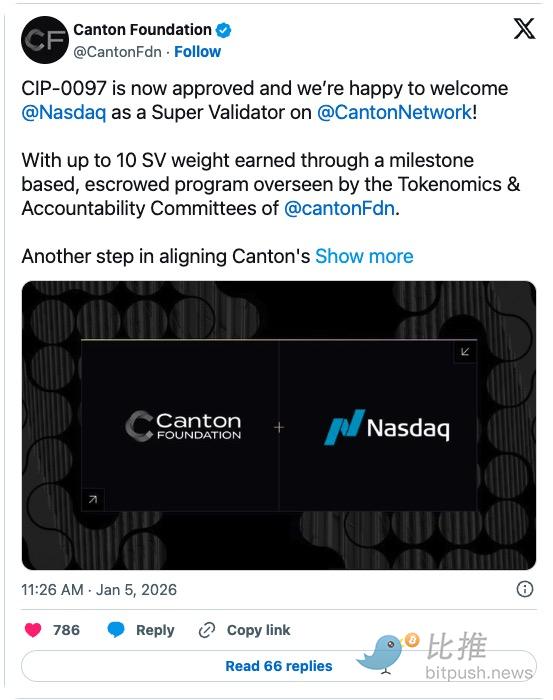
Regarding its consensus mechanism, the Canton Network is validated by an invite-only set of 13 "Super Validator" nodes, many of which are operated by the network's investors. One node is operated by the Canton Foundation, which is composed of early enterprise supporters, brand partners, and investors.

Most activity on the network occurs at the independent "canton" level, similar to how the Osmosis exchange in the Cosmos interoperability ecosystem aggregates the main liquidity and user activity. The validators of these independent cantons are responsible for processing all data on their independent "shard" and enjoy high flexibility in customizing the rules of that independent execution environment, including preferences for gas fees and data sharing.

Due to the inherently opaque design architecture adopted by Canton, the authenticity and sources of its published metrics (such as asset size and transaction volume) are difficult to verify independently.

However, representative independent application cases have emerged in the ecosystem: for example, the recently launched Temple Digital Group exchange, supported by YZi Labs, is operating as an independent Canton sub-network.

Token Economics

The Canton Network is built around its native utility token, Canton Coin (ticker CC), which is designed to "reward actual network usage rather than speculative behavior."

Similar to Ethereum, Canton burns tokens when users pay gas fees, creating deflationary pressure on CC. When the network is used for transactions, settlements, data synchronization, or asset transfers, all fees paid in CC are burned, permanently removed from circulation.

Similar to Bitcoin, Canton employs a programmatic token issuance curve, with regular halving events. New CC tokens can be continuously minted by various network participants by adding "measurable utility" to the network.
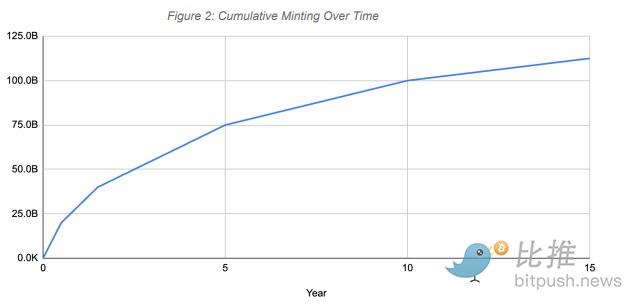
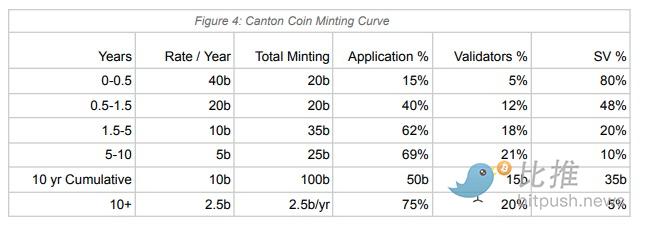
Currently, permitted Canton Super Validators (primarily early investors) are eligible for 48% of the CC issuance as a reward for maintaining global consensus. Validators receive 12% of the total CC supply, allocated mainly based on the value of Canton Coin transfers initiated by their users, and potentially rewarded based on node uptime if the minting cap allows.

Similar to Berachain, Canton also allocates tokens directly to applications in the form of gas fee rebates. "Featured" applications (which can be designated by Super Validators) can mint CC up to 100 times the burned fees, while non-featured applications can mint up to 80% of the burned fees.

It is worth noting that, at the time of writing, CC token minting is still proceeding according to the plan for years 0.5 to 1.5 in the chart below. However, with the second Canton halving scheduled to occur in just three days, the CC minting rate will soon be halved, and its distribution will be adjusted according to the plan for years 1.5 to 5 in the chart below.

For investors seeking trading opportunities, the supply reduction from the CC halving event may, through supply and demand dynamics, push the token price higher in the short term, regardless of the network's fundamental investment thesis.
Conclusion: A Glossy Narrative with Underlying Concerns

Canton undoubtedly presents a compelling investment story, but its potential opportunities are matched by outstanding questions.

Its highly configurable, privacy-focused design holds clear appeal for traditional finance giants, but the network's complex token economic structure and centralized control system introduce significant insider advantages, increasing the risk of imbalanced token distribution.

The permitted Super Validators, through their ability to designate "Featured" applications, continue to wield excessive influence over Canton's issuance. This means the flow of CC tokens will remain heavily controlled by insiders, even though this group's own issuance is set to decrease by approximately 80% within days.

The sudden rise of the Canton Network on the eve of its second halving adds another layer of suspense to the market. In the early halving phases, the supply shock effect is often most pronounced—while the upcoming emission cut for CC creates a clear catalytic opportunity for short-term trading, long-term investors should still view it with caution: the price impact from supply constriction should not be conflated with sustainable fundamental value.


Twitter:https://twitter.com/BitpushNewsCN

Bitpush TG Discussion Group:https://t.me/BitPushCommunity

Bitpush TG Subscription: https://t.me/bitpush

Original link:https://www.bitpush.news/articles/7601459

Preguntas relacionadas

QWhat is the Canton Network and why is it gaining attention in the cryptocurrency industry?

ACanton Network is a blockchain focused on real-world assets, gaining attention for integrating traditional finance giants like DTCC and JPMorgan, claiming to support over $6 trillion in on-chain real assets and process $280 billion in daily transaction volume.

QHow does Canton Network's technical architecture work, particularly regarding its consensus mechanism?

ACanton Network uses an interoperability layer connecting independent networks called 'cantons', with consensus managed by 13 invitation-only 'Super Validators' nodes, many operated by the network's investors, similar to how Cosmos enables direct communication between independent chains.

QWhat is the role of the native utility token Canton Coin (CC) in the network's economy?

ACanton Coin (CC) is used for paying gas fees, which are burned to create deflationary pressure. It features programmed token issuance with periodic halvings, and new CC can be minted by network participants who add measurable utility, with allocations to validators and featured applications.

QWhat are the potential risks and concerns associated with Canton Network's token economics and control structure?

AConcerns include centralized control by Super Validators who have significant influence over token distribution and featured applications, creating potential insider advantages and risks of imbalanced token allocation, despite the deflationary mechanisms and halving events.

QHow does Canton Network's upcoming halving event impact CC token supply and potential market effects?

AThe upcoming halving will reduce CC issuance by half, potentially creating short-term price increases due to supply shock, but long-term investors should distinguish between supply-driven price effects and sustainable fundamental value.

Lecturas Relacionadas

The Verdict in Choi Tae-won's Divorce Case: Revealing the Inheritance Undercurrent Behind SK Hynix's Trillion-Won Empire

SK Group Chairman Chey Tae-won's high-profile divorce case, involving a record 1.38 trillion won settlement, has drawn attention to the succession plans for Korea's second-largest conglomerate, especially its crown jewel, SK hynix. Unlike traditional chaebol scripts centered on the eldest son, Chey's three children from his marriage to former President Roh Tae-woo's daughter, Roh Soh-yeong, are carving distinct, non-traditional paths. Eldest daughter Chey Yun-jung (b. 1989) is seen as the most evident successor. With a scientific and consulting background, she holds executive roles at SK bioscience and SK Inc.'s growth support department, focusing on future strategy and biopharma. Her marriage is to an AI infrastructure entrepreneur, not a traditional business alliance. Second daughter Chey Min-jung (b. 1991) took a unique route, voluntarily serving as a South Korean naval officer, including an anti-piracy deployment. She later worked on policy and strategy for SK hynix in Washington D.C. before co-founding an AI-driven healthcare startup. She married a former U.S. Marine Corps officer, connecting her to U.S. defense and policy circles—networks crucial for a global semiconductor giant. The only son, Chey In-geun (b. 1995), who studied physics like his father, worked briefly at SK E&S before joining McKinsey. Despite fitting the traditional "heir" profile as the eldest son, he remains silent and holds no public position or shares in SK, suggesting the old succession playbook is obsolete. As SK hynix's valuation soars, becoming a geopolitical asset in the AI era, the heirs' legitimacy is no longer automatic. They must prove themselves in fields like AI biotech, global policy, and strategic consulting. Their marriages also reflect new elite networks in tech and defense, not old political alliances. Their inheritance is the complex challenge of navigating a globalized, tech-driven world, not just a corporate throne.

marsbitAyer 09:06

The Verdict in Choi Tae-won's Divorce Case: Revealing the Inheritance Undercurrent Behind SK Hynix's Trillion-Won Empire

marsbitAyer 09:06

From OpenSea to OpenRouter: Is Alex Atallah Repeating His 'Exit at the Peak' Playbook?

From OpenSea to OpenRouter: Is Alex Atallah Repeating His "Exit at the Peak" Playbook? According to the Wall Street Journal, payments giant Stripe is in talks to acquire the AI model aggregation platform OpenRouter in a potential deal valuing the company near $100 billion. This would mark founder Alex Atallah's second creation of a company reaching a $100 billion valuation, following his co-founding of NFT marketplace OpenSea. OpenRouter, founded just over three years ago, has grown rapidly by acting as a unified gateway for developers to access over 400 AI models. It currently has about 10 million users and processes over 200 trillion tokens monthly. While the platform's annualized revenue is around $50 million, its valuation has skyrocketed from $1.3 billion in March 2026. The potential acquisition by Stripe, a company OpenRouter's founder once likened it to, represents a major expansion into AI infrastructure for the payments leader. This move echoes Atallah's previous timing with OpenSea, where he departed before the NFT market's significant downturn. For OpenRouter, selling now may be strategic. Despite its scale, its business model—charging a 5-5.5% fee on AI inference calls—faces pressure from competition, open-source models, and potential price wars among model providers, limiting its profitability narrative for an IPO. A key asset for potential acquirers like Stripe is OpenRouter's vast repository of real-world AI usage data, which offers unique insights into model performance and developer preferences that are difficult to replicate. Whether this potential deal signifies a new valuation benchmark for AI infrastructure or another market peak signal remains to be seen.

链捕手Ayer 08:42

From OpenSea to OpenRouter: Is Alex Atallah Repeating His 'Exit at the Peak' Playbook?

链捕手Ayer 08:42

Trading

Spot
活动图片





