Bitcoin price crashed amidst wider sell off, this could be the next stop

newsbtcPublicado a 2022-09-15Actualizado a 2022-09-15

Resumen

Bitcoin price plunged close to 8% over the past day owing to the high Consumer Price Index report. The prices of most altcoins fell on their respective charts after the...

Bitcoin price plunged close to 8% over the past day owing to the high Consumer Price Index report.
""

The prices of most altcoins fell on their respective charts after the CPI showed a 0.1% increase in August, which has now taken the unadjusted value to 8.3%.
""

The annual increase was expected to be 8.1%. Over the last 24 hours, Bitcoin registered a 4% loss.
""

Given that the market is undergoing an extended sell-off, a further fall in BTC’s value could be expected. The technical outlook for the coin was bearish as buyers left the market at the time of writing.
""

Bitcoin price has been struggling at $18,900 for the past month, but it has managed to break through this price level in the last week.
""

Bitcoin has soared past the $22,000 level. The recent blow from the CPI report has pushed the coin downwards.
""

Indicators have chosen to side with the bears given how sellers are dominating the market at press time. The global cryptocurrency market cap today is at $1.04 trillion, with a 2.5% negative change in the last 24 hours.
""

Bitcoin Price Analysis: One Day Chart
Bitcoin Price

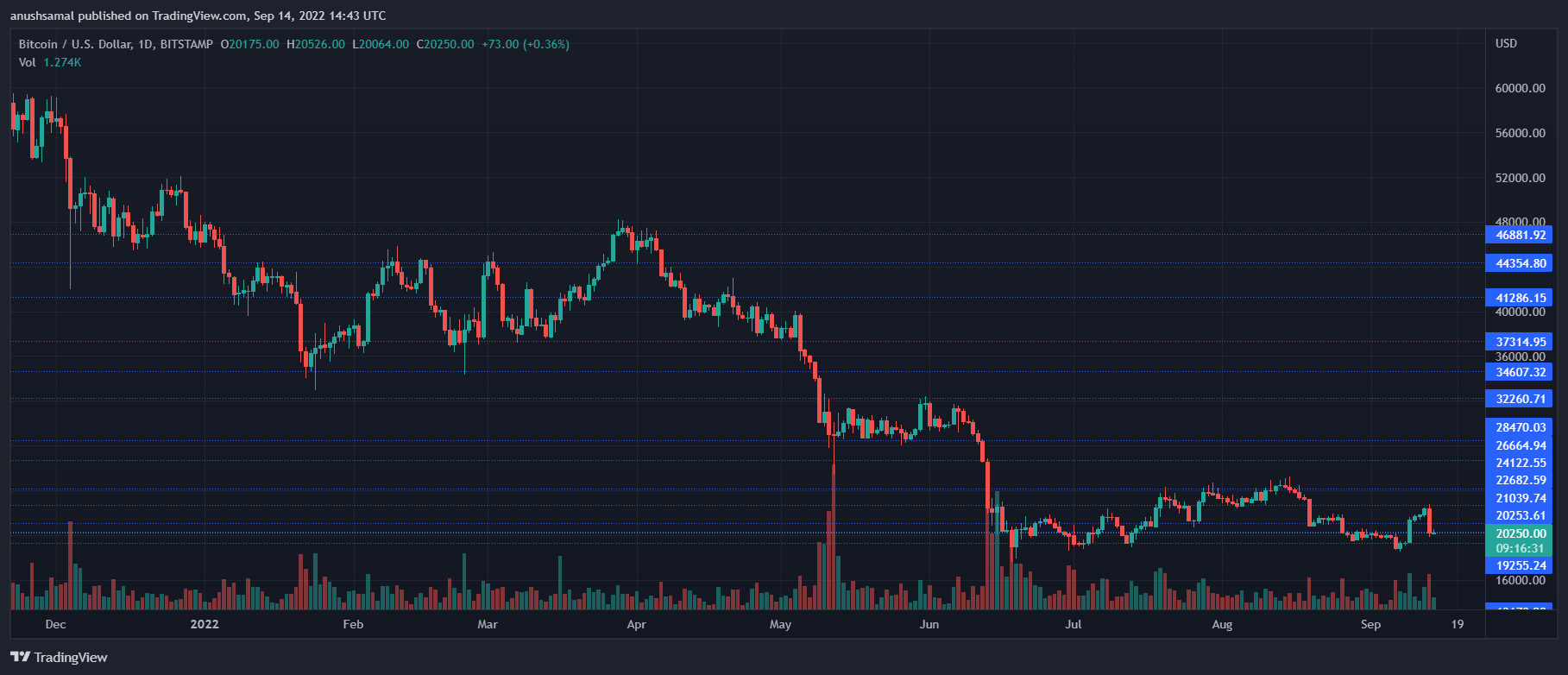
Bitcoin was priced at $20,200 on the one-day chart | Source: BTCUSD on TradingView

""

BTC was trading at $20,200 at the time of writing. The plunge from the $22,000 mark was sudden due to the unanticipated number from the CPI report.
""

Immediate resistance for Bitcoin price was at the $21,000 mark. If BTC manages to topple this level, it can get back to trading above the $22,000 price mark.
""

Local support for BTC was at $19,200. However, with the intense sell-off, the coin could fall to trade near the $18,900 support line.
""

The amount of Bitcoin traded in the past session grew slightly, indicating that there was an influx of buying strength.
""

Technical Analysis
Bitcoin Price

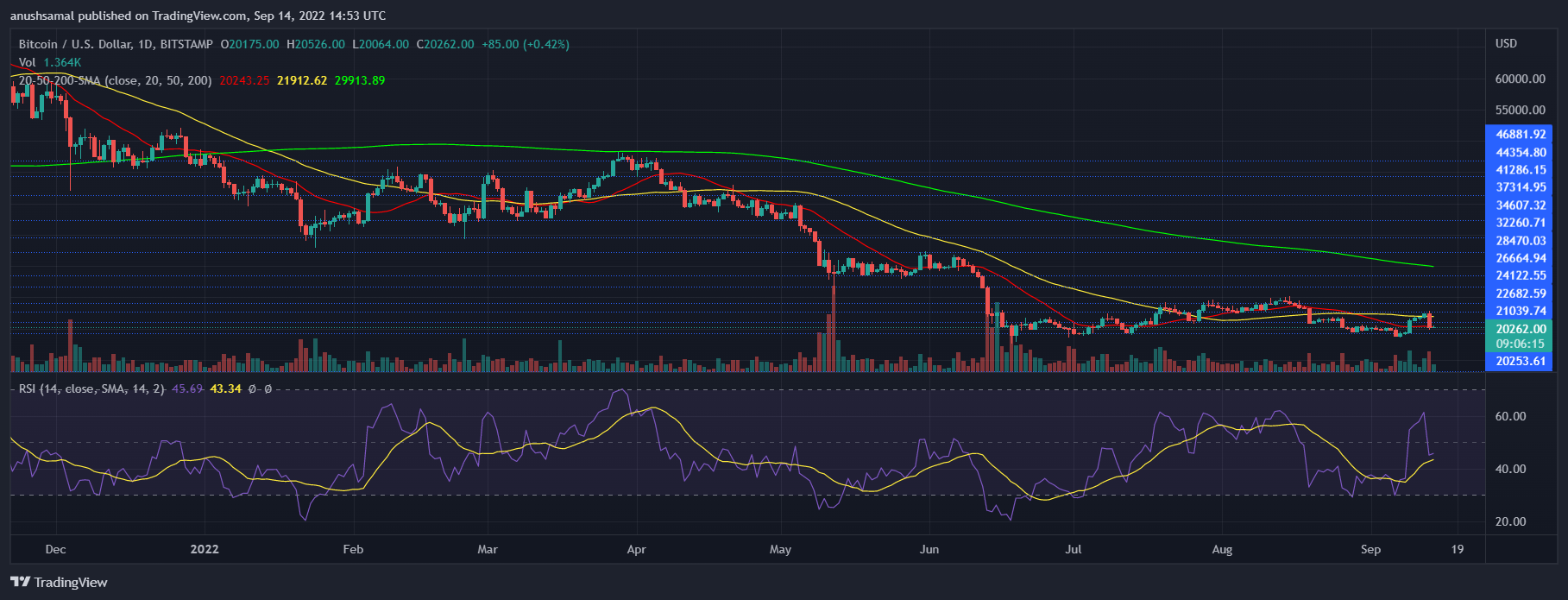
Bitcoin displayed a small uptick in the number of buyers on the one-day chart | Source: BTCUSD on TradingView

""

BTC has registered a sharp fall in buying strength over the last 24 hours. This fall in buyers has further pushed the price near the nearest support line.
""

The Relative Strength Index was seen below the half-line, indicating strong selling strength and, therefore, bea""rishness.

Over the past few trading sessions, RSI noted a small uptick, indicating that the buying strength increased slightly.
""

Bitcoin price just fell through the 20-SMA line, which was also a sign that sellers were driving the price momentum in the market.
Bitcoin Price

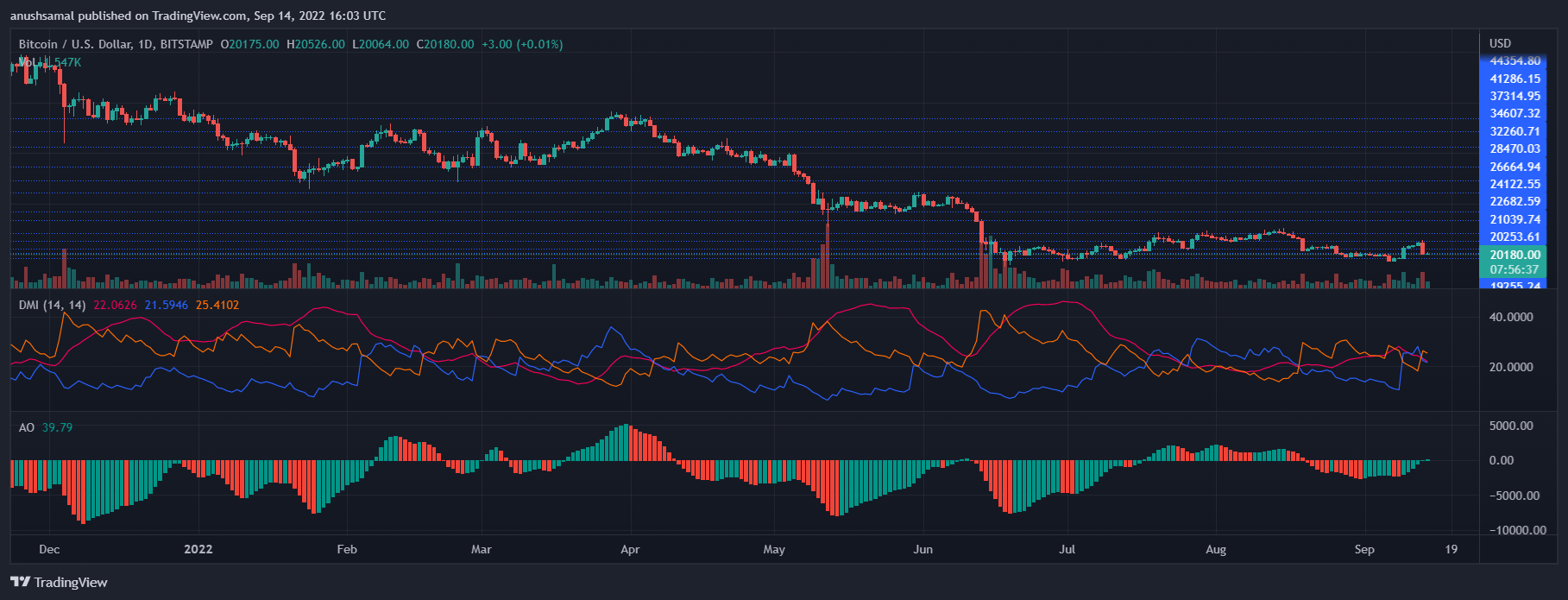
Bitcoin registered buy signal on the one-day chart | Source: BTCUSD on TradingView

""

BTC displayed buy signal despite the market registering a tiny buy signal after buying strength displayed an appreciation.
""

The Awesome Oscillator depicts the overall market strength and the direction of the price. AO climbed above the half-line, indicating that buyers could act on this price action.
""

Even if buyers act on the buy signal, the price of the asset would hardly notice an upward movement. The Directional Movement Index signals the price direction and momentum.
""

DMI was negative as the -DI (orange) line was above the +DI (blue) line. The Average Directional Index (red) was above the 20 mark, which means that the present price direction has gathered strength.


Lecturas Relacionadas

SEC Slams the Brakes at the Last Minute, Halting "Tokenized U.S. Stocks"

On May 22, the U.S. SEC postponed the release of a key "innovation exemption" draft that would have permitted crypto-native platforms to issue and trade tokenized U.S. stocks on decentralized venues without full traditional exchange compliance. This would have legalized a "third-party token" model used overseas, where platforms issue tokens tracking stock prices without the underlying company's involvement, raising unresolved questions about shareholder rights, dividends, and sanctions enforcement. Meanwhile, the SEC had already approved a different, compliant path for tokenization led by Nasdaq and NYSE. Their model integrates tokenized stocks into existing settlement systems (like DTCC), preserving all shareholder rights. This creates a fundamental conflict: crypto platforms seek a permissionless, 24/7 on-chain parallel market, while traditional exchanges advocate for an upgraded, regulated version of the current system. Intense lobbying from traditional exchange groups like the World Federation of Exchanges argued the exemption would create an unfair regulatory advantage and dilute investor protection. Even some compliant crypto firms favored delay. Internally, SEC commissioners were divided on the scope and pace of the exemption. The delay highlights a critical policy crossroads. With significant trading volume already occurring overseas, the SEC's decision will determine whether the U.S. embraces a dual-track system for tokenized equities or sidelines itself from an emerging global infrastructure. The core unresolved question remains the legal status and rights of holders of third-party tokenized stocks. The SEC paused because the draft framework risked creating a major new asset class with profound, unanswered legal implications.

marsbitHace 2 min(s)

SEC Slams the Brakes at the Last Minute, Halting "Tokenized U.S. Stocks"

marsbitHace 2 min(s)

Is a Super IPO Wave Coming? Will It Drain and Crash the U.S. Stock Market?

The article discusses concerns about a potential "super IPO wave" hitting the U.S. stock market, with major companies like SpaceX, OpenAI, and Anthropic preparing to go public. While these large IPOs could collectively raise hundreds of billions, raising fears of a market "blood drain," analysis suggests the impact may be limited. Key points include: * Historical data shows IPO waves often coincide with strong market returns, as they typically occur during periods of high investor demand. * Model estimates suggest even the largest IPOs might only cause a market dip of around 1%. They are more likely to trigger a routine market pullback rather than end a bull market. * The current demand side remains supportive due to high household cash balances, strong corporate earnings growth, continued stock fund inflows, and robust share buyback announcements. * The main risk lies in concentrated investor positions, particularly in large-cap tech stocks, which are at elevated levels. A shift in funds towards new issuances could pressure these crowded sectors. * Recent fund flows show strength concentrated in U.S. and tech stocks, while other regions like Europe and Japan are experiencing outflows. The conclusion is that the IPO wave itself is unlikely to crash the market unless it coincides with a weakening in underlying demand factors like earnings or fund inflows into U.S. equities. The focus should be on whether demand can continue to absorb the new supply.

marsbitHace 8 min(s)

Is a Super IPO Wave Coming? Will It Drain and Crash the U.S. Stock Market?

marsbitHace 8 min(s)

Vitalik is Personally 'Dismantling' the Ethereum Foundation

Vitalik Buterin recently published an extensive article addressing core concerns about Ethereum's future direction and the role of the Ethereum Foundation (EF). He clarifies that the EF is not his personal domain nor the central authority of Ethereum; it operates as just one node within the broader ecosystem. The board makes collective decisions, with significant operational work led by Aya Miyaguchi, allowing Vitalik to focus on technical matters. The article critiques the perception that the EF should act like a conventional, fast-moving tech company. Buterin warns that merely chasing higher TPS, lower latency, or better marketing—like other chains—risks diluting Ethereum's foundational values. He draws a parallel to Google's evolution away from its "Don't be evil" ethos. Instead, the EF's renewed mandate is to focus on preserving and strengthening Ethereum's core principles, summarized as CROPS: **C**ensorship-resistance, **R**esistance to capture, **O**pen source, **P**rivacy, and **S**ecurity. The foundation will concentrate its limited resources (holding only ~0.16% of ETH) on these long-term, non-commercializable fundamentals, while ecosystem growth, applications, and market-facing activities should be driven by external teams and capital. Buterin outlines key technical priorities aligned with this vision: 1) Advancing formal verification to mathematically prove the absence of bugs; 2) Enhancing consensus security to maintain operation without reliance on social coordination during outages; and 3) Reducing dependency on intermediaries (like RPCs) to strengthen user sovereignty and privacy. He acknowledges ETH as Ethereum's most valuable asset, crucial for security, but stresses that promoting its value is a task for the wider ecosystem, not the EF. Ultimately, Buterin's message is a strategic refocus: the EF will become a smaller, more focused entity guarding Ethereum's essential, harder-to-achieve properties, ensuring it remains distinct not just in performance but in its commitment to decentralization, resistance, and security.

marsbitHace 13 min(s)

Vitalik is Personally 'Dismantling' the Ethereum Foundation

marsbitHace 13 min(s)

After Futu Securities Was Banned, Will Buying Stocks On-Chain Be a New Solution?

After Chinese regulators announced crackdowns on cross-border securities platforms like Futu Securities, some investors are exploring whether blockchain-based stock trading could offer an alternative. However, this article argues that "on-chain stocks" are not a legal loophole for mainland Chinese investors to bypass securities, foreign exchange, and cryptocurrency regulations. Instead, it represents an infrastructure experiment in tokenizing traditional assets like U.S. stocks and ETFs for a global audience. The appeal of on-chain stocks lies in offering a more seamless, 24/7 trading experience using crypto wallets and stablecoins, particularly for non-U.S. investors and crypto natives. Projects typically issue tokens that track the price of underlying assets, but these are often financial instruments or structured products, not direct equity ownership conferring voting rights. For investors, key risks include unclear legal rights, redemption mechanisms, regional access restrictions, and the misalignment between on-chain token trading hours and the actual stock market. Using stablecoins to purchase these tokens does not legitimize otherwise restricted capital outflows for Chinese residents. For entrepreneurs, the opportunity lies not in creating new retail channels to circumvent regulations, but in building B2B infrastructure—such as compliance, custody, identity verification, and reporting tools—for licensed institutions exploring asset tokenization. In conclusion, while on-chain stocks represent a significant trend in bridging traditional finance with blockchain, they are not a regulatory workaround. Their long-term viability depends on robust compliance, clear legal structures, and serving legitimate global demand, rather than facilitating unauthorized cross-border investment.

marsbitHace 13 min(s)

After Futu Securities Was Banned, Will Buying Stocks On-Chain Be a New Solution?

marsbitHace 13 min(s)

Trading

Spot
Futuros
活动图片