Last night, an incident dubbed the "most absurd fat-finger error in DeFi history" exploded across the crypto community.
The protagonist of the story is an anonymous "whale." Through the app interface of the DeFi lending protocol Aave, he initiated a seemingly simple transaction: exchanging a whopping $50.43 million USDT stablecoin for AAVE tokens.
How large was this transaction? Large enough to instantly "dry up" the liquidity for the vast majority of tokens on the market. Due to the inherently limited trading depth of AAVE tokens, such a massive buy order directly triggered a disastrous slippage. Simply put, slippage is the deviation between the price you expect to trade at and the price you actually get. In this transaction, the slippage was over 99%.
Transaction link: https://etherscan.io/tx/0x9fa9feab3c1989a33424728c23e6de07a40a26a98ff7ff5139f3492ce430801f
What does this mean? When this transaction was finally executed through on-chain routers like CoW Swap, this user received only 324 AAVE tokens, worth about $36,000 at the market price at the time.
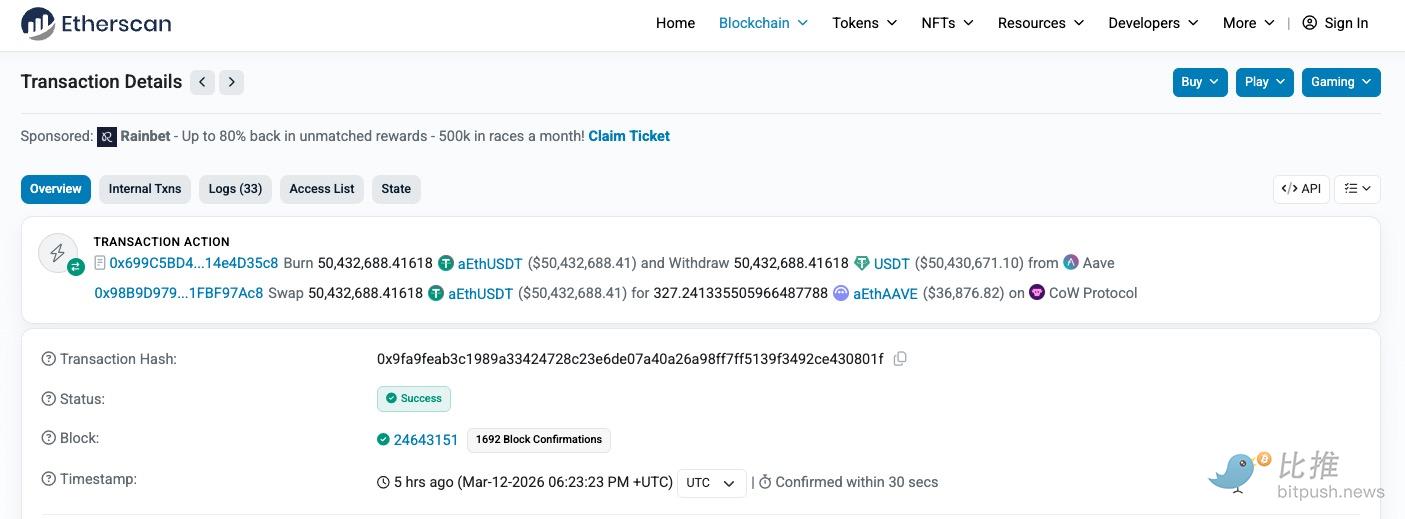
$50.43 million vs. $36,000. One transaction, nearly $50 million evaporated in an instant.
Aave's founder, Stani Kulechov, later explained the incident on social media.
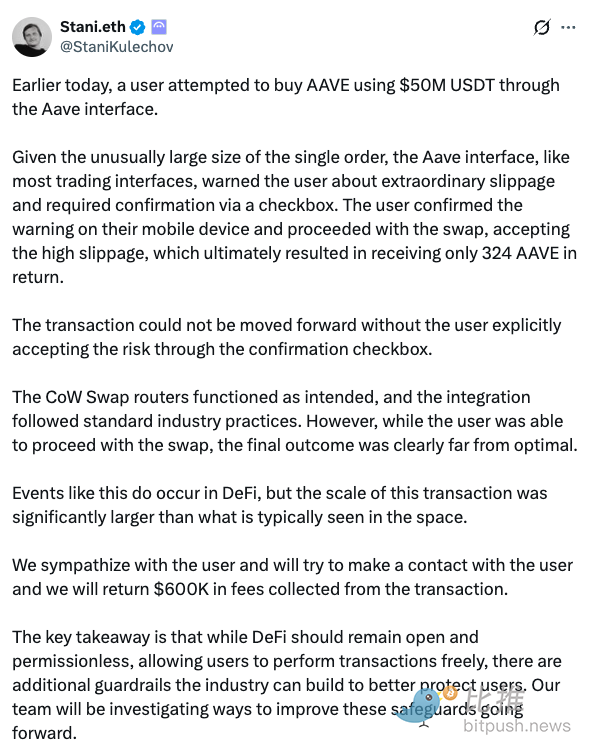
According to his description, the user completed the operation on Aave's mobile app. When the system detected the extreme slippage this massive transaction could cause, the interface popped up a risk warning and required the user to check a confirmation box to indicate they were aware of the risks. On their phone, the user checked that small box and then clicked confirm.
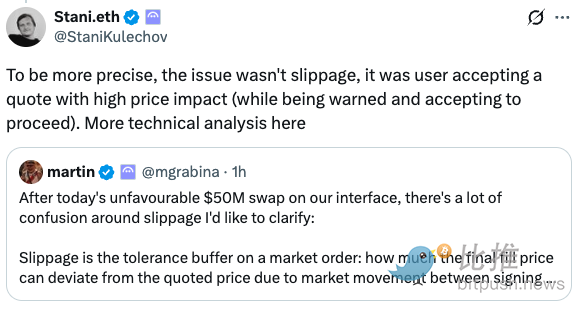
He stated that all procedures were standard and the protocol itself was functioning normally.
The event shocked the entire crypto community, combining elements of the "absurd":
1. Scale: $50 million, even in the crypto world frequented by institutions, is a huge sum of money that many would look up to.
2. Mobile operation, how bold? This was one of the most heated points of discussion in the community. A comment from one netizen received many likes: "Who keeps $50 million on their phone???"
3. Checkbox too 'makeshift'?: The most ironic part of the whole event was that decisive "checkbox." In traditional finance, a multi-million dollar transaction requires layers of approval, multiple reviews, and phone confirmations. In decentralized DeFi, the entire firewall is simplified into a checkbox that can be passed with a simple tap. The community mocked this as the "DeFi version of 'I have read and agree to the terms and conditions'."
The owner of address 0x98b sparked community speculation. Through on-chain tracing, analyst Specter believes this wallet is likely related to the 1011 insider whale Garrett Jin.
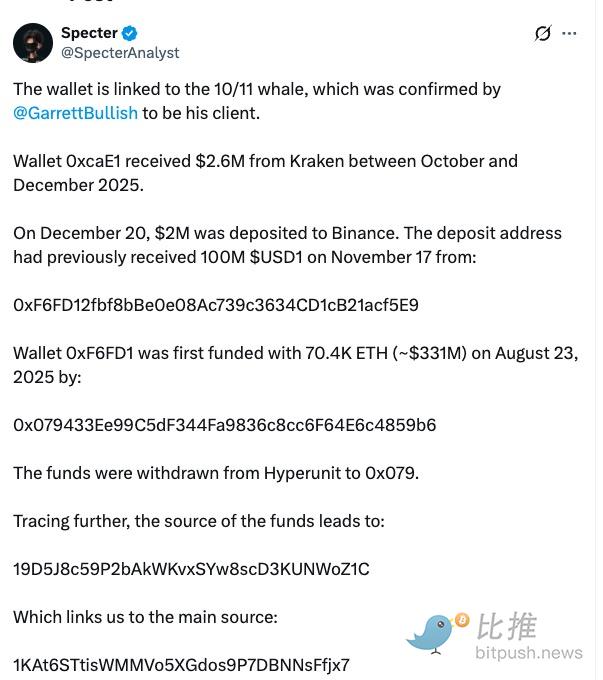
The analyst pointed out that fund flow shows the wallet received about $2.6M from Kraken (Oct-Dec 2025) and was traced back to the Bitcoin address 1KAt6STtisWMMVo5XGdos9P7DBNNsFfjx7—a famous Bitcoin cold wallet holding about 80,000 BTC (worth billions of dollars), often associated with early Bitcoin miners or institutional investors. The community speculates that this "whale" might be a Bitcoin millionaire diversifying into Ethereum, but a operational error led to huge losses.
Of course, there are also conspiracy theorists怀疑ing if this is some form of "money laundering"? But it's just speculation for now, without any solid evidence.
Blame the User, or Blame the Protocol?
The event quickly split into two main camps on social media:
One view holds that the user must be responsible for their own actions. The core spirit of DeFi is "not your keys, not your coins"; you control your assets, so you must pay for every operation you make. In a permissionless financial system, you can't expect someone to save you when you make a mistake.
More people pointed the finger at Aave's interface design. They argued that a UI that uses merely a checkbox to prevent a $50 million loss is itself a failure. Some developers suggested that for such extreme, obviously unreasonable transactions, the interface should impose more "aggressive" friction, such as forcing the user to type a specific phrase like "I confirm I will lose 99.9% of my funds" to proceed, or directly setting an insurmountable slippage上限.
The core of this debate actually touches on the biggest paradox DeFi currently faces: how to provide users with sufficient safety protections while adhering to the core principles of decentralization and permissionlessness?
Aave's team reacted quite quickly. Founder Stani promised to refund the approximately $600,000 in fees collected from this transaction to the victim. More importantly, they announced they would review and improve related protective measures, such as optimizing UI/UX design and setting stricter slippage上限s, to prevent similar tragedies from happening again.
What Does This Incident Leave Us With?
This $50 million "slip" incident, although an extreme case, once again highlights the deep-seated worries of DeFi:
1. DeFi's Risk Amplification Effect: Automation, permissionlessness, and composability—the magic of DeFi—also amplify any tiny user error. One "slip," and the cost could be losing everything.
2. Urgency of UI/UX Optimization: For DeFi to go mainstream, user experience and safety protections must be improved. How to introduce more "smart guardrails" while maintaining the spirit of decentralization, such as multiple confirmations for large transactions, AI-assisted risk assessment, etc., is a topic every protocol needs to consider.
3. Challenges of MEV and Ethereum's Mechanism: The loss being extracted by MEV highlights the "law of the jungle" on the blockchain. This might accelerate the migration to fairer mechanisms, like PBS optimizations or Layer 2 solutions.
4. Lack of User Education: Many users may not fully understand professional concepts like "slippage" and "liquidity depth." If a whale can make such a mistake, let alone the average retail investor? The entire industry needs to invest more resources to help users build necessary risk awareness.
After all, the price of such a "slip" is just too expensive.
Twitter:https://twitter.com/BitpushNewsCN
Bitpush TG Discussion Group:https://t.me/BitPushCommunity
Bitpush TG Subscription: https://t.me/bitpush