Viewpoint: A $4 Billion Buyback Can Fix Liquidity, But Not U.S. Fiscal Health

marsbitPublicado a 2026-08-20Actualizado a 2026-08-20

Resumen

On August 19, the U.S. Treasury announced it would increase its maximum single-operation buyback size for long-term bonds from $2 billion to at least $4 billion, aiming to improve market liquidity. This move initially led to a pullback in long-term yields, such as the 30-year Treasury yield which had recently hit a 2007 high near 5.34%, sparking talk of potential "Treasury support." However, an opposing perspective argues this is merely a temporary fix. While buybacks can enhance trading conditions for older, less-liquid bonds, they do not address the underlying fiscal pressures. The Treasury's actions are a form of debt management, not monetary stimulus like QE; the funds used for buybacks ultimately come from cash balances or new borrowing. They do not reduce the government's overall financing needs. The core issue is growing fiscal supply. With the federal deficit reaching a record $432 billion in July 2026 and cumulative deficits already surpassing the prior fiscal year's total, the market faces a massive wave of new debt issuance. The recent surge in long-term yields may reflect a repricing of this persistent fiscal risk and the associated term premium, rather than just a liquidity shortage. Furthermore, demand-side challenges loom. Foreign holdings of U.S. Treasuries have recently declined, and if official demand weakens, the market will rely more on price-sensitive private investors, potentially requiring higher yields to clear future auctions. In essence, the Trea...

Editor's Note: On August 19, the U.S. Treasury Department announced an expansion of its long-term Treasury buyback program, increasing the maximum single-operation size for 10–20 year and 20–30 year Treasury bonds from $2 billion to at least $4 billion. Previously, the yield on the 30-year Treasury note had briefly risen to around 5.34%, the highest level since 2007. Following the announcement, long-end yields fell rapidly.

This gave the market a straightforward bullish narrative: the Treasury is taking more proactive steps to improve the liquidity of long-term bonds, potentially even creating a kind of "Treasury floor" expectation.

However, Marcus Nunes, in his article "The Treasury's $4 Billion Band-Aid," offers a counterpoint: while buybacks can indeed alleviate liquidity issues, if the pressure on long-term bonds stems from larger fiscal deficits, increased bond supply, and weaker marginal buying interest, then a $4 billion buyback does not address the real underlying conflict.

In other words, the market needs to distinguish between two things: the Treasury can make bonds easier to trade, but it cannot use buybacks to reduce the total amount the U.S. government ultimately needs to finance.

The following is a translated compilation of the original article:

On August 19, U.S. Treasury Secretary Scott Bessent announced an increase in the maximum single-operation size for liquidity support buybacks of 10–20 year and 20–30 year Treasury bonds, from $2 billion to at least $4 billion. The market reaction was swift. The yield on the 30-year Treasury note, which had earlier climbed to about 5.34%, subsequently retreated noticeably, while assets like stocks and gold strengthened in tandem.

But the author, Nunes, believes this reaction risks causing the market to overlook a more fundamental issue: Treasury buybacks address liquidity, not the fiscal deficit.

Buybacks Can Improve Trading, But Don't Reduce Government Financing Needs

Treasury buybacks are not quantitative easing.

When the Federal Reserve conducts QE, it can create base money to purchase Treasuries by expanding its balance sheet; the Treasury lacks this ability. The funds it uses to buy back old debt ultimately still come from its cash balance or from new debt issuance.

Therefore, Treasury buybacks are fundamentally more akin to debt structure management.

They can repurchase illiquid older securities, improving market liquidity, and can to some extent increase demand for bonds of specific maturities. However, they do not change one fact: the U.S. government still needs to issue bonds to finance its fiscal deficit.

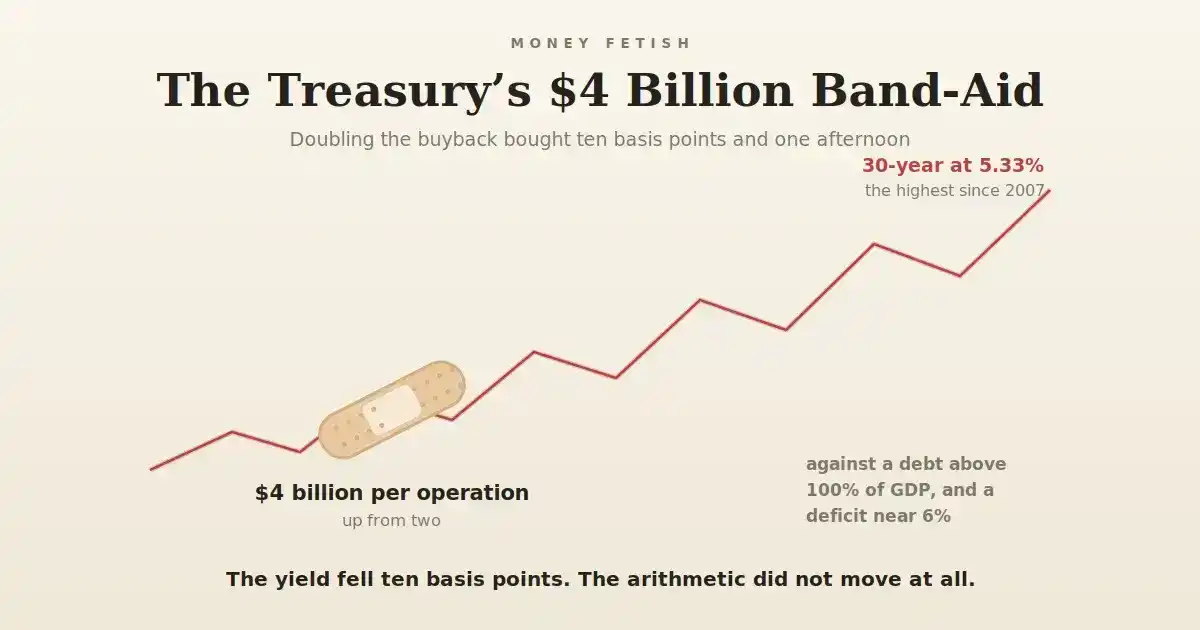
The scale difference is particularly stark. The U.S. Treasury previously estimated needing to borrow a net $739 billion in the third quarter of 2026, while this single-operation buyback increase for long-term Treasuries is merely from $2 billion to at least $4 billion.

This is why Nunes refers to it as a "Band-Aid." Four billion dollars is enough to improve trading conditions for some long-term bonds, but it is unlikely to alter the overall supply and demand dynamics of the entire U.S. Treasury market.
What's Really Weighing on Long Bonds is the Growing Fiscal Supply

In Nunes's framework, the recent rise of the 30-year Treasury yield above 5% cannot be interpreted solely as a liquidity issue. More importantly, the amount the U.S. government needs to finance remains substantial.

In July 2026, the U.S. federal budget deficit reached $432 billion, a 48% year-over-year increase, setting a record high for any July. The cumulative deficit for the first 10 months of the fiscal year stands at approximately $1.8 trillion, already surpassing the total for the entire 2025 fiscal year.
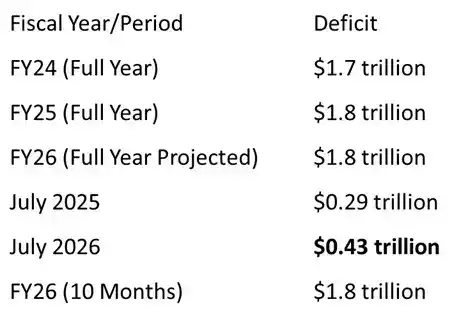
U.S. Federal Deficit – Year-on-Year Comparison

Meanwhile, total U.S. federal debt surpassed $40 trillion on August 19. As the debt stock grows and borrowing costs have risen in recent years, interest expenses are also climbing higher.

This means the core problem facing the U.S. Treasury is not that "old bonds are hard to trade," but rather: who will absorb the massive future supply of new bonds? If investors believe fiscal deficits will remain elevated in the future, they will demand higher yields to absorb the supply of long-term bonds.

From this perspective, the 30-year yield breaking through 5% may not be a temporary market malfunction, but rather a repricing of U.S. fiscal risk and duration risk.

The Buyer Problem Can't Be Solved by $4 Billion Either

Nunes also highlights the shift in foreign demand.

According to the U.S. Treasury's TIC data, foreign holdings of U.S. Treasuries decreased by approximately $72.1 billion month-over-month in June, with Japan, China, and the UK all seeing declines of varying degrees. This is not enough to prove foreign investors are "fleeing U.S. Treasuries en masse," as single-month holdings can be affected by exchange rates, custodian location changes, and asset allocation shifts. Furthermore, TIC data itself cannot fully identify the ultimate owners of securities. However, it at least indicates that previously stable foreign demand can no longer be taken for granted.
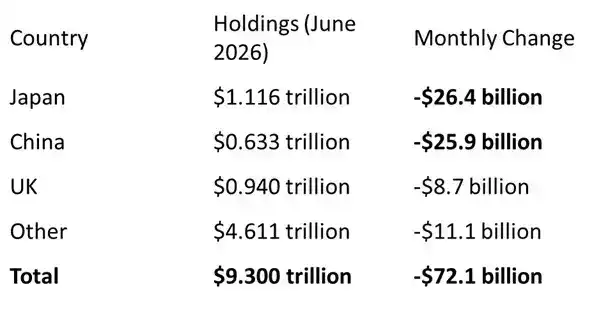
Foreign Holdings of U.S. Treasury Securities (June 2026)

More important is the buyer structure. If the willingness of foreign official institutions to absorb U.S. Treasuries declines, the U.S. will need to rely more on private investors. Private capital typically places greater emphasis on price and yield, meaning the market may require higher long-term interest rates to attract sufficient funds to take on the growing bond supply.

This is also why simply increasing buybacks doesn't solve the problem. The Treasury can buy back a portion of old debt, but it cannot dictate at what price other investors are willing to hold the large volumes of long-term bonds the U.S. will issue in the future.

The Real Divide: Is This a Liquidity Problem or a Fiscal Problem?

Supporters of expanding buybacks could argue that the Treasury is not attempting to solve the fiscal deficit. Buybacks are inherently a market liquidity tool. If they can improve the trading of old securities and reduce market friction, they have already achieved their policy objective. In this sense, criticizing buybacks with "$4 billion can't fix the deficit" might itself confuse the purpose of the policy tool.

But the real question Nunes poses is this: if the primary force driving long-end yields higher has shifted from liquidity to fiscal supply, then continuing to use liquidity tools will naturally have limited effectiveness.

These two explanations correspond to two completely different market judgments. If the recent selloff in long bonds was mainly due to insufficient market depth, deteriorating liquidity in old securities, and short-term positioning shocks, then the Treasury's expanded buyback might be enough to stabilize the market. However, if the rise in long-end yields primarily reflects persistent fiscal deficits, larger long-term bond supply, and higher term premia, then buybacks can only make the adjustment process smoother; they are unlikely to change the ultimate level of yields.

This is the article's core judgment: The Treasury can improve the "trading problem" in the Treasury market, but it cannot buy away America's "fiscal problem" through buybacks.

What truly needs to be watched next is not how much the Treasury increases its next buyback size, but whether long-term Treasury auctions continue to attract sufficient demand, whether the fiscal deficit narrows, and whether higher yields can re-attract foreign and private buyers.

If these variables do not improve, then the yield decline brought about by the $4 billion initiative is more likely to be a short-term buffer, rather than a true reversal of the pressure on U.S. long bonds.


Criptos en tendencia

Preguntas relacionadas

QWhat is the main action taken by the U.S. Treasury according to the article, and what was its immediate market impact?

AThe U.S. Treasury announced an expansion of its long-term bond repurchase program, increasing the maximum single-operation size for 10–20 year and 20–30 year Treasuries from $2 billion to at least $4 billion. The immediate market impact was a rapid decline in long-term bond yields, particularly the 30-year yield which had previously reached a high, and a simultaneous strengthening of assets like stocks and gold.

QAccording to Marcus Nunes's perspective in the article, what fundamental problem does the Treasury's bond repurchase fail to address?

AAccording to Marcus Nunes, the Treasury's bond repurchase program addresses market liquidity issues but fails to address the fundamental problem of the U.S. government's large fiscal deficits and the associated high financing needs. The repurchase does not reduce the total amount the government ultimately needs to borrow.

QWhy does the author refer to the $4 billion repurchase increase as a 'Band-Aid' solution?

AThe author refers to it as a 'Band-Aid' because while the $4 billion increase can improve trading conditions for some long-term bonds, its scale is negligible compared to the broader financing needs (e.g., an estimated $739 billion in net borrowing needed for a single quarter). Therefore, it cannot meaningfully alter the overall supply and demand dynamics of the U.S. Treasury market driven by large fiscal deficits.

QWhat are the two main factors, beyond liquidity, that the article suggests are putting upward pressure on long-term bond yields?

ABeyond liquidity issues, the two main factors are: 1) The increasingly large supply of new bonds required to finance persistent and growing U.S. federal budget deficits. 2) Potential weakening in demand from traditional major buyers, such as foreign official institutions, which may require higher yields to attract sufficient private investor capital to absorb the supply.

QWhat does the article conclude about the true test for the U.S. long-term bond market, beyond the Treasury's repurchase actions?

AThe article concludes that the true test for the U.S. long-term bond market is not the size of Treasury repurchases, but whether upcoming long-term bond auctions continue to attract sufficient demand, whether the fiscal deficit narrows, and whether higher yields can successfully re-attract foreign and private investor buying. Without improvement in these underlying variables, the yield decline from the repurchase program is likely just a short-term buffer, not a fundamental reversal of pressure.

Lecturas Relacionadas

U.S. Liquidity Support Has Arrived, This is the Core Positive Catalyst

The U.S. Treasury announced on August 19th an expansion of its liquidity support repurchase operations for long-term bonds. The single-operation limit for older, off-the-run nominal coupon securities in the 10-20 year and 20-30 year maturities will be increased from $2 billion to at least $4 billion, effective from September 9th until the end of the current quarterly refunding on November 4th. The market reacted positively to the news, with yields on 10-year and 30-year Treasury notes falling. This action is seen as a key relief for assets like tech stocks, long-term bonds, gold, and cryptocurrencies, as a lower long-end yield reduces discount rate pressure on valuations. However, analysts caution against interpreting this as a form of quantitative easing (QE). The operation specifically targets less liquid older bonds to improve market functioning, unlike QE which involves the Federal Reserve expanding its balance sheet. The move is viewed primarily as a signal that the Treasury is unwilling to let liquidity deteriorate in the long-end of the bond market, prompting short-covering and a relief rally. Its impact is constrained by the scale (a potential maximum of around $14 billion in additional repurchases this quarter), funding sources that may shift pressure to other maturities, and overarching macro factors like inflation and Fed policy. The sustainability of the resulting market rebound will be tested by the Treasury's November quarterly refunding statement. If it includes sustained repurchases and a slowdown in long-term net issuance, the valuation support for long-duration assets could persist. If not, the operation may prove to be merely a tactical measure to reduce short-term volatility without altering the long-term pressures from deficits and inflation.

marsbitHace 49 min(s)

U.S. Liquidity Support Has Arrived, This is the Core Positive Catalyst

marsbitHace 49 min(s)

SEC New Regulations Released, Bulls Are Here

The U.S. Securities and Exchange Commission (SEC), under Chairman Paul Atkins, has released a draft of the "Regulation Crypto Assets." This proposal introduces a new regulatory framework for crypto asset issuance and fundraising. A key feature is the establishment of an "Investment Contract Safe Harbor" mechanism, allowing projects to raise up to $5 million (or higher amounts for larger projects) over four years without full securities registration. To exit this safe harbor and potentially shed securities status, project teams must self-certify via a Form TR, declaring they have completed or permanently ceased their previously stated "essential managerial efforts." The SEC retains the power to challenge this certification after the fact. This shift moves the regulatory focus from pre-approval to a system of issuer self-attestation and SEC post-facto enforcement. It clarifies the process for determining when a token may transition from being an investment contract to a non-securities asset. The rules also specify that airdrops and network rewards may be counted toward fundraising limits, and they incentivize fundraising activities to remain within the U.S. jurisdiction. The draft is seen as a move away from the previous "regulation by enforcement" approach and an effort to provide clearer guidelines while Congressional legislation like the CLARITY法案 faces delays. The proposal is currently open for public comment.

marsbitHace 58 min(s)

SEC New Regulations Released, Bulls Are Here

marsbitHace 58 min(s)

Trading

Spot

Artículos destacados

Cómo comprar 4

¡Bienvenido a HTX.com! Hemos hecho que comprar 4 (4) sea simple y conveniente. Sigue nuestra guía paso a paso para iniciar tu viaje de criptos.Paso 1: crea tu cuenta HTXUtiliza tu correo electrónico o número de teléfono para registrarte y obtener una cuenta gratuita en HTX. Experimenta un proceso de registro sin complicaciones y desbloquea todas las funciones.Obtener mi cuentaPaso 2: ve a Comprar cripto y elige tu método de pagoTarjeta de crédito/débito: usa tu Visa o Mastercard para comprar 4 (4) al instante.Saldo: utiliza fondos del saldo de tu cuenta HTX para tradear sin problemas.Terceros: hemos agregado métodos de pago populares como Google Pay y Apple Pay para mejorar la comodidad.P2P: tradear directamente con otros usuarios en HTX.Over-the-Counter (OTC): ofrecemos servicios personalizados y tipos de cambio competitivos para los traders.Paso 3: guarda tu 4 (4)Después de comprar tu 4 (4), guárdalo en tu cuenta HTX. Alternativamente, puedes enviarlo a otro lugar mediante transferencia blockchain o utilizarlo para tradear otras criptomonedas.Paso 4: tradear 4 (4)Tradear fácilmente con 4 (4) en HTX's mercado spot. Simplemente accede a tu cuenta, selecciona tu par de trading, ejecuta tus trades y monitorea en tiempo real. Ofrecemos una experiencia fácil de usar tanto para principiantes como para traders experimentados.

949 Vistas totalesPublicado en 2025.10.20Actualizado en 2026.06.02

Cómo comprar 4

Discusiones

Bienvenido a la comunidad de HTX. Aquí puedes mantenerte informado sobre los últimos desarrollos de la plataforma y acceder a análisis profesionales del mercado. A continuación se presentan las opiniones de los usuarios sobre el precio de 4 (4).

活动图片