A New Era: The Fundamental Transformation of China's Entrepreneurs

marsbitPublicado a 2026-08-03Actualizado a 2026-08-03

Resumen

A profound generational shift is underway among Chinese entrepreneurs. The wealth and influence once dominated by real estate and internet giants is now being claimed by a new wave of founders driving breakthroughs in AI, semiconductors, and robotics. This change is vividly reflected in 2026's wealth rankings. Figures like Zhang Yiming (ByteDance), Liang Wenfeng (DeepSeek), Chen Tianshi (Cambricon), and Wang Xingxing (Unitree Robotics) are ascending. Their wealth stems not from traditional business models but from market expectations for future technological competitiveness, with AI, chips, and smart hardware becoming the primary engines of wealth creation. Their common trait is a foundational focus on technology, often starting from the laboratory rather than a business plan. Examples include Chen Tianshi's decade-long push in AI chips, Liang Wenfeng's core algorithmic innovations at DeepSeek with a compact team, and Zhu Yiming's "no salary until profitable" 9-year journey to build Changxin Memory into a global DRAM player. This transition marks a fundamental shift in China's economic imperative: from commercial expansion and learning to indigenous innovation and deep industrial capability. While the previous generation built the foundational market and infrastructure, this new cohort is tasked with achieving global leadership in core technologies, moving China from "keeping pace" to pioneering original, breakthrough innovations that are industrialized at scale. The baton...

The summer of 2026 is destined to be recorded in the annals of Chinese business history.

On July 27th, ChangXin Memory Technologies (CXMT) made its debut on the STAR Market (China's Nasdaq-style board), with its market capitalization soaring past 3.28 trillion yuan, instantly becoming the most valuable stock on the A-share market. On the morning of July 31st, it further surged past 4 trillion yuan. Zhu Yiming, the company's founder—a Tsinghua University physics graduate who pledged "no salary until the company turns profitable" and went without a single yuan in salary for seven full years—saw his personal shareholding value exceed 90 billion yuan.

In the same month, Wang Xingxing, founder of robotics company Unitree Robotics, graced the cover of TIME magazine under the headline, "The Robot Age Has Arrived." The full-page cover featured a photo of him standing beside the company's 2.7-meter-tall mass-produced manned mech, the GD01. TIME described him as "an atypical prophet of the AI era." It had been a full eight years since the last Chinese entrepreneur, Baidu founder Robin Li, appeared on the magazine's cover.

Just a month prior, AI chipmaker Cambricon became the first company on the STAR Market to surpass a market cap of 1 trillion yuan, with shares held by its 'post-85s' founder Chen Tianshi valued at nearly 300 billion yuan. Meanwhile, Liang Wenfeng, founder of DeepSeek which had just completed its first funding round, topped the global AI wealth list with a fortune of $36 billion, while ByteDance founder Zhang Yiming retained the top spot on the New Fortune 'Creation & Wealth' list with 543.9 billion yuan.

This cluster of events points unmistakably to the same profound shift: China's entrepreneur community is undergoing a deep-seated generational transition.

01. From "Internet" to "Artificial Intelligence"

The changing composition of China's wealth lists offers the most direct window into the evolution of the Chinese economy.

Over the past two decades, the protagonists of China's rich lists have changed several times. Real estate, retail, internet, FMCG, e-commerce, social media, and mobile internet entrepreneurs have successively entered the core positions of the wealth rankings.

Behind this lies the constant shifting of China's leading industries.

Today, the wealth landscape is undergoing another major reshuffle.

Zhang Yiming's defense of his top spot is first and foremost a testament to ByteDance's commercial success. However, to view it merely as the victory of an internet company would be to underestimate the deeper significance of this wealth shift: ByteDance is itself in the midst of migrating from the internet era to the AI era.

Zhang Yiming's ascension, in a sense, reflects the shifting primary drivers of wealth creation in China—from demographic dividends to technological dividends. The development prospects of AI business are also a key factor driving the continuous revaluation of ByteDance's market capitalization.

Zhang Yiming first appeared on a major wealth list in 2018, with his estimated holdings valued at around 12 billion yuan. The rocket-like speed of his wealth accumulation in the following few years is backed by the super-cycle of mobile internet and AI convergence, as well as the market's continuous revaluation of ByteDance's global business and AI potential.

A significant change here is: Entrepreneurial wealth increasingly reflects market expectations for future technological competitiveness.

This is even more evident in the 2026 New Fortune list. The list shows that 114 individuals from the TMT (Technology, Media, Telecommunications) sector made the cut, with a combined shareholding value of 4.6 trillion yuan, accounting for 26.9% of the total wealth on the list—a record high. AI large language models, chips, optical modules, embodied AI, and AI hardware emerged as the most concentrated wealth creation directions.
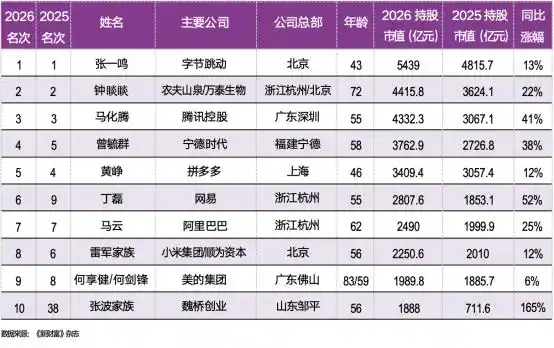
▲ Top 10 of the 2026 New Fortune 500 Creation & Wealth List. Source: Shenzhen News Network

Independent innovation and breakthroughs in core technologies, with AI leading the charge, are creating and concentrating wealth at an unprecedented speed and scale. In the 2025 New Fortune 500 list, DeepSeek founder Liang Wenfeng debuted on the list, entering the top ten with a fortune of 184.62 billion yuan. According to relevant institution statistics, the large model sector has already created at least 36 billionaires, with cumulative wealth reaching several hundred billion yuan.

The reshaping of the wealth map is not merely an industrial replacement, but a generational handover of entrepreneurs. Names like 43-year-old Zhang Yiming, 41-year-old Liang Wenfeng, 36-year-old Wang Xingxing, and 41-year-old Chen Tianshi are replacing those born in the 1960s and 1950s as the leading figures on China's wealth lists.

This is not a transfer of wealth between different individuals, but the passing of the baton from one era to the next.

02. From "Doing Business" to "Developing Technology"

If the most important keywords of the previous wave of Chinese business were "market" and "business model," then today's most important keyword is "technology."

This generation of entrepreneurs shares a distinct common trait: the starting point for many of their ventures is not a business plan, but a laboratory.

Chen Tianshi is a typical case.

Born in 1985, he entered the Special Class for the Gifted Young (SCGY) at the University of Science and Technology of China at age 16, completed his undergraduate and doctoral studies there, and then conducted research at the Institute of Computing Technology, Chinese Academy of Sciences, focusing on deep learning and artificial intelligence, becoming a world-class scientist in the AI field. In 2016, he co-founded Cambricon with his brother Chen Yunji, choosing a direction that was at the time extremely cutting-edge and challenging—AI chips.

Cambricon did not rapidly monetize through a proven business model. Instead, it underwent a long period of technological investment. At its 2020 IPO, its revenue was only 4.59 billion yuan, with a net loss attributable to shareholders of 4.35 billion yuan. In subsequent years, revenue fluctuated around 7 billion yuan, while net losses attributable to shareholders expanded annually, reaching a peak loss of 12.57 billion yuan in 2022.

Finally, the turning point arrived in 2025. The company achieved revenue of 64.97 billion yuan, with a net profit attributable to shareholders of 20.59 billion yuan, marking its first annual profit. In Q1 2026, revenue reached 28.85 billion yuan, a year-on-year increase of 159.56%; net profit attributable to shareholders was 10.13 billion yuan, up 185.04% year-on-year. On June 30th, Cambricon's market capitalization broke through 1 trillion yuan for the first time, becoming the first company on the STAR Market to achieve a trillion-yuan valuation.

Regarding this journey from losses to profitability, from a valuation of tens of billions at IPO to a trillion yuan, what deserves the most attention is not the stock price increase, but one fact: China's AI chips have progressed from laboratory technology to the stage of industrial-scale production.
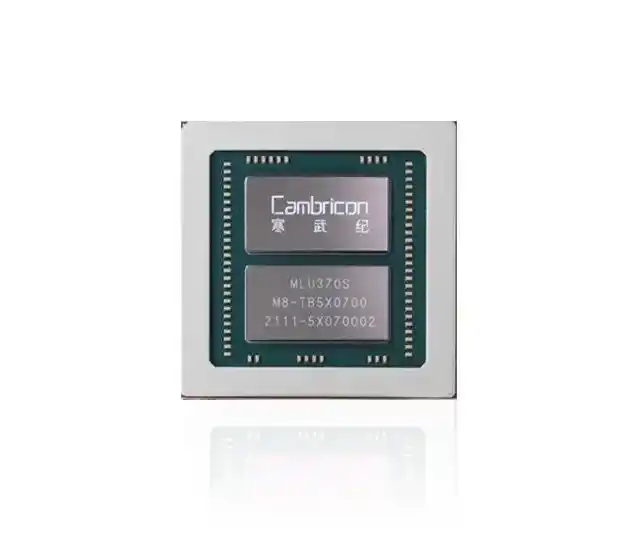
▲ Image Source: Cambricon

Liang Wenfeng presents another type of archetype.

He studied at Zhejiang University for his bachelor's and master's degrees. In 2015, he co-founded quantitative hedge fund High-Flyer Capital (幻方量化), before later entering the large model field. The emergence of DeepSeek made the world reassess Chinese AI entrepreneurs.

Its unique aspect is that Liang Wenfeng did not start with "building an AI application." Instead, he began from more fundamental problems like model architecture, training algorithms, and computational efficiency optimization, leading to disruptive innovation. At the time DeepSeek shone on the world stage, its core R&D team, including Liang Wenfeng, numbered fewer than 150 people—a stark contrast to the scale of international AI giants like OpenAI.

This mode of entrepreneurship is indeed different from traditional internet startups. Internet entrepreneurship often starts by finding users, then searching for a product; technological entrepreneurship frequently reverses this: first solving a technical problem, then discovering the industrial potential it can unlock.

Zhu Yiming's story illustrates this change even more profoundly.

In 2005, he returned to China to found GigaDevice. In 2016, he dedicated himself to building China's domestic DRAM industry; after 2018, he focused his primary efforts on ChangXin Memory Technologies, pledging not to take a salary until the project became profitable. For a full seven years, he did not receive a single yuan in salary.

ChangXin also experienced a long period of losses, with a net loss attributable to shareholders of 16.34 billion yuan in 2023, and 7.145 billion yuan in 2024. In 2025, the company achieved revenue of 61.799 billion yuan, a year-on-year increase of 155.60%; net profit was 7.144 billion yuan, marking its first annual profit.

In Q1 2026, driven by rising DRAM prices, growing computing power demand, and production capacity ramp-up, revenue further reached 50.8 billion yuan, up 719.13% year-on-year; net profit attributable to shareholders was 24.762 billion yuan. On its first trading day, July 27th, ChangXin's market cap soared to 3.28 trillion yuan.

But more noteworthy than the market capitalization is the position this company has reached—a position where few Chinese enterprises have been able to firmly stand before.

DRAM is a highly concentrated market with extremely high technical barriers, long dominated by Samsung, SK Hynix, and Micron. According to Omdia data, based on Q4 2025 sales statistics, ChangXin's global market share has increased to 7.67%, making it the world's fourth-largest DRAM manufacturer.

It has not yet changed the established global memory market landscape, but it has entered the list of major global players. This is a historic leap.

The length of this journey far exceeded most people's imaginations. From the project launch in 2016 to its first profit in 2025, ChangXin walked a full nine years. This is not a story about wealth; it is a story about faith in technology.

A UBS report shows that in 2025, 70 new billionaires emerged in mainland China, with the technology sector becoming the primary engine of wealth creation. The emergence of these "engineer billionaires" signifies a fundamental change in the composition of China's business elite:

The starting point of entrepreneurship is shifting from "doing business" to "developing technology."

03. From "Expanding the Market" to "Deepening the Industry"

Rather than saying Chinese entrepreneurs are simply undergoing a change of guard, it's more accurate to say: the Chinese economy is presenting entrepreneurs with a new set of questions.

The previous generation of entrepreneurs laid the foundation; today's tech entrepreneurs are building the skyscraper upon it.

Without the foundation, the building cannot rise high.

If not for the groundwork laid by Wang Shi and Wang Jianlin in urbanization and real estate, the internet popularization driven by Jack Ma and Pony Ma, the supply chain accumulation from decades of Chinese manufacturing, the influx of a large number of engineering talents into the industry, and the massive digital consumer market, there wouldn't be the fertile industrial soil for today's AI, chip, and robotics entrepreneurs.

The pioneer-level entrepreneurs solved the most critical questions of one or even several eras. Today, the questions have changed.

The 2025 Government Work Report proposed developing New Quality Productive Forces according to local conditions, promoting the integrated development of technological innovation and industrial innovation, cultivating future industries like biomanufacturing, quantum technology, embodied AI, and 6G, and continuously advancing the "AI Plus" initiative.

By the 2026 Government Work Report, it was further noted that China had taken a lead in the R&D and application of AI, biopharmaceuticals, robotics, and quantum technologies, achieving new breakthroughs in chip self-reliance, and seeing domestic large models leading the global open-source ecosystem.

Consequently, the entire Chinese economy has bid farewell to the stage of "crossing the river by feeling the stones," entering a new era of true innovation-driven, and moreover, independent innovation-driven growth: achieving the possible where others deem it impossible, and reaching global leadership in areas others thought China could not.

For Zhu Yiming's ChangXin, the turning point from massive losses to huge profits was singular: product competitiveness brought by technological breakthroughs.

For Chen Tianshi's Cambricon, the leap from losses to profit crossed not just financial thresholds, but critical points in technological capability.

For Liang Wenfeng's DeepSeek, challenging OpenAI's massive compute route with a low-cost training strategy is not about following, but about originality.

These names represent a new type of entrepreneur: original, groundbreaking, global in impact. The stage they are ascending is no longer just China's business arena, but the table of global industrial competition.

This so-called "generational handover" never concerns just wealth or titles. What is being handed over is a nation's structural capacity to participate in global competition.

The previous generation of entrepreneurs accomplished the commercial expansion through learning and catching up; the task for the new generation is to push Chinese technology from "keeping up" to "capable of original innovation, breakthroughs, and industrialization."

The shift from business innovation to technological innovation, from traffic-driven growth to technology-driven growth, from "expanding the market" to "deepening the industry"—it's all just beginning.

The names highlighted today—Zhu Yiming, Chen Tianshi, Liang Wenfeng, Wang Xingxing... are merely the first batch of individuals stepping into the center stage of this era.

This article is from the WeChat public account "HuaShang Strategy" by HuaShang Strategy.

Criptos en tendencia

Preguntas relacionadas

QAccording to the article, what is the most significant change happening to the Chinese entrepreneur group?

AThe most significant change is a profound generational transition, characterized by a shift from 'doing business' based on market models and population dividends to 'doing technology' focused on original innovation, core technological breakthroughs, and global industrial competition in fields like AI, semiconductors, and robotics.

QWhat key event symbolized the rise of this new generation of technology-driven entrepreneurs in 2026, as described in the article?

AThe symbolic event was Changxin Technology's listing on the STAR Market in July 2026, where its market capitalization soared to over 3.28 trillion yuan, making it the 'share king' of the A-share market, representing the success of a long-term, R&D-intensive venture in the core DRAM semiconductor field.

QHow does the article characterize the difference in the starting point for business between the older generation of entrepreneurs and the new generation?

AThe older generation often started with business plans seeking markets and models, while the new generation frequently starts from laboratories, tackling fundamental technical problems first—like AI chip architecture or foundational AI models—before seeking their industrial applications and market space.

QWhat economic shift does the success of entrepreneurs like Zhang Yiming (ByteDance) and Liang Wenfeng (DeepSeek) reflect, according to the article?

ATheir success reflects a shift in China's wealth creation engine from relying on population and market scale dividends to relying more on technology dividends. Their wealth increasingly represents the market's valuation of future technological competitiveness and potential for original innovation.

QWhat is the new core proposition or mission for China's economy and its new generation of entrepreneurs, as outlined in the article's conclusion?

AThe new mission is to move from commercial expansion and learning/catching-up to achieving original, breakthrough, and industrializing technological capabilities. The goal is to lead in global industrial competition, particularly in domains like AI, chips, and robotics, transforming China's participation in the global economy from following to pioneering.

Lecturas Relacionadas

XRP Ledger Active Users Approach 200,000

The number of daily active users on the XRP Ledger is approaching 200,000, one of the highest levels in recent months. Despite XRP continuing to trade below key technical resistance, on-chain data shows accelerated network activity, suggesting growing ecosystem usage even as price momentum remains subdued. The increase to roughly 190,800 daily active users has been sustained through late July, marking a significant recovery from levels around 100,000 during the broader market correction. This rise indicates user return driven by sustained engagement rather than just speculative trading. Higher address activity typically reflects broader blockchain adoption and can boost transaction counts, payment volumes, and dApp liquidity—considered healthier indicators than price fluctuations. However, XRP's price has not mirrored this network improvement, currently trading near $1.07 and struggling to break resistance at $1.10. It remains below its 50-day and 100-day moving averages, with a recent attempt to break out of a symmetrical triangle losing momentum. The technical outlook remains mixed; while blockchain activity shows improving fundamentals, price action lacks confirmation of a broader recovery. A decisive break above the 200-day moving average near $1.21 is needed to strengthen the long-term technical outlook. Momentum indicators like the RSI, around 47, show a balanced forecast with reduced selling pressure. In conclusion, XRP Ledger user activity nears a yearly high despite the asset's price being below major technical barriers. Sustained user growth, coupled with a price recovery above key moving averages, could begin to align the technical structure with the strengthening on-chain fundamentals.

cryptonews.ruHace 27 min(s)

XRP Ledger Active Users Approach 200,000

cryptonews.ruHace 27 min(s)

ZEC Price Just Surpassed $490 — Here's What Fueled the Rally

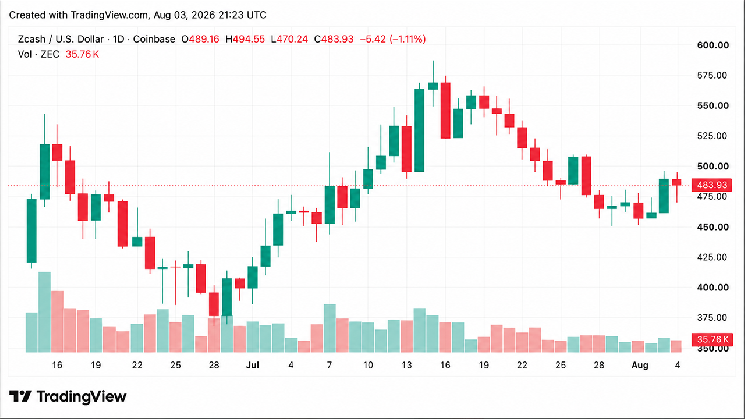
ZEC Surges Past $490, Key Drivers Behind the Rally On August 3, the privacy-focused cryptocurrency Zcash (ZEC) surged nearly 5%, climbing over $20 in a six-hour rally to a session high near $494. This move helped ZEC's market cap reclaim $8 billion, solidifying its position as the most valuable privacy coin and marking an almost 8% gain for the month. While benefiting from a broader market uptrend, ZEC's outperformance was driven by significant fundamental catalysts. The primary driver was the integration by privacy infrastructure project Nym of Zcash's new shielded pool, Ironwood. This enables direct, end-to-end private payments in ZEC for network services, a landmark development for privacy-first decentralized finance. The rally coincides with renewed industry focus on privacy as digital assets mature. Industry observers note privacy is becoming the "next frontier," evolving from Bitcoin's proof-of-concept to Ethereum's programmability and Solana's scalability. Commentary highlighted that true privacy, via zero-knowledge (ZK) technology which is now production-ready, was a foundational goal for early crypto pioneers. Further momentum came from Zcash's progress in decentralized governance, launching a retroactive grant funding (RetroPGF-like) program. This shifts treasury fund distribution from closed committees to direct coin holder voting, pioneering a privacy-native funding mechanism. ZEC's surge helped push the total market capitalization of privacy-focused coins above $30 billion. Other notable gainers included NEAR, ZK, and NOCK. However, losses in coins like ZANO, ZBT, and a significant drop in last week's leader COTI partially offset the sector's overall gains.

cryptonews.ruHace 42 min(s)

ZEC Price Just Surpassed $490 — Here's What Fueled the Rally

cryptonews.ruHace 42 min(s)

Trading

Spot

Artículos destacados

Qué es $S$

Entendiendo SPERO: Una Visión General Completa Introducción a SPERO A medida que el panorama de la innovación continúa evolucionando, la aparición de tecnologías web3 y proyectos de criptomonedas juega un papel fundamental en la configuración del futuro digital. Un proyecto que ha atraído la atención en este campo dinámico es SPERO, denotado como SPERO,$$s$. Este artículo tiene como objetivo reunir y presentar información detallada sobre SPERO, para ayudar a entusiastas e inversores a comprender sus fundamentos, objetivos e innovaciones dentro de los dominios web3 y cripto. ¿Qué es SPERO,$$s$? SPERO,$$s$ es un proyecto único dentro del espacio cripto que busca aprovechar los principios de descentralización y tecnología blockchain para crear un ecosistema que promueva la participación, la utilidad y la inclusión financiera. El proyecto está diseñado para facilitar interacciones de igual a igual de nuevas maneras, proporcionando a los usuarios soluciones y servicios financieros innovadores. En su esencia, SPERO,$$s$ tiene como objetivo empoderar a los individuos al proporcionar herramientas y plataformas que mejoren la experiencia del usuario en el espacio de las criptomonedas. Esto incluye habilitar métodos de transacción más flexibles, fomentar iniciativas impulsadas por la comunidad y crear caminos para oportunidades financieras a través de aplicaciones descentralizadas (dApps). La visión subyacente de SPERO,$$s$ gira en torno a la inclusividad, buscando cerrar brechas dentro de las finanzas tradicionales mientras aprovecha los beneficios de la tecnología blockchain. ¿Quién es el Creador de SPERO,$$s$? La identidad del creador de SPERO,$$s$ sigue siendo algo oscura, ya que hay recursos públicos limitados que proporcionan información de fondo detallada sobre su(s) fundador(es). Esta falta de transparencia puede derivarse del compromiso del proyecto con la descentralización, una ética que muchos proyectos web3 comparten, priorizando las contribuciones colectivas sobre el reconocimiento individual. Al centrar las discusiones en torno a la comunidad y sus objetivos colectivos, SPERO,$$s$ encarna la esencia del empoderamiento sin señalar a individuos específicos. Como tal, comprender la ética y la misión de SPERO sigue siendo más importante que identificar a un creador singular. ¿Quiénes son los Inversores de SPERO,$$s$? SPERO,$$s$ cuenta con el apoyo de una diversa gama de inversores que van desde capitalistas de riesgo hasta inversores ángeles dedicados a fomentar la innovación en el sector cripto. El enfoque de estos inversores generalmente se alinea con la misión de SPERO, priorizando proyectos que prometen avances tecnológicos sociales, inclusión financiera y gobernanza descentralizada. Estas fundaciones de inversores suelen estar interesadas en proyectos que no solo ofrecen productos innovadores, sino que también contribuyen positivamente a la comunidad blockchain y sus ecosistemas. El respaldo de estos inversores refuerza a SPERO,$$s$ como un contendiente notable en el dominio de proyectos cripto que evoluciona rápidamente. ¿Cómo Funciona SPERO,$$s$? SPERO,$$s$ emplea un marco multifacético que lo distingue de los proyectos de criptomonedas convencionales. Aquí hay algunas de las características clave que subrayan su singularidad e innovación: Gobernanza Descentralizada: SPERO,$$s$ integra modelos de gobernanza descentralizada, empoderando a los usuarios para participar activamente en los procesos de toma de decisiones sobre el futuro del proyecto. Este enfoque fomenta un sentido de propiedad y responsabilidad entre los miembros de la comunidad. Utilidad del Token: SPERO,$$s$ utiliza su propio token de criptomoneda, diseñado para servir diversas funciones dentro del ecosistema. Estos tokens permiten transacciones, recompensas y la facilitación de servicios ofrecidos en la plataforma, mejorando la participación y la utilidad general. Arquitectura en Capas: La arquitectura técnica de SPERO,$$s$ apoya la modularidad y escalabilidad, permitiendo la integración fluida de características y aplicaciones adicionales a medida que el proyecto evoluciona. Esta adaptabilidad es fundamental para mantener la relevancia en el cambiante paisaje cripto. Participación de la Comunidad: El proyecto enfatiza iniciativas impulsadas por la comunidad, empleando mecanismos que incentivan la colaboración y la retroalimentación. Al nutrir una comunidad sólida, SPERO,$$s$ puede abordar mejor las necesidades de los usuarios y adaptarse a las tendencias del mercado. Enfoque en la Inclusión: Al ofrecer tarifas de transacción bajas e interfaces amigables para el usuario, SPERO,$$s$ busca atraer a una base de usuarios diversa, incluyendo a individuos que anteriormente pueden no haber participado en el espacio cripto. Este compromiso con la inclusión se alinea con su misión general de empoderamiento a través de la accesibilidad. Cronología de SPERO,$$s$ Entender la historia de un proyecto proporciona información crucial sobre su trayectoria de desarrollo y hitos. A continuación se presenta una cronología sugerida que mapea eventos significativos en la evolución de SPERO,$$s$: Fase de Conceptualización e Ideación: Las ideas iniciales que forman la base de SPERO,$$s$ fueron concebidas, alineándose estrechamente con los principios de descentralización y enfoque comunitario dentro de la industria blockchain. Lanzamiento del Whitepaper del Proyecto: Tras la fase conceptual, se lanzó un whitepaper completo que detalla la visión, los objetivos y la infraestructura tecnológica de SPERO,$$s$ para generar interés y retroalimentación de la comunidad. Construcción de Comunidad y Primeras Interacciones: Se realizaron esfuerzos de divulgación activa para construir una comunidad de primeros adoptantes y posibles inversores, facilitando discusiones en torno a los objetivos del proyecto y obteniendo apoyo. Evento de Generación de Tokens: SPERO,$$s$ llevó a cabo un evento de generación de tokens (TGE) para distribuir sus tokens nativos a los primeros seguidores y establecer liquidez inicial dentro del ecosistema. Lanzamiento de la dApp Inicial: La primera aplicación descentralizada (dApp) asociada con SPERO,$$s$ se puso en marcha, permitiendo a los usuarios interactuar con las funcionalidades centrales de la plataforma. Desarrollo Continuo y Alianzas: Actualizaciones y mejoras continuas a las ofertas del proyecto, incluyendo alianzas estratégicas con otros actores en el espacio blockchain, han moldeado a SPERO,$$s$ en un jugador competitivo y en evolución en el mercado cripto. Conclusión SPERO,$$s$ se erige como un testimonio del potencial de web3 y las criptomonedas para revolucionar los sistemas financieros y empoderar a los individuos. Con un compromiso con la gobernanza descentralizada, la participación comunitaria y funcionalidades diseñadas de manera innovadora, allana el camino hacia un paisaje financiero más inclusivo. Como con cualquier inversión en el espacio cripto que evoluciona rápidamente, se anima a los posibles inversores y usuarios a investigar a fondo y participar de manera reflexiva con los desarrollos en curso dentro de SPERO,$$s$. El proyecto muestra el espíritu innovador de la industria cripto, invitando a una mayor exploración de sus innumerables posibilidades. Mientras el viaje de SPERO,$$s$ aún se desarrolla, sus principios fundamentales pueden, de hecho, influir en el futuro de cómo interactuamos con la tecnología, las finanzas y entre nosotros en ecosistemas digitales interconectados.

244 Vistas totalesPublicado en 2024.12.17Actualizado en 2024.12.17

Qué es $S$

Qué es AGENT S

Agent S: El Futuro de la Interacción Autónoma en Web3 Introducción En el paisaje en constante evolución de Web3 y las criptomonedas, las innovaciones están redefiniendo constantemente cómo los individuos interactúan con las plataformas digitales. Uno de estos proyectos pioneros, Agent S, promete revolucionar la interacción humano-computadora a través de su marco agente abierto. Al allanar el camino para interacciones autónomas, Agent S busca simplificar tareas complejas, ofreciendo aplicaciones transformadoras en inteligencia artificial (IA). Esta exploración detallada profundizará en las complejidades del proyecto, sus características únicas y las implicaciones para el dominio de las criptomonedas. ¿Qué es Agent S? Agent S se presenta como un marco agente abierto innovador, diseñado específicamente para abordar tres desafíos fundamentales en la automatización de tareas informáticas: Adquisición de Conocimiento Específico del Dominio: El marco aprende inteligentemente de diversas fuentes de conocimiento externas y experiencias internas. Este enfoque dual le permite construir un rico repositorio de conocimiento específico del dominio, mejorando su rendimiento en la ejecución de tareas. Planificación a Largo Plazo de Tareas: Agent S emplea planificación jerárquica aumentada por la experiencia, un enfoque estratégico que facilita la descomposición y ejecución eficiente de tareas complejas. Esta característica mejora significativamente su capacidad para gestionar múltiples subtareas de manera eficiente y efectiva. Manejo de Interfaces Dinámicas y No Uniformes: El proyecto introduce la Interfaz Agente-Computadora (ACI), una solución innovadora que mejora la interacción entre agentes y usuarios. Utilizando Modelos de Lenguaje Multimodal de Gran Escala (MLLMs), Agent S puede navegar y manipular diversas interfaces gráficas de usuario sin problemas. A través de estas características pioneras, Agent S proporciona un marco robusto que aborda las complejidades involucradas en la automatización de la interacción humana con las máquinas, preparando el terreno para una multitud de aplicaciones en IA y más allá. ¿Quién es el Creador de Agent S? Si bien el concepto de Agent S es fundamentalmente innovador, la información específica sobre su creador sigue siendo elusiva. El creador es actualmente desconocido, lo que resalta ya sea la etapa incipiente del proyecto o la elección estratégica de mantener a los miembros fundadores en el anonimato. Independientemente de la anonimidad, el enfoque sigue siendo en las capacidades y el potencial del marco. ¿Quiénes son los Inversores de Agent S? Dado que Agent S es relativamente nuevo en el ecosistema criptográfico, la información detallada sobre sus inversores y patrocinadores financieros no está documentada explícitamente. La falta de información disponible públicamente sobre las bases de inversión u organizaciones que apoyan el proyecto plantea preguntas sobre su estructura de financiamiento y hoja de ruta de desarrollo. Comprender el respaldo es crucial para evaluar la sostenibilidad del proyecto y su posible impacto en el mercado. ¿Cómo Funciona Agent S? En el núcleo de Agent S se encuentra una tecnología de vanguardia que le permite funcionar de manera efectiva en diversos entornos. Su modelo operativo se basa en varias características clave: Interacción Humano-Computadora Similar a la Humana: El marco ofrece planificación avanzada de IA, esforzándose por hacer que las interacciones con las computadoras sean más intuitivas. Al imitar el comportamiento humano en la ejecución de tareas, promete elevar las experiencias de los usuarios. Memoria Narrativa: Empleada para aprovechar experiencias de alto nivel, Agent S utiliza memoria narrativa para hacer un seguimiento de las historias de tareas, mejorando así sus procesos de toma de decisiones. Memoria Episódica: Esta característica proporciona a los usuarios una guía paso a paso, permitiendo que el marco ofrezca apoyo contextual a medida que se desarrollan las tareas. Soporte para OpenACI: Con la capacidad de ejecutarse localmente, Agent S permite a los usuarios mantener el control sobre sus interacciones y flujos de trabajo, alineándose con la ética descentralizada de Web3. Fácil Integración con APIs Externas: Su versatilidad y compatibilidad con varias plataformas de IA aseguran que Agent S pueda encajar sin problemas en ecosistemas tecnológicos existentes, convirtiéndolo en una opción atractiva para desarrolladores y organizaciones. Estas funcionalidades contribuyen colectivamente a la posición única de Agent S dentro del espacio cripto, ya que automatiza tareas complejas y de múltiples pasos con una intervención humana mínima. A medida que el proyecto evoluciona, sus posibles aplicaciones en Web3 podrían redefinir cómo se desarrollan las interacciones digitales. Cronología de Agent S El desarrollo y los hitos de Agent S pueden encapsularse en una cronología que resalta sus eventos significativos: 27 de septiembre de 2024: El concepto de Agent S fue lanzado en un documento de investigación integral titulado “Un Marco Agente Abierto que Usa Computadoras Como un Humano”, mostrando las bases del proyecto. 10 de octubre de 2024: El documento de investigación fue puesto a disposición del público en arXiv, ofreciendo una exploración profunda del marco y su evaluación de rendimiento basada en el benchmark OSWorld. 12 de octubre de 2024: Se lanzó una presentación en video, proporcionando una visión visual de las capacidades y características de Agent S, involucrando aún más a posibles usuarios e inversores. Estos marcadores en la cronología no solo ilustran el progreso de Agent S, sino que también indican su compromiso con la transparencia y la participación comunitaria. Puntos Clave Sobre Agent S A medida que el marco Agent S continúa evolucionando, varios atributos clave destacan, subrayando su naturaleza innovadora y potencial: Marco Innovador: Diseñado para proporcionar un uso intuitivo de las computadoras similar a la interacción humana, Agent S aporta un enfoque novedoso a la automatización de tareas. Interacción Autónoma: La capacidad de interactuar de manera autónoma con las computadoras a través de GUI significa un salto hacia soluciones informáticas más inteligentes y eficientes. Automatización de Tareas Complejas: Con su metodología robusta, puede automatizar tareas complejas y de múltiples pasos, haciendo que los procesos sean más rápidos y menos propensos a errores. Mejora Continua: Los mecanismos de aprendizaje permiten a Agent S mejorar a partir de experiencias pasadas, mejorando continuamente su rendimiento y eficacia. Versatilidad: Su adaptabilidad en diferentes entornos operativos como OSWorld y WindowsAgentArena asegura que pueda servir a una amplia gama de aplicaciones. A medida que Agent S se posiciona en el paisaje de Web3 y criptomonedas, su potencial para mejorar las capacidades de interacción y automatizar procesos significa un avance significativo en las tecnologías de IA. A través de su marco innovador, Agent S ejemplifica el futuro de las interacciones digitales, prometiendo una experiencia más fluida y eficiente para los usuarios en diversas industrias. Conclusión Agent S representa un audaz avance en la unión de la IA y Web3, con la capacidad de redefinir cómo interactuamos con la tecnología. Aunque aún se encuentra en sus primeras etapas, las posibilidades para su aplicación son vastas y atractivas. A través de su marco integral que aborda desafíos críticos, Agent S busca llevar las interacciones autónomas al primer plano de la experiencia digital. A medida que nos adentramos más en los reinos de las criptomonedas y la descentralización, proyectos como Agent S sin duda desempeñarán un papel crucial en la configuración del futuro de la tecnología y la colaboración humano-computadora.

644 Vistas totalesPublicado en 2025.01.14Actualizado en 2025.01.14

Qué es AGENT S

Cómo comprar S

¡Bienvenido a HTX.com! Hemos hecho que comprar Sonic (S) sea simple y conveniente. Sigue nuestra guía paso a paso para iniciar tu viaje de criptos.Paso 1: crea tu cuenta HTXUtiliza tu correo electrónico o número de teléfono para registrarte y obtener una cuenta gratuita en HTX. Experimenta un proceso de registro sin complicaciones y desbloquea todas las funciones.Obtener mi cuentaPaso 2: ve a Comprar cripto y elige tu método de pagoTarjeta de crédito/débito: usa tu Visa o Mastercard para comprar Sonic (S) al instante.Saldo: utiliza fondos del saldo de tu cuenta HTX para tradear sin problemas.Terceros: hemos agregado métodos de pago populares como Google Pay y Apple Pay para mejorar la comodidad.P2P: tradear directamente con otros usuarios en HTX.Over-the-Counter (OTC): ofrecemos servicios personalizados y tipos de cambio competitivos para los traders.Paso 3: guarda tu Sonic (S)Después de comprar tu Sonic (S), guárdalo en tu cuenta HTX. Alternativamente, puedes enviarlo a otro lugar mediante transferencia blockchain o utilizarlo para tradear otras criptomonedas.Paso 4: tradear Sonic (S)Tradear fácilmente con Sonic (S) en HTX's mercado spot. Simplemente accede a tu cuenta, selecciona tu par de trading, ejecuta tus trades y monitorea en tiempo real. Ofrecemos una experiencia fácil de usar tanto para principiantes como para traders experimentados.

1.3k Vistas totalesPublicado en 2025.01.15Actualizado en 2026.06.02

Cómo comprar S

Discusiones

Bienvenido a la comunidad de HTX. Aquí puedes mantenerte informado sobre los últimos desarrollos de la plataforma y acceder a análisis profesionales del mercado. A continuación se presentan las opiniones de los usuarios sobre el precio de S (S).

活动图片