炒股炒成了“炒币”,欢迎回归原生家庭

marsbitPublicado a 2026-07-30Actualizado a 2026-07-30

Resumen

2026年7月,韩国股市经历剧烈震荡,KOSPI指数单日暴跌近9%,科技股领跌,导致数十万杠杆账户爆仓。此现象并非孤例,全球科技股市场正呈现出与加密货币市场相似的特征:由宏大叙事(如AI)驱动定价、社交媒体加速共识形成、以及高杠杆交易放大波动。 此前,部分币圈投资者因加密市场低迷而转向看似更成熟的美股,并将追逐热点、高杠杆等交易习惯带入股市,推动了存储芯片等板块的暴涨。然而,随后的暴跌速度甚至超过了比特币等加密货币,凸显出当前部分科技股的高波动性。 分析指出,市场交易逻辑正在发生“去理性化”转变:估值更多依赖未来叙事而非当前盈利;通过杠杆ETF等工具,散户杠杆大幅增加;投资决策越来越依赖于社交媒体信息。这导致市场波动加剧,形成“股市币圈化”现象。 颇具讽刺意味的是,正当部分科技股波动加剧时,比特币反而因其ETF化和机构接纳,波动率相对降低,变得更像传统资产。文章最后警示,无论市场如何变化,由杠杆和狂热情绪驱动的投机泡沫,其破裂的代价最终由参与者承担。

作者:豆丸了

2026 年 7 月 13 日,首尔。

韩国综合指数 KOSPI 单日暴跌 8.95%,年内第 7 次熔断。SK 海力士,韩国人眼里的"国运股",单日重挫 15.37%,近二十年没见过这么狠的跌幅。三星电子也跌了 10%以上。

超过 120 万个杠杆账户弹出追缴保证金通知,券商系统自动平仓 32 万到 46 万个账户,更扎心的是,爆仓的人里 62%是 20 到 30 岁的年轻人,有人亏掉了婚房首付,有人贷款炒股......

釜山一个 20 多岁的小伙子,因为听信了股票 YouTuber 推荐亏损,直接拿刀去捅了那个博主。

这些字眼放在以前,大概率用来描述币圈大跌后的场景,如今,它正在科技股退潮后的韩国、美国和日本市场重复上演。

大涨大跌只是表象,真正发生变化的是定价方式,叙事压过估值,杠杆放大情绪,社交媒体把共识迅速推向极端。

全球股市,尤其是科技股,正在变得越来越像币圈。

回归原生家庭

“欢迎回到原生家庭。”

暴跌后,转战股市的币圈交易员纷纷书写亏损小作文,上述留言在评论区随处可见。
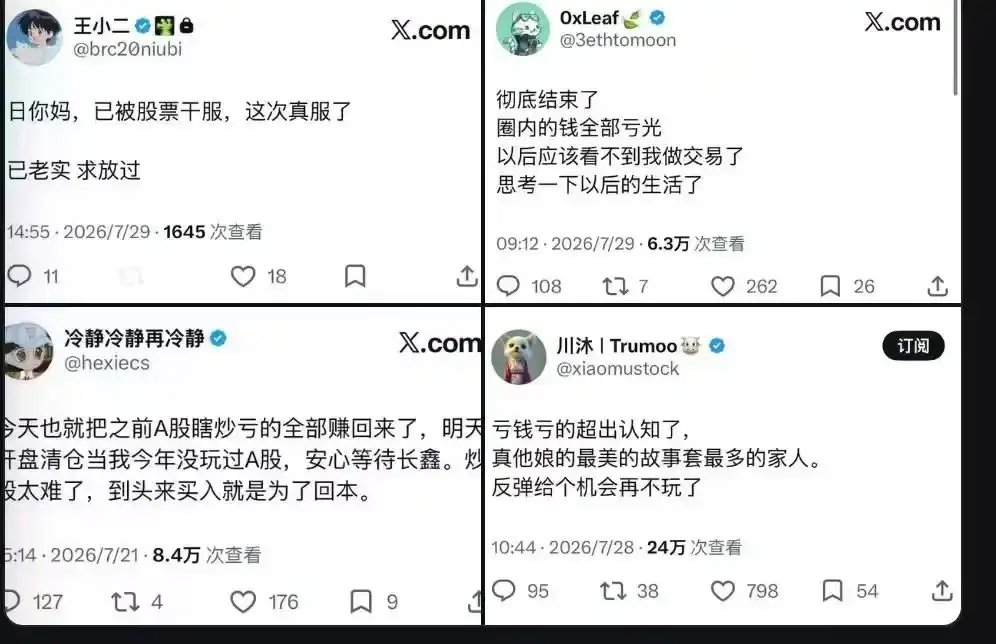
所谓“原生家庭”,指的就是加密货币。2025 年下半年到 2026 年初,一场“出走原生家庭”的大戏在币圈上演。

一批在加密货币市场摸爬滚打多年的 KOL 和资深玩家,开始对币圈失去信心。比特币横盘震荡,交易量萎靡,Meme 币割了一茬又一茬,很多人觉得“这圈子没劲了”,开始把注意力转向美股。

这个选择看起来十分合理。

股票有收入、有利润、有财报,还有 SEC 监管。相比缺乏现金流、完全依靠共识定价的加密项目,美股至少像一种更成熟、更安全的资产。

币圈交易员带走的不仅是流动性,交易方式也一并带了过去。

在加密市场,他们习惯追逐新叙事、寻找高弹性标的、使用杠杆,并根据社交媒体的情绪迅速换仓。进入股票市场后,这套方法几乎没有改变,只是交易对象从代币换成了 AI、存储芯片和杠杆 ETF,屡次取得大结果。

存储股很快成为新的集体共识。

逻辑并不复杂:AI 服务器需要更多高带宽内存,HBM 供不应求,存储价格上涨,美光、三星电子和 SK 海力士自然成为最直接的“卖铲人”,孙哥那句“永远缺存储”更是深入人心。

不少加密 KOL 摇身一变,开始讲美股、讲存储周期、讲 AI 资本开支。2 倍做多 SK 海力士等产品,也被当成了比普通股票“效率更高”的押注工具。

直到 7 月行情反转。

比特币反而成了“低波动资产”

从顶点跌一半需要多久?

比特币用了 268 天,白银完成相近幅度的回撤用了 169 天。

相比之下,闪迪下跌约 55%只用了 36 天,SK 海力士下跌约 53%只用了 34 天。

同样是“腰斩”,比特币用了近九个月,存储股只用了一个多月。
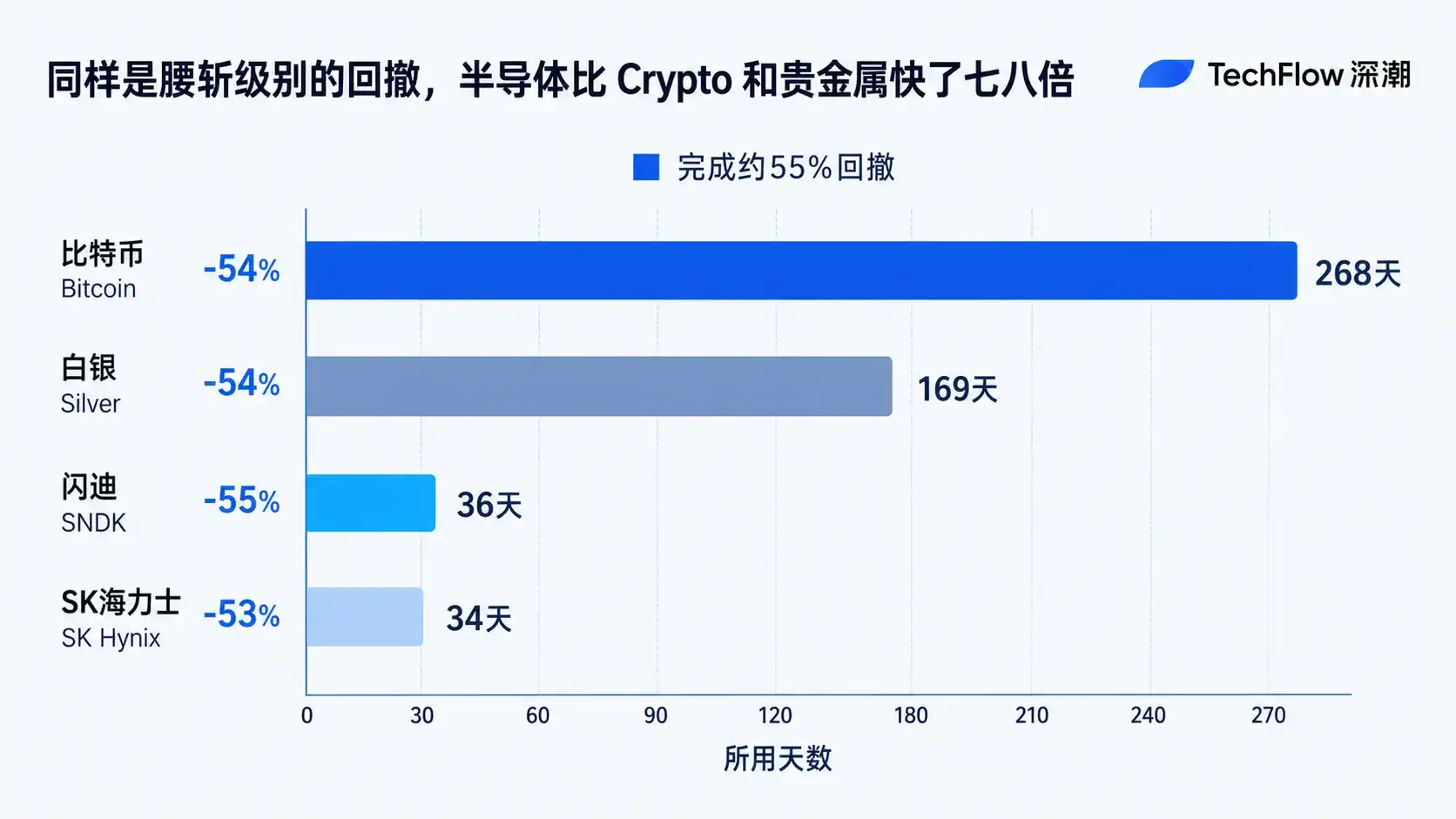
这正是本轮行情吊诡之处:过去,投资者担心比特币会在几天内暴涨暴跌,股票则依靠盈利和估值缓慢调整;现在,一些科技股正在用比加密货币更短的时间,走完一轮完整的泡沫破裂。

非常反直觉,和部分科技股相比,比特币正在变得相对稳定。

嘉信理财统计显示,2025 年比特币的历史波动率约为 42%,最大回撤约 32%;同期特斯拉的波动率约 63%,最大回撤 48%,英伟达的波动率约 50%,最大回撤 37%。

比特币仍然是高风险资产,只是部分大型科技股波动更大。

Bitwise 在 2026 年度展望中甚至预测,比特币的整体波动率可能继续低于英伟达。

所以现在的局面挺荒诞的:比特币越来越像科技股,科技股却越来越像比特币。

当叙事成为估值锚

币圈有句古话,炒币就是炒叙事。

2026 年的全球科技股,正在把这句话变成现实。

AI 当然不是空气,英伟达、微软、谷歌和大型云计算公司拥有真实收入,也在投入真金白银建设数据中心。

但从“AI 确实会创造价值”,到“任何沾上 AI 的公司都值得以任何价格买入”,中间隔着一条很长的路。

在行情最热的时候,这条路被市场直接省略了。

AI 服务器、光模块、存储芯片、数据中心、电力设备乃至核能公司,只要能被放进 AI 产业链,股价就可能迅速上涨。业务还在规划,订单尚未落地,但市场会先按照几年后的最好结果进行定价。

韩国的故事是“AI 半导体关系国运”。随着 KOSPI 不断创出新高,越来越多家庭开始为未成年子女开设股票账户,把三星电子、SK 海力士等热门股票当作长期礼物。

A 股也出现了类似的集中。2026 年上半年,TMT 板块市值达到 41.78 万亿元,占 A 股总市值约 31.45%;在部分交易日,科技板块成交额一度接近全市场的一半。

美国市场则长期围绕少数大型科技公司定价。当指数涨幅越来越依赖几家公司,当基金、期权和散户共同涌入同一批股票,看似分散的投资组合,实际上都在押注同一个 AI 故事。

这和以前的币圈颇为相似,2021 年狗狗币暴涨,不是因为技术突破,是因为马斯克发了一条推特。2026 年的科技股暴涨,也不是因为所有公司都业绩爆发,是因为 ChatGPT 让所有人相信“AI 将重写一切”。

叙事能够如此迅速地主导市场,也离不开传播方式的变化。

过去,股票信息主要来自财报、研报和机构路演。今天,越来越多人的投资决定来自 YouTube、X、短视频和付费社群。

复杂的公司研究被压缩成几句话:时间会证明算力和光模块、AI 算力永远不够......

社交媒体的算法也不会奖励谨慎,一夜暴富永远是流量密码:有人靠期权一夜翻倍,有打工人重仓存储股实现财务自由,有人用杠杆 ETF 在几个月里赚到数年工资。

K 线是最好的宣传,大量宝妈、大妈开始拿出自己的私房钱入市,甚至有人卖房炒股,恰如几年前一群学生辍学 all in Web3......

杠杆狂欢

币圈最可怕的不是波动,是杠杆加波动的死亡组合,2026 年的全球股市,正在完美复刻。

2026 年 5 月 27 日,韩国交易所批准了 16 只以个股为标的的 2 倍杠杆 ETF 上市,挂钩标的就是三星电子和 SK 海力士。

散户疯了。从获批到 7 月中旬,韩国散户累计净买入 14 万亿韩元(约 640 亿人民币)的单股杠杆 ETF,同期外国投资者只买了约 2 万亿韩元。

这些 ETF 有几个致命设计。

这类产品每天重新调整仓位。震荡越剧烈,净值损耗越明显。假设一只股票先下跌 10%,再上涨 11.1%,股价可以回到原点;对应的 2 倍杠杆产品却会先跌 20%,再上涨 22.2%,最终仍然亏损约 2.2%。

在快速下跌时,问题更加严重。

为了维持目标杠杆,产品需要在下跌后被动降低风险敞口。卖出会进一步压低标的价格,价格下跌又触发更多减仓、止损和保证金压力。

高盛后来指出,这批产品“快速去杠杆”是 KOSPI 日内异常波动的主因,机构净卖的 62%来自 ETF 相关清算。

两个月后,韩国监管紧急叫停所有新的个股杠杆 ETF 上市,最低保证金从 1000 万韩元大幅上调到 3000 万韩元,而且只认现金。

但晚了,2.3 万亿韩元的强平金额,数十万家庭的财富灰飞烟灭。

即便是全球最深度的美股市场,也在经历杠杆的反噬。

摩根大通分析师最新指出,美股还有“去杠杆空间”,需要三个月才能恢复到 4 月前水平。

存储芯片股杠杆 ETF 的规模与标的市值之比,是所有股票 ETF 平均水平的三倍。即便是整体杠杆股票指数 ETF,其比率相对自身历史也处于高位。

一次退化

“股市币圈化”并不意味着股票已经和加密货币完全一样。

股票背后仍有公司、资产、收入和现金流,也有财务披露、审计和监管。即便市场情绪消退,一家真正赚钱的公司依然拥有可以被计算的价值。

真正发生变化的是交易层。

过去,人们购买一家公司的未来利润;现在,越来越多人是在交易一个主题的热度。

股市币圈化,本质上是一场去理性化的革命。

传统股市看 PE、现金流,币圈化股市看叙事、想象力;传统股市波动率 20%算高,币圈化股市个股单日波动 10%到 15%成常态。

传统股市杠杆通过融资融券,币圈化股市通过 ETF、衍生品、量化策略;传统股市信息来自研报、财报,币圈化股市信息来自推特、YouTuber、社群;传统股市机构理性定价,币圈化股市机构散户化,量化追涨杀跌......

更可笑的是,如今比特币在努力变得像股票,通过 ETF、机构化、波动率下降,逐渐被主流金融接纳。

这是一个荒诞的交叉点。

从币圈转战股市的人,最终发现自己并没有离开“原生家庭”,那是一套不断重复的机制:宏大的故事、拥挤的仓位、轻易获得的杠杆,以及每个人都相信自己可以在别人之前离场。

韩国散户在交易论坛上写下的那句话,值得所有人记住:我想回到炒股之前的日子,把我的钱还给我。

但市场从不退款。

Criptos en tendencia

Preguntas relacionadas

Q文章中描述的韩国股市暴跌事件发生在哪一年?

A文章中描述的韩国股市暴跌事件发生在2026年。

Q文章指出,全球股市尤其是科技股,正在变得越来越像币圈的核心原因是什么?

A核心原因是股票的定价方式发生了变化,叙事压过估值,社交媒体将共识迅速推向极端,同时杠杆放大了市场情绪。

Q文章中提到的“原生家庭”指的是什么?为什么一些币圈交易员会“回归原生家庭”?

A“原生家庭”在文章中指的是加密货币市场。币圈交易员会“回归原生家庭”是因为他们发现,自己转战股市后,运用的交易策略(追逐叙事、使用杠杆、依赖社交媒体情绪)和在币圈时一样,且股市的剧烈波动与币圈相似,让他们有种又回到了熟悉环境的感觉。

Q根据文章中的数据,为什么说比特币反而正在变得相对稳定?

A根据嘉信理财的统计数据,2025年比特币的历史波动率和最大回撤低于同期的特斯拉和英伟达等部分大型科技股。同时,文中对比显示,存储股“腰斩”所用的时间远短于比特币,这反直觉地表明,与某些高波动的科技股相比,比特币的波动性相对较低。

Q文章认为韩国批准上市的个股2倍杠杆ETF有哪些致命的设计缺陷,并导致了严重后果?

A其致命设计缺陷在于:1. 每日重新调整仓位,在股价震荡(非单边市)时会导致显著的净值损耗;2. 在快速下跌时,为了维持目标杠杆,需要被动减仓,这会进一步压低股价,形成“下跌-减仓-再下跌”的恶性循环,最终在2026年7月的暴跌中触发了大规模强平,导致数十万家庭财富受损。

Lecturas Relacionadas

PA Graphics Explanation | One Chart to Understand the Major Web3 Events in August 2026

**PANews Crypto Calendar: Key Web3 Events in August 2026** PANews introduces its revamped crypto calendar, featuring comprehensive coverage, flexible filtering, and easy export options. The market in August will be shaped by multiple key events across macroeconomics, regulation, tokenomics, and project developments: * **Macro & Policy:** Key US economic data releases (July Non-Farm Payrolls, CPI), the Federal Reserve meeting minutes, and the Jackson Hole Economic Symposium will be in focus. On the regulatory front, the US Senate plans to release a new draft of the *CLARITY Act*, while the EU's expanded crypto ban against Belarus comes into effect. * **Token Unlocks:** Significant token unlocks are scheduled for assets including ENA, AVAX, CONX, ZRO, and KAITO, which may influence market volatility. * **Project Updates & Shutdowns:** Several services, including Exchange Art, Ctrl Wallet, Zapper, NFTfi, and Summer.fi, are set to cease operations or undergo major adjustments. Users are advised to manage their assets accordingly. * **Corporate Activity:** Q2 earnings reports from companies like SpaceX, Circle, and Nvidia are due. Unitree Robotics will initiate its IPO subscription on the STAR Market, and Moonshot AI plans to begin a Pre-IPO financing round. * **Industry Events:** Major conferences such as Bitcoin Asia 2026 and the 2026 Digital Expo will take place. The overarching market narrative for August will revolve around macroeconomic expectations, regulatory developments, token unlock schedules, and ongoing industry consolidation.

marsbitHace 7 min(s)

PA Graphics Explanation | One Chart to Understand the Major Web3 Events in August 2026

marsbitHace 7 min(s)

Wall Street's Most Famous 'Cassandra' Now Has His Sights Set on Nvidia

Michael Burry, the famed "Big Short" investor, has once again captured Wall Street's attention with a series of short positions against major tech and semiconductor stocks, most notably Nvidia. In late June and July, through his "Cassandra Unchained" newsletter, Burry disclosed short bets against Nvidia, Tesla, Applied Materials, Caterpillar, the SOXX semiconductor ETF, and later, Micron Technology. His core thesis revolves around potential distortions in the AI infrastructure boom, specifically questioning whether extended depreciation schedules (e.g., 6 years vs. a realistic 2-3 years for AI chips) by cloud giants like Microsoft and Google artificially inflate profits. He also raises concerns about possible "off-balance-sheet circular financing," where chip demand might be propped up by vendor-backed funding to clients. Nvidia's stock experienced volatility following these disclosures, briefly dipping but largely holding near Burry's reported entry points, leaving his positions roughly flat or slightly underwater as of late July. This move is part of a pattern for Burry, whose track record since his legendary 2008 bet is mixed. He has faced notable losses, such as on Tesla in 2021, while scoring on broader market turns like the 2020 pandemic crash. His methodology focuses intensely on free cash flow and scrutinizing original financial documents to spot overvaluation and structural risks, but it often struggles with timing the market. The article contrasts Burry's stance with other prominent investors. Steve Eisman, another "Big Short" figure, is not shorting Nvidia, citing strong fundamentals but expressing nervousness about sustainability. Jim Chanos agrees with the broad "accounting mismatch" concern—comparing it to the dot-com bubble—but targets financial leverage in private equity firms rather than the chip stocks themselves. While Nvidia's short interest remains relatively low at 1.3-1.4% of float, the massive stock size means absolute short losses have been significant, exceeding $5 billion earlier this year. The piece concludes that for ordinary investors, the key takeaway is not replicating specific short bets but learning from the critical frameworks these investors use: questioning rosy accounting, identifying structural vulnerabilities, and maintaining skepticism during market euphoria, even if pinpointing the exact catalyst for a downturn remains elusive.

marsbitHace 32 min(s)

Wall Street's Most Famous 'Cassandra' Now Has His Sights Set on Nvidia

marsbitHace 32 min(s)

Weekly Selection丨Epic Stock Market Volatility, Changxin Tech's IPO Reshapes Storage Landscape, Saylor Aims to Re-Anchor STRC Around September 8th

PANews Weekly Digest: Market Turmoil, Tech Breakthroughs, and Crypto Developments. The week saw significant volatility across global markets. South Korea's KOSPI index experienced extreme turbulence, including multiple trading halts, largely driven by sharp declines in AI hardware stocks like SK Hynix. In contrast, China's Changxin Xinqiao (CXC) achieved a landmark IPO with a market cap surpassing 4 trillion yuan, marking a major success for the domestic DRAM industry after a decade of losses. In the crypto and Web3 space, several key narratives emerged. AI is driving demand for new infrastructure, with projects like AI agent wallets and programmable payments gaining traction, attracting interest from firms like Coinbase. The Bitcoin mining sector is pivoting, with companies like MARA focusing on energy management as electricity becomes a core AI-era asset. Meanwhile, the RWA (Real World Assets) sector faces a "utilization puzzle," with hundreds of billions in on-chain assets remaining dormant. Notable market movements included a historic single-day surge of over 17% for the KOSPI index and a significant migration of $16.5 billion in staked ETH within the Lido ecosystem. Michael Saylor announced a target to re-peg the STRC stablecoin around September 8th. Other highlights include discussions on Ethereum's ambitious 2030 roadmap for scaling and privacy, analysis showing high protocol revenues not always translating to token price gains, and warnings from Citi about potential extreme commodity price shocks by late 2026.

marsbitHace 37 min(s)

Weekly Selection丨Epic Stock Market Volatility, Changxin Tech's IPO Reshapes Storage Landscape, Saylor Aims to Re-Anchor STRC Around September 8th

marsbitHace 37 min(s)

When the Market Begins to Question AI Capex: A Full Analysis of Q2 Earnings Reports from Five Tech Giants

In late July 2026, five major US tech giants—Alphabet, Intel, Microsoft, Meta, and Apple—released their Q2 earnings reports. While all companies exceeded revenue and profit expectations, driven by strong AI-related business growth, investor reactions diverged sharply due to concerns over escalating AI capital expenditures (capex) and their impact on free cash flow. Alphabet reported strong revenue growth and a surging cloud business, but its stock fell after announcing a doubled year-on-year capex and negative quarterly free cash flow for the first time. Intel posted its strongest revenue growth in over 15 years, but its stock experienced volatile trading after significantly raising its full-year capex guidance. Microsoft saw its stock surge after beating estimates and, crucially, lowering its capex forecast while projecting positive free cash flow. Meta faced the most severe sell-off as its profits declined despite revenue beats, with free cash flow plunging over 90% and its capex guidance raised. Apple reported record June-quarter results, but its stock plummeted after providing Q4 revenue guidance that fell short of expectations, citing supply chain constraints and forex headwinds. The overall takeaway is that the market's focus has shifted from validating AI demand to scrutinizing the timeline for returns on massive AI investments. Companies demonstrating a clearer path to managing capex and preserving free cash flow, like Microsoft, were rewarded, while those signaling continued aggressive spending faced investor skepticism.

Odaily星球日报Hace 46 min(s)

When the Market Begins to Question AI Capex: A Full Analysis of Q2 Earnings Reports from Five Tech Giants

Odaily星球日报Hace 46 min(s)

a16z: From Companies to DAOs, DUNA May Become the Next Generation Organizational Form

This article, "From Companies to DAOs: How DUNA Could Become the Next Organizational Form," traces the 500-year evolution of business collaboration. It begins with medieval structures like the *commenda* and Florentine *compagnia*, which exposed partners to personal risk. The modern corporation, exemplified by the Dutch East India Company (VOC), was a revolutionary leap, enabling large-scale, capital-intensive ventures by offering limited liability and reducing coordination costs. However, corporations introduced new challenges like principal-agent problems and bureaucratic overhead. The piece argues that software and internet-native protocols are now reducing these traditional overheads. Decentralized Autonomous Organizations (DAOs) emerged as a new model for coordination without centralized management. Yet, DAOs face a significant legal vacuum: they lack legal recognition, leaving members exposed to unlimited personal liability, and their tokens are vulnerable to being classified as securities under unclear regulations (e.g., the Howey Test). This has forced projects into suboptimal workarounds like offshore foundations. The article identifies the Decentralized Unincorporated Nonprofit Association (DUNA) as a potential solution. Recently legalized in states like Wyoming, the DUNA provides a legal wrapper for decentralized networks. It grants key protections—legal personality, limited liability, and perpetual existence—to a group without imposing a traditional hierarchical management structure. This allows token-holder communities to govern, hold assets, and contract as a single legal entity, aligning with their decentralized nature. While DUNA doesn't solve all governance challenges or magically resolve securities law questions, it represents a crucial step. It fills the legal recognition gap, offering a native legal form for internet-scale, decentralized collaboration and extending the separation of personal risk from organizational venture into a new domain.

marsbitHace 1 hora(s)

a16z: From Companies to DAOs, DUNA May Become the Next Generation Organizational Form

marsbitHace 1 hora(s)

Trading

Spot

Artículos destacados

Cómo comprar HOME

¡Bienvenido a HTX.com! Hemos hecho que comprar Defi.app (HOME) sea simple y conveniente. Sigue nuestra guía paso a paso para iniciar tu viaje de criptos.Paso 1: crea tu cuenta HTXUtiliza tu correo electrónico o número de teléfono para registrarte y obtener una cuenta gratuita en HTX. Experimenta un proceso de registro sin complicaciones y desbloquea todas las funciones.Obtener mi cuentaPaso 2: ve a Comprar cripto y elige tu método de pagoTarjeta de crédito/débito: usa tu Visa o Mastercard para comprar Defi.app (HOME) al instante.Saldo: utiliza fondos del saldo de tu cuenta HTX para tradear sin problemas.Terceros: hemos agregado métodos de pago populares como Google Pay y Apple Pay para mejorar la comodidad.P2P: tradear directamente con otros usuarios en HTX.Over-the-Counter (OTC): ofrecemos servicios personalizados y tipos de cambio competitivos para los traders.Paso 3: guarda tu Defi.app (HOME)Después de comprar tu Defi.app (HOME), guárdalo en tu cuenta HTX. Alternativamente, puedes enviarlo a otro lugar mediante transferencia blockchain o utilizarlo para tradear otras criptomonedas.Paso 4: tradear Defi.app (HOME)Tradear fácilmente con Defi.app (HOME) en HTX's mercado spot. Simplemente accede a tu cuenta, selecciona tu par de trading, ejecuta tus trades y monitorea en tiempo real. Ofrecemos una experiencia fácil de usar tanto para principiantes como para traders experimentados.

252 Vistas totalesPublicado en 2025.06.10Actualizado en 2026.06.10

Cómo comprar HOME

Discusiones

Bienvenido a la comunidad de HTX. Aquí puedes mantenerte informado sobre los últimos desarrollos de la plataforma y acceder a análisis profesionales del mercado. A continuación se presentan las opiniones de los usuarios sobre el precio de HOME (HOME).

活动图片