Data Review: How Much Profit Did Prediction Markets Reap from a Single World Cup?

Odaily星球日报Publicado a 2026-07-27Actualizado a 2026-07-27

Resumen

**How Much Did the 2026 World Cup Boost Prediction Markets? A Data Review.** The 2026 World Cup provided a major, temporary boost to leading prediction markets, according to an analysis of Kalshi, Polymarket, and predict.fun. During the tournament, total nominal trading volume reached $543.38 billion on Kalshi, $209.88 billion on Polymarket, and $10.92 billion on predict.fun. While Kalshi maintained an overall lead, Polymarket narrowed the gap significantly in World Cup-specific markets. All platforms saw daily trading volumes roughly double or more during the event compared to pre-tournament levels, but activity largely retreated to baseline shortly after the final. Fee revenue also surged. Kalshi's weekly fees peaked at over $100 million in the fourth week, totaling $473.2 million for the tournament. Polymarket's weekly fees stabilized around $20 million, totaling $111.4 million. Predict.fun saw its weekly fee income rise from a pre-tournament $159k to a peak of $755k, with a six-week total of $3.48 million. Post-tournament, daily fee income declined for all three. Analysis of Total Value Locked (TVL) showed Polymarket's deposits remained flat around $4.4-$4.8 billion during the World Cup and later fell, suggesting the event spurred high-frequency trading but not long-term capital commitment. In contrast, predict.fun's TVL saw a clear inflow during the tournament's knockout stages, rising to a peak near $25 million before easing. The data confirms that mega-sports even...

Original | Odaily Planet Daily (@OdailyChina)

Author | Asher (@Asher_ 0210)

The 2026 World Cup has concluded, and prediction markets are undergoing a phased review.

Over the past six weeks, many users engaged in trading predictions on match outcomes, qualification scenarios, and championship winners, adding a layer of real-time interaction to viewing. Now that the tournament is over, Odaily Planet Daily will review the performance of leading prediction market platforms Kalshi, Polymarket, and predict.fun before, during, and after the World Cup from three dimensions: trading volume, fee revenue, and TVL.

World Cup Drove Prediction Market Trading Volume to New Highs, But the Momentum Didn't Last

Kalshi Maintains Lead, Polymarket Narrows Gap, predict.fun Breaks Through with World Cup

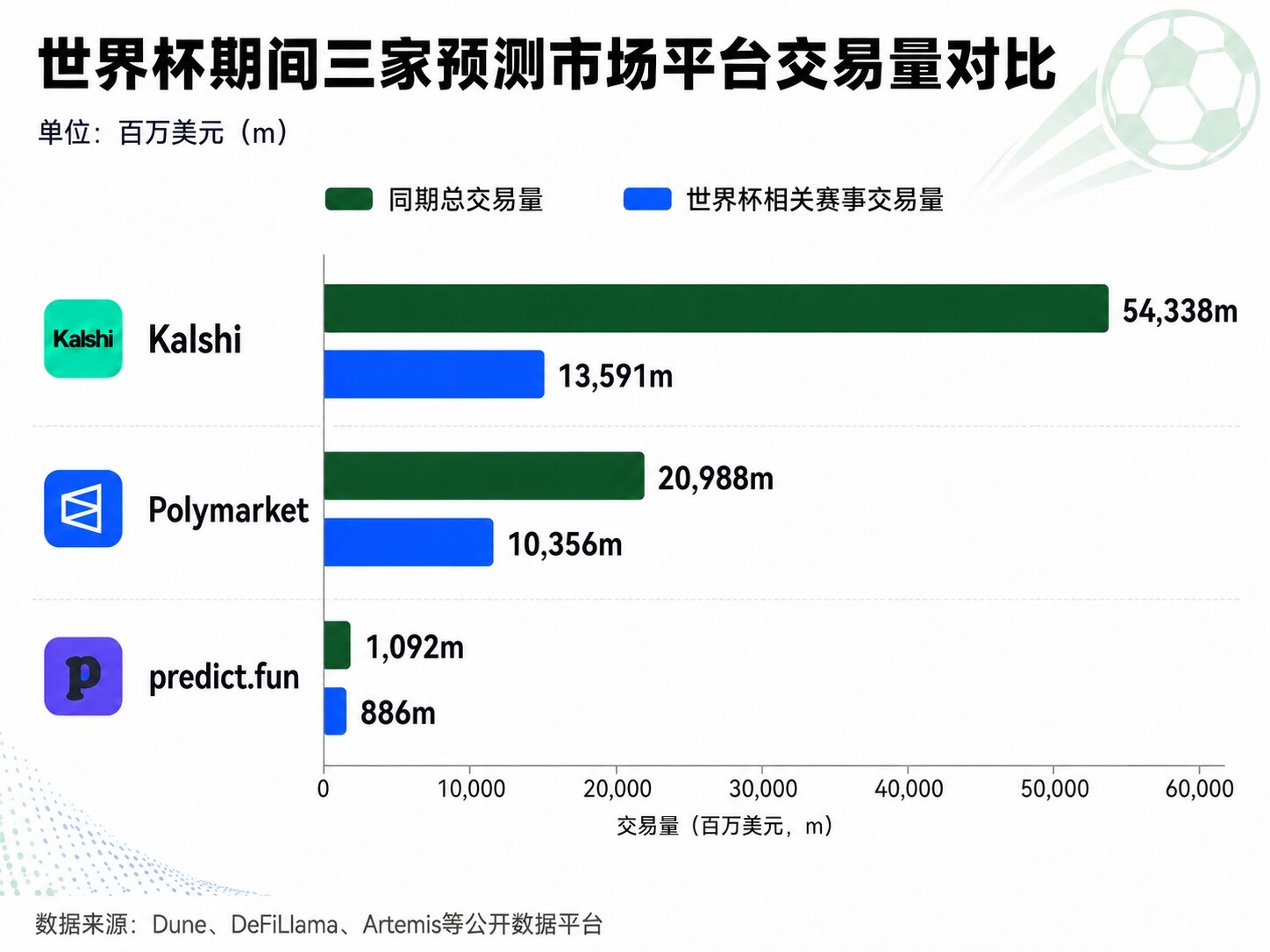
Looking at total platform trading volume during the World Cup period, Kalshi still maintains a clear lead. During the same period, Kalshi's total trading volume reached $54.338 billion, while Polymarket's was $20.988 billion, the former being about 2.6 times the latter. However, considering only World Cup-related events, the gap between the two narrows significantly. Kalshi's related trading volume was $13.591 billion, while Polymarket reached $10.356 billion, the former being only about 1.3 times the latter.(Note: Trading volume discussed in this article is nominal trading volume.)

In the past, Polymarket's representative markets were more concentrated in US elections, cryptocurrency, and geopolitical events. The World Cup further elevated the importance of sports markets on the platform, shifting them from a supplementary category to a core trading segment. Kalshi's advantage lies in its more dispersed trading structure; besides the World Cup, other sports events, politics, and macro markets continue to contribute trading volume, providing more scenarios to sustain activity after the tournament ends.

predict.fun's total platform trading volume during the World Cup reached $1.092 billion, with World Cup-related markets contributing $886 million. Although the overall scale still shows a clear gap compared to Kalshi and Polymarket, for a platform launched just over half a year ago, achieving nearly $900 million in trading volume from this World Cup has made predict.fun one of the most prominent new platforms benefiting from this round of tournament gains.
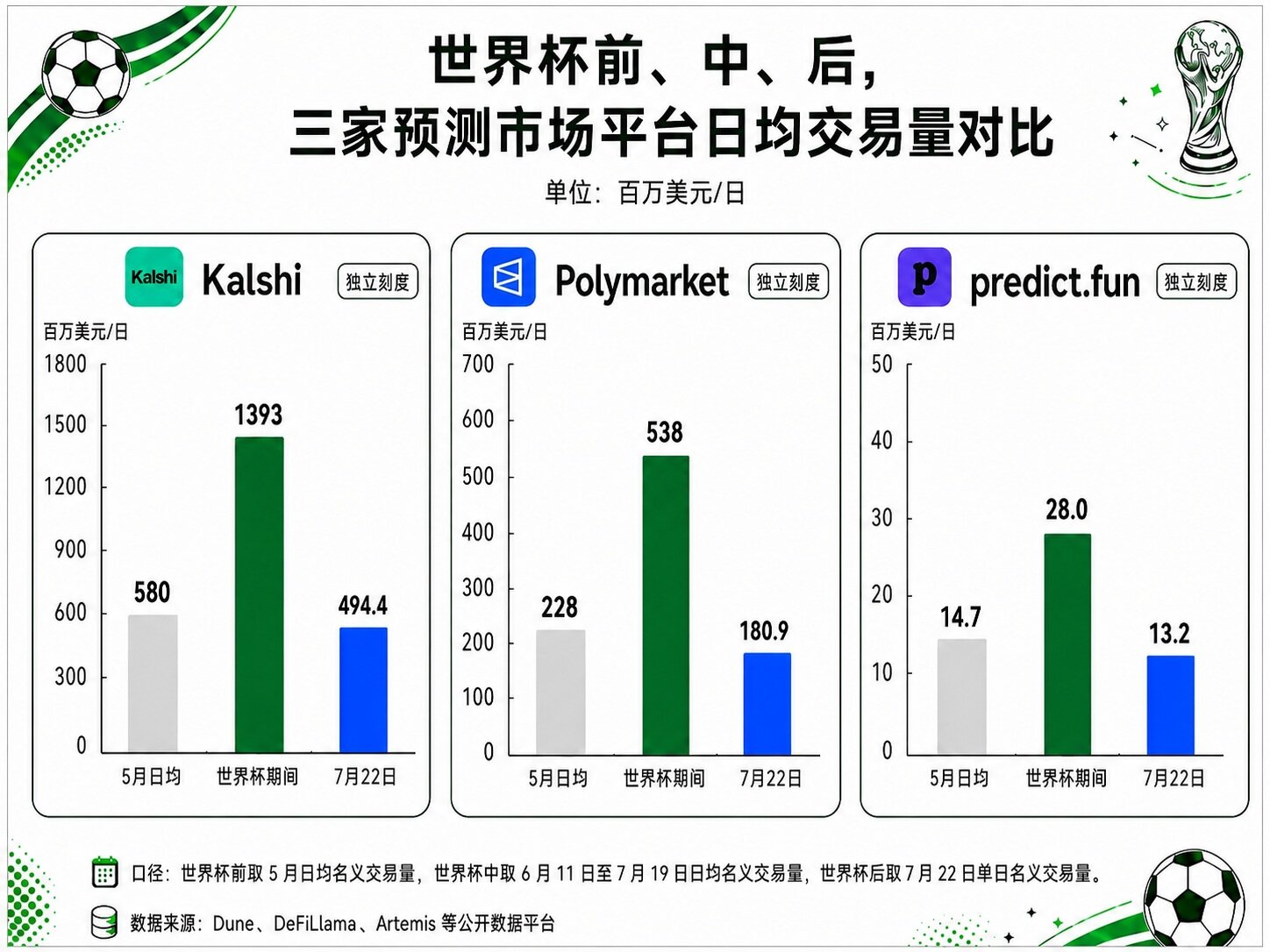
Changes in Average Daily Trading Volume for the Three Prediction Market Platforms Before, During, and After the World Cup

Kalshi's increase in trading volume during the World Cup was the most significant. Its average daily nominal trading volume in May was $580 million, rising to $1.393 billion during the tournament, an increase of about 140%. By July 22nd, trading volume fell back to $494.4 million, already below the May average daily level.

Polymarket's change magnitude was similar to Kalshi's. Its average daily nominal trading volume in May was $228 million, rising to $538 million during the World Cup, an increase of about 136%. By July 22nd, trading volume dropped to $180.9 million, also below pre-tournament levels.

predict.fun had a lower base, but the boost from the World Cup was still clear. Its average daily nominal trading volume in May was $14.7 million, rising to $28 million during the tournament, nearly doubling. By July 22nd, trading volume was $13.2 million, basically returning to pre-tournament levels.

Taking just one day's trading volume after the World Cup for comparison, the growth brought by the World Cup appears more like a concentrated release of event traffic, rather than elevating the platform's daily trading volume to a permanently higher level. Whether it can rise again in the future depends on whether other sports events and non-sports markets can capture the trading demand left after the World Cup.
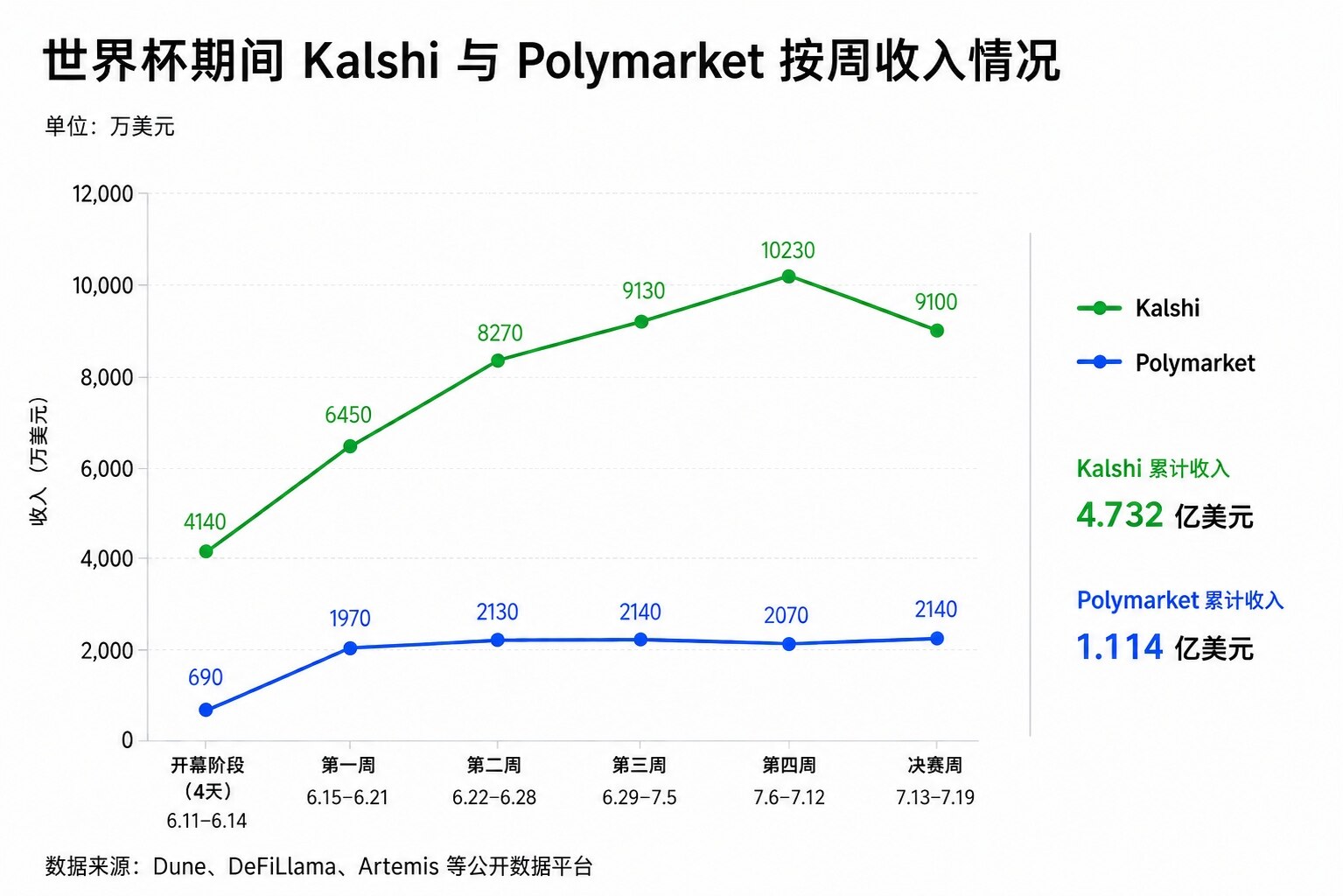
How Much Fee Revenue Did the World Cup Generate for the Three Prediction Market Platforms?

Kalshi's Fee Revenue Rose Continuously as the Tournament Progressed, Exceeding $100 Million in a Single Week in Week 4

Kalshi's fee revenue curve showed a strong overall upward trend. Revenue for the opening four-day period was $41.4 million, rising to $64.5 million in the first week, further increasing to $82.7 million in the second week, reaching $91.3 million in the third week, and rising another step in the fourth week with single-week revenue reaching $102.3 million, the highest point during the entire World Cup period. The final week saw a slight drop to $91 million. Throughout the World Cup, Kalshi's cumulative fee revenue reached $473.2 million.

The World Cup's impact on Kalshi not only brought initial attention at the start but, more importantly, sustained trading heat into the latter stages of the tournament. Single-week revenue exceeding $100 million also means Kalshi not only benefited from World Cup gains in trading volume but also successfully converted this wave of traffic into platform revenue at the monetization level.

Polymarket's Fee Revenue Was More Stable, But Didn't See Accelerated Volume Growth Like Kalshi in the Latter Stages

Polymarket's fee revenue trend was noticeably flatter. Revenue for the opening four-day period was $6.9 million, rising to $19.7 million in the first week. Subsequent weeks two, three, four, and the final week were $21.3 million, $21.4 million, $20.7 million, and $21.4 million respectively. Throughout the World Cup, Polymarket's cumulative fee revenue reached $111.4 million.

Starting from the first week, Polymarket's weekly fee revenue remained largely stable around $20 million. The World Cup did elevate Polymarket's fee revenue to a higher level, but from the second week onward, the platform did not continue to amplify gains as the tournament progressed like Kalshi did, instead operating within a relatively stable range.
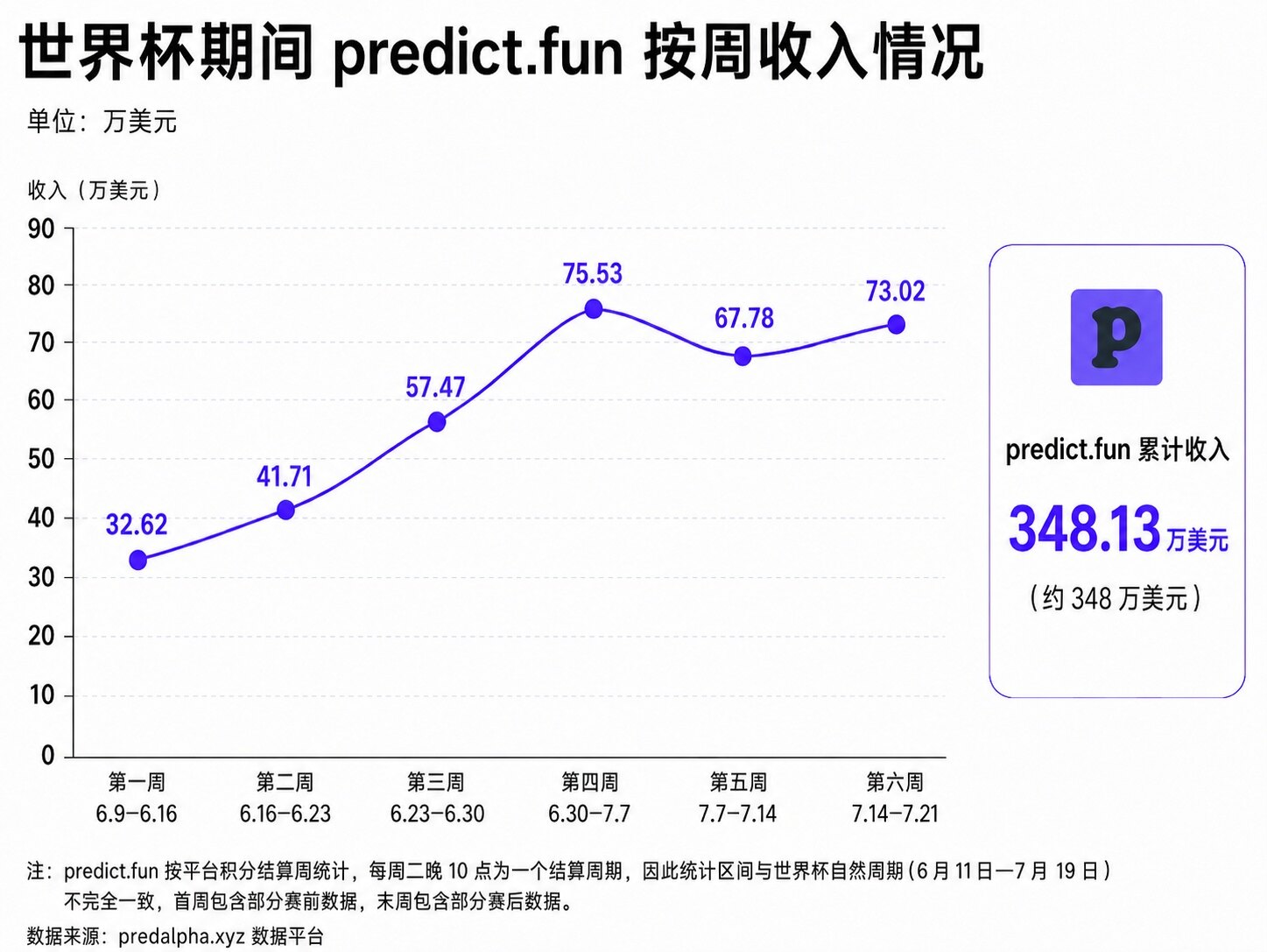
predict.fun's Fee Revenue Gradually Increased as the Tournament Progressed, Cumulative $3.481 Million Over Six Settlement Weeks

predict.fun's fee revenue is counted by platform settlement weeks, switching cycles every Tuesday at 10 PM, so it does not perfectly align with the natural World Cup schedule from June 11th to July 19th. The first settlement week was June 9th to June 16th, including two days of pre-tournament data; the last settlement week was July 14th to July 21st, also incorporating two days of post-tournament data.

Looking at the revenue trend, predict.fun's fee revenue for the first settlement week was $326.2 thousand. It then increased for three consecutive weeks, reaching $755.3 thousand from June 30th to July 7th, setting the single-week high during the World Cup period. The subsequent two weeks recorded $677.8 thousand and $730.2 thousand respectively. Although not setting new highs, these were still significantly higher than early in the tournament. The cumulative fee revenue for the six settlement weeks during the World Cup reached $3.4813 million.

The settlement week before the World Cup, June 2nd to June 9th, predict.fun's fee revenue was only $159.4 thousand. Entering the World Cup period, revenue for the first week rose to $326.2 thousand, an increase of about 105%. Subsequently, most settlement weeks further increased to over $500 thousand. Even though the first and last periods included some pre- and post-tournament data, the World Cup's boost to predict.fun's fee revenue remained significant.
After the World Cup, Fee Revenue Generally Declined Across Platforms, with Kalshi Experiencing the Smallest Drop

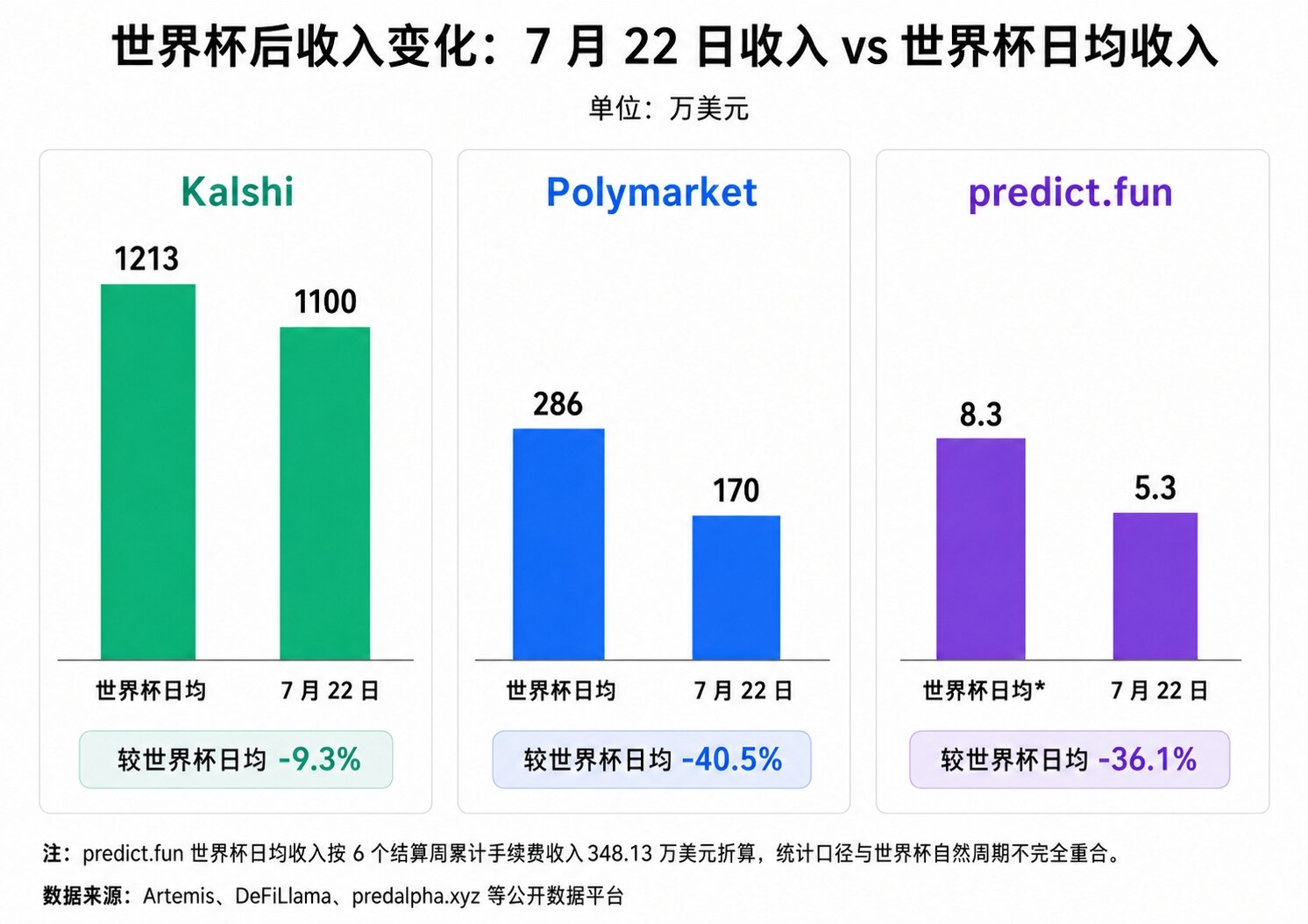
Kalshi's average daily fee revenue during the World Cup was $12.13 million, dropping to $11 million on July 22nd, a decrease of 9.3%. Among the three platforms, Kalshi's post-tournament decline was the smallest. Although fee revenue fell from the peak levels during the tournament, it remained close to the World Cup daily average.

Polymarket's drop was more pronounced. Its average daily fee revenue during the World Cup was $2.86 million, dropping to $1.7 million on July 22nd, a decrease of 40.5%. The revenue increment the World Cup brought to Polymarket was relatively concentrated, and as the tournament ended, this increment quickly dissipated.

predict.fun's average daily fee revenue during the World Cup was approximately $83 thousand, dropping to $53 thousand on July 22nd, a decrease of 36.1%, similar in magnitude to Polymarket's decline. Although the statistical method differs slightly from the first two, the post-tournament trend is clear. The World Cup also provided a significant boost to predict.fun's fee revenue, which similarly receded relatively quickly after the event.
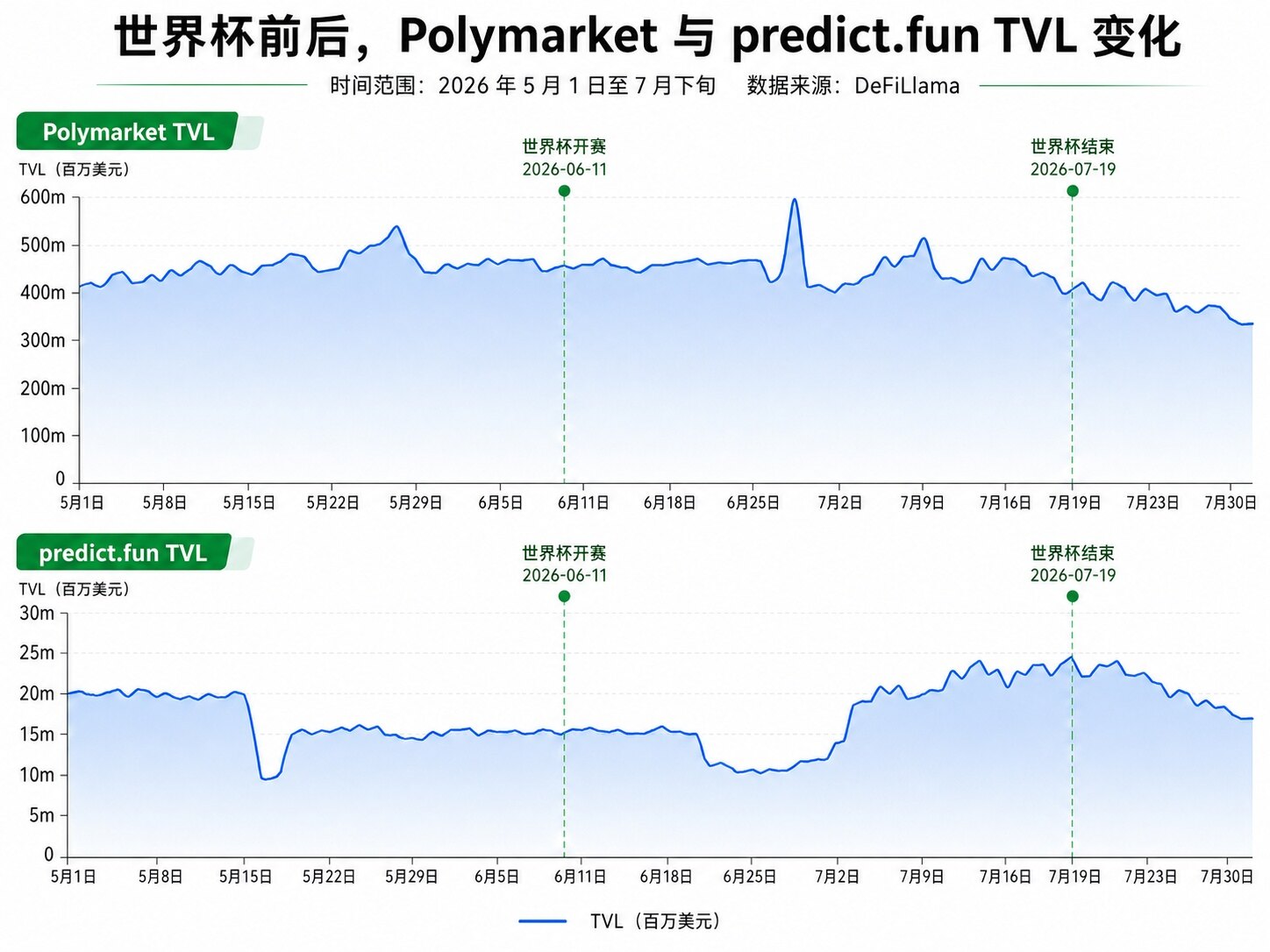
World Cup Didn't Elevate Polymarket's TVL, While predict.fun Saw Capital Inflow in the Latter Stages

Polymarket's TVL did not rise in sync with trading volume during the World Cup. In early May, the platform's TVL was around $410 million, and for most of the subsequent period, it remained in the range of $440 million to $480 million. After the World Cup began, TVL continued to fluctuate mainly around this level. Although it briefly spiked in late June and early July, it did not form a sustained upward trend.

After mid-July, TVL began to decline noticeably, dropping to around $400 million by the end of the World Cup, and has since fallen further to about $340 million. While trading volume significantly expanded during the tournament, the platform's settled capital did not correspondingly convert into long-term retained funds, indicating that the World Cup brought more high-frequency trading demand rather than simultaneously translating into persistent capital.

predict.fun's trend was more phased. In early May, its TVL was around $20 million. By mid-May, it had dropped to about $10 million, then maintained around $15 million until mid-June. At the start of the World Cup, TVL did not immediately rise. It wasn't until early July that it began to rebound quickly, reaching the $20-25 million range during the latter half of the tournament and hitting a phase high around the end of the World Cup.

After the tournament, TVL gradually declined, currently at about $17 million, but still higher than the low point in late June. Compared to Polymarket, predict.fun's capital changes were more closely linked to the World Cup's progress, especially with more noticeable capital inflows during the knockout stages.

(Note: As Kalshi's TVL data is not available on-chain, this section only discusses Polymarket and predict.fun.)
Summary

The World Cup indeed brought substantial trading volume and fee revenue to prediction markets, but post-tournament data also shows that this growth did not naturally continue. The average daily trading volume and fee revenue for all three platforms declined after the event, and Polymarket's TVL continued to fall. Mega-events can concentrate and amplify trading demand in the short term but may not directly elevate a platform's long-term activity level.

However, the World Cup benefits are not confined to short-term data alone. It at least validated that sports events can provide prediction markets with continuous, high-frequency, short-cycle trading scenarios and helped more users develop the habit of repeated trading across consecutive matches.

The World Cup has ended, but the competition around user retention, market supply, and normalized trading is just beginning.


Criptos en tendencia

Preguntas relacionadas

QAccording to the article, which prediction market platform achieved the highest total nominal trading volume during the 2026 World Cup?

AKalshi achieved the highest total nominal trading volume during the 2026 World Cup, reaching $54.338 billion.

QWhat was the key difference between Kalshi's and Polymarket's fee income trends during the World Cup, as highlighted in the article?

AKalshi's fee income showed a strong upward trend throughout the tournament, peaking at over $100 million in a single week. In contrast, Polymarket's fee income was more stable, leveling off after an initial rise and not showing the same accelerated growth in the latter stages of the tournament.

QThe article mentions that the post-tournament transaction volume data indicates the World Cup growth did not 'naturally extend'. Which platform's data is used to illustrate a significant drop in daily fee income after the event?

APolymarket is used to illustrate a significant post-tournament drop. Its daily fee income fell from $2.86 million during the tournament to $1.7 million on July 22nd, a drop of 40.5%. Predict.fun also saw a 36.1% drop in daily fee income.

QHow did the Total Value Locked (TVL) on predict.fun change during the World Cup, according to the article's analysis?

APredict.fun's TVL showed a delayed but clear correlation with the World Cup. It did not rise immediately at the start but began a rapid increase in early July, peaking between $20-25 million during the tournament's knockout stages (the latter half). After the event, it gradually declined but remained above its pre-tournament lows.

QWhat positive long-term effect did the article suggest the World Cup had on the prediction market space, beyond just short-term data?

AThe article suggested that the World Cup validated that major sports events can provide high-frequency, short-cycle trading scenarios for prediction markets. It also helped more users develop a habit of repeated trading across consecutive matches, which is beneficial for the industry's long-term growth.

Lecturas Relacionadas

The Semiconductor Industry's Most Obscure Chokepoint Material: It Has Multiplied in Price Unnoticed, and China Just Banned Its Export

"Helium: The Silent Choke Point in Semiconductors" Helium, despite being the universe's second most abundant element, is critically scarce on Earth. It cannot be synthesized artificially and escapes Earth's gravity once released, making it a non-renewable resource. Yet, it is indispensable for advanced semiconductor manufacturing, requiring ultra-high purity (99.9999%) for processes like wafer etching, leak detection, and thermal management in lithography tools, with no viable substitutes. This low-profile resource, whose price has doubled unnoticed, suddenly gained attention when China imposed an export ban on July 10th. The ban is a response to a severe global shortage triggered months earlier. In March, missile attacks damaged the world's largest helium production hub in Qatar's Ras Laffan, halting a third of global supply with repairs expected to take 3-5 years. Concurrently, Russia tightened export controls, and the US sold off its federal helium reserve. Approximately 200 specialized transport containers, each worth ~$1 million, were stranded with perishable cargo. Global spot prices skyrocketed, and chipmakers like TSMC warned of potential impacts. China, which imports over 84% of its helium (primarily from Qatar and Russia), faces a severe squeeze. Despite being helium-poor, China has developed domestic extraction technology over five years, processing byproduct gases from LNG plants to produce ultra-pure helium. Domestic output, while still only covering less than 20% of demand, enabled the recent export ban aimed at securing domestic supply for its own expanding chip industry. The industry now faces "Helium Shortage 5.0." With key global sources constrained for years, this invisible gas—once wasted on party balloons—has become a critical, geopolitically charged bottleneck for chips, healthcare (MRI machines), and beyond, forcing the world to finally treat it as the finite strategic resource it is.

marsbitHace 25 min(s)

The Semiconductor Industry's Most Obscure Chokepoint Material: It Has Multiplied in Price Unnoticed, and China Just Banned Its Export

marsbitHace 25 min(s)

Early Investor of Unitree Bets on a Brain-Computer Interface Company

"Wabo Technologies, a brain-computer interface (BCI) startup, has secured new funding from Vertex Ventures (under Temasek), Hongtai Fund, Chengdu Future Industry Fund, and Huifengda Capital. Vertex Ventures is known for its early bet on Unitree Robotics. Inspired by the sci-fi film "Avatar," founder Zhang Xingzhi has pursued human-machine interaction for over a decade. He established Wabo in late 2025, coinciding with China's push for BCI as a future industry. Unlike companies focused solely on medical hardware, Wabo positions itself as a model company. Its core mission is to develop a "Human Neural Intent Model" that decodes EEG, EMG, and behavioral signals to understand a user's goals, confirmations, corrections, and stop intentions before physical action, translating them into standardized control signals for machines, robots, or smart devices. The young, full-stack team, backed by academic collaborators from Tianjin University and Fudan University, quickly attracted investors. The company had previously raised a seed round from Ceyuan Capital. Investors were impressed by Wabo's systematic capabilities in data collection, signal processing, and engineering, seeing potential beyond a single hardware product toward a reusable layer of human intent interpretation. Applications span medical rehabilitation, smart homes, embodied AI, and even space exploration, with Wabo partnering with Tianjin University on pioneering "space BCI" research. Wabo plans a dual-headquarters strategy, with Shanghai focusing on high-end R&D and model development, and Chengdu handling hardware, product development, and supply chain. The BCI sector in China is heating up, with over 30 financing deals in early 2026. Zhang believes future competition will center on who can build a sustainable data-model-scenario loop. He predicts industry consolidation within three years, with only companies that master this闭环 surviving. The vision from "Avatar" is inching closer to reality."

marsbitHace 40 min(s)

Early Investor of Unitree Bets on a Brain-Computer Interface Company

marsbitHace 40 min(s)

ChangXin Technology: A Cyclical Stock Standing Atop the Cycle Peak

Changxin Technology: A Cyclical Stock at the Peak On July 27, 2026, Changxin Technology topped the A-share market with a market capitalization of 3.28 trillion yuan, surging 465% on its first trading day. The company, which lost 16.3 billion yuan in 2023, reported an estimated net profit of 50-57 billion yuan for the first half of 2026. Its dramatic reversal mirrors the volatile DRAM (Dynamic Random Access Memory) cycle. The DRAM industry is inherently cyclical, with booms and busts every 3-4 years. This is due to product standardization and a significant time lag in supply adjustment. When prices rise, manufacturers expand capacity, but new production takes 2-3 years to come online, often leading to oversupply and price crashes when demand cools. Changxin's performance perfectly tracks this cycle. It recorded deep losses in 2023-2024 during the industry downturn, turned its first annual profit in 2025, and saw profits skyrocket in Q1 2026. This surge is primarily price-driven. The AI boom has led major players like Samsung and SK Hynix to shift 70-80% of new capacity to high-margin HBM (High Bandwidth Memory), creating a severe shortage and price explosion in general-purpose DRAM markets where Changxin competes. However, a massive global capacity expansion is underway. The top three manufacturers have announced nearly $70 billion in capital expenditure for 2026. Changxin itself plans to expand from three to seven 12-inch wafer fabs. This investment will translate into significant new supply in 2-3 years. While DRAM prices are expected to remain high through 2026-2027, price growth is already slowing, and a potential downturn is forecast for around 2028 as new capacity ramps up. A key challenge for Changxin is catching up in the critical HBM segment. While it has delivered HBM3 samples, leaders are already mass-producing more advanced HBM3E. Success in HBM is crucial for gaining true cyclical resilience. In conclusion, Changxin is a commendable company that has broken foreign monopolies in DRAM. Its long-term growth narrative—driven by import substitution and AI—is valid. Yet, its current valuation of 5-6x forward P/E, typical for a cyclical stock at its peak, suggests much future growth is already priced in. AI may extend the current cycle but cannot eliminate the industry's inherent volatility. For investors, the critical question is preparedness for the inevitable downturn when the cycle turns.

marsbitHace 45 min(s)

ChangXin Technology: A Cyclical Stock Standing Atop the Cycle Peak

marsbitHace 45 min(s)

Trading

Spot

Artículos destacados

Cómo comprar DATA

¡Bienvenido a HTX.com! Hemos hecho que comprar DATA Network (DATA) sea simple y conveniente. Sigue nuestra guía paso a paso para iniciar tu viaje de criptos.Paso 1: crea tu cuenta HTXUtiliza tu correo electrónico o número de teléfono para registrarte y obtener una cuenta gratuita en HTX. Experimenta un proceso de registro sin complicaciones y desbloquea todas las funciones.Obtener mi cuentaPaso 2: ve a Comprar cripto y elige tu método de pagoTarjeta de crédito/débito: usa tu Visa o Mastercard para comprar DATA Network (DATA) al instante.Saldo: utiliza fondos del saldo de tu cuenta HTX para tradear sin problemas.Terceros: hemos agregado métodos de pago populares como Google Pay y Apple Pay para mejorar la comodidad.P2P: tradear directamente con otros usuarios en HTX.Over-the-Counter (OTC): ofrecemos servicios personalizados y tipos de cambio competitivos para los traders.Paso 3: guarda tu DATA Network (DATA)Después de comprar tu DATA Network (DATA), guárdalo en tu cuenta HTX. Alternativamente, puedes enviarlo a otro lugar mediante transferencia blockchain o utilizarlo para tradear otras criptomonedas.Paso 4: tradear DATA Network (DATA)Tradear fácilmente con DATA Network (DATA) en HTX's mercado spot. Simplemente accede a tu cuenta, selecciona tu par de trading, ejecuta tus trades y monitorea en tiempo real. Ofrecemos una experiencia fácil de usar tanto para principiantes como para traders experimentados.

147 Vistas totalesPublicado en 2026.07.01Actualizado en 2026.07.01

Cómo comprar DATA

Discusiones

Bienvenido a la comunidad de HTX. Aquí puedes mantenerte informado sobre los últimos desarrollos de la plataforma y acceder a análisis profesionales del mercado. A continuación se presentan las opiniones de los usuarios sobre el precio de DATA (DATA).

活动图片