CASHCAT Anjlok 32% Saat Paus Uang Kripto Mencairkan $2,85 Juta – Bisakah $0,10 Bertahan?

ambcryptoPublicado a 2026-07-15Actualizado a 2026-07-15

Resumen

Cash Cat (CASHCAT), aset kripto yang ramai diperbincangkan, merosot tajam 32% menjadi sekitar $0,12 setelah mencapai rekor tertinggi $0,23 pada 14 Juli. Tekanan jual meningkat setelah seorang "paus" menguangkan keuntungan besar. Trader tersebut menjual 16,3 juta CASHCAT senilai $2,85 juta, yang awalnya hanya dibeli seharga $3.000, menandakan memudarnya sentimen spekulatif. Tekanan pasar semakin intens dengan likuidasi posisi long mencapai $2,14 juta. Volume jual di pasar perpetual (65,57 juta) juga melampaui volume beli (45 juta), dengan pembelian bersih negatif sekitar -100 juta, menunjukkan dominasi aksi jual dan ketakutan trader terhadap kerugian lebih lanjut. Dengan tekanan jual yang agresif, CASHCAT berisiko mengalami penurunan lebih dalam. Untuk mencegah penurunan lebih lanjut, memecoin ini perlu mempertahankan level support $0,10. Jika level tersebut tidak bertahan, harga berpotensi melanjutkan penurunan menuju $0,08. Pemulihan hanya mungkin terjadi jika CASHCAT berhasil kembali ke level $0,20.

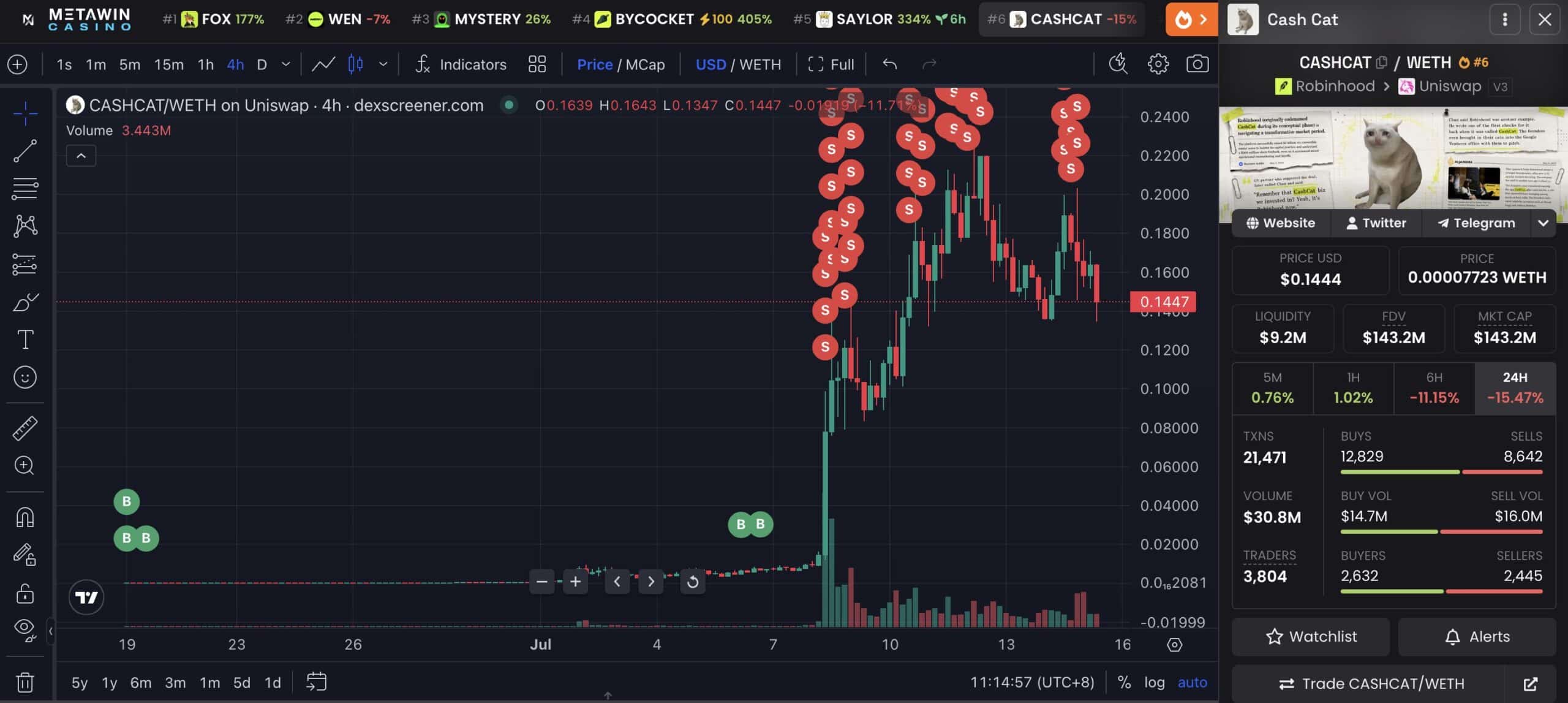
Cash Cat [CASHCAT] telah menjadi salah satu aset kripto yang paling banyak dibicarakan dalam seminggu terakhir. Di tengah kehebohan pasar yang ekstrem, memecoin ini melonjak ke rekor tertinggi sepanjang masa $0,23 pada tanggal 14 Juli.

Sejak itu, memecoin ini mengalami tekanan penurunan yang ekstrem seiring dengan turunnya harga. Pada saat penulisan, CASHCAT diperdagangkan di sekitar $0,12, setelah mengalami penurunan sebesar 32% pada grafik harian. Dengan penurunan harga yang terus berlanjut, investor berpenghasilan tinggi yang bergegas mengakumulasi lebih awal telah berubah menjadi bearish dan mulai mencairkan aset mereka.

Pedagang CASHCAT Jual $2,8 Juta dalam Token

Ketika demam CASHCAT melanda pasar, para pedagang, terutama paus, mengerahkan modal yang signifikan untuk mengakumulasi token ini. Namun, momentum ini perlahan-lahan memudar di tengah penurunan harga, dan para pedagang ini telah mulai mencairkan aset mereka.
Sumber: Lookonchain

Menurut Lookonchain, seorang pedagang mencairkan $2,85 juta dari CASHCAT, mengamankan keuntungan 952×. Pedagang tersebut hanya menghabiskan $3.000 untuk membeli 16,3 juta CASHCAT, kemudian menjual seluruh jumlahnya seharga 1.527 ETH senilai $2,85 juta.

Dengan mengunci keuntungan ini, paus tersebut menandakan memudarnya spekulasi pasar, karena pencairan besar sering kali menandakan sentimen yang menurun. Karena itu, bahkan para spekulan pun menjadi skeptis dan kini memperkirakan pasar akan terus menurun.

Tekanan Pasar Mengintensifkan

Selain keluarnya paus, peserta pasar CASHCAT menghadapi tekanan yang ekstrem. Sebelumnya, para pedagang terlalu bullish dan membuka posisi leverage, mengincar tren naik yang berkelanjutan.

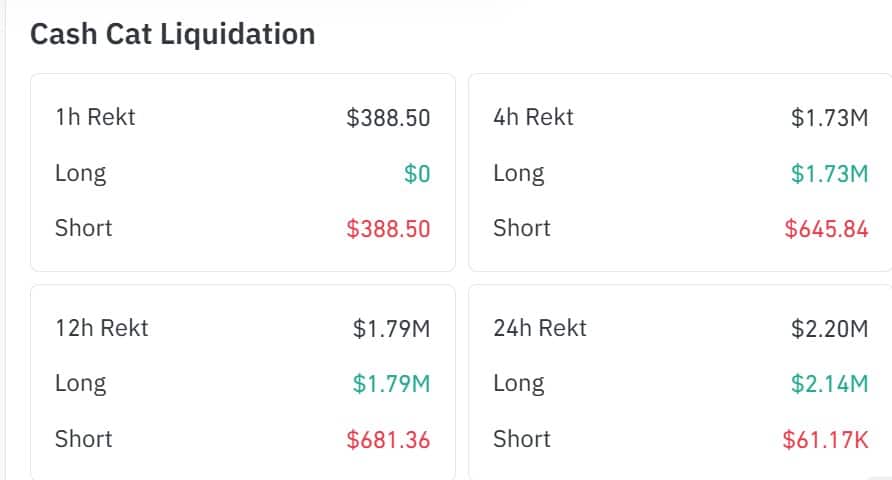
Namun, seiring memecoin terus menurun, penurunan harga ini memicu gelombang likuidasi posisi long. Menurut data CoinGlass, posisi long senilai $2,14 juta lenyap, menandakan kekuatan tren penurunan.
Sumber: CoinGlass

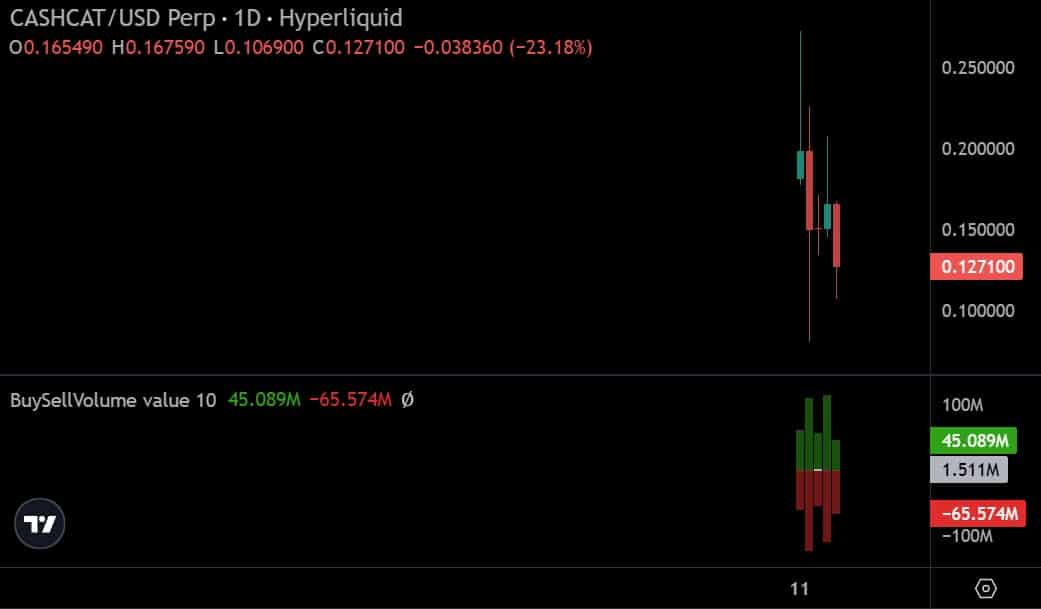
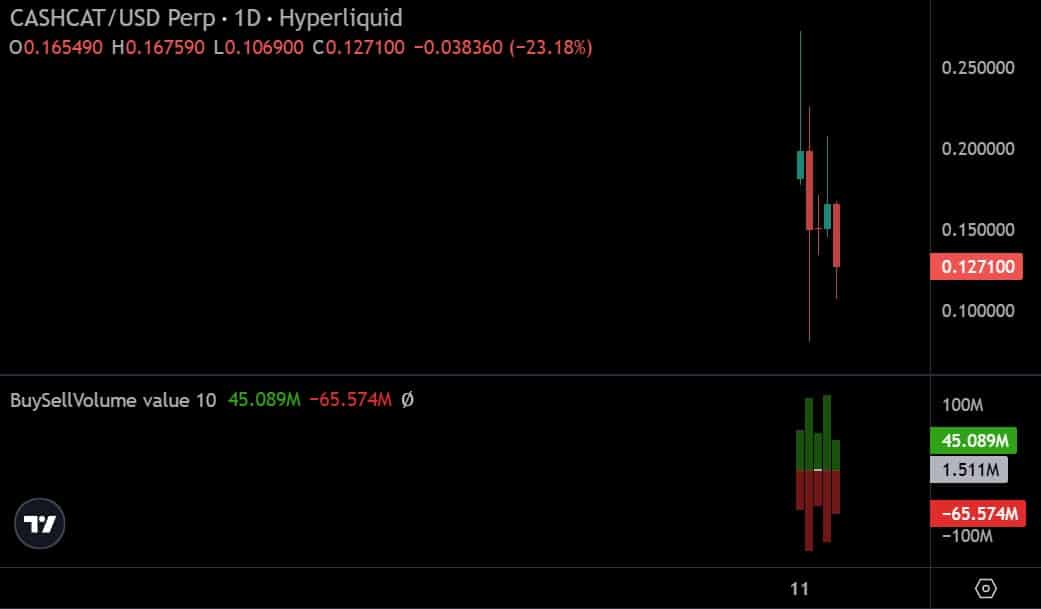
Seperti yang diduga, risiko likuidasi yang meningkat ini memicu kepanikan di kalangan pedagang, mendorong mereka untuk menutup posisi mereka. Misalnya, memecoin mencatat volume Jual Perps sebesar 65,57 juta dibandingkan dengan volume beli 45 juta.
Sumber: Coinalyze

Pada saat yang sama, pembelian bersih altcoin ini tetap negatif sekitar -100 juta, dengan delta -20,49 juta. Pembelian perps negatif menunjukkan bahwa lebih banyak pedagang menutup perdagangan mereka, takut kerugian lebih lanjut.

Apa Langkah Selanjutnya untuk Memecoin Ini?

Selain itu, CASHCAT saat ini berada di bawah tekanan ekstrem, dengan sebagian besar peserta pasar menjual secara agresif. Dalam kondisi pasar seperti ini, memecoin ini berisiko mengalami penurunan lebih lanjut.

Oleh karena itu, jika para pedagang terus menutup posisi mereka, CASHOUT kemungkinan akan menembus support $0,1 dan turun menuju $0,08. Untuk menghindari slippage lebih lanjut, memecoin ini perlu merebut kembali $0,2, yang secara efektif akan menghapus semua bear di pasar.


Ringkasan Akhir

  • Seorang pedagang menjual 16,3 juta CASHCAT senilai $2,85 juta setelah berinvestasi $3 ribu.
  • Cashcat turun 32% ke posisi terendah $0,11 di tengah tekanan bearish yang intens.

Criptos en tendencia

Preguntas relacionadas

QApa yang menyebabkan penurunan harga CASHCAT sebesar 32%?

APenurunan harga CASHCAT sebesar 32% disebabkan oleh tekanan jual yang ekstrem di pasar, termasuk aksi whale yang mencairkan token senilai $2,85 juta, serta likuidasi posisi long yang mencapai $2,14 juta yang memicu kepanikan di kalangan trader.

QBerapa keuntungan yang diperoleh trader (whale) dari penjualan CASHCAT?

ATrader (whale) tersebut memperoleh keuntungan sebesar 952x dari investasi awalnya. Ia menghabiskan $3.000 untuk membeli 16,3 juta CASHCAT dan menjual seluruhnya senilai 1.527 ETH yang setara dengan $2,85 juta.

QApa yang ditunjukkan oleh volume jual perpetual (Perps Sell) yang lebih tinggi daripada volume beli untuk CASHCAT?

AVolume jual perpetual (Perps Sell) CASHCAT sebesar 65,57 juta yang lebih tinggi daripada volume beli 45 juta menunjukkan bahwa lebih banyak trader yang menutup atau membuka posisi jual, mencerminkan sentimen bearish dan ketakutan akan kerugian lebih lanjut di pasar.

QLevel support penting apa yang disebutkan untuk CASHCAT, dan risiko apa jika level itu terlewati?

ALevel support penting yang disebutkan adalah $0,10. Jika level ini tidak dapat dipertahankan dan terlewati, dikhawatirkan harga CASHCAT dapat terus turun menuju level $0,08.

QApa kondisi yang diperlukan agar CASHCAT bisa membalikkan tren bearish menurut artikel?

AMenurut artikel, untuk membalikkan tren bearish dan menghapus tekanan jual, CASHCAT perlu berhasil menguat dan mereklaim level harga $0,20.

Lecturas Relacionadas

UNI Doubles in Two Months Against the Trend: A 5-Year-Overdue Value Realization

Amidst a generally stagnant crypto market in June and July, UNI, the governance token of Uniswap, saw a significant surge, nearly doubling in price from around $2.3 to $4.6. This rally represents a delayed but significant value reassessment, triggered by the practical implementation of its long-debated "fee switch" mechanism. The key turning point was the on-chain execution of the UNIfication proposal in December 2025. It activated a protocol fee on select pools, directed Unichain sequencer revenue (net of costs) to a communal treasury, executed a one-time burn of 100 million UNI, and established a system where all protocol revenue flows into a "TokenJar" contract. This treasury has a single exit: purchasing and permanently burning UNI via a "Firepit" contract. Initially, the market reacted tepidly as the generated revenue and corresponding burn rate were modest. The narrative shifted dramatically in July 2025 with two major developments. First, the launch of Robinhood Chain, tailored for tokenized stocks, rapidly became a primary source of volume and fees for Uniswap, at one point contributing nearly half of its weekly fees. Second, governance votes successfully expanded the fee mechanism to v4 pools and initiated a temperature check for fees on Robinhood Chain. The activation of v4 fees caused the protocol's daily revenue earmarked for UNI burns to nearly triple. The core of UNI's recent price action is the transition from a pure governance token to a cash-flow asset with a permanent, protocol-funded buyer. Its effectiveness is amplified by UNI's mature and widely distributed supply, with no major impending unlocks to dilute the impact of the buybacks. The sustainability of this rally now hinges on whether the transaction volume, particularly on Robinhood Chain, persists after its initial gas subsidies expire, determining if this is a genuine value realization or a subsidy-fueled spike.

marsbitHace 28 min(s)

UNI Doubles in Two Months Against the Trend: A 5-Year-Overdue Value Realization

marsbitHace 28 min(s)

Breaking: Google Earth Urgently Pulls Back Nano Banana 2 Image Generation Feature!

Google Earth's newly launched "Create image" feature, powered by the Nano Banana 2 AI image generation model, was abruptly withdrawn shortly after its release due to being "played" by users. The feature allowed users to generate and overlay AI-created visuals directly onto real-world satellite and 3D maps in Google Earth. The tool enabled creative applications like historical recreations (e.g., visualizing ancient Pompeii), generating informational graphics for landmarks, and envisioning architectural projects or futuristic cityscapes on real terrain. It operated under "geospatial grounding," meaning the AI respected the underlying geography, topography, and perspective of the chosen map view. The model also integrated with Gemini to retrieve relevant factual information. However, upon release, users quickly tested its limits. A prominent example involved reimagining Philadelphia's historic Independence Hall as a post-apocalyptic ruin overrun by "happy" zombies, evil clowns, and giant alien mechs. This highlighted both the feature's playful potential and its risks regarding the generation of inappropriate or misleading content on realistic maps, leading to its swift temporary removal. Google stated it would re-release the feature after implementing "enhanced guardrails." Analysts note this move strategically leverages Google's vast proprietary geospatial data, positioning its AI not just for artistic generation but for spatially accurate world visualization—a unique advantage in the competitive AI image generation landscape.

marsbitHace 2 hora(s)

Breaking: Google Earth Urgently Pulls Back Nano Banana 2 Image Generation Feature!

marsbitHace 2 hora(s)

Altman Admits: Overestimated AI Snatching Jobs! Huang Renxun: The Unemployment Narrative Is Completely Backwards

Sam Altman has revised his earlier predictions about AI rapidly replacing jobs, admitting he overestimated the speed at which AI would eliminate entry-level white-collar roles. Speaking on the "Invest Like the Best" podcast, he stated that people do not truly want an AI CEO, as accountability and human connection remain critical. He found that individuals prefer interacting with people who can be held responsible for decisions. Similarly, NVIDIA's Jensen Huang argued that the narrative of AI destroying jobs is misguided. He distinguishes between tasks and jobs, noting that while AI can automate specific tasks, entire jobs—encompassing communication, judgment, coordination, and accountability—are not eliminated. He cited examples like radiologists and software engineers, where demand for these roles has increased as AI handles repetitive tasks, allowing for business expansion and the creation of more positions. Data from a University of Maryland and LinkUp study supports this, showing that U.S. job postings for new graduates have actually risen, countering the fear of vanishing entry-level roles. However, a significant shift is occurring: the traditional entry-level tasks that help newcomers gain experience are being automated, making initial career access more challenging. The key insight is that as AI takes over standardized tasks, the enduring value of human work shifts toward areas of responsibility, trust-building, and final decision-making—aspects that AI cannot replicate. The real "moat" for professionals lies in these irreplaceable human elements.

marsbitHace 2 hora(s)

Altman Admits: Overestimated AI Snatching Jobs! Huang Renxun: The Unemployment Narrative Is Completely Backwards

marsbitHace 2 hora(s)

Weekly Editor's Picks (0725-0731)

Weekly Editor's Picks (0725-0731) provides a curated selection of deep analysis, filtering out market noise. Key themes from this week include: **Macro & Policy:** The Federal Reserve's upcoming meeting is marked by high uncertainty, balancing cooling inflation data against persistent price pressures. Meanwhile, the U.S. crypto regulatory Clarity Act faces critical political hurdles, with its 2026 passage probability seen as low. **Investing & Crypto:** Analysis suggests long-term crypto success depends on conviction through volatile cycles, focusing on assets like Bitcoin and core smart contract platforms. A trend noted is the increasing similarity between global equity markets (especially tech) and crypto, driven by narrative and leverage. Several major crypto protocols show strong revenue growth, but this isn't always translating to token price appreciation due to sell pressure and structural factors. **AI & Semiconductors:** Nvidia's rising credit default swap rates signal market concern over AI infrastructure financing risks. The storage sector experienced volatility as markets began pricing in potential 2027 oversupply. Despite a record profitable quarter, SK Hynix's results were deemed "below expectations," reflecting heightened investor demands for future growth visibility. **Markets & DeFi:** TradeXYZ demonstrated remarkable accuracy in pre-market pricing for a major A股 listing. The token ONDO saw gains, linked to its growing role in the on-chain tokenized stock ecosystem. **Ethereum:** Post-Pectra upgrade, a major structural shift is underway as Lido begins migrating millions of ETH to new validator architectures designed for capital efficiency. **Also Highlighted:** Butian's bullish stock market move; OpenAI's Altman promising major advances; Samsung and SK Hynix securing large AI chip deals; Apple reaching a $5T market cap; and ongoing discussions around exchange security following Poolin's bankruptcy case.

marsbitHace 2 hora(s)

Weekly Editor's Picks (0725-0731)

marsbitHace 2 hora(s)

Trading

Spot

Artículos destacados

Cómo comprar CAT

¡Bienvenido a HTX.com! Hemos hecho que comprar Simon's Cat (CAT) sea simple y conveniente. Sigue nuestra guía paso a paso para iniciar tu viaje de criptos.Paso 1: crea tu cuenta HTXUtiliza tu correo electrónico o número de teléfono para registrarte y obtener una cuenta gratuita en HTX. Experimenta un proceso de registro sin complicaciones y desbloquea todas las funciones.Obtener mi cuentaPaso 2: ve a Comprar cripto y elige tu método de pagoTarjeta de crédito/débito: usa tu Visa o Mastercard para comprar Simon's Cat (CAT) al instante.Saldo: utiliza fondos del saldo de tu cuenta HTX para tradear sin problemas.Terceros: hemos agregado métodos de pago populares como Google Pay y Apple Pay para mejorar la comodidad.P2P: tradear directamente con otros usuarios en HTX.Over-the-Counter (OTC): ofrecemos servicios personalizados y tipos de cambio competitivos para los traders.Paso 3: guarda tu Simon's Cat (CAT)Después de comprar tu Simon's Cat (CAT), guárdalo en tu cuenta HTX. Alternativamente, puedes enviarlo a otro lugar mediante transferencia blockchain o utilizarlo para tradear otras criptomonedas.Paso 4: tradear Simon's Cat (CAT)Tradear fácilmente con Simon's Cat (CAT) en HTX's mercado spot. Simplemente accede a tu cuenta, selecciona tu par de trading, ejecuta tus trades y monitorea en tiempo real. Ofrecemos una experiencia fácil de usar tanto para principiantes como para traders experimentados.

130 Vistas totalesPublicado en 2024.12.13Actualizado en 2026.06.02

Cómo comprar CAT

Qué es TRUMP CAT

Familia Gato Trump, $Gato Trump: Un Misterio Desenredado Introducción En el paisaje en constante evolución de proyectos de criptomonedas e innovaciones web3, ha surgido un fenómeno curioso—uno que parece estar en la línea entre la criptomoneda y la cultura de memes de internet. Este es el enigmático “Familia Gato Trump”, también conocido como “$Gato Trump”. Aunque puede despertar curiosidad entre los entusiastas de las criptomonedas, la realidad parece estar muy alejada de la definición estándar de un proyecto cripto. Este artículo tiene como objetivo explorar el concepto de Familia Gato Trump, sacando a la luz el contexto que lo rodea y aclarando su estatus en el ámbito cripto. ¿Qué es Familia Gato Trump, $Gato Trump? A primera vista, uno podría pensar que “Familia Gato Trump” se refiere a una criptomoneda legítima o un proyecto web3. Sin embargo, tras una investigación más profunda, se hace evidente que el término carece de las características de una empresa cripto tradicional. En cambio, “Gato Trump” parece estar predominantemente asociado con la cultura de memes virales que surgió tras las declaraciones controvertidas del ex presidente de EE. UU. Donald Trump sobre los inmigrantes haitianos. La cobertura mediática provocó una miríada de memes, interpretaciones humorísticas y una ola de comentarios sociales. Estos memes representan diversas formas de sátira centradas en el diálogo de Trump, a menudo utilizando gatos en escenarios cómicos y a veces absurdos. En lugar de ser un proyecto estructurado destinado a abordar avances tecnológicos o transacciones financieras, el concepto de “Familia Gato Trump” existe predominantemente en el ámbito del humor de internet. ¿Quién es el Creador de Familia Gato Trump, $Gato Trump? En la investigación de quién está detrás de la “Familia Gato Trump”, se hace evidente que no existe un creador identificable o figura fundadora. El fenómeno parece haber surgido de la expresión colectiva de internet, en lugar de un visionario singular con un objetivo de proyecto definido. Esta anonimidad enfatiza aún más su estatus como un meme en lugar de una iniciativa estructurada similar a la mayoría de los proyectos cripto conocidos. ¿Quiénes son los Inversores de Familia Gato Trump, $Gato Trump? Dado que “Familia Gato Trump” no se ajusta a las características de un proyecto cripto reputado, la cuestión de la inversión se vuelve irrelevante. No ha habido fundaciones u organizaciones establecidas expresando apoyo a un proyecto con este nombre. En cambio, lo que existe son contribuyentes individuales a la cultura de memes—aficionados, artistas y usuarios de redes sociales que colectivamente pueblan internet con sus interpretaciones y humor en torno al término “Gato Trump”. Este crecimiento orgánico dentro de la comunicación humana digital refleja más un comentario social que un paisaje de inversión financiera. ¿Cómo Funciona Familia Gato Trump, $Gato Trump? Si uno busca establecer cómo opera “Familia Gato Trump”, la respuesta es muy diferente de lo que podría esperarse de los proyectos cripto estándar. No hay mecanismos operativos, innovaciones tecnológicas o características únicas inherentes a este fenómeno. En cambio, existe a través de la propagación viral en línea, dependiendo de las plataformas de redes sociales para su proliferación. El “cómo” reside en el ámbito de la cultura y la comunicación—su esencia deriva de la dinámica de la interacción social en lugar de los protocolos cripto establecidos o las funcionalidades de blockchain. Lo que hace único a “Gato Trump”, si es que hay algo, es la forma en que dramatiza un diálogo político a través del humor. Las personas utilizan visuales atractivos, bromas internas y narrativas inventivas para transmitir sentimientos sobre figuras políticas y problemas sociales. El poder de los memes trasciende la comunicación tradicional, encapsulando pensamientos complejos en una forma que resuena ampliamente, pero que sigue siendo elusiva en términos de éxito cuantificable o metas estructuradas. Cronología de Familia Gato Trump, $Gato Trump Septiembre de 2024: El discurso en torno a los comentarios de Donald Trump sobre los inmigrantes haitianos que supuestamente consumen mascotas gana tracción en línea, llevando a una florecimiento de memes e interpretaciones paródicas en varias plataformas. Impacto Continuo: Tras este período, el fenómeno “Gato Trump” sigue vivo mientras los usuarios de redes sociales aprovechan el humor para abordar, criticar o simplemente celebrar la absurdidad de las conversaciones y eventos políticos. Es esencial notar que, dado que “Familia Gato Trump” carece de la estructura formal de un proyecto tradicional, la cronología consiste principalmente en observaciones anecdóticas en lugar de hitos notables comúnmente encontrados en empresas cripto reconocidas. Puntos Clave Cultura de Memes: En lugar de una iniciativa cripto estructurada, “Gato Trump” se alinea más con el paisaje en evolución de los memes de internet. Origen del Término: La génesis de “Gato Trump” se relaciona directamente con los comentarios del presidente Trump sobre los inmigrantes haitianos, provocando una representación humorística generalizada. Ausencia de un Marco de Proyecto: El término no se alinea con ningún objetivo de proyecto definido, creadores o inversores, marcándolo como una experiencia cultural novedosa en lugar de un proyecto cripto. Conclusión En resumen, la investigación sobre “Familia Gato Trump, $Gato Trump” revela un fenómeno arraigado en la cultura de memes de internet en lugar de un proyecto reconocido dentro de los sectores de criptomonedas o web3. La viralidad que rodea el término nace de la participación colectiva de los usuarios, reflejando el discurso digital moderno en lugar de una iniciativa formalizada con estructura o previsión estratégica. Por toda la curiosidad que pueda invocar entre aquellos que buscan el próximo gran proyecto cripto, “Familia Gato Trump” sirve como un testimonio de la creatividad, humor y a menudo absurda relación de la humanidad con la política en la era digital.

292 Vistas totalesPublicado en 2025.01.22Actualizado en 2025.01.22

Qué es TRUMP CAT

Discusiones

Bienvenido a la comunidad de HTX. Aquí puedes mantenerte informado sobre los últimos desarrollos de la plataforma y acceder a análisis profesionales del mercado. A continuación se presentan las opiniones de los usuarios sobre el precio de CAT (CAT).

活动图片














