Vibe Coding Đốt Nhầm 55 Vạn Token, Anh Chàng Nhờ Tiếng Cười Chê Mà Kiếm Ngược Lại 7 Tỷ

marsbitPublicado a 2026-07-06Actualizado a 2026-07-06

Resumen

Một nhân viên tại công ty dịch vụ tài chính doanh nghiệp Slash (Mỹ) đã sử dụng Vibe Coding (lập trình dựa trên cảm hứng/mô tả) để tạo ra trò chơi bắn súng pixel có tên "Brainrot Shooter". Ban đầu, anh ta chia sẻ một bảng chi phí AI token giả lên tới 81.267 USD (khoảng 55 triệu RMB), gây xôn xao và lo ngại về một "sự cố chi phí" tốn kém. Tuy nhiên, trò chơi nhanh chóng thu hút sự chú ý, với gần 7.000 người chơi trong 48 giờ đầu và nhận được đề nghị hợp tác quảng cáo từ các thương hiệu. Công ty đã nhanh chóng chuyển hướng, coi đây là một "dự án chiến lược" thay vì sự cố. Bất ngờ hơn, nhân viên này sau đó tiết lộ trò chơi đã gián tiếp mang về cho Slash **1 tỷ USD AUM (Tài sản được quản lý) mới**, tương đương khoảng 7 tỷ RMB. Cuối cùng, anh ta thừa nhận hóa đơn 81.267 USD là giả mạo, chi phí AI thực tế để phát triển trò chơi chưa đến 200 USD. Toàn bộ sự việc thực chất là một chiến dịch marketing được dàn dựng khéo léo, biến một trò chơi đơn giản thành câu chuyện viral toàn cầu, nâng cao đáng kể độ nhận diện thương hiệu của công ty.

Một nhân viên đáp lại lời kêu gọi của công ty, lao đầu vào thế giới của Vibe Coding, chăm chỉ 'mài' ra một trò chơi FPS phong cách pixel đầy "não mục".

Chưa kịp vui mừng trong lòng, anh ta lướt mắt nhìn qua một cái.

Trời ơi, thứ này ngốn của tôi tới 81.267 đô la token (tương đương 55 vạn nhân dân tệ)???

Vậy chẳng phải là gây ra một họa l...ớ...n rồi sao!

(Chỗ này phải phát ra tiếng của Vương đại nương nương trong "Tri Phủ".mp3)

Sếp chỉ khuyến khích mọi người Vibe Coding, đâu có bảo tôi tiêu tiền như nước đâu!

Công ty cũng không biết nói gì, đành ngậm ngùi chia sẻ lại, hy vọng mọi người qua lại đều chơi thử trò nhỏ này, hóa đơn 8 vạn đô la coi như là chi phí marketing để mọi người biết đến công ty chúng tôi qua trò chơi nhỏ vậy.
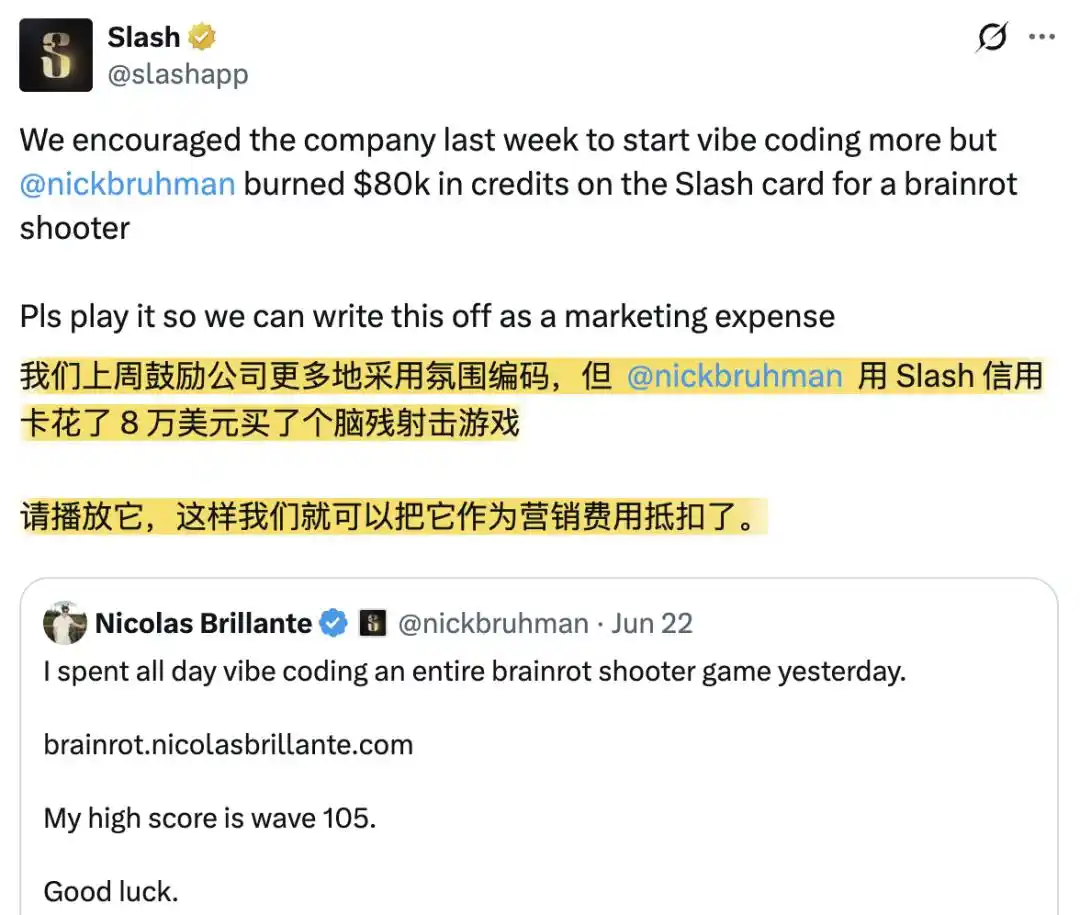
Sự tình đã đến nước này......

Ơ, sao lại còn có bất ngờ nữa?

Trò chơi lên sóng 48 giờ, thu hút 6912 người chơi, tích lũy thời gian chơi 8986 giờ, còn có 3 thương hiệu chủ động hỏi hợp tác quảng cáo.

Vụ "sự cố chi phí" ban đầu, nhanh chóng được công ty đổi tên thành "dự án chiến lược".

Bạn tưởng câu chuyện đến đây là kết thúc?

Còn có kịch tính hơn nữa.

Nhân viên sau đó báo tin vui trên X, trò chơi nhỏ não mục đốt mất 8 vạn đô la này, đã mang về cho công ty 100 triệu đô la AUM mới.

Khoảng 7 tỷ nhân dân tệ.

Tính ra, hóa đơn AI đủ để khiến người ta mất việc ngay lập tức lúc đầu, tỷ suất hoàn vốn lại vượt quá 1200 lần.

Vụ này thuộc dạng thất mã tri mã, cuối cùng con ngựa không những tự mình derderder quay về, mà phía sau còn dẫn theo một đoàn ngựa.

8 vạn đô la, chỉ Vibe ra một trò chơi nhỏ não mục

Tên công ty Mỹ này là Slash, một công ty dịch vụ tài chính doanh nghiệp, chủ yếu cung cấp tài khoản ngân hàng thương mại, thẻ công ty, quản lý vốn cho doanh nghiệp.

Không lâu trước khi sự việc xảy ra, Slash vừa tuyên bố quy mô tài sản quản lý nền tảng vượt 1 tỷ đô la.

Đồng thời, công ty nội bộ cũng đang tích cực thúc đẩy nhân viên sử dụng AI, đặc biệt khuyến khích mọi người thử nghiệm Vibe Coding vốn đang nổi như cồn trong giới lập trình viên toàn cầu.

Vibe Coding chủ trương một điều "code có thể không biết, yêu cầu thì phải dám đưa ra".

Thế là trưởng bộ phận kinh doanh chiến lược của Slash là Nicolas Brilliante (dưới đây gọi thân mật là Nicolas) hào hứng muốn thử Vibe ra một trò chơi nhỏ.

Trò chơi cuối cùng được đặt tên là "Brainrot Shooter (Trò chơi bắn súng não mục)".
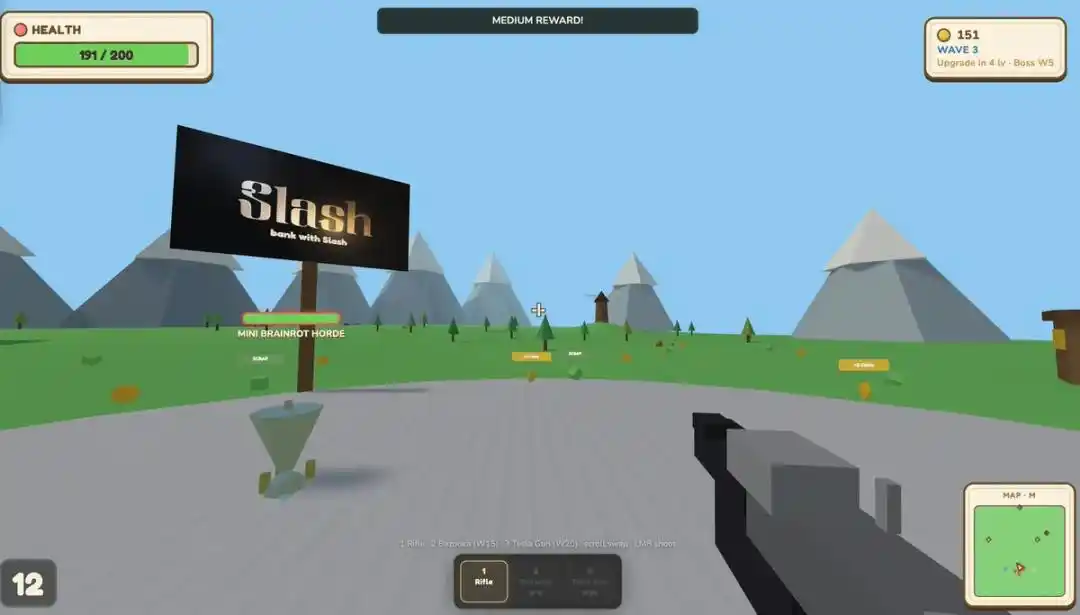
Nó sử dụng lối chơi bắn súng góc nhìn thứ nhất, bản đồ được cấu thành từ các khối pixel, hơi hơi giống một chút xíu "Minecraft". Người chơi cầm vũ khí chạy khắp nơi trong bản đồ, đuổi theo các nhân vật não mục trên mạng như Skibidi Toilet, Tung Tung Tung Sahur mà tấn công liên hồi.

Trò chơi này nói thế nào nhỉ, từ đồ họa, lối chơi đến quy mô phát triển, đều giống một Demo web được ghép nhanh hơn.

Đặt vào cửa hàng trò chơi, đại khái thuộc mức độ mà người chơi xem xong tên là đoán ra toàn bộ lối chơi.

Nhưng Nicolas khóc lóc thảm thiết, nói rằng thứ này khiến anh ta vô cớ trong vòng một tuần tiêu AI Credits như nước chảy mất 81.267 đô la.

Anh ta còn tự giễu với cư dân mạng xung quanh rằng đây đúng là một sự cố, mình đã đánh giá thấp khả năng của bản thân.
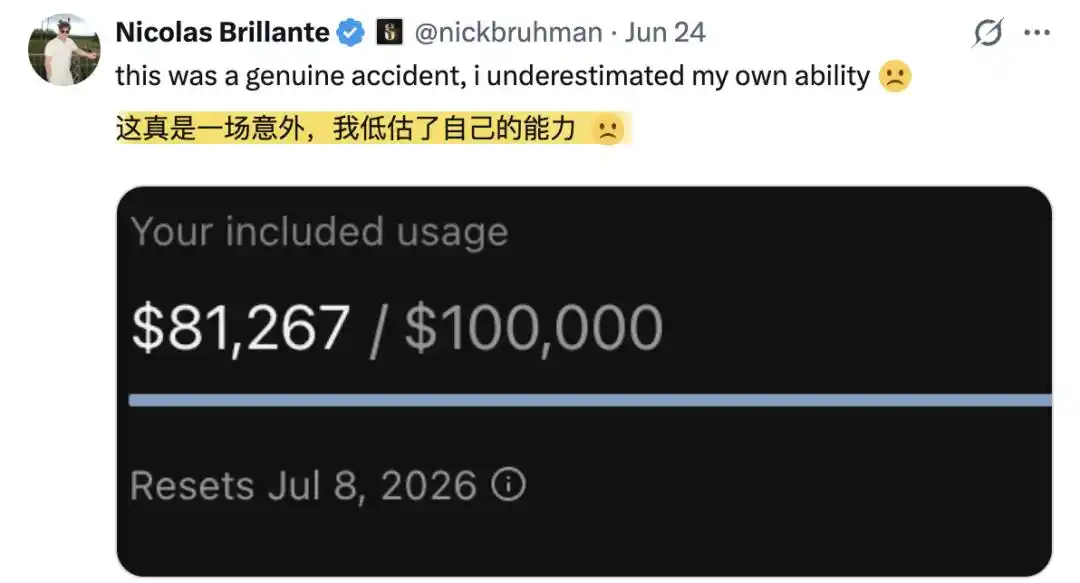
Không phải nói khả năng phát triển game đâu, mà là nói khả năng đốt Token ấy.

Đúng là một đòn phủ đầu~

Tin tức nhanh chóng lan truyền, người xem xung quanh biểu thị, bản thân từng làm game phức tạp hơn nhiều, làm sao có thể đốt mất 8 vạn đô la chứ.

Còn có người ăn dưa hấu nghiêm túc thay Slash tính toán, cho rằng nhân viên dù hoàn toàn sử dụng mô hình đắt nhất, để AI làm việc liên tục một tuần, cũng khó giải thích khoản chi tiêu khủng khiếp như vậy.

Ngoài quần chúng nhiệt tình, thị trường dự đoán Polymarket cũng đến xem xung quanh, nói rằng Slash có thể vì vụ sự cố này mà cân nhắc lại chiến lược lập trình AI nội bộ công ty.

Làm sao? Làm được sao??
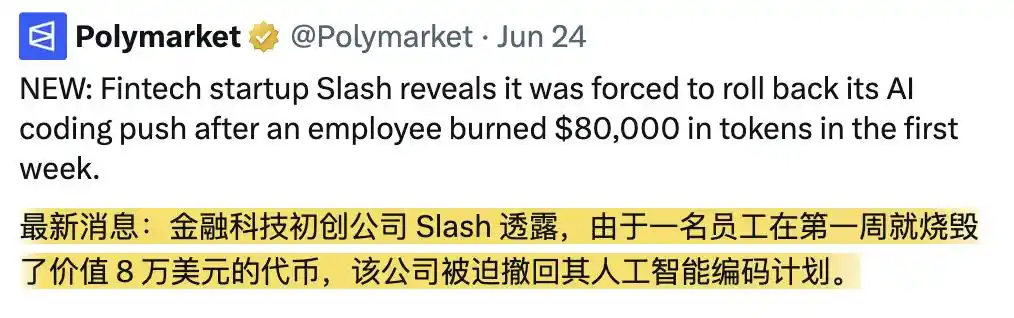
Thế giới này đúng là điên thật.

Loại họa này, người/công ty gây ra thực ra cũng không ít.

Tháng 12 năm ngoái, Uber giới thiệu cho toàn thể kỹ sư các công cụ lập trình AI như Claude Code, Cursor, khuyến khích Vibe Coding, kết quả 4 tháng đốt hết ngân sách cả năm.

Các công ty khác thực ra cũng dần nếm được mùi vị.

Ngày 1 tháng 7, nhà phân tích UBS viết trong một báo cáo: "Theo các cuộc đối thoại với hơn chục giám đốc IT doanh nghiệp trong vài tuần qua, 60% doanh nghiệp hiện nay đang bằng cách nào đó thông qua thiết lập một mức độ hàng rào để hạn chế chi tiêu AI."

Sắc thái chuyển biến gấp, sự cố lắc lư thân hình biến thành giai thoại

Lúc đó nhiều người xem kịch trong lòng chỉ có một vấn đề: Nicolas, rốt cuộc anh khi nào mới bị sa thải vậy? Online chờ rất nóng lòng.

Nicolas bên này không còn kế, có thể cứu vớt chút gì thì cứu vớt chút ấy vậy.

Slash chính thức trên X biểu thị, sự tình đã đến nước này, ball ball bạn mau mau đến chơi kiệt tác Vibe Coding của chúng tôi.

Tốt nhất để tài chính tin rằng, 8 vạn đô la này thuộc chi phí marketing.

Tuy nhiên, thông báo sa thải còn chưa chờ đến, trò chơi đã nổi trước.

Slash sau đó công bố bảng thành tích 48 giờ lên sóng của game.

  • Tổng cộng có 6912 người chơi vào game
  • Tích lũy thời gian chơi đạt 8986 giờ
  • Số người chơi trực tuyến cùng lúc cao nhất 437 người
  • Trung bình mỗi người chơi chơi khoảng 1.3 giờ

Đây đều không phải trọng điểm.

Trọng điểm là có 3 thương hiệu chủ động tìm đến hỏi hợp tác quảng cáo rồi!

Thái độ của bộ phận tài chính Slash lập tức xoay chuyển 180 độ.

Định nghĩa của trò chơi nhỏ này trong nội bộ công ty, cũng chính thức từ "expense incident", tức sự cố chi phí, nâng cấp thành "strategic initiative (dự án chiến lược)".

Bạn nói xem này ╮(╯▽╰)╭

Không ai chơi thì gọi là sự cố, có lưu lượng rồi thì bắt đầu nói giá trị chiến lược, nói nghe hay một chút, doanh nghiệp còn khá hiểu gọi là thuận theo thời thế.

Nicolas cũng lập tức hồi phục hùng phong, nói rằng 8 vạn đô la tuy đã không lấy lại được, nhưng game có thể tiếp tục lặp lại, cho đến khi nó thực sự đáng giá vài triệu đô la.

Nicolas và công ty bắt đầu vừa lặp lại game, vừa dùng cách tiếp quảng cáo nhỏ tích hợp sẵn để hồi... hồi huyết.

Những đối tác quảng cáo đầu tiên nhanh chóng xuất hiện lấp lánh.

Nhờ lưu lượng, Slash nhanh chóng đưa các công ty AI như Melius, Bland vào game.
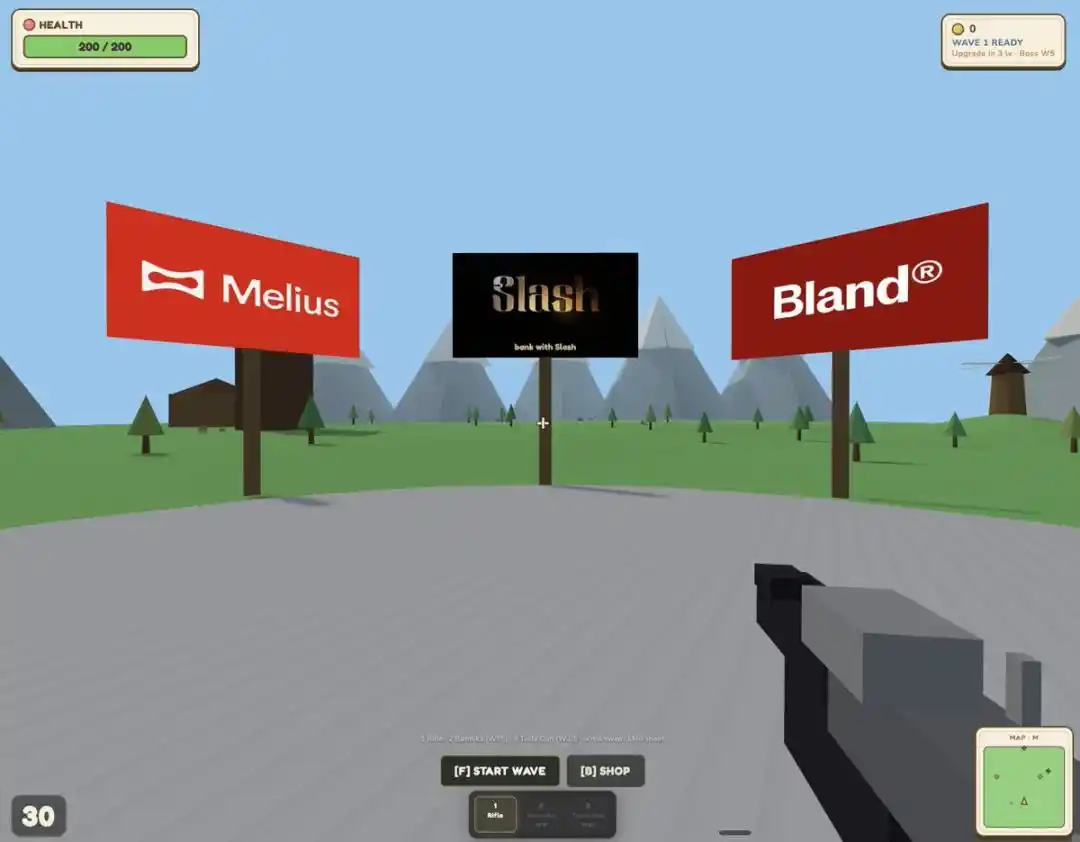
Một công ty dịch vụ tài chính doanh nghiệp, vì nhân viên dùng AI làm một trò chơi bắn súng não mục, bất ngờ sở hữu một vị trí quảng cáo truyền thông mới.

Kích thích không?

Chỉ cần lưu lượng đủ lớn, gây họa cũng có thể được đóng gói thành đổi mới.

Mang về 100 triệu đô la AUM

Người Trung Quốc đều biết, thầy trò Đường Tăng bốn người từ Đại Lôi Âm Tự lấy được chân kinh, câu chuyện Tây Du Ký vẫn chưa kết thúc.

Bởi vì họ quên hỏi Phật tổ lão quy Thông Thiên Hà mấy khi có thể tu luyện thành người, lão rùa tức giận, thân hình lắc lư một cái, đem thầy trò bốn người, ngựa trắng, kinh quyển toàn bộ lật xuống sông.

Chuyện của Nicolas này từ bi chuyển hỉ, thực ra đã có thể tính một HE rồi chứ?

Không, chuyện này vẫn chưa xong.

Không lâu sau, Nicolas lại lần nữa xuất hiện đăng bài, lần này càng lấp lánh hơn——

Còn nhớ mọi người trước đây chê cười tôi đốt mất 8 vạn đô la AI Credits không? Bây giờ, trò chơi nhỏ được làm ra thông qua Vibe Coding này, đã mang về cho Slash 100 triệu đô la AUM.

Theo anh ta biết, trước đây chưa có ai thông qua một trò chơi Vibe Coding mà đạt đến trình độ này.

AUM là viết tắt của Assets Under Management, thường dịch là quy mô tài sản quản lý, chỉ tổng lượng tiền khách hàng mà nền tảng quản lý.

Cũng tức là trò chơi não mục không mang về cho công ty bao nhiêu doanh thu trực tiếp, nhưng sau khi trò chơi nổi, có khoảng 100 triệu đô la tiền mới đã vào nền tảng của họ.

Slash không tiết lộ thêm tiền đến từ bao nhiêu khách hàng, chu kỳ thống kê dài bao lâu, cũng như cụ thể chứng minh thế nào những AUM mới này do trò chơi mang lại.

Do đó 100 triệu đô la này hiện vẫn thuộc dữ liệu tự báo của công ty và người trong cuộc, thiếu xác minh của bên thứ ba.

Tuy nhiên, dù không tính toàn bộ AUM mới vào đầu trò chơi, hiệu ứng lan truyền mà Brainrot Shooter mang lại cũng khá đáng kể.

Cảm khái thay, một công ty công nghệ tài chính vốn chủ yếu phục vụ khách hàng doanh nghiệp, lại nhờ một trò chơi nhỏ đồ họa thô sơ mà bước vào tầm mắt công chúng rộng rãi hơn.

Ban đầu, tôi muốn dùng "mất ở phía đông thu lại ở phía tây", hoặc "thất mã tri mã yên tri phi phúc" để biểu đạt cảm tưởng sau khi xem của tôi.

Qua vài ngày sau, Nicolas đắc ý cười một tiếng:

Đừng vội, còn có màn thứ hai.

One More Thing

Vốn tưởng bụi bặm đã định, ai ngờ sấm sét giữa đồng bằng.

Đợi đến khi câu chuyện "nhân viên tiêu 8 vạn đô la làm game, bất ngờ mang về cho công ty 100 triệu đô la AUM" truyền đi triệt để, Nicolas mới hé lộ đáp án cuối cùng.

Hóa đơn AI 81.267 đô la kia, là! GIẢ! MẠO!

Anh ta thừa nhận, số tiền trong ảnh chụp màn hình là dùng Inspect Element của trình duyệt sửa ra bằng tay.

Phiên bản đầu tiên của Brainrot Shooter thực tế chỉ tốn chi phí AI khoảng 80 đô la. Tiếp tục sửa Bug, thêm nội dung sau đó, chi phí tích lũy cũng không vượt quá 200 đô la.

Vụ hóa đơn token khủng khiếp khiến lòng người ăn dưa hấu "trời ơi sao lại như vậy - cười chết người này sắp bị sa thải rồi nhỉ - ừ công ty còn có chút nhân tính - wow cuối cùng lại kiếm được tiền kính phục kính phục" kia, từ đầu đến cuối chính là một trò lừa.

Wow, não trái tôi nói, vô ngôn thật sao lại là một chiêu marketing?

Não phải tôi nói, nói đạo lý, chiêu marketing này cũng khá thành công đấy chứ!

Bây giờ, hãy cho sự kiện "hóa đơn khủng Vibe Coding trò chơi nhỏ pixel não mục" này viết lại tóm tắt hoàn chỉnh:

Nicolas và công ty dùng chưa đến 200 đô la, Vibe Coding ra một trò chơi nhỏ não mục, sau đó lại thuận tay Vibe Marketing ra một tin tức toàn cầu.

Liên kết tham khảo:

[1]https://x.com/nickbruhman/status/2070558467010580877?s=20

[2]https://www.businessinsider.com/ubs-enterprises-ai-spending-tokens-2026-7?utm_source=chatgpt.com

[3]https://x.com/nickbruhman/status/2072703116667916307

Bài viết này đến từ tài khoản công chúng WeChat "Lượng Tử Vị", tác giả: Hành Vũ

Criptos en tendencia

Preguntas relacionadas

QCâu chuyện xoay quanh vấn đề gì và ai là nhân vật chính?

ACâu chuyện xoay quanh việc nhân viên Nicolas Brilliante (biệt danh 'Nicolas') của công ty dịch vụ tài chính Slash (Mỹ) được cho là đã 'vô tình' chi tiêu 81,267 đô la token AI (tương đương 55 triệu NDT) để phát triển một trò chơi nhỏ bằng Vibe Coding, nhưng sau đó sự việc bất ngờ chuyển biến thành một chiến dịch marketing thành công, đem về cho công ty 1 tỷ đô la AUM mới.

QTrò chơi 'Brainrot Shooter' được mô tả như thế nào và tại sao nó lại gây chú ý?

A'Brainrot Shooter' là một trò chơi bắn súng góc nhìn thứ nhất (FPS) với phong cách pixel đơn giản, tương tự 'Minecraft', nơi người chơi truy đuổi các nhân vật 'não mục' (brainrot) trên Internet. Ban đầu, nó thu hút sự chú ý vì được cho là có chi phí phát triển khổng lồ 81,267 đô la cho một sản phẩm có vẻ đơn giản, nhưng sau đó lại gây sốt vì thu hút được lượng người chơi đáng kể và mang về cơ hội hợp tác quảng cáo.

QSự kiện này đã biến chuyển từ một 'sự cố chi phí' thành 'dự án chiến lược' như thế nào?

ABan đầu, việc chi tiêu số token AI lớn được coi là một 'sự cố chi phí' (expense incident) nghiêm trọng. Tuy nhiên, sau khi trò chơi ra mắt và thu hút 6,912 người chơi với gần 9,000 giờ chơi chỉ trong 48 giờ, cùng với việc 3 thương hiệu chủ động đề nghị hợp tác quảng cáo, công ty Slash đã nhanh chóng thay đổi quan điểm. Họ tái định danh dự án thành một 'sáng kiến chiến lược' (strategic initiative), coi số tiền đã chi là chi phí marketing hiệu quả.

QKết quả cuối cùng được tuyên bố của chiến dịch này là gì và có điểm gì đáng chú ý?

ATheo tuyên bố của nhân vật chính Nicolas Brilliante, trò chơi 'Brainrot Shooter' cuối cùng đã mang về cho công ty Slash 1 tỷ đô la Tài sản được Quản lý mới (AUM - Assets Under Management), tương đương khoảng 7 tỷ NDT. Điều đáng chú ý nhất là toàn bộ câu chuyện 'hóa đơn token 81,267 đô la' thực ra là một phần của chiến dịch marketing, vì chi phí AI thực tế để phát triển trò chơi chỉ dưới 200 đô la.

QBài học hoặc thông điệp chính có thể rút ra từ câu chuyện này là gì?

ACâu chuyện này minh họa một cách sáng tạo về sức mạnh của marketing và việc tạo dựng câu chuyện truyền thông. Từ một 'sự cố' có vẻ tiêu cực (chi tiêu quá mức), công ty và nhân viên đã khéo léo xoay chuyển tình thế, biến nó thành một câu chuyện lan truyền (viral story) thu hút sự chú ý toàn cầu, từ đó quảng bá hình ảnh công ty, sản phẩm trò chơi và cuối cùng thu hút được khách hàng/dòng vốn mới. Nó cũng cho thấy hiệu quả bất ngờ của việc kết hợp các xu hướng như Vibe Coding với chiến lược truyền thông thông minh.

Lecturas Relacionadas

Reviewing 8 'Cash Cow' Projects in the Bear Market: The Leader Repurchased $283 Million Worth This Year

This article highlights eight cryptocurrency projects that have demonstrated strong cash-generating capabilities and implemented significant token buyback programs during the bear market of 2026. These projects, dubbed "cash cows," are repurchasing their own tokens, often reducing supply. According to data from Tokenomist, the projects with notable buyback activity from January 1st to June 30th are: Meteora (MET), Pump.fun (PUMP), GMX, Rollbit (RLB), Metaplex (MPLX), Hyperliquid (HYPE), Lighter (LIT), and Aave. Notably, MET's buybacks equaled 71% of its January token supply, while HYPE executed the largest buyback by value at $283 million. Key project summaries include: - **Hyperliquid (HYPE):** The leader by dollar value, its perpetual DEX protocol has repurchased and burned 44 million HYPE tokens (approx. 4.4% of supply) using a significant portion of trading fees, with total buybacks exceeding $1.1 billion since March 2025. - **Meteora (MET):** Its buyback of 336.2 million MET tokens had the greatest proportional impact on its circulating supply, equivalent to 71% of its supply at the start of the year. - **Pump.fun (PUMP):** The popular memecoin launchpad has cumulatively bought back over $400 million worth of PUMP since July 2025, using 50% of net revenue for buybacks and burns since April. - **Aave (AAVE):** Despite facing a major security incident earlier in the year, the lending protocol has continued its buyback program, repurchasing over 200,000 AAVE tokens. Its team is designing a new automated buyback mechanism. - **GMX, Lighter (LIT), Rollbit (RLB), and Metaplex (MPLX)** also have active buyback mechanisms funded by protocol fees or revenues. The article concludes that while token buybacks and burns do not guarantee price appreciation—as market conditions, news, and other factors play a role—these projects stand out for their ability to generate consistent cash flow in a challenging market environment.

marsbitHace 18 min(s)

Reviewing 8 'Cash Cow' Projects in the Bear Market: The Leader Repurchased $283 Million Worth This Year

marsbitHace 18 min(s)

Ethereum Sheds Its Load? What Ethereum Supporters Think About the Lean Ethereum Upgrade and the Future Market

Ethereum is back in focus with the announcement of the "Lean Ethereum" upgrade roadmap, described by Vitalik Buterin as Ethereum's third major update. This proposal aims to fundamentally redesign the consensus, data, and execution layers from first principles, striving to make Ethereum **simpler, more secure (quantum-resistant), more verifiable, and more scalable.** The announcement comes amidst a broader restructuring within the ecosystem, including a 20% staff reduction at the Ethereum Foundation and the emergence of new organizations like EthLabs. This has sparked a debate among Ethereum supporters ("E-bizens"). **Optimists** view Lean Ethereum as a critical refocusing on core protocol fundamentals: * **sassal.eth** calls it the ultimate bullish catalyst, envisioning a future where running a node is so lightweight it could be done on a smartwatch, greatly enhancing decentralization. * **Ryan Sean Adams** sees it as Ethereum moving from "narrative expansion" to "protocol hardening," addressing long-term foundational issues like security and scalability. * Analysts like **BITWU** and **蓝狐 (Blue Fox)** frame it as a third-phase evolution towards a "minimal, durable, and credible base layer" designed for the next decade. * **gigi发财猪** interprets the organizational changes as Ethereum "shedding old baggage and forming new teams" for a lighter, more agile approach. * **Xiyu** notes that the roadmap itself provides a much-needed new narrative for market sentiment recovery. **Cautious voices** acknowledge the vision but emphasize execution and market timing: * **Ignas** warns that while the roadmap addresses key community requests, it overlooks tokenomics, and competitors are gaining ground in areas like RWA. Timely delivery is crucial; delays could be bearish. * **Dankrad Feist**, a former Ethereum Foundation researcher, agrees on direction but criticizes the proposed 3-4 year timeline as too slow for the current market pace, especially with AI-aided development available. **In summary,** optimists believe Lean Ethereum reaffirms Ethereum's long-term value proposition as a decentralized world computer, while the cautious argue that its success hinges on faster delivery and tangible results to maintain market relevance. Despite ongoing criticism, the move signals Ethereum's effort to regroup and reclaim initiative at the protocol level.

marsbitHace 1 hora(s)

Ethereum Sheds Its Load? What Ethereum Supporters Think About the Lean Ethereum Upgrade and the Future Market

marsbitHace 1 hora(s)

AI Folding: Fable 5 and GPT-5.6 Are Becoming the Privilege of a Few

【AI Accessibility Gap Widens: Elite Tools Like Fable 5 and GPT-5.6 Are Becoming Privileged】 We are witnessing a growing "AI divide." A stark reality is emerging: a tiny fraction of elites, primarily in tech, are using powerful next-generation models like Fable 5 or the upcoming GPT-5.6, while the vast majority of the public only has access to "toys" - free, limited models equivalent to ChatGPT's basic versions (8B to 30B parameters). This creates a massive experiential chasm and cognitive dissonance. Industry outsiders see AI as overhyped and ineffective, unable to grasp its transformative potential, while insiders leverage these advanced models for a decisive competitive edge. The gap isn't just about model quality but product functionality. Free users get a simple chatbot. Paying elites get integrated workflow systems—capable of creating specialized agents, processing complex data, and handling real-world tasks like management, coding, and planning. Demos showcasing AI planning weddings or building apps feel disconnected from everyday needs like managing bills, groceries, or health. The cost barrier is immense, with reports of engineers spending $1000 daily on Fable 5 inference. Elite users employ sophisticated multi-model workflows, combining different AIs for ideation, architecture, execution, and review, completing complex projects in minutes instead of weeks. This divide extends to critical areas like healthcare, where free models are dangerously unreliable for medical queries. However, some argue that for 90% of common business tasks, mid-tier models like GPT-5.5 are sufficient; the perceived limitation often stems from poor integration and lack of context, not model intelligence. Ultimately, unequal access to cutting-edge AI is creating a new form of social stratification, where the most powerful tools are becoming the exclusive privilege of a few.

marsbitHace 1 hora(s)

AI Folding: Fable 5 and GPT-5.6 Are Becoming the Privilege of a Few

marsbitHace 1 hora(s)

Cathie Wood's June $77M Investment: Are Crypto Stocks a True 'Substitute' for Bitcoin?

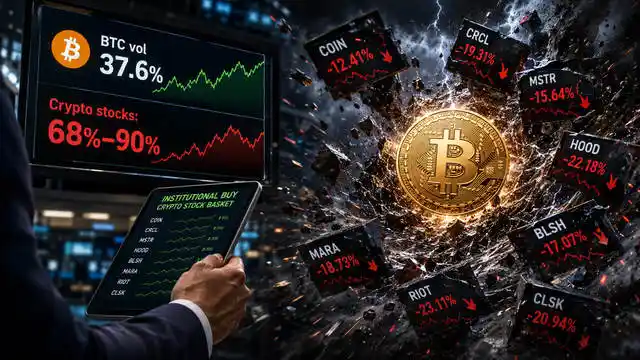
In June, Cathie Wood's ARK Invest purchased $77 million worth of publicly traded crypto-related stocks, including Coinbase, Circle, and Bullish, during Bitcoin's worst monthly performance in four years. This aligns with the investment thesis that such stocks offer a compliant way to gain exposure to the crypto cycle without directly holding Bitcoin. However, data analysis reveals significant drawbacks. A group of nine U.S.-listed crypto companies showed 30-day annualized realized volatility between 68% and 90%, nearly double Bitcoin's 37.6%. Over 90 days, Circle's volatility reached 103.6% versus Bitcoin's 37.8%. Drawdowns were also more severe for stocks like Circle (-51.4%) and MicroStrategy (-48.6%) compared to Bitcoin's -36.4% from its January high. Correlation analysis shows most stocks share only a moderate link to Bitcoin. For example, Circle, Robinhood, and Bullish have a 90-day correlation coefficient of just 0.55–0.58 with BTC, meaning only about one-third of their price movement is explained by Bitcoin's action. The rest stems from company-specific risks: earnings, competition, fundraising, and equity dilution. MicroStrategy (MSTR) is the notable exception, acting as a leveraged Bitcoin proxy with a beta of 1.59 and 0.85 correlation. Coinbase offers relatively balanced exposure. Circle exemplifies "crypto-wrapped" corporate risk, with its recent crash tied to stablecoin competition, not Bitcoin. Robinhood's diversified business insulates it from crypto downturns but also limits upside. Bitcoin miners like RIOT and MARA have posted significant gains year-to-date, driven primarily by their pivot to AI compute services, not Bitcoin's price. The article highlights that investing in crypto stocks often means accepting amplified volatility or layering on business-specific risks absent from direct Bitcoin ownership. For instance, MicroStrategy's recent challenges—its market value falling below its Bitcoin holdings (mNAV <1) and facing potential Bitcoin sales for liquidity—demonstrate equity-specific hazards like dilution and financing pressures not faced by a direct Bitcoin holder. ARK's buying spree represents a bet on a basket of different business models with varying crypto exposure, not a simple, lower-risk substitute for holding Bitcoin.

marsbitHace 1 hora(s)

Cathie Wood's June $77M Investment: Are Crypto Stocks a True 'Substitute' for Bitcoin?

marsbitHace 1 hora(s)

Trading

Spot

Artículos destacados

Qué es $S$

Entendiendo SPERO: Una Visión General Completa Introducción a SPERO A medida que el panorama de la innovación continúa evolucionando, la aparición de tecnologías web3 y proyectos de criptomonedas juega un papel fundamental en la configuración del futuro digital. Un proyecto que ha atraído la atención en este campo dinámico es SPERO, denotado como SPERO,$$s$. Este artículo tiene como objetivo reunir y presentar información detallada sobre SPERO, para ayudar a entusiastas e inversores a comprender sus fundamentos, objetivos e innovaciones dentro de los dominios web3 y cripto. ¿Qué es SPERO,$$s$? SPERO,$$s$ es un proyecto único dentro del espacio cripto que busca aprovechar los principios de descentralización y tecnología blockchain para crear un ecosistema que promueva la participación, la utilidad y la inclusión financiera. El proyecto está diseñado para facilitar interacciones de igual a igual de nuevas maneras, proporcionando a los usuarios soluciones y servicios financieros innovadores. En su esencia, SPERO,$$s$ tiene como objetivo empoderar a los individuos al proporcionar herramientas y plataformas que mejoren la experiencia del usuario en el espacio de las criptomonedas. Esto incluye habilitar métodos de transacción más flexibles, fomentar iniciativas impulsadas por la comunidad y crear caminos para oportunidades financieras a través de aplicaciones descentralizadas (dApps). La visión subyacente de SPERO,$$s$ gira en torno a la inclusividad, buscando cerrar brechas dentro de las finanzas tradicionales mientras aprovecha los beneficios de la tecnología blockchain. ¿Quién es el Creador de SPERO,$$s$? La identidad del creador de SPERO,$$s$ sigue siendo algo oscura, ya que hay recursos públicos limitados que proporcionan información de fondo detallada sobre su(s) fundador(es). Esta falta de transparencia puede derivarse del compromiso del proyecto con la descentralización, una ética que muchos proyectos web3 comparten, priorizando las contribuciones colectivas sobre el reconocimiento individual. Al centrar las discusiones en torno a la comunidad y sus objetivos colectivos, SPERO,$$s$ encarna la esencia del empoderamiento sin señalar a individuos específicos. Como tal, comprender la ética y la misión de SPERO sigue siendo más importante que identificar a un creador singular. ¿Quiénes son los Inversores de SPERO,$$s$? SPERO,$$s$ cuenta con el apoyo de una diversa gama de inversores que van desde capitalistas de riesgo hasta inversores ángeles dedicados a fomentar la innovación en el sector cripto. El enfoque de estos inversores generalmente se alinea con la misión de SPERO, priorizando proyectos que prometen avances tecnológicos sociales, inclusión financiera y gobernanza descentralizada. Estas fundaciones de inversores suelen estar interesadas en proyectos que no solo ofrecen productos innovadores, sino que también contribuyen positivamente a la comunidad blockchain y sus ecosistemas. El respaldo de estos inversores refuerza a SPERO,$$s$ como un contendiente notable en el dominio de proyectos cripto que evoluciona rápidamente. ¿Cómo Funciona SPERO,$$s$? SPERO,$$s$ emplea un marco multifacético que lo distingue de los proyectos de criptomonedas convencionales. Aquí hay algunas de las características clave que subrayan su singularidad e innovación: Gobernanza Descentralizada: SPERO,$$s$ integra modelos de gobernanza descentralizada, empoderando a los usuarios para participar activamente en los procesos de toma de decisiones sobre el futuro del proyecto. Este enfoque fomenta un sentido de propiedad y responsabilidad entre los miembros de la comunidad. Utilidad del Token: SPERO,$$s$ utiliza su propio token de criptomoneda, diseñado para servir diversas funciones dentro del ecosistema. Estos tokens permiten transacciones, recompensas y la facilitación de servicios ofrecidos en la plataforma, mejorando la participación y la utilidad general. Arquitectura en Capas: La arquitectura técnica de SPERO,$$s$ apoya la modularidad y escalabilidad, permitiendo la integración fluida de características y aplicaciones adicionales a medida que el proyecto evoluciona. Esta adaptabilidad es fundamental para mantener la relevancia en el cambiante paisaje cripto. Participación de la Comunidad: El proyecto enfatiza iniciativas impulsadas por la comunidad, empleando mecanismos que incentivan la colaboración y la retroalimentación. Al nutrir una comunidad sólida, SPERO,$$s$ puede abordar mejor las necesidades de los usuarios y adaptarse a las tendencias del mercado. Enfoque en la Inclusión: Al ofrecer tarifas de transacción bajas e interfaces amigables para el usuario, SPERO,$$s$ busca atraer a una base de usuarios diversa, incluyendo a individuos que anteriormente pueden no haber participado en el espacio cripto. Este compromiso con la inclusión se alinea con su misión general de empoderamiento a través de la accesibilidad. Cronología de SPERO,$$s$ Entender la historia de un proyecto proporciona información crucial sobre su trayectoria de desarrollo y hitos. A continuación se presenta una cronología sugerida que mapea eventos significativos en la evolución de SPERO,$$s$: Fase de Conceptualización e Ideación: Las ideas iniciales que forman la base de SPERO,$$s$ fueron concebidas, alineándose estrechamente con los principios de descentralización y enfoque comunitario dentro de la industria blockchain. Lanzamiento del Whitepaper del Proyecto: Tras la fase conceptual, se lanzó un whitepaper completo que detalla la visión, los objetivos y la infraestructura tecnológica de SPERO,$$s$ para generar interés y retroalimentación de la comunidad. Construcción de Comunidad y Primeras Interacciones: Se realizaron esfuerzos de divulgación activa para construir una comunidad de primeros adoptantes y posibles inversores, facilitando discusiones en torno a los objetivos del proyecto y obteniendo apoyo. Evento de Generación de Tokens: SPERO,$$s$ llevó a cabo un evento de generación de tokens (TGE) para distribuir sus tokens nativos a los primeros seguidores y establecer liquidez inicial dentro del ecosistema. Lanzamiento de la dApp Inicial: La primera aplicación descentralizada (dApp) asociada con SPERO,$$s$ se puso en marcha, permitiendo a los usuarios interactuar con las funcionalidades centrales de la plataforma. Desarrollo Continuo y Alianzas: Actualizaciones y mejoras continuas a las ofertas del proyecto, incluyendo alianzas estratégicas con otros actores en el espacio blockchain, han moldeado a SPERO,$$s$ en un jugador competitivo y en evolución en el mercado cripto. Conclusión SPERO,$$s$ se erige como un testimonio del potencial de web3 y las criptomonedas para revolucionar los sistemas financieros y empoderar a los individuos. Con un compromiso con la gobernanza descentralizada, la participación comunitaria y funcionalidades diseñadas de manera innovadora, allana el camino hacia un paisaje financiero más inclusivo. Como con cualquier inversión en el espacio cripto que evoluciona rápidamente, se anima a los posibles inversores y usuarios a investigar a fondo y participar de manera reflexiva con los desarrollos en curso dentro de SPERO,$$s$. El proyecto muestra el espíritu innovador de la industria cripto, invitando a una mayor exploración de sus innumerables posibilidades. Mientras el viaje de SPERO,$$s$ aún se desarrolla, sus principios fundamentales pueden, de hecho, influir en el futuro de cómo interactuamos con la tecnología, las finanzas y entre nosotros en ecosistemas digitales interconectados.

113 Vistas totalesPublicado en 2024.12.17Actualizado en 2024.12.17

Qué es $S$

Qué es AGENT S

Agent S: El Futuro de la Interacción Autónoma en Web3 Introducción En el paisaje en constante evolución de Web3 y las criptomonedas, las innovaciones están redefiniendo constantemente cómo los individuos interactúan con las plataformas digitales. Uno de estos proyectos pioneros, Agent S, promete revolucionar la interacción humano-computadora a través de su marco agente abierto. Al allanar el camino para interacciones autónomas, Agent S busca simplificar tareas complejas, ofreciendo aplicaciones transformadoras en inteligencia artificial (IA). Esta exploración detallada profundizará en las complejidades del proyecto, sus características únicas y las implicaciones para el dominio de las criptomonedas. ¿Qué es Agent S? Agent S se presenta como un marco agente abierto innovador, diseñado específicamente para abordar tres desafíos fundamentales en la automatización de tareas informáticas: Adquisición de Conocimiento Específico del Dominio: El marco aprende inteligentemente de diversas fuentes de conocimiento externas y experiencias internas. Este enfoque dual le permite construir un rico repositorio de conocimiento específico del dominio, mejorando su rendimiento en la ejecución de tareas. Planificación a Largo Plazo de Tareas: Agent S emplea planificación jerárquica aumentada por la experiencia, un enfoque estratégico que facilita la descomposición y ejecución eficiente de tareas complejas. Esta característica mejora significativamente su capacidad para gestionar múltiples subtareas de manera eficiente y efectiva. Manejo de Interfaces Dinámicas y No Uniformes: El proyecto introduce la Interfaz Agente-Computadora (ACI), una solución innovadora que mejora la interacción entre agentes y usuarios. Utilizando Modelos de Lenguaje Multimodal de Gran Escala (MLLMs), Agent S puede navegar y manipular diversas interfaces gráficas de usuario sin problemas. A través de estas características pioneras, Agent S proporciona un marco robusto que aborda las complejidades involucradas en la automatización de la interacción humana con las máquinas, preparando el terreno para una multitud de aplicaciones en IA y más allá. ¿Quién es el Creador de Agent S? Si bien el concepto de Agent S es fundamentalmente innovador, la información específica sobre su creador sigue siendo elusiva. El creador es actualmente desconocido, lo que resalta ya sea la etapa incipiente del proyecto o la elección estratégica de mantener a los miembros fundadores en el anonimato. Independientemente de la anonimidad, el enfoque sigue siendo en las capacidades y el potencial del marco. ¿Quiénes son los Inversores de Agent S? Dado que Agent S es relativamente nuevo en el ecosistema criptográfico, la información detallada sobre sus inversores y patrocinadores financieros no está documentada explícitamente. La falta de información disponible públicamente sobre las bases de inversión u organizaciones que apoyan el proyecto plantea preguntas sobre su estructura de financiamiento y hoja de ruta de desarrollo. Comprender el respaldo es crucial para evaluar la sostenibilidad del proyecto y su posible impacto en el mercado. ¿Cómo Funciona Agent S? En el núcleo de Agent S se encuentra una tecnología de vanguardia que le permite funcionar de manera efectiva en diversos entornos. Su modelo operativo se basa en varias características clave: Interacción Humano-Computadora Similar a la Humana: El marco ofrece planificación avanzada de IA, esforzándose por hacer que las interacciones con las computadoras sean más intuitivas. Al imitar el comportamiento humano en la ejecución de tareas, promete elevar las experiencias de los usuarios. Memoria Narrativa: Empleada para aprovechar experiencias de alto nivel, Agent S utiliza memoria narrativa para hacer un seguimiento de las historias de tareas, mejorando así sus procesos de toma de decisiones. Memoria Episódica: Esta característica proporciona a los usuarios una guía paso a paso, permitiendo que el marco ofrezca apoyo contextual a medida que se desarrollan las tareas. Soporte para OpenACI: Con la capacidad de ejecutarse localmente, Agent S permite a los usuarios mantener el control sobre sus interacciones y flujos de trabajo, alineándose con la ética descentralizada de Web3. Fácil Integración con APIs Externas: Su versatilidad y compatibilidad con varias plataformas de IA aseguran que Agent S pueda encajar sin problemas en ecosistemas tecnológicos existentes, convirtiéndolo en una opción atractiva para desarrolladores y organizaciones. Estas funcionalidades contribuyen colectivamente a la posición única de Agent S dentro del espacio cripto, ya que automatiza tareas complejas y de múltiples pasos con una intervención humana mínima. A medida que el proyecto evoluciona, sus posibles aplicaciones en Web3 podrían redefinir cómo se desarrollan las interacciones digitales. Cronología de Agent S El desarrollo y los hitos de Agent S pueden encapsularse en una cronología que resalta sus eventos significativos: 27 de septiembre de 2024: El concepto de Agent S fue lanzado en un documento de investigación integral titulado “Un Marco Agente Abierto que Usa Computadoras Como un Humano”, mostrando las bases del proyecto. 10 de octubre de 2024: El documento de investigación fue puesto a disposición del público en arXiv, ofreciendo una exploración profunda del marco y su evaluación de rendimiento basada en el benchmark OSWorld. 12 de octubre de 2024: Se lanzó una presentación en video, proporcionando una visión visual de las capacidades y características de Agent S, involucrando aún más a posibles usuarios e inversores. Estos marcadores en la cronología no solo ilustran el progreso de Agent S, sino que también indican su compromiso con la transparencia y la participación comunitaria. Puntos Clave Sobre Agent S A medida que el marco Agent S continúa evolucionando, varios atributos clave destacan, subrayando su naturaleza innovadora y potencial: Marco Innovador: Diseñado para proporcionar un uso intuitivo de las computadoras similar a la interacción humana, Agent S aporta un enfoque novedoso a la automatización de tareas. Interacción Autónoma: La capacidad de interactuar de manera autónoma con las computadoras a través de GUI significa un salto hacia soluciones informáticas más inteligentes y eficientes. Automatización de Tareas Complejas: Con su metodología robusta, puede automatizar tareas complejas y de múltiples pasos, haciendo que los procesos sean más rápidos y menos propensos a errores. Mejora Continua: Los mecanismos de aprendizaje permiten a Agent S mejorar a partir de experiencias pasadas, mejorando continuamente su rendimiento y eficacia. Versatilidad: Su adaptabilidad en diferentes entornos operativos como OSWorld y WindowsAgentArena asegura que pueda servir a una amplia gama de aplicaciones. A medida que Agent S se posiciona en el paisaje de Web3 y criptomonedas, su potencial para mejorar las capacidades de interacción y automatizar procesos significa un avance significativo en las tecnologías de IA. A través de su marco innovador, Agent S ejemplifica el futuro de las interacciones digitales, prometiendo una experiencia más fluida y eficiente para los usuarios en diversas industrias. Conclusión Agent S representa un audaz avance en la unión de la IA y Web3, con la capacidad de redefinir cómo interactuamos con la tecnología. Aunque aún se encuentra en sus primeras etapas, las posibilidades para su aplicación son vastas y atractivas. A través de su marco integral que aborda desafíos críticos, Agent S busca llevar las interacciones autónomas al primer plano de la experiencia digital. A medida que nos adentramos más en los reinos de las criptomonedas y la descentralización, proyectos como Agent S sin duda desempeñarán un papel crucial en la configuración del futuro de la tecnología y la colaboración humano-computadora.

517 Vistas totalesPublicado en 2025.01.14Actualizado en 2025.01.14

Qué es AGENT S

Cómo comprar S

¡Bienvenido a HTX.com! Hemos hecho que comprar Sonic (S) sea simple y conveniente. Sigue nuestra guía paso a paso para iniciar tu viaje de criptos.Paso 1: crea tu cuenta HTXUtiliza tu correo electrónico o número de teléfono para registrarte y obtener una cuenta gratuita en HTX. Experimenta un proceso de registro sin complicaciones y desbloquea todas las funciones.Obtener mi cuentaPaso 2: ve a Comprar cripto y elige tu método de pagoTarjeta de crédito/débito: usa tu Visa o Mastercard para comprar Sonic (S) al instante.Saldo: utiliza fondos del saldo de tu cuenta HTX para tradear sin problemas.Terceros: hemos agregado métodos de pago populares como Google Pay y Apple Pay para mejorar la comodidad.P2P: tradear directamente con otros usuarios en HTX.Over-the-Counter (OTC): ofrecemos servicios personalizados y tipos de cambio competitivos para los traders.Paso 3: guarda tu Sonic (S)Después de comprar tu Sonic (S), guárdalo en tu cuenta HTX. Alternativamente, puedes enviarlo a otro lugar mediante transferencia blockchain o utilizarlo para tradear otras criptomonedas.Paso 4: tradear Sonic (S)Tradear fácilmente con Sonic (S) en HTX's mercado spot. Simplemente accede a tu cuenta, selecciona tu par de trading, ejecuta tus trades y monitorea en tiempo real. Ofrecemos una experiencia fácil de usar tanto para principiantes como para traders experimentados.

1.1k Vistas totalesPublicado en 2025.01.15Actualizado en 2026.06.02

Cómo comprar S

Discusiones

Bienvenido a la comunidad de HTX. Aquí puedes mantenerte informado sobre los últimos desarrollos de la plataforma y acceder a análisis profesionales del mercado. A continuación se presentan las opiniones de los usuarios sobre el precio de S (S).

活动图片