Is XRP’s $1 price zone a bear trap? Here’s what the data suggests

ambcryptoPublicado a 2026-07-05Actualizado a 2026-07-05

Resumen

Discussion of a new altcoin cycle is building. This week, Ethereum outperformed Bitcoin, signaling growing altcoin momentum. Ripple (XRP) surged nearly 9%, briefly reclaiming $1.18, its highest level since mid-June, indicating strong capital rotation into higher-beta altcoins. A whale opened a $16 million long position around $1.10, already showing significant profit. While parabolic long leverage near the $1 supply zone raises the risk of a volatility-induced pullback, sustained institutional demand provides a counter-narrative. U.S. spot XRP ETFs have seen nine consecutive weeks of net inflows, totaling $17.19 million this week, contrasting with outflows from Ethereum ETFs. This suggests XRP's consolidation around $1 may be a potential bear trap, with institutional backing and bullish positioning supporting further upside.

Talk of a new altcoin cycle is starting to pick up again.

Based on how this week has played out, that narrative is beginning to gain traction. On the weekly timeframe, while Bitcoin [BTC] is up more than 5%, Ethereum [ETH] has attracted 2x the capital inflows, pushing the ETH/BTC ratio up nearly 7%. More importantly, this marks the ratio’s strongest weekly gain since August 2025, reinforcing the idea that “altcoin-led” momentum is starting to build across the market.

Ripple hasn’t been left behind. As the chart below shows, the token is up nearly 9% this week, with its highest wick reaching $1.18, a level it hadn’t reclaimed since losing it in mid-June. That move points to strong buying interest as capital continues rotating into higher-beta altcoins.
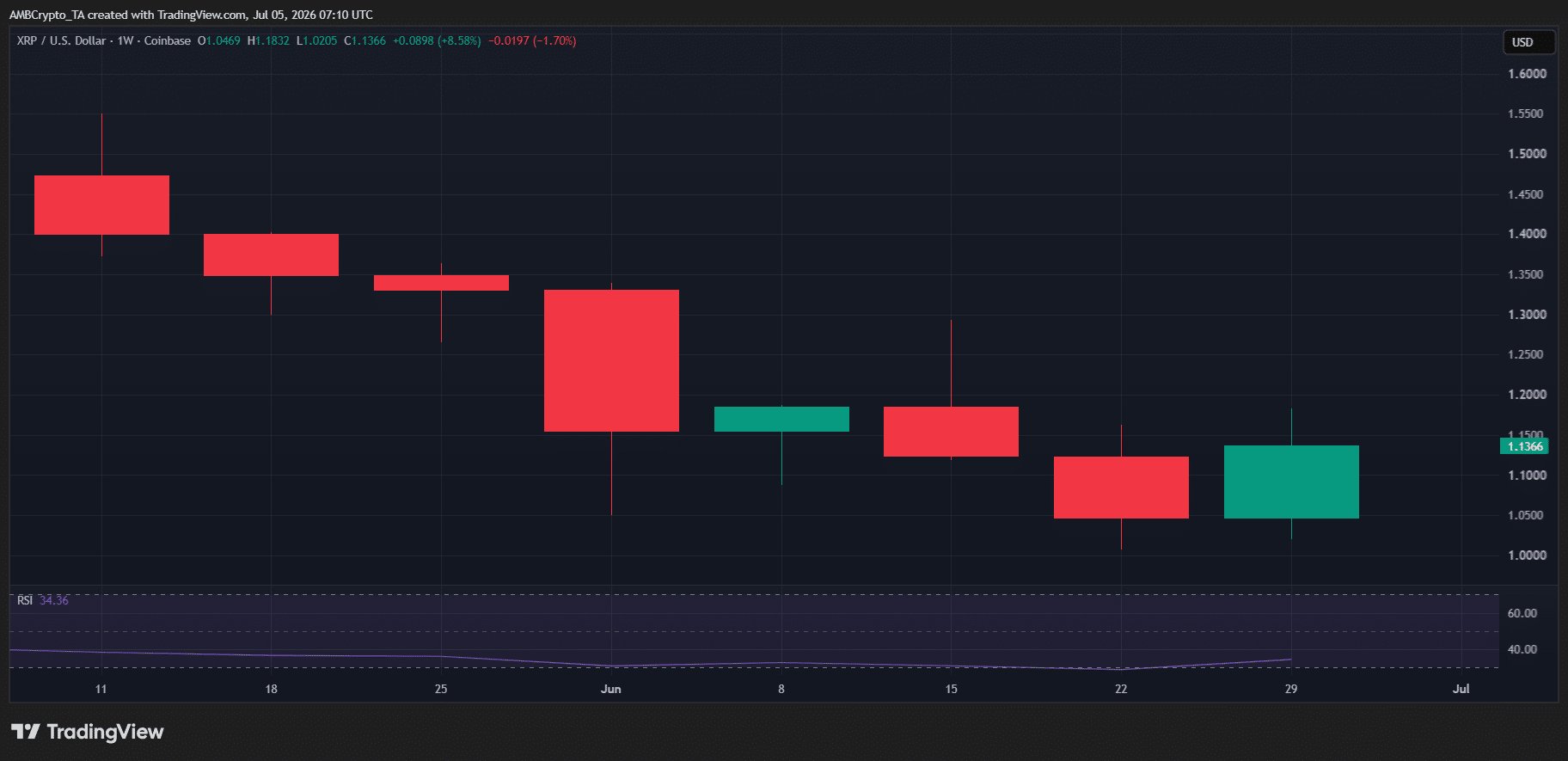
Source: TradingView (XRP/USDT)

Backing this up, the XRP/USDT ratio has also climbed more than 3% this week.

Against this backdrop, leaning long on XRP isn’t a stretch. In fact, an analyst recently flagged a whale opening a $16 million XRP long at an average entry of $1.10. At the time of writing, the position was already sitting on roughly $477,000 in unrealized profit.

With altcoin momentum continuing to build, this doesn’t look like a random high-leverage bet. If anything, it signals growing conviction that XRP still has room to move higher as capital continues rotating into altcoins. That naturally raises the question: Is XRP’s current setup quietly turning into a textbook bear trap?

XRP’s leverage spike puts the $1 level under the spotlight

Long positioning in XRP is starting to go parabolic.

Normally, when leverage gets this crowded on the long side, the risk of a volatility event increases. Even a modest shift in sentiment can trigger a wave of long liquidations, especially with XRP still trading around the $1 supply zone. In that scenario, the ongoing altcoin rally alone may not be enough to keep the uptrend intact.

That’s why the case for a near-term pullback is gaining traction, with liquidity continuing to stack up around the $1 level. But institutional positioning paints a different picture, suggesting XRP’s latest move isn’t just riding the broader market’s altcoin momentum.
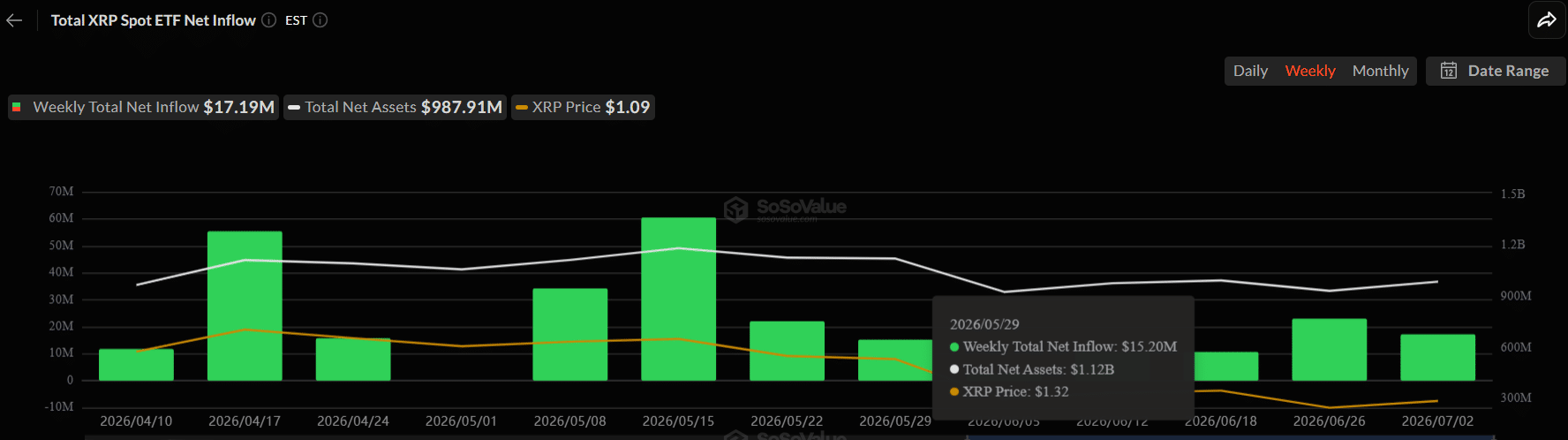
Source: SoSoValue

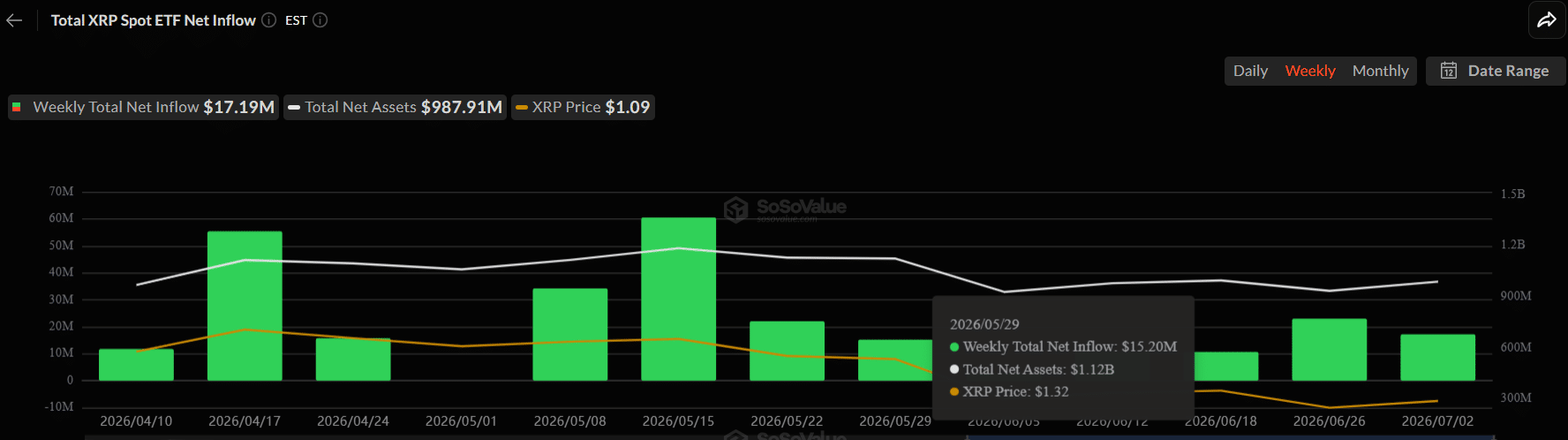
As the chart above shows, it’s been another strong week for spot XRP ETFs.

According to SoSoValue, U.S. spot Ripple ETFs recorded $17.19 million in inflows over the period. This came despite two days of net outflows during the week, showing demand remained resilient. More notably, the ETFs have now logged nine consecutive weeks of net inflows, pointing to “sustained” institutional interest.

By contrast, Ethereum ETFs have posted consecutive net outflows over the same period. This divergence could set XRP apart from other altcoins. In simple terms, while ETH is leading short-term gains, it still looks driven by capital rotation.

XRP, on the other hand, is showing stronger longer-term momentum, making its consolidation around $1 look more like a potential bear trap, with long positioning adding to the bullish pressure.


Final Summary

  • Altcoins are gaining momentum, with ETH and XRP both seeing strong weekly inflows and price gains.
  • Even with heavy long leverage near $1, steady XRP ETF inflows suggest demand is still strong and a bear trap is possible.


Criptos en tendencia

Preguntas relacionadas

QWhat is the main narrative gaining traction in the cryptocurrency market according to the article?

AThe main narrative is the start of a new altcoin cycle, evidenced by stronger capital inflows into altcoins like Ethereum and XRP compared to Bitcoin.

QHow has the XRP/USDT ratio performed this week, and what does it indicate?

AThe XRP/USDT ratio has climbed more than 3% this week, indicating strong buying interest and capital rotation into higher-beta altcoins like XRP.

QWhat significant event did an analyst highlight regarding XRP's price action, and what was the outcome?

AAn analyst highlighted a whale opening a $16 million XRP long position at an average entry of $1.10. At the time of writing, the position had roughly $477,000 in unrealized profit.

QWhat risk does the article associate with the parabolic increase in long positioning for XRP?

AThe article states that when leverage gets this crowded on the long side, the risk of a volatility event increases. A modest shift in sentiment could trigger a wave of long liquidations, especially around the $1 supply zone.

QHow do XRP ETF flows contrast with Ethereum ETF flows, and what does this suggest for XRP's momentum?

AU.S. spot XRP ETFs recorded $17.19 million in net inflows over the week, marking nine consecutive weeks of net inflows. In contrast, Ethereum ETFs posted consecutive net outflows. This suggests XRP has stronger, more sustained institutional demand and longer-term momentum, making its consolidation around $1 look more like a potential bear trap.

Lecturas Relacionadas

A Decade of Change: The Demise of Crypto Startups

"The Decade-Long Transformation: The Demise of Crypto Startups" The article traces the dramatic evolution of the cryptocurrency industry from its anarchic beginnings to its current highly regulated and institutionalized state. In the early days (circa 2017), launching a crypto startup was remarkably simple: a whitepaper, a GitHub repository, and a Telegram group could attract thousands of retail investors via an Initial Coin Offering (ICO). Founders operated anonymously with near-zero regulatory and financial barriers, enabling rapid, global innovation but also widespread fraud. By 2026, the landscape is fundamentally different. To operate in major markets like the US, EU, and Asia, crypto businesses must now navigate a complex web of regulations akin to traditional finance. Compliance costs are prohibitive: estimates for a US multi-state operation range from $750,000 to $1.2 million in the first three years, with annual costs exceeding $2 million thereafter. Regulations like MiCA in the EU and New York's BitLicense have created high capital and operational hurdles that act as barriers to entry. Simultaneously, venture capital investment has shifted dramatically. Following the collapses of Terra and FTX, funding has concentrated in later-stage, established companies, creating a "barbell market." Early-stage and seed funding has shrunk significantly, while mega-funds like Andreessen Horowitz's $15 billion pool dominate. Most capital now flows to trading platforms, lending infrastructure, and B2B services. This environment favors mergers and acquisitions as the primary path for growth. Companies like Coinbase and Ripple are acquiring firms like Deribit and Hidden Road not for their technology, but for their licenses, banking relationships, and institutional trust—assets far more valuable than code. Distribution channels, compliance, and brand reputation have become the new moats, overshadowing pure technical innovation. The industry's maturation brings benefits: reduced scams, increased institutional participation, and clearer regulatory frameworks. However, it comes at a cost. The low-barrier, experimental ethos that defined crypto's first decade is fading. Entrepreneurs without substantial capital, pre-existing licenses, or institutional connections face immense challenges. Funding for exploratory fields like decentralized social media or novel governance models is drying up. Ultimately, the crypto industry is replicating the consolidation pattern seen in banking and tech after the 2008 financial crisis. While this brings stability and legitimacy, it raises a critical question: in this new, resource-intensive reality, is there still room for the disruptive, from-scratch innovation that gave birth to the sector?

Foresight NewsHace 58 min(s)

A Decade of Change: The Demise of Crypto Startups

Foresight NewsHace 58 min(s)

Trading

Spot

Artículos destacados

Cómo comprar DATA

¡Bienvenido a HTX.com! Hemos hecho que comprar DATA Network (DATA) sea simple y conveniente. Sigue nuestra guía paso a paso para iniciar tu viaje de criptos.Paso 1: crea tu cuenta HTXUtiliza tu correo electrónico o número de teléfono para registrarte y obtener una cuenta gratuita en HTX. Experimenta un proceso de registro sin complicaciones y desbloquea todas las funciones.Obtener mi cuentaPaso 2: ve a Comprar cripto y elige tu método de pagoTarjeta de crédito/débito: usa tu Visa o Mastercard para comprar DATA Network (DATA) al instante.Saldo: utiliza fondos del saldo de tu cuenta HTX para tradear sin problemas.Terceros: hemos agregado métodos de pago populares como Google Pay y Apple Pay para mejorar la comodidad.P2P: tradear directamente con otros usuarios en HTX.Over-the-Counter (OTC): ofrecemos servicios personalizados y tipos de cambio competitivos para los traders.Paso 3: guarda tu DATA Network (DATA)Después de comprar tu DATA Network (DATA), guárdalo en tu cuenta HTX. Alternativamente, puedes enviarlo a otro lugar mediante transferencia blockchain o utilizarlo para tradear otras criptomonedas.Paso 4: tradear DATA Network (DATA)Tradear fácilmente con DATA Network (DATA) en HTX's mercado spot. Simplemente accede a tu cuenta, selecciona tu par de trading, ejecuta tus trades y monitorea en tiempo real. Ofrecemos una experiencia fácil de usar tanto para principiantes como para traders experimentados.

8 Vistas totalesPublicado en 2026.07.01Actualizado en 2026.07.01

Cómo comprar DATA

Discusiones

Bienvenido a la comunidad de HTX. Aquí puedes mantenerte informado sobre los últimos desarrollos de la plataforma y acceder a análisis profesionales del mercado. A continuación se presentan las opiniones de los usuarios sobre el precio de DATA (DATA).

活动图片