CBRS First Post-IPO Earnings Report: Revenue Doubles but Gross Margin Guidance Plummets, OpenAI's Massive Order Faces a Long Road to Realization

marsbitPublicado a 2026-06-24Actualizado a 2026-06-24

Resumen

Cerebras Systems (CBRS) released its first quarterly report since going public. Q1 core revenue of $191.3M beat expectations, surging 92% YoY, with full-year revenue guidance raised to $855-$865M. However, the company's Q2 gross margin guidance of 36%-38% represents a sharp drop from Q1's 47%, sending shares down over 10% after-hours. Management attributed the margin pressure to temporary costs from leasing back hardware to deploy capacity for OpenAI, highlighting a business model shift from selling chips to selling compute power. While growth is strong, key investor debates center on valuation, customer concentration, and long-term contracts. Revenue remains heavily concentrated (86% from two UAE-linked entities in FY25), though major deals with OpenAI (a $20B+ contract) and AWS provide a long-term growth narrative. Analysts are broadly bullish, citing Cerebras's unique wafer-scale chip architecture as a potential advantage in the AI inference market. However, skeptics point to the narrow moat of its speed advantage, uncertainties around margin recovery amid its business transition, and a high valuation (~50x forward sales) that prices in the flawless execution of its large, long-dated contracts.

Author: David, Chaoxiang Research

Chaoxiang Guide: Cerebras (CBRS) delivered its first quarterly report since the IPO. Q1 core revenue was $191 million, a 92% year-over-year increase, exceeding market expectations. However, Q2 core gross margin guidance dropped sharply from 46.5% to 36%-38%, causing the stock price to fall over 10% after-hours. This company, which makes chips from an entire wafer and bets on the AI inference track, holds OpenAI contracts worth over $20 billion and an AWS cooperation framework. Full-year revenue guidance is $855-$865 million. The growth data is solid, but the valuation debate is equally significant.

Key Points of Focus

  1. Revenue beats expectations, guidance beats even more. Q1 core revenue was $191.3 million (up 92% YoY), higher than the consensus estimate of approximately $181 million. Full-year core revenue guidance of $855-$865 million (up 69% YoY) exceeds the market expectation of $828 million. On a GAAP basis, cloud and services revenue reached $82.8 million, a 178% YoY increase, making it the fastest-growing segment.
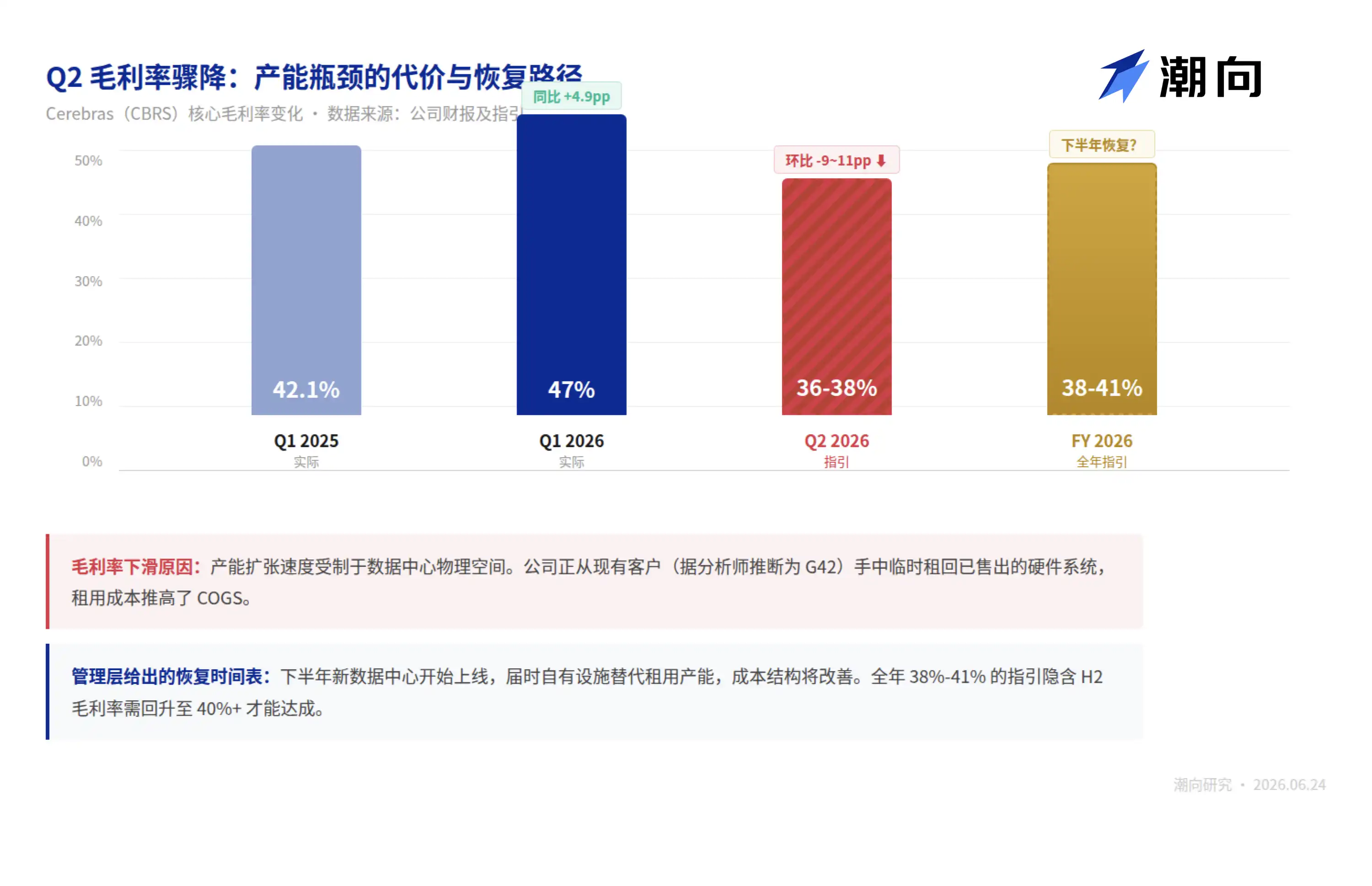
  2. The sharp drop in gross margin guidance is the biggest negative this quarter. Q1 core gross margin was 47%, up nearly 5 percentage points YoY. However, Q2 guidance fell to 36%-38%, a drop of about 10 percentage points from Q1; full-year guidance is 38%-41%. Management attributed this to insufficient data center capacity: the company is temporarily leasing back systems from existing customers who have already purchased the hardware to deploy capacity, worsening short-term costs. After-hours stock price fell over 10%.
  3. Customer concentration shows signs of improvement but is far from resolved. 86% of FY2025 revenue came from two UAE-related entities (MBZUAI accounted for 62%, G42 for 24%). OpenAI will start contributing revenue in February 2026, and the AWS cooperation is expected to reflect financially only in 2027. Genuine revenue diversification will not be verifiable until 2027.
  4. Valuation pricing extends to 2028. Based on the after-hours price of about $200, CBRS trades at about 90x trailing twelve-month revenue; even using the full-year guidance midpoint of $860 million, the forward P/S is still above 50x. The median price target from 10 covering analysts is $300 (range $250-$340), which implicitly assumes the OpenAI contract worth over $20 billion and AWS deployments are fulfilled on schedule and volume.
  5. Short-term catalysts and headwinds coexist. Catalysts: Accelerated deployment of OpenAI's 750MW computing power, AWS inference solution rollout, new data center capacity coming online in the second half. Headwinds: Lock-up period contains unconventional early release clauses (triggered if market cap exceeds $40 billion, current market cap is near that threshold), unclear path to gross margin recovery, OpenAI itself is not yet profitable and has already scaled back some computing power commitments.

Earnings Reveal Business Model Shift: From Selling Chips to Selling Computing Power

The most easily overlooked detail in the Q1 report is the change in revenue mix.

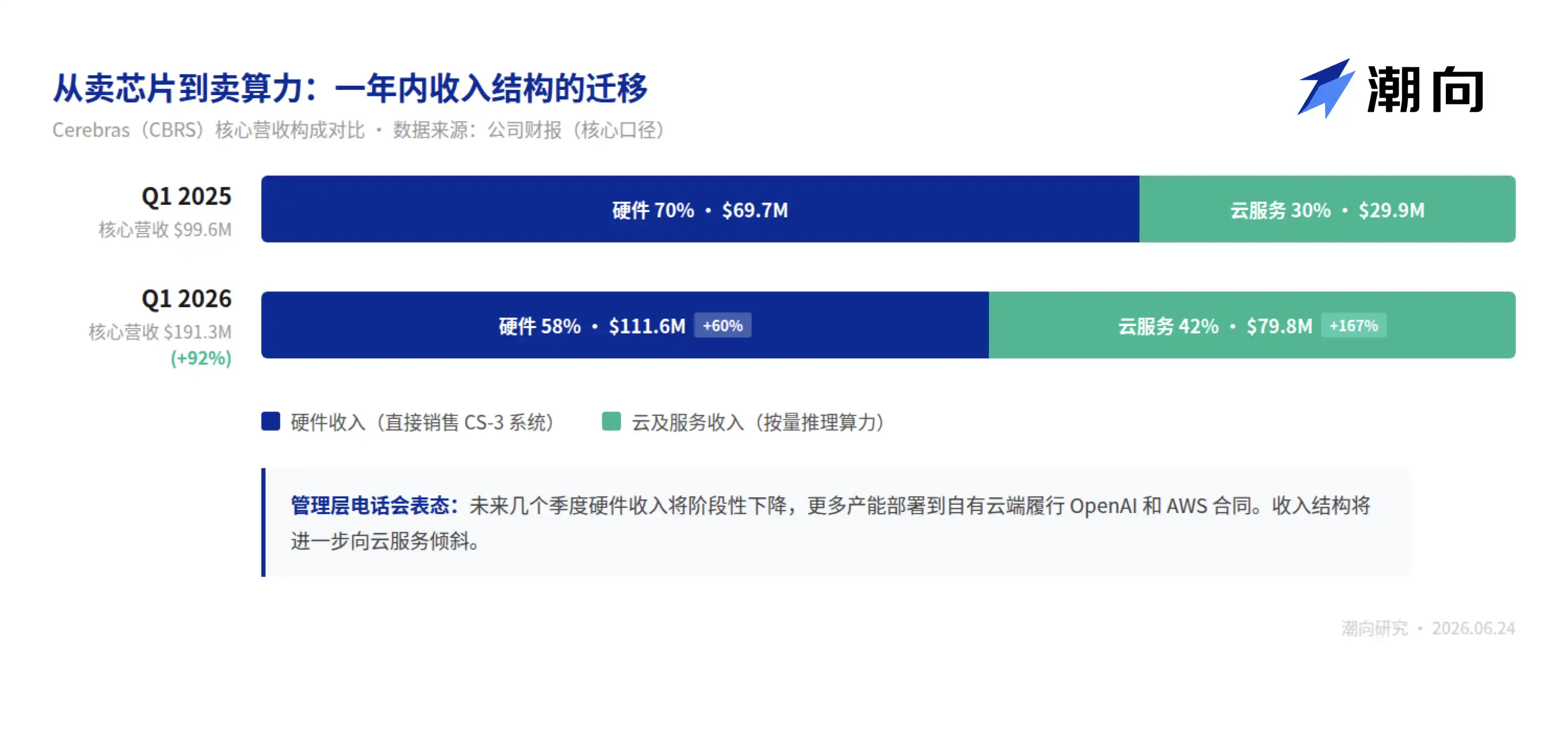
Under the core metric, hardware revenue was $111.6 million, accounting for 58% of total revenue; cloud and services revenue was $79.8 million, accounting for 42%. A year ago, this ratio was roughly 70:30. Cloud services revenue grew 167% YoY, nearly three times the growth rate of hardware.

Management made this trend clearer on the earnings call:

Hardware revenue will decline sequentially in the coming quarters because the company will deploy more hardware capacity into its own cloud to fulfill OpenAI's and AWS's inference computing power contracts, rather than selling directly to customers. Cerebras is shifting from a "chip-selling company" to a "computing power-selling company."

This transformation directly explains the sharp drop in Q2 gross margin guidance.
An analyst pressed for details on capacity deployment during the call. Management revealed:

The company's current bottleneck is not chip supply from TSMC, but the physical space in data centers. To deliver computing power to OpenAI as soon as possible, Cerebras is "temporarily leasing back" hardware systems already sold to G42 (its previous largest customer and a minority equity investor).

Deploying its own systems in leased third-party facilities worsens the cost structure in the short term, which is the main reason for the gross margin guidance drop from 47% to 36%-38%. Management's timeline indicates new data centers will start coming online in the second half of the year, easing cost pressures at that time.

The financial structure of the OpenAI contract is also worth unpacking. On the surface, it's a multi-year computing power purchase worth over $20 billion, but underneath, three relationships are layered: OpenAI provided Cerebras with a $1 billion operating capital loan (reflected on the Q1 balance sheet as $621 million in current loans and $362 million in non-current loans), while also receiving warrants for Cerebras stock.

In other words, OpenAI simultaneously plays the roles of largest customer, creditor, and potential shareholder for Cerebras. Risk disclosures in the S-1 indicate that if Cerebras fails to deliver capacity as agreed, OpenAI has the right to terminate the contract and trigger loan repayment.
The cooperation framework with AWS adopts a "split inference" architecture: AWS's Trainium 3 chip handles prompt input (prefill stage), while Cerebras's CS-3 system is dedicated to high-speed output generation (decode stage). This design allows Cerebras to handle only the part of the inference pipeline where its speed advantage is greatest. However, management declined to disclose the specific scale of the AWS cooperation during the Q&A and stated that revenue contribution would only appear on the financials in 2027.

The common feature of these two large contracts is: Contract sizes are massive, but realization paths are long, and heavily dependent on Cerebras's data center construction progress.

Full-year revenue guidance of $855-$865 million implies the next three quarters need to average around $220 million each, with sequential acceleration in growth. Management's statement is "year-over-year growth will increase each quarter in 2026, with more revenue concentrated in the second half."

The Bull Case: Nine Banks Initiate Coverage with Buy Ratings, What Are They Buying?

On June 8, the day the IPO quiet period ended, nine underwriting banks simultaneously initiated coverage, all issuing Buy or Outperform ratings. CBRS stock rose 18.3% that day. This kind of coordinated bullishness is not uncommon for US IPOs (underwriters have inherent interests), but their investment theses point to the same core proposition.

Thesis One: The battlefield for AI computing power is shifting from training to inference, and the rules of competition in inference differ from training.

Morgan Stanley analyst Joseph Moore issued an Overweight rating with a $250 price target in his June 8 initiation report. His core argument is: The training scenario competes on total computing throughput, where NVIDIA GPU clusters dominate absolutely; the inference scenario competes on the speed and latency of single responses, as models must process millions of user requests per second, and speed directly impacts service cost and user experience. Cerebras's wafer-scale chips, with their on-chip SRAM capacity far exceeding conventional GPUs (data doesn't need frequent movement to external memory), possess a structural advantage in inference latency. Moore's statement is that Cerebras is "the only company that has commercially deployed wafer-scale processors," giving it a first-mover advantage over NVIDIA.

Citi analyst Atif Malik gave the highest price target among coverages at $340. Mizuho added a technical detail in its June 8 report: The WSE-3 chip has 44GB of built-in SRAM, several times that of Google's latest TPU and Groq's LPU, a hardware gap that cannot be closed through architectural optimization in the short term.

Thesis Two: Two major contracts advance Cerebras from a "technology story" to a "revenue story."

The OpenAI contract exceeds $20 billion, covering 750MW of inference computing power, to be delivered over multiple years. Amortized over five years, this contract alone would contribute approximately $4 billion in annual revenue, nearly 5 times the midpoint of the 2026 full-year revenue guidance. Although management refused to disclose the specific amount for the AWS cooperation, the framework is confirmed: Cerebras's inference capabilities will be offered globally to enterprise customers through Amazon Bedrock.

Q1 earnings data provided early validation. OpenAI began deploying Cerebras systems in February, and cloud service revenue jumped from less than $30 million YoY to nearly $80 million in one quarter. Management's statement is "year-over-year growth will increase each quarter in 2026, with more revenue concentrated in the second half." The full-year guidance of $855-$865 million exceeds the consensus estimate of $828 million.

Thesis Three: The density of coverage right after the quiet period is itself a signal.

The median price target from 10 analysts is $300, with a low of $250 (Morgan Stanley) and a high of $340 (Citi). Based on the after-hours price of $200, the median target implies about 50% upside. Wedbush ($270 target), Needham ($300), Barclays ($280), TD Cowen ($275), and Craig-Hallum (Buy) all initiated coverage in the same week.

The underlying assumption of the bull case can be summed up in one sentence:

If AI inference becomes a larger computing power market than training (multiple institutions predict inference spending will surpass training by 2027), and Cerebras's speed advantage is real and sustainable, then it only needs to capture 3%-5% of the market where NVIDIA holds an 80%+ share to justify its current valuation.

The Bear Case: Gross Margin, Customer Concentration, and the Fragility of a $45 Billion Valuation

For each of the bull's three theses, the bears have counterarguments.

Counterargument One: The moat from inference speed advantage may be narrower than imagined.

Cerebras's speed advantage is built on on-chip SRAM capacity, but NVIDIA is not standing still. The B300 chip released by NVIDIA in March significantly increased HBM bandwidth, and Groq's LPU architecture is also iterating rapidly on the inference front.

Viewed from another angle: Cerebras's customers are currently highly concentrated in just OpenAI and AWS. OpenAI is also one of NVIDIA's largest GPU purchasing clients, and AWS's in-house Trainium chip is covering more and more inference scenarios. Cerebras's major customers are simultaneously betting on alternatives, meaning its speed premium will face continuous price negotiation pressure.

Counterargument Two: The gross margin decline might not be just "temporary."

Management attributed the Q2 gross margin drop from 47% to 36%-38% to temporary leasing costs due to insufficient data center capacity. But this explanation assumes "costs will improve when new data centers come online in the second half."

Considering that revenue scale is expected to jump in the second half (management explicitly stated revenue is back-end loaded), and new data center capacity ramp-up itself requires time and capital investment, this recovery path is not easy.

A deeper issue is the impact of the business model shift itself on gross margin. Cerebras's shift from selling hardware to selling cloud computing power means taking on data center construction, operation, and depreciation costs. As depreciation expenses for self-built data centers are accounted for, uncertainty remains over whether cloud service gross margins can stay above 50%. The profitability ceiling of this business model has yet to be tested.

Counterargument Three: Customer concentration is a problem that has "changed names but is not solved."

In 2024, G42 alone contributed 85% of Cerebras's revenue. In 2025, G42's share dropped to 24%, but MBZUAI (Mohamed bin Zayed University of Artificial Intelligence) surged from nothing to 62%. The S-1 prospectus clearly labels these two as "related parties." The two UAE-related entities combined still account for 86% of revenue. Revenue source diversification is more about a change in names rather than substantive dispersion.

Finally, CBRS's IPO lock-up period contains an unconventional clause:

If the company's market cap consistently exceeds $40 billion, insider shares can be released early. At the after-hours price of $200, the current market cap is about $45 billion, already near the trigger line. On the short side, as of May 29, the short interest was 17.15% of the float, which is on the high side. If the lock-up period triggers an early release, unleashing a large number of insider shares, combined with existing short pressure, the stock could face concentrated selling.


Criptos en tendencia

Preguntas relacionadas

QWhat was the main negative surprise in Cerebras' (CBRS) Q2 guidance according to the article?

AThe main negative surprise was the sharp decline in the Q2 core gross margin guidance from 47% in Q1 to a range of 36%-38%. This triggered a more than 10% drop in the stock price after hours.

QWhat are the two major contracts that represent the 'revenue story' for Cerebras' future growth?

AThe two major contracts are: 1) The over $20 billion, multi-year contract with OpenAI for 750MW of inference compute power, with revenue contribution starting from February 2026. 2) The collaboration framework with AWS to offer inference solutions via Amazon Bedrock, with revenue expected to show up in financials from 2027.

QWhy does the article argue that Cerebras' customer concentration issue is 'not solved' despite the changing names?

AIn FY2025, 86% of Cerebras' revenue still comes from two UAE-affiliated entities: MBZUAI (62%) and G42 (24%). These are noted as related parties. Therefore, while the name of the largest contributor changed, revenue remains heavily concentrated within a related group, not genuinely diversified.

QAccording to the bullish analyst logic, what is Cerebras' key structural advantage in the AI inference market?

AIts key structural advantage is the massive on-chip SRAM capacity (44GB on the WSE-3) of its wafer-scale processors. This allows data to be processed without frequent transfers to external memory, significantly reducing latency, which is critical for real-time AI inference serving user requests.

QWhat is the primary reason given by management for the expected sharp decline in Q2 gross margins?

AManagement attributed the decline to a shortage of data center capacity. To expedite deployment for OpenAI, Cerebras is temporarily leasing back hardware systems already sold to existing customers (like G42). This short-term rental arrangement worsens the cost structure, pressuring margins. They expect pressure to ease when new data centers come online in the second half of the year.

Lecturas Relacionadas

The Full Story of How Crypto Unicorn Blockstream Is Mired in Serious Fraud Allegations

This article details serious allegations of fraud against Bitcoin infrastructure company Blockstream, founded by Bitcoin pioneer Adam Back. In June 2024, investigative account NatInfoSec published a report accusing Blockstream's mining note (BMN) program of potentially operating a multi-billion dollar scheme with Ponzi-like characteristics. The core allegations focus on Blockstream Mining Notes (BMNs), which offer investors fixed annual yields up to approximately 20% from Bitcoin mining. NatInfoSec's investigation raises several key issues: 1. **Suspicious Hashrate & Payout Capacity**: The analysis suggests Blockstream would need 20-45 EH/s of mining power to cover its BMN obligations, but its public dashboard shows only around 15 EH/s. Furthermore, no verifiable public evidence (e.g., grid connection records, import data) was found to support the massive mining operation required. 2. **Questionable Payout Source**: The BMN contract allows Blockstream to use Bitcoin from *any source* (Substitute Performance BTC) to fulfill investor payouts, raising concerns that payouts may not come from actual mining revenue. 3. **High-Risk, Fixed Returns**: Offering ~20% fixed yields in the volatile, cyclical Bitcoin mining industry is viewed as highly unusual and requires clear explanation. 4. **Undisclosed Criminal Record of Key Figure**: Christopher William Cook, a key figure in Blockstream's mining operations and CEO of spin-off Exacore, was found to have a federal felony conviction for mail fraud in 2008, a fact not disclosed in BMN offering documents. His background was also allegedly embellished. 5. **Potential Contagion to BSTR SPAC**: Questions were raised about whether these liabilities and Cook's record should have been disclosed in the SEC filings for Bitcoin Standard Treasury Company (BSTR), a separate Adam Back-associated firm planning a SPAC merger. The crypto community is divided. BitMEX Research validated Cook's criminal record and expressed concern over the high yields but found other evidence lacking or misleading, noting the legal separation between BMN, Blockstream, and BSTR. Blockstream defenders, like Samson Mow, argue the mining is real. Critics, however, emphasize the lack of independent, verifiable proof of the mining operation's scale and the true source of investor payouts. The article concludes that BMN remains shrouded in key unanswered questions regarding its actual size, the verifiability of its underlying mining assets and payouts, the source of its high yields, and the full role and disclosure concerning Chris Cook. Blockstream had not issued a comprehensive response at the time of writing.

marsbitHace 2 hora(s)

The Full Story of How Crypto Unicorn Blockstream Is Mired in Serious Fraud Allegations

marsbitHace 2 hora(s)

The Full Story Behind Encryption Unicorn Blockstream's Deep Entanglement in Serious Fraud Allegations

This article details allegations of serious fraud surrounding the crypto company Blockstream, founded by Bitcoin pioneer Adam Back. Investigation account NatInfoSec accuses Blockstream of raising billions through its Blockstream Mining Note (BMN) products, which offer high fixed yields of up to 20% from purported mining revenue. The core allegations are: 1) Blockstream's public mining hash rate (15 EH/s) appears insufficient to cover the massive payout obligations from sold BMN notes, raising questions about the true source of investor payouts. 2) Key executive Christopher William Cook, central to the mining operations, has a prior federal conviction for mail fraud, a fact not disclosed to investors. Cook's background and lavish lifestyle are highlighted as red flags. 3) The structure allows payouts from any source of BTC, not necessarily mining revenue, which critics argue gives it Ponzi-like characteristics. The controversy also touches on Bitcoin Standard Treasury Company (BSTR), a related entity planning a SPAC上市. Critics question whether BMN's liabilities and Cook's record should be disclosed in BSTR's filings. BitMEX Research offered a tempered analysis, confirming Cook's criminal record is likely true and the high yields concerning, but found other claims like insufficient抵押证据 less substantiated. Community debate centers on the need for verifiable proof of Blockstream's mining output and revenue. The article concludes that while fraud is not proven, BMN presents significant, unresolved questions regarding its actual scale, the source of its high fixed returns, the verifiability of its mining operations and payouts, and the full disclosure of associated risks and personnel backgrounds. Blockstream has not yet issued a formal response.

链捕手Hace 3 hora(s)

The Full Story Behind Encryption Unicorn Blockstream's Deep Entanglement in Serious Fraud Allegations

链捕手Hace 3 hora(s)

Trading

Spot
Futuros

Artículos destacados

Qué es $S$

Entendiendo SPERO: Una Visión General Completa Introducción a SPERO A medida que el panorama de la innovación continúa evolucionando, la aparición de tecnologías web3 y proyectos de criptomonedas juega un papel fundamental en la configuración del futuro digital. Un proyecto que ha atraído la atención en este campo dinámico es SPERO, denotado como SPERO,$$s$. Este artículo tiene como objetivo reunir y presentar información detallada sobre SPERO, para ayudar a entusiastas e inversores a comprender sus fundamentos, objetivos e innovaciones dentro de los dominios web3 y cripto. ¿Qué es SPERO,$$s$? SPERO,$$s$ es un proyecto único dentro del espacio cripto que busca aprovechar los principios de descentralización y tecnología blockchain para crear un ecosistema que promueva la participación, la utilidad y la inclusión financiera. El proyecto está diseñado para facilitar interacciones de igual a igual de nuevas maneras, proporcionando a los usuarios soluciones y servicios financieros innovadores. En su esencia, SPERO,$$s$ tiene como objetivo empoderar a los individuos al proporcionar herramientas y plataformas que mejoren la experiencia del usuario en el espacio de las criptomonedas. Esto incluye habilitar métodos de transacción más flexibles, fomentar iniciativas impulsadas por la comunidad y crear caminos para oportunidades financieras a través de aplicaciones descentralizadas (dApps). La visión subyacente de SPERO,$$s$ gira en torno a la inclusividad, buscando cerrar brechas dentro de las finanzas tradicionales mientras aprovecha los beneficios de la tecnología blockchain. ¿Quién es el Creador de SPERO,$$s$? La identidad del creador de SPERO,$$s$ sigue siendo algo oscura, ya que hay recursos públicos limitados que proporcionan información de fondo detallada sobre su(s) fundador(es). Esta falta de transparencia puede derivarse del compromiso del proyecto con la descentralización, una ética que muchos proyectos web3 comparten, priorizando las contribuciones colectivas sobre el reconocimiento individual. Al centrar las discusiones en torno a la comunidad y sus objetivos colectivos, SPERO,$$s$ encarna la esencia del empoderamiento sin señalar a individuos específicos. Como tal, comprender la ética y la misión de SPERO sigue siendo más importante que identificar a un creador singular. ¿Quiénes son los Inversores de SPERO,$$s$? SPERO,$$s$ cuenta con el apoyo de una diversa gama de inversores que van desde capitalistas de riesgo hasta inversores ángeles dedicados a fomentar la innovación en el sector cripto. El enfoque de estos inversores generalmente se alinea con la misión de SPERO, priorizando proyectos que prometen avances tecnológicos sociales, inclusión financiera y gobernanza descentralizada. Estas fundaciones de inversores suelen estar interesadas en proyectos que no solo ofrecen productos innovadores, sino que también contribuyen positivamente a la comunidad blockchain y sus ecosistemas. El respaldo de estos inversores refuerza a SPERO,$$s$ como un contendiente notable en el dominio de proyectos cripto que evoluciona rápidamente. ¿Cómo Funciona SPERO,$$s$? SPERO,$$s$ emplea un marco multifacético que lo distingue de los proyectos de criptomonedas convencionales. Aquí hay algunas de las características clave que subrayan su singularidad e innovación: Gobernanza Descentralizada: SPERO,$$s$ integra modelos de gobernanza descentralizada, empoderando a los usuarios para participar activamente en los procesos de toma de decisiones sobre el futuro del proyecto. Este enfoque fomenta un sentido de propiedad y responsabilidad entre los miembros de la comunidad. Utilidad del Token: SPERO,$$s$ utiliza su propio token de criptomoneda, diseñado para servir diversas funciones dentro del ecosistema. Estos tokens permiten transacciones, recompensas y la facilitación de servicios ofrecidos en la plataforma, mejorando la participación y la utilidad general. Arquitectura en Capas: La arquitectura técnica de SPERO,$$s$ apoya la modularidad y escalabilidad, permitiendo la integración fluida de características y aplicaciones adicionales a medida que el proyecto evoluciona. Esta adaptabilidad es fundamental para mantener la relevancia en el cambiante paisaje cripto. Participación de la Comunidad: El proyecto enfatiza iniciativas impulsadas por la comunidad, empleando mecanismos que incentivan la colaboración y la retroalimentación. Al nutrir una comunidad sólida, SPERO,$$s$ puede abordar mejor las necesidades de los usuarios y adaptarse a las tendencias del mercado. Enfoque en la Inclusión: Al ofrecer tarifas de transacción bajas e interfaces amigables para el usuario, SPERO,$$s$ busca atraer a una base de usuarios diversa, incluyendo a individuos que anteriormente pueden no haber participado en el espacio cripto. Este compromiso con la inclusión se alinea con su misión general de empoderamiento a través de la accesibilidad. Cronología de SPERO,$$s$ Entender la historia de un proyecto proporciona información crucial sobre su trayectoria de desarrollo y hitos. A continuación se presenta una cronología sugerida que mapea eventos significativos en la evolución de SPERO,$$s$: Fase de Conceptualización e Ideación: Las ideas iniciales que forman la base de SPERO,$$s$ fueron concebidas, alineándose estrechamente con los principios de descentralización y enfoque comunitario dentro de la industria blockchain. Lanzamiento del Whitepaper del Proyecto: Tras la fase conceptual, se lanzó un whitepaper completo que detalla la visión, los objetivos y la infraestructura tecnológica de SPERO,$$s$ para generar interés y retroalimentación de la comunidad. Construcción de Comunidad y Primeras Interacciones: Se realizaron esfuerzos de divulgación activa para construir una comunidad de primeros adoptantes y posibles inversores, facilitando discusiones en torno a los objetivos del proyecto y obteniendo apoyo. Evento de Generación de Tokens: SPERO,$$s$ llevó a cabo un evento de generación de tokens (TGE) para distribuir sus tokens nativos a los primeros seguidores y establecer liquidez inicial dentro del ecosistema. Lanzamiento de la dApp Inicial: La primera aplicación descentralizada (dApp) asociada con SPERO,$$s$ se puso en marcha, permitiendo a los usuarios interactuar con las funcionalidades centrales de la plataforma. Desarrollo Continuo y Alianzas: Actualizaciones y mejoras continuas a las ofertas del proyecto, incluyendo alianzas estratégicas con otros actores en el espacio blockchain, han moldeado a SPERO,$$s$ en un jugador competitivo y en evolución en el mercado cripto. Conclusión SPERO,$$s$ se erige como un testimonio del potencial de web3 y las criptomonedas para revolucionar los sistemas financieros y empoderar a los individuos. Con un compromiso con la gobernanza descentralizada, la participación comunitaria y funcionalidades diseñadas de manera innovadora, allana el camino hacia un paisaje financiero más inclusivo. Como con cualquier inversión en el espacio cripto que evoluciona rápidamente, se anima a los posibles inversores y usuarios a investigar a fondo y participar de manera reflexiva con los desarrollos en curso dentro de SPERO,$$s$. El proyecto muestra el espíritu innovador de la industria cripto, invitando a una mayor exploración de sus innumerables posibilidades. Mientras el viaje de SPERO,$$s$ aún se desarrolla, sus principios fundamentales pueden, de hecho, influir en el futuro de cómo interactuamos con la tecnología, las finanzas y entre nosotros en ecosistemas digitales interconectados.

87 Vistas totalesPublicado en 2024.12.17Actualizado en 2024.12.17

Qué es $S$

Qué es AGENT S

Agent S: El Futuro de la Interacción Autónoma en Web3 Introducción En el paisaje en constante evolución de Web3 y las criptomonedas, las innovaciones están redefiniendo constantemente cómo los individuos interactúan con las plataformas digitales. Uno de estos proyectos pioneros, Agent S, promete revolucionar la interacción humano-computadora a través de su marco agente abierto. Al allanar el camino para interacciones autónomas, Agent S busca simplificar tareas complejas, ofreciendo aplicaciones transformadoras en inteligencia artificial (IA). Esta exploración detallada profundizará en las complejidades del proyecto, sus características únicas y las implicaciones para el dominio de las criptomonedas. ¿Qué es Agent S? Agent S se presenta como un marco agente abierto innovador, diseñado específicamente para abordar tres desafíos fundamentales en la automatización de tareas informáticas: Adquisición de Conocimiento Específico del Dominio: El marco aprende inteligentemente de diversas fuentes de conocimiento externas y experiencias internas. Este enfoque dual le permite construir un rico repositorio de conocimiento específico del dominio, mejorando su rendimiento en la ejecución de tareas. Planificación a Largo Plazo de Tareas: Agent S emplea planificación jerárquica aumentada por la experiencia, un enfoque estratégico que facilita la descomposición y ejecución eficiente de tareas complejas. Esta característica mejora significativamente su capacidad para gestionar múltiples subtareas de manera eficiente y efectiva. Manejo de Interfaces Dinámicas y No Uniformes: El proyecto introduce la Interfaz Agente-Computadora (ACI), una solución innovadora que mejora la interacción entre agentes y usuarios. Utilizando Modelos de Lenguaje Multimodal de Gran Escala (MLLMs), Agent S puede navegar y manipular diversas interfaces gráficas de usuario sin problemas. A través de estas características pioneras, Agent S proporciona un marco robusto que aborda las complejidades involucradas en la automatización de la interacción humana con las máquinas, preparando el terreno para una multitud de aplicaciones en IA y más allá. ¿Quién es el Creador de Agent S? Si bien el concepto de Agent S es fundamentalmente innovador, la información específica sobre su creador sigue siendo elusiva. El creador es actualmente desconocido, lo que resalta ya sea la etapa incipiente del proyecto o la elección estratégica de mantener a los miembros fundadores en el anonimato. Independientemente de la anonimidad, el enfoque sigue siendo en las capacidades y el potencial del marco. ¿Quiénes son los Inversores de Agent S? Dado que Agent S es relativamente nuevo en el ecosistema criptográfico, la información detallada sobre sus inversores y patrocinadores financieros no está documentada explícitamente. La falta de información disponible públicamente sobre las bases de inversión u organizaciones que apoyan el proyecto plantea preguntas sobre su estructura de financiamiento y hoja de ruta de desarrollo. Comprender el respaldo es crucial para evaluar la sostenibilidad del proyecto y su posible impacto en el mercado. ¿Cómo Funciona Agent S? En el núcleo de Agent S se encuentra una tecnología de vanguardia que le permite funcionar de manera efectiva en diversos entornos. Su modelo operativo se basa en varias características clave: Interacción Humano-Computadora Similar a la Humana: El marco ofrece planificación avanzada de IA, esforzándose por hacer que las interacciones con las computadoras sean más intuitivas. Al imitar el comportamiento humano en la ejecución de tareas, promete elevar las experiencias de los usuarios. Memoria Narrativa: Empleada para aprovechar experiencias de alto nivel, Agent S utiliza memoria narrativa para hacer un seguimiento de las historias de tareas, mejorando así sus procesos de toma de decisiones. Memoria Episódica: Esta característica proporciona a los usuarios una guía paso a paso, permitiendo que el marco ofrezca apoyo contextual a medida que se desarrollan las tareas. Soporte para OpenACI: Con la capacidad de ejecutarse localmente, Agent S permite a los usuarios mantener el control sobre sus interacciones y flujos de trabajo, alineándose con la ética descentralizada de Web3. Fácil Integración con APIs Externas: Su versatilidad y compatibilidad con varias plataformas de IA aseguran que Agent S pueda encajar sin problemas en ecosistemas tecnológicos existentes, convirtiéndolo en una opción atractiva para desarrolladores y organizaciones. Estas funcionalidades contribuyen colectivamente a la posición única de Agent S dentro del espacio cripto, ya que automatiza tareas complejas y de múltiples pasos con una intervención humana mínima. A medida que el proyecto evoluciona, sus posibles aplicaciones en Web3 podrían redefinir cómo se desarrollan las interacciones digitales. Cronología de Agent S El desarrollo y los hitos de Agent S pueden encapsularse en una cronología que resalta sus eventos significativos: 27 de septiembre de 2024: El concepto de Agent S fue lanzado en un documento de investigación integral titulado “Un Marco Agente Abierto que Usa Computadoras Como un Humano”, mostrando las bases del proyecto. 10 de octubre de 2024: El documento de investigación fue puesto a disposición del público en arXiv, ofreciendo una exploración profunda del marco y su evaluación de rendimiento basada en el benchmark OSWorld. 12 de octubre de 2024: Se lanzó una presentación en video, proporcionando una visión visual de las capacidades y características de Agent S, involucrando aún más a posibles usuarios e inversores. Estos marcadores en la cronología no solo ilustran el progreso de Agent S, sino que también indican su compromiso con la transparencia y la participación comunitaria. Puntos Clave Sobre Agent S A medida que el marco Agent S continúa evolucionando, varios atributos clave destacan, subrayando su naturaleza innovadora y potencial: Marco Innovador: Diseñado para proporcionar un uso intuitivo de las computadoras similar a la interacción humana, Agent S aporta un enfoque novedoso a la automatización de tareas. Interacción Autónoma: La capacidad de interactuar de manera autónoma con las computadoras a través de GUI significa un salto hacia soluciones informáticas más inteligentes y eficientes. Automatización de Tareas Complejas: Con su metodología robusta, puede automatizar tareas complejas y de múltiples pasos, haciendo que los procesos sean más rápidos y menos propensos a errores. Mejora Continua: Los mecanismos de aprendizaje permiten a Agent S mejorar a partir de experiencias pasadas, mejorando continuamente su rendimiento y eficacia. Versatilidad: Su adaptabilidad en diferentes entornos operativos como OSWorld y WindowsAgentArena asegura que pueda servir a una amplia gama de aplicaciones. A medida que Agent S se posiciona en el paisaje de Web3 y criptomonedas, su potencial para mejorar las capacidades de interacción y automatizar procesos significa un avance significativo en las tecnologías de IA. A través de su marco innovador, Agent S ejemplifica el futuro de las interacciones digitales, prometiendo una experiencia más fluida y eficiente para los usuarios en diversas industrias. Conclusión Agent S representa un audaz avance en la unión de la IA y Web3, con la capacidad de redefinir cómo interactuamos con la tecnología. Aunque aún se encuentra en sus primeras etapas, las posibilidades para su aplicación son vastas y atractivas. A través de su marco integral que aborda desafíos críticos, Agent S busca llevar las interacciones autónomas al primer plano de la experiencia digital. A medida que nos adentramos más en los reinos de las criptomonedas y la descentralización, proyectos como Agent S sin duda desempeñarán un papel crucial en la configuración del futuro de la tecnología y la colaboración humano-computadora.

497 Vistas totalesPublicado en 2025.01.14Actualizado en 2025.01.14

Qué es AGENT S

Cómo comprar S

¡Bienvenido a HTX.com! Hemos hecho que comprar Sonic (S) sea simple y conveniente. Sigue nuestra guía paso a paso para iniciar tu viaje de criptos.Paso 1: crea tu cuenta HTXUtiliza tu correo electrónico o número de teléfono para registrarte y obtener una cuenta gratuita en HTX. Experimenta un proceso de registro sin complicaciones y desbloquea todas las funciones.Obtener mi cuentaPaso 2: ve a Comprar cripto y elige tu método de pagoTarjeta de crédito/débito: usa tu Visa o Mastercard para comprar Sonic (S) al instante.Saldo: utiliza fondos del saldo de tu cuenta HTX para tradear sin problemas.Terceros: hemos agregado métodos de pago populares como Google Pay y Apple Pay para mejorar la comodidad.P2P: tradear directamente con otros usuarios en HTX.Over-the-Counter (OTC): ofrecemos servicios personalizados y tipos de cambio competitivos para los traders.Paso 3: guarda tu Sonic (S)Después de comprar tu Sonic (S), guárdalo en tu cuenta HTX. Alternativamente, puedes enviarlo a otro lugar mediante transferencia blockchain o utilizarlo para tradear otras criptomonedas.Paso 4: tradear Sonic (S)Tradear fácilmente con Sonic (S) en HTX's mercado spot. Simplemente accede a tu cuenta, selecciona tu par de trading, ejecuta tus trades y monitorea en tiempo real. Ofrecemos una experiencia fácil de usar tanto para principiantes como para traders experimentados.

1.0k Vistas totalesPublicado en 2025.01.15Actualizado en 2026.06.02

Cómo comprar S

Discusiones

Bienvenido a la comunidad de HTX. Aquí puedes mantenerte informado sobre los últimos desarrollos de la plataforma y acceder a análisis profesionales del mercado. A continuación se presentan las opiniones de los usuarios sobre el precio de S (S).

活动图片