Over $31 Million Stolen from Humanity, Is the Team Behind It Paving the Way for a New Project?

Odaily星球日报Publicado a 2026-06-09Actualizado a 2026-06-09

Resumen

The article reports a major security incident involving Humanity Protocol (H), resulting in over $31 million stolen. The team attributes the hack to a private key leak from a Humanity Foundation member, leading to a rapid sale of H tokens and a 90% price drop. However, prominent on-chain investigator ZachXBT suggests the event might be an "exit scam" orchestrated by the team, rather than an external hack. This suspicion is fueled by the team's controversial history, including past management failures, legal issues, and previous scandals like outsourced technology and problematic airdrops. Further investigation reveals that the core team behind Humanity is already involved with a new project called "Everything," which recently secured funding. This has led to community speculation that the alleged hack is a deliberate scheme to abandon the H project while shifting focus and resources to their new venture, leaving investors to bear the losses. The article questions whether this is a genuine security failure or a premeditated "rug pull" strategy.

Original | Odaily Planet Daily(@OdailyChina)

Author | Wenser(@wenser 2010)
When it rains, it pours. The crypto market has once again been hit by a major security incident with over $30 million in stolen funds.

In the early hours this morning, on-chain monitoring showed that the Humanity Protocol was hacked, with over 17 wallets holding H tokens compromised, resulting in total losses exceeding $19 million. Subsequently, the scale of the lost funds expanded to over $31 million. After the successful attack, the hacker quickly swapped the H tokens for ETH to facilitate subsequent money laundering.

Terence, the founder of Humanity, later confirmed that the incident was due to the private key of a Humanity Foundation member being leaked and exploited by hackers. Following this news, the price of the H token plummeted below $0.08, with a 24-hour drop of over 90%.

Against the backdrop of a minor rebound in the broader market, the "bear market staple" has played out once again. Is it hackers being unpreventable, or is there more to the story?

When a "Human-Induced Security Incident" Occurs at Humanity: Team Member Private Key Leak OR Project Team's Deliberate Plot?

According to the latest official response from Humanity, project founder Terence confirmed that the private key of a Humanity Foundation member had been leaked. As a precaution, please do not interact with cross-chain bridges or any liquidity pools until safety is confirmed. The Foundation is working with security experts and exchange partners to handle the matter and will provide ongoing updates. Furthermore, the official advises users to temporarily revoke permissions granted to the project's contract addresses until the official investigation results are disclosed.

Meanwhile, the "hack" continues. According to LookonChain monitoring, the Humanity hacker minted an additional 100 million H tokens on BSC, valued at $11.4 million, indicating that the sell-off may continue.

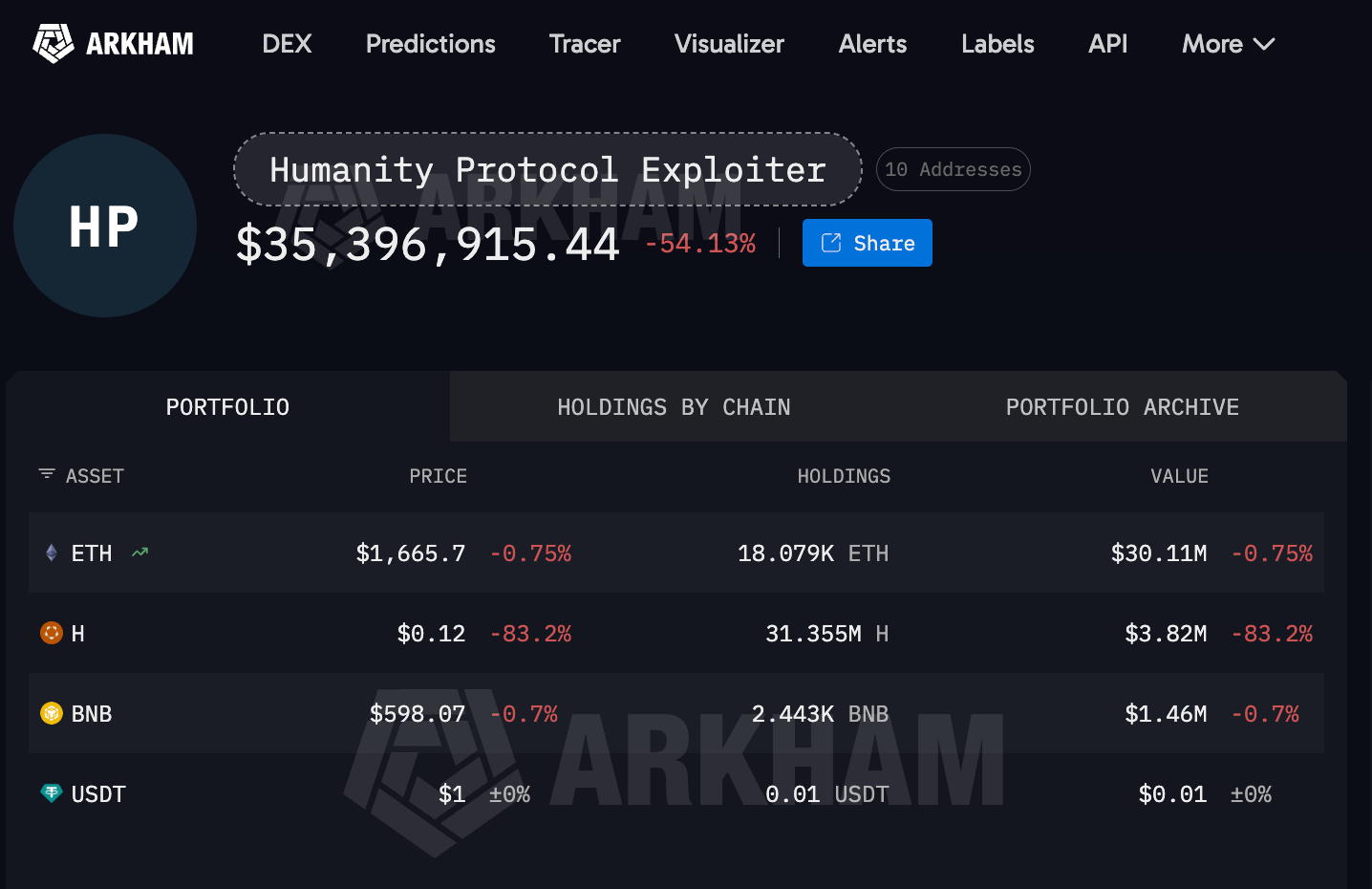
As of the time of writing, the address associated with the Humanity hacker holds over 31.35 million H tokens, valued at approximately $3.82 million; holds about 18,000 ETH, valued at over $30.11 million; its BNB holdings have also increased to 2,443, worth nearly $1.5 million; and it continues to mint more H tokens.

On-chain address monitoring information for the hacker can be found at: https://arkm.com/explorer/entity/dcfac174-1b67-46d6-8cab-5b8e955ca921.
Regarding this major security incident with over $30 million in stolen funds, on-chain detective ZachXBT also offered his preliminary investigation conclusions:

He first posted, "Unclear if hack or team maliciously rugged. Looking at the chart and the concentrated supply, the H team was likely working with an active market maker. However, all H tokens were sold on (on-chain) DEXs, not CEXs."

Subsequently, he gave a preliminary conclusion, stating: "This 'security incident' was likely planned. I don't believe the team's corresponding story at all; it's just an excuse made by ill-intentioned people to get away." It's worth mentioning that the Humanity project team does indeed have a "dark history."

Humanity Team's Dark History: Technical Outsourcing, Airdrop Drama, and Team Scandals

In fact, the crypto community's dissatisfaction with Humanity is not without reason.

Previously, when WorldCoin gained fame as a "human iris identity verification project," Humanity, as a "palm print verification identity security protocol," quickly capitalized on the hot concept and rose to prominence. At that time, it was highly sought after as a partner for KYC or identity verification in numerous crypto project airdrops. However, on the other hand, its background team, its promoted "palm print security verification technology," and its token airdrop process all sparked market controversy. For more details, see "From Palm Print 'Revolution' to Access Control Manufacturer, Tearing Apart Humanity's Two-Faced 'Technological' Charade."

Not only that, in June last year, on-chain investigator Specter pointed out in a post: "After understanding the team composition of Humanity, it's concerning: Among the 4 team leaders, 3 have problematic past records involving mismanagement, lawsuits, or financial irregularities."
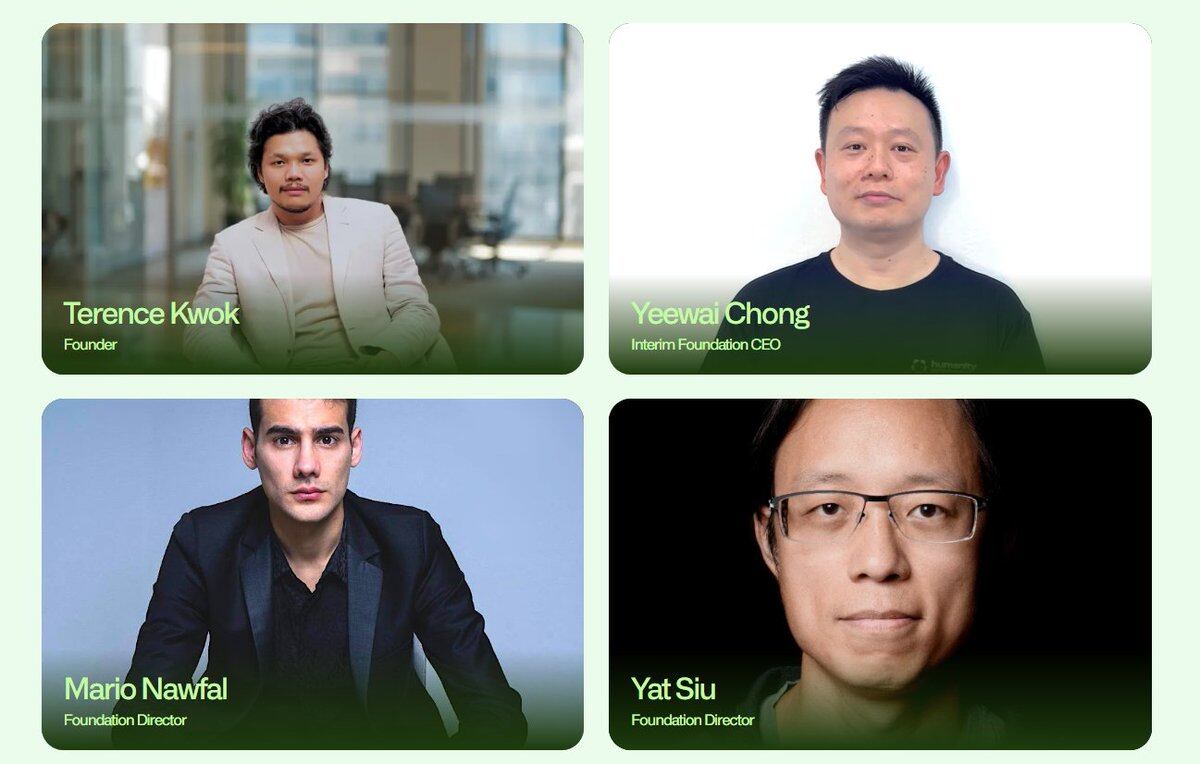
Among them, project founder and CEO Terence Kwok has a previous "entrepreneurial history." He founded Tink Labs, which once raised $200 million and reached a peak valuation of $1.5 billion, but ultimately went bankrupt in 2019 due to "mismanagement."

Foundation head Mario Nawfal has previously been accused of withholding wages and is implicated in improper financing, false promises, and coercing whistleblowers into silence. He also has a series of "blemished histories": the project Froothie was fined in Australia for false advertising; sued by Juicero; accused of invoice manipulation during his tenure at NFT Tech; and engaged in controversial behavior with BitClout token trading.

As for Yat Siu, founder of Animoca Brands, one of Humanity's backers, he was previously involved in violations related to blockchain and crypto investments, leading to his company being delisted from the Australian Securities Exchange.

Coupled with Humanity's past incidents being exposed, such as "Shenzhen technical outsourcing," large-scale sybil attacks in token airdrops, and airdrops worth single-digit amounts for loyal users, this theft incident is hard not to be seen as having ulterior motives.

Appearing Hacked, Actually a Golden Cicada Shedding Its Shell? Humanity Team Accused of Already Shifting to a New Project

Soon, more information was revealed by the crypto community and on-chain detective ZachXBT.

After suggesting that the Humanity theft might be a planned event, ZachXBT again posted, questioning Humanity's official account: "You chose to hype your token for weeks without any real substance and think the crypto community would blindly believe your story? Please disclose all your active market-making agreements with related entities in Hong Kong first."

Subsequently, he even shared a previous tweet from crypto KOL Irene Zhao, which mentioned: "2 years ago, I made a 100x return on my KOL round investment in H tokens; now, I have also participated in the KOL round financing for Everything, a new project incubated by the Humanity team."

In January this year, Everything, which promotes the concept of an "all-in-one exchange," announced the completion of a $6.9 million seed round. The round was led by Humanity's venture capital arm, Humanity Investments, with participation from Animoca Brands, Hex Trust, WallStreetBets creator Jamie Rogozinski, and Three Point Capital. The platform emphasizes its advantage in integrating perpetual contracts, spot markets, prediction markets, and payment functions.

Looking at it now, it's a familiar taste (combining current hotspots), a familiar recipe (similar investor team composition). Often, we have to admire the keen sense and superb execution of these "entrepreneurial veterans." As for the KOLs and investors involved, perhaps all benefits have already been divided behind the scenes, leaving the losses for the token traders on stage.

Of course, in the crypto market, projects and token prices are always two sides of the same coin. As for how the H token price performs subsequently, it may still depend on the handling plan of the Humanity project team and the stage performance of the market makers.


Preguntas relacionadas

QAccording to the article, what was the official explanation given by the Humanity Protocol team for the massive security breach?

AThe official explanation, as confirmed by Humanity founder Terence, was that a private key belonging to a member of the Humanity Foundation was compromised and exploited by hackers.

QWhat was the estimated total loss from the Humanity Protocol attack as detailed in the report?

AThe estimated total loss from the attack exceeded $31 million. Initially, over 17 wallets holding H tokens were drained for over $19 million, and the scale later expanded to over $31 million.

QWho is ZachXBT and what was his preliminary conclusion about the nature of the incident?

AZachXBT is a well-known on-chain investigator. His preliminary conclusion was that the security event was likely a deliberate, man-made scheme, suggesting it was an exit strategy rather than a genuine hack.

QWhat new project is mentioned as being incubated by the Humanity team, according to the article?

AThe new project mentioned is called 'Everything', a platform described as an all-in-one exchange. It was announced in January and raised $6.9 million in seed funding, led by Humanity's venture arm, Humanity Investments.

QWhat are some of the alleged 'black histories' or past controversies associated with key members of the Humanity team mentioned in the article?

AThe article mentions several controversies: Founder Terence Kwok's previous venture Tink Labs collapsed due to mismanagement; Foundation lead Mario Nawfal allegedly had issues with unpaid wages, false promises, and questionable financial practices; and investor Yat Siu's company was delisted from the Australian Stock Exchange for irregularities in blockchain investments.

Lecturas Relacionadas

If the AI Bubble Is Already Bursting, Who Will Truly Remain?

**Summary: If the AI Bubble is Bursting, What Will Remain?** The debate around an AI bubble is intensifying, with figures like Ray Dalio warning of high valuations while Jensen Huang sees immense opportunity. This echoes the dot-com bubble, which saw massive wealth destruction but ultimately left behind critical infrastructure like undersea cables and broadband, enabling future giants like Amazon and Netflix. Similarly, today's AI boom involves trillions invested in data centers, power, cooling, and GPUs, while application-layer revenue remains comparatively modest. This investment-disparity signals a bubble. However, the core technological progress is real and accelerating. AI inference costs have plummeted by over 99.7% since 2023, making intelligence increasingly cheap and accessible. This cost collapse is unlocking vast new demand. Instead of reducing spending, enterprises are tripling their AI cloud expenditure. Cheap "tokens" enable AI to move beyond simple chatbots into complex workflows—automating code writing, legal document review, financial analysis, and scientific research. This follows "Jevons's paradox": improved efficiency leads to greater total consumption. The market is now undergoing a necessary purification, weeding out "API-wrapper" startups with no real moat. The deeper evolution involves a shift from capital expenditure (CapEx) on infrastructure to operational expenditure (OpEx) on value-creation in applications. While hardware vendors currently profit most, long-term value will migrate to AI-native firms solving vertical industry problems. Ultimately, a market correction will cleanse speculative excess but will not reverse the AI+ trend. The massive physical and algorithmic infrastructure being built will endure, becoming a cheap, utility-like foundation. Just as the internet became indispensable to all industries post-2000, AI is poised to empower and redefine every sector, moving society irreversibly toward an intelligence-augmented era. The bubble may burst, but the underlying productive momentum is solid.

链捕手Hace 4 min(s)

If the AI Bubble Is Already Bursting, Who Will Truly Remain?

链捕手Hace 4 min(s)

Microsoft CEO: In the AI Era, How Do You Define a Company's Moat?

Microsoft CEO Satya Nadella argues that in the AI era, a company's true competitive edge, or "moat," is not determined by choosing the single most powerful model, but by its ability to build a continuous "learning loop." This system integrates and evolves by connecting human workflows, domain expertise, organizational judgment, and employee experience. He posits that future companies will accumulate two types of capital: Human Capital (employee knowledge, judgment, creativity) and "Token Capital" (a firm's own built and owned AI capabilities). Importantly, AI amplifies rather than devalues human capital. Human direction is essential to guide progress, as computational power alone is aimless. The core opportunity lies in creating a closed-loop system where human and token capital reinforce each other in a compound, self-improving cycle. A company must be able to preserve its unique institutional knowledge—its "company veteran" expertise—even if it switches underlying general-purpose AI models. This requires private evaluation benchmarks, reinforcement learning environments based on internal data, and queryable knowledge bases. Nadella warns against a future where economic value is concentrated by a few dominant models that commoditize entire industries' knowledge. Instead, the priority should be building a broad "frontier ecosystem" where every company, industry, and nation can own its learning loop. This allows organizations to retain control of their intellectual property, amplify employee capabilities, and ensure the economic value created by AI is captured within their own businesses and communities. True corporate sovereignty in the AI age comes from turning organizational knowledge into a compounding system that creates enduring, defensible value.

marsbitHace 39 min(s)

Microsoft CEO: In the AI Era, How Do You Define a Company's Moat?

marsbitHace 39 min(s)

ETFs Are Just the Ticket: The True Institutionalization of Bitcoin Is Happening Where You Can't See It

Beyond the Bitcoin ETF spotlight, a deeper institutionalization is underway, leveraging Bitcoin as a foundational financial primitive. Institutions are using Bitcoin for purposes long reserved for assets like U.S. Treasuries and gold: as collateral for loans, insurance reserves, and the backbone of rated bonds. Examples include a Barbados-based insurer capitalizing with $40M in Bitcoin reserves and Ledn's $188M securitization of Bitcoin-backed loans, which received the first-ever investment-grade rating (BBB-) from S&P for a digital asset-backed security. This structure was stress-tested during a 27% price drop in early 2026, triggering automatic liquidations that functioned as designed but revealed the systemic risk of synchronized selling across leveraged positions. Infrastructure is evolving to support this, with platforms like Anchorage Digital's Atlas network enabling secure, institutional-grade settlement and collateral management. Strategies like basis trades and corporate treasuries (exemplified by companies like MicroStrategy issuing billions in equity and debt to fund Bitcoin acquisitions) further integrate Bitcoin into financial mechanics. While ETFs solved "how to own" Bitcoin, these developments answer "what to do with it," embedding the asset into the working machinery of finance—as collateral upon which loans, derivatives, and structured products are built. The real, enduring institutional shift is happening in these largely invisible plumbing and financing systems.

marsbitHace 45 min(s)

ETFs Are Just the Ticket: The True Institutionalization of Bitcoin Is Happening Where You Can't See It

marsbitHace 45 min(s)

ZEC Co-Founder Responds to Orchard Vulnerability: No Signs of Theft, Orchard Pool to Be Sealed

ZEC Co-Founder Addresses Orchard Vulnerability: No Signs of Theft, Plans to Sunset Orchard Pool A security vulnerability was recently discovered in Zcash's Orchard shielded pool, raising key concerns. The primary questions are whether the flaw was exploited, if user funds are safe, whether users can verify the total ZEC supply, and if other similar vulnerabilities exist. Analysis suggests the vulnerability was likely not exploited prior to its discovery. It was found proactively by a researcher using specialized tools, not due to an active breach. The development team and mining pools acted quickly to contain the issue. Typical financially-motivated attacks would likely have left visible on-chain evidence, which has not been observed. User funds in Orchard are considered safe and should be recoverable, assuming no prior exploitation. If the flaw was never used, all legitimate funds can be withdrawn. The article outlines risks associated with moving funds to transparent addresses or other pools, but concludes that leaving assets in place is a reasonable option. Currently, users cannot independently verify that the total ZEC supply hasn't been inflated due to this bug. However, the planned Ironwood network upgrade is designed to resolve this. It will permanently close the Orchard pool to new deposits and internal transfers, allowing only withdrawals. This mechanism will cap total withdrawals at the amount of legitimately deposited funds, enabling anyone to cryptographically verify the supply post-upgrade. Multiple teams, including Shielded Labs, have conducted extensive audits focused on counterfeiting vulnerabilities, assisted by advanced AI tools. No additional flaws of this type have been found so far, increasing confidence that no other similar undisclosed vulnerabilities exist. In summary, evidence indicates the Orchard bug was probably not used, user funds are secure, and no other counterfeiting flaws are currently known. The upcoming Ironwood upgrade will restore users' ability to independently verify the total ZEC supply, closing this chapter.

Foresight NewsHace 50 min(s)

ZEC Co-Founder Responds to Orchard Vulnerability: No Signs of Theft, Orchard Pool to Be Sealed

Foresight NewsHace 50 min(s)

Trading

Spot
Futuros
活动图片