ETFs Are Just the Ticket: The True Institutionalization of Bitcoin Is Happening Where You Can't See It

marsbitPublicado a 2026-06-15Actualizado a 2026-06-15

Resumen

Beyond the Bitcoin ETF spotlight, a deeper institutionalization is underway, leveraging Bitcoin as a foundational financial primitive. Institutions are using Bitcoin for purposes long reserved for assets like U.S. Treasuries and gold: as collateral for loans, insurance reserves, and the backbone of rated bonds. Examples include a Barbados-based insurer capitalizing with $40M in Bitcoin reserves and Ledn's $188M securitization of Bitcoin-backed loans, which received the first-ever investment-grade rating (BBB-) from S&P for a digital asset-backed security. This structure was stress-tested during a 27% price drop in early 2026, triggering automatic liquidations that functioned as designed but revealed the systemic risk of synchronized selling across leveraged positions. Infrastructure is evolving to support this, with platforms like Anchorage Digital's Atlas network enabling secure, institutional-grade settlement and collateral management. Strategies like basis trades and corporate treasuries (exemplified by companies like MicroStrategy issuing billions in equity and debt to fund Bitcoin acquisitions) further integrate Bitcoin into financial mechanics. While ETFs solved "how to own" Bitcoin, these developments answer "what to do with it," embedding the asset into the working machinery of finance—as collateral upon which loans, derivatives, and structured products are built. The real, enduring institutional shift is happening in these largely invisible plumbing and financing ...

Author: Andjela Radmilac

Compiled by: Deep Tide TechFlow

Deep Tide TechFlow Introduction: ETFs only solve "how to buy Bitcoin," but few have noticed that Wall Street is already using it to do what U.S. Treasuries and gold have done for years: collateralizing loans, insurance reserves, and rating bonds. The liquidation wave in February proved this system can withstand pressure but also exposed the fatal flaw of a collective stampede in the leverage chain.

Everyone knows about ETFs, but almost no one knows that while ETFs are capturing all the attention, dozens of institutional products built around Bitcoin are quietly emerging—from a $40 million insurance reserve in Barbados to S&P-rated bonds being sold to Wall Street investors by Jefferies.

ETFs answered only one question: how ordinary investors and institutions can hold Bitcoin within a regulated wrapper. The products in this article answer a different, arguably more important question: once you own Bitcoin, what can you do with it?

The answer: exactly what the financial industry has always done with U.S. Treasuries and gold. You can use it as collateral to borrow money, post it as margin for trades, backstop insurance policies as reserves, or build a corporate balance sheet on top of it.

Assets capable of doing all these things simultaneously are sometimes called financial primitives, a fancy term for "building blocks": things that are widely accepted and easily valued, upon which the rest of the financial system can stack loans, bonds, and derivatives. Treasuries earned this status because everyone agrees on their value and how to seize them if a trade goes wrong.

Bitcoin is now undergoing the same test. Early results explain why some of the biggest players in this market genuinely don't care whether the price goes up or down.

Insurance Reserves, Consumer Credit, and the First Rated Bitcoin Bond

In March 2025, Tabit Insurance, a Barbados-licensed insurer founded by former Bittrex executives, capitalized a property and casualty insurance entity with $40 million funded entirely by Bitcoin.

Essentially, Bitcoin holders surrendered their holdings to back real insurance policies covering storm damage and lawsuits against company directors. In return, they earned a near 10% dollar-denominated yield. Policies and premiums remained in dollars, so clients never touched cryptocurrency, while Bitcoin served as the reserve to pay claims if problems arose.

Tabit holds a Class 2 license from the Barbados Financial Services Commission and is structured as a segregated accounts company. This means each investor fund pool is legally isolated from others, so losses in one account don't drain capital from another.

Regulators and auditors can also check the reserves on the blockchain in real-time, providing more transparency than traditional insurers offer in their quarterly reports. CEO Stephen Stonberg noted that the entire global reinsurance industry runs on roughly $800 billion in capital, while Bitcoin is a multi-trillion-dollar asset class. Thus, even a small portion of this wealth flowing into underwriting would be felt across the entire industry.

While insurance reserves are indeed an unexpected use case for Bitcoin, lending is where things get serious. Bitcoin-collateralized loans work in a straightforward way: you pledge your coins to a lender, receive dollars, and when you repay, you get your coins back.

Holders do this because selling triggers taxable gains and ends their exposure to future price appreciation, while borrowing against coins gives them cash without relinquishing any holdings.

Transaction volume across platforms reached about $2 billion in 2025. Toronto-based Ledn alone reported issuing over $9.5 billion since 2018. Major banks like JPMorgan Chase have also launched similar products for their own clients.

In February 2026, this lending business entered the mainstream bond market. Ledn completed a $188 million securitization, meaning it bundled 5,441 loans into a pool and sold bonds whose interest payments come from borrower repayments.

The bonds were split into two tranches: $160 million in senior notes that get paid first, rated BBB- by S&P Global Ratings (an investment-grade rating, the first ever assigned to a digital asset-backed security), and $28 million in riskier subordinate notes rated B-, which absorb first losses in exchange for higher yields.

By crypto standards, the underlying numbers are conservative. The 2,914 U.S. borrowers in the pool owe $199.1 million but have pledged around 4,079 BTC, worth $356.9 million. This translates to a loan-to-value ratio of 55.8%, meaning they pledged nearly $2 worth of Bitcoin for every $1 borrowed.

Ledn CEO Adam Reeds stated that this structure creates a "direct pipeline" between Bitcoin holders seeking liquidity and the world's deepest pools of institutional capital. Bitwise's European Head of Research, Andre Dragosch, added that the deal proves traditional finance now views Bitcoin as legitimate, even pristine, collateral.

The structure was almost immediately stress-tested, revealing both the model's strength and its fragility. Bitcoin fell about 27% from mid-January to February 2026, pushing up the loan-to-value ratio across the pool and triggering margin calls—automatic demands for borrowers to either add more collateral or watch the lender sell it.

Ledn eventually liquidated roughly a quarter of the loans originally intended for the deal. The sale still went through, partly because these automatic liquidations worked exactly as designed, and Ledn never suffered a loss when selling collateral due to default.

The perverse consequence to remember: when many lenders run the same triggers on the same volatile asset, a sharp price drop forces them to sell simultaneously, and this selling further depresses the price, triggering more sales. The system passed its first real test, but it also revealed where it would break under sufficient stress.

Collateral Networks, Carry Trades, and Corporate Balance Sheets

Beneath these products, the market's fundamental mechanics are being rebuilt to resemble currency and bond markets more closely, where the entity holding your assets, the platform you trade on, and the system settling the trades are three separate things.

Anchorage Digital, which operates the only federally chartered crypto bank in the U.S., launched its Atlas settlement network in April 2024. This allows institutions to settle trades directly with each other without parking funds in custody accounts or pre-funding exchanges.

By March 2026, Atlas had connected nearly 600 participants, four times the number from a year earlier, processed hundreds of billions in settlements, and expanded to managing collateral. This means the bank now monitors loan positions, issues margin calls, and handles liquidations on behalf of lenders.

Cantor Fitzgerald chose Anchorage and Copper.co to play this role for its global Bitcoin financing business in March 2025. Copper's ClearLoop system lets trading firms lock their coins in custody while still trading across multiple exchanges, so a repeat of the FTX collapse wouldn't take client assets.

All of this makes posting Bitcoin as margin as routine and safe as posting Treasuries—a prerequisite for the expansion of everything else mentioned in this article.

A significant portion of the institutional capital flowing through these mechanisms has absolutely no view on Bitcoin's price. The basis trade has been one of the most popular institutional strategies since the ETF launch, exploiting the fact that Bitcoin futures typically trade slightly above the spot price: funds buy spot Bitcoin or ETF shares while simultaneously selling futures contracts at a higher price, profiting from the spread regardless of where the price goes next, as gains on one leg offset losses on the other.

After ETFs gave funds an easy way to hold the spot side, hedge funds built record short positions in CME futures, where open interest climbed from around 30,000 contracts in early 2024 to a peak near 45,000 in November of that year.

This trade became large enough that its unwinding can now move the market on its own. CME open interest fell below $10 billion in April 2026 as these paired positions closed, mechanically selling pressure and depressing prices regardless of anyone's sentiment.

CME continues to build for this crowd, adding 24/7 trading in May 2026 and launching Bitcoin volatility index futures in June, allowing institutions to bet on or hedge the severity of price swings rather than its direction.

Corporate treasuries take this idea the furthest. As of late May 2026, MicroStrategy holds 843,738 BTC. The company has issued $6.7 billion in convertible notes (bonds convertible to stock if the share price rises), plus $15.5 billion in preferred stock across five different instruments—securities paying fixed dividends that sit between debt and common stock—to fund its aggressive BTC purchases.

In 2025 alone, it raised $25.3 billion, making it the largest U.S. equity issuer that year, accounting for about 8% of all issuance. It markets its preferred securities as "digital credit," a full-fledged fixed-income product line whose dividends are ultimately serviced by the Bitcoin balance sheet.

Shareholders effectively get leveraged Bitcoin exposure through the stock; dividend investors get double-digit yields backed by the coins. From Tokyo-listed Metaplanet to Semler Scientific, imitators are copying Michael Saylor's risk playbook.

Private banks run parallel assembly lines for wealthy clients, packaging structured notes that cap the downside of Bitcoin exposure in exchange for giving up some upside, allowing conservative portfolios to hold an asset that would otherwise be too volatile for them.
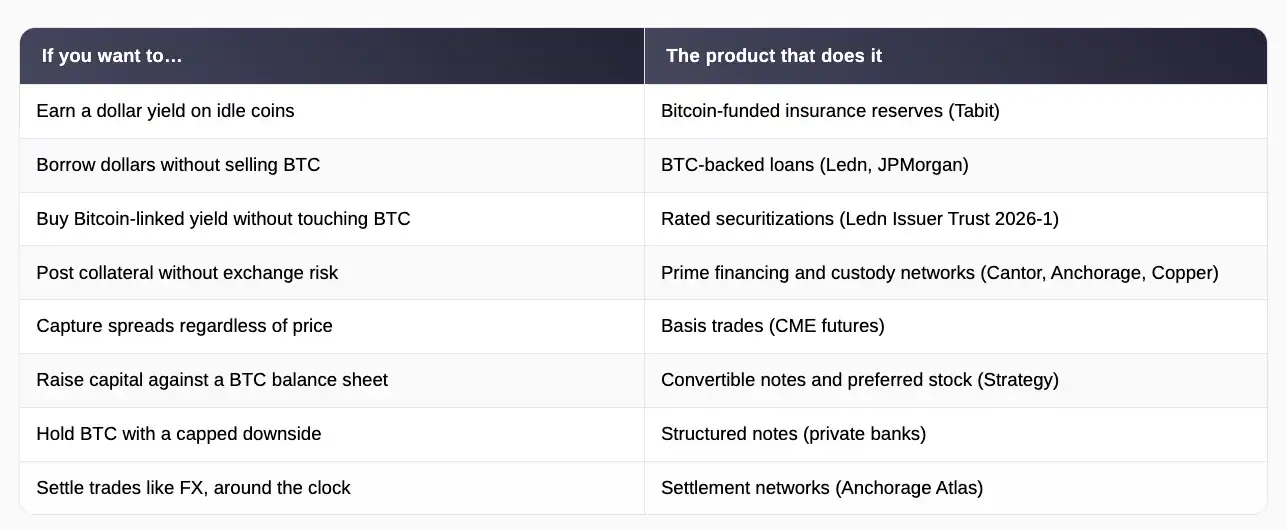
This brings us full circle to the opening paradox.

ETFs answered how institutions can own Bitcoin. The products described in this article answer what they own it for. An asset that simultaneously capitalizes Caribbean reinsurers, backs investment-grade bonds, posts margin for CME derivatives, and services preferred stock dividends has moved far beyond speculative adoption and into the working machinery of finance.

Historians of this market may ultimately see ETFs as the visible first layer of institutionalization, while the lasting change happened in the plumbing of funding and settlement systems, where Bitcoin is doing the work Treasuries and gold have done for generations: serving as collateral upon which everything else is built.

The risks are real, as proven by the February liquidation wave, and they grow with leverage. But the direction seems set. Bitcoin's most important institutional role may never appear on a fund flows chart because it is becoming part of the machinery itself.


Preguntas relacionadas

QAccording to the article, what is a key limitation of Bitcoin ETFs, and what more fundamental change is occurring behind the scenes?

AThe key limitation of Bitcoin ETFs is that they only solve the problem of 'how to buy Bitcoin' in a regulated wrapper for institutions and ordinary investors. The more fundamental change happening behind the scenes is Bitcoin's evolution into a 'financial primitive,' where it is increasingly used within the financial system's plumbing for purposes like collateral for loans, insurance reserves, and backing rated bonds, similar to the roles of U.S. Treasuries and gold.

QWhat was the significance of the $188 million securitization deal led by Ledn in February 2026, as mentioned in the article?

AThe $188 million securitization deal led by Ledn was significant because it packaged 5,441 Bitcoin-backed loans into bonds that were sold to institutional investors. Crucially, S&P Global Ratings assigned an investment-grade rating of BBB- to the senior tranche of these bonds. This marked the first time a security backed by digital assets ever received an investment-grade rating, signaling traditional finance's growing acceptance of Bitcoin as legitimate collateral.

QThe article describes how Bitcoin's use as collateral poses a systemic risk. What specific event in February 2026 highlighted this vulnerability, and how did it manifest?

AThe vulnerability was highlighted in February 2026 when Bitcoin's price fell by approximately 27%. This drop increased the loan-to-value ratios across many lending platforms, triggering widespread margin calls. The systemic risk manifested as a 'collective stampede,' where many lenders were forced to liquidate collateral (sell Bitcoin) simultaneously to cover loans. These automated sales further depressed the price, potentially triggering more liquidations in a vicious cycle, exposing the fragility of highly leveraged systems built on volatile collateral.

QBeyond lending and bonds, what are two other institutional use cases for Bitcoin described in the article, and how do they function?

ATwo other institutional use cases described are: 1) Insurance Reserves: Companies like Tabit Insurance use a pool of Bitcoin as capital to back traditional property and casualty insurance policies. Policyholders pay premiums in dollars, and Bitcoin acts as the reserve to pay claims if needed, offering investors a yield. 2) Corporate Treasury Strategy: Companies like Strategy (and followers like Metaplanet) use their balance sheets to hold Bitcoin, financing purchases by issuing corporate debt (e.g., convertible notes, preferred shares). This allows shareholders to get leveraged Bitcoin exposure and fixed-income investors to earn yields ultimately serviced by the Bitcoin holdings.

QWhat infrastructure development, mentioned in the article, is crucial for enabling Bitcoin to be used as routine collateral like U.S. Treasuries?

AThe development of new settlement and collateral management networks is crucial. Specifically, the article highlights Anchorage Digital's Atlas network and Copper's ClearLoop system. These platforms allow institutions to settle trades directly with each other and manage collateral (like monitoring loans and issuing margin calls) without having to pre-fund exchange accounts. This separation of custody, trading, and settlement makes using Bitcoin as collateral safer and more routine, mirroring the infrastructure of traditional bond and money markets.

Lecturas Relacionadas

The Most Advanced Large Models Are Now Subject to Export Controls Like Enriched Uranium

In an unprecedented move mirroring the control of enriched uranium, the US Commerce Department has imposed an export control ban on Anthropic's advanced AI models, Fable 5 and Mythos 5, forcing their global shutdown. This marks the first time a purely digital entity—a set of neural network weights—has been subjected to such hardware-like strategic export restrictions, based not on physical scarcity but on its concentrated "capability density." The article draws a direct parallel to the historical control of nuclear technology, arguing that just as uranium ore becomes a controlled substance only when enriched to a critical threshold, AI capabilities become subject to regulation when compressed into a single, potent, and easily accessible interface. This "enriched AI" is seen as crossing a threshold where its aggregated power poses a potential threat. The author predicts three major consequences over the next decade. First, capability auditing will become institutionalized, with governments setting compliance checklists and thresholds for model power, triggering automatic export controls. Second, jurisdictional boundaries will blur as US export controls extend their reach globally, governing any user of American AI services regardless of location, forcing non-US entities to reconsider their AI supply chain dependencies. Third, a technological bifurcation will occur, splitting the AI landscape into a restricted, high-risk track of advanced US proprietary models and a more reliable track of open-source or locally developed alternatives, where guaranteed access may outweigh raw performance. The core crisis exposed is the lack of a legal property rights framework for AI "intelligence." While companies invest heavily in integrating these models into their production systems, legally they only purchase a service that can be revoked at any time, leaving them with no recourse for their sunk investments. The conclusion warns of a permanently fractured digital world where the most capable models may not be the most usable, and clear, unassailable ownership of technology will become paramount.

marsbitHace 13 min(s)

The Most Advanced Large Models Are Now Subject to Export Controls Like Enriched Uranium

marsbitHace 13 min(s)

From a $300 Million Valuation to a 'Fire Sale' at Tens of Millions: What Happened to Messari?

On June 12, leading crypto data and capital markets platform Blockworks announced its acquisition of competitor Messari for over $10 million. This price represents a significant discount from Messari's 2022 valuation peak of approximately $300 million, highlighting the survival pressures faced by high-valuation startups during the bear market and a consolidation wave in data infrastructure. Blockworks, founded in 2018, began as a media and events company but has pivoted to focus on institutional-grade data, investor relations, and compliance tools. Its recent Series A extension round, valuing the company at $192 million, aimed to fund this shift and strategic acquisitions like this one. Messari, also founded in 2018, grew as a go-to platform for professional crypto research and data, raising a $35 million Series B at its $300 million valuation in late 2022. However, the prolonged bear market and subsequent internal changes, including founder Ryan Selkis's departure in 2024, increased operational pressures. The acquisition integrates Messari's extensive data platform and API capabilities with Blockworks's strengths in issuer-side disclosure, investor relations, and compliance workflows. The combined entity aims to build a unified "system of record" for the on-chain market. This reflects a broader industry trend where high-quality, structured data is becoming critical for institutional adoption, AI agents, and creating data moats akin to traditional financial platforms like Bloomberg. The deal exemplifies how market consolidation is reshaping the fragmented crypto data landscape.

marsbitHace 41 min(s)

From a $300 Million Valuation to a 'Fire Sale' at Tens of Millions: What Happened to Messari?

marsbitHace 41 min(s)

If the AI Bubble Is Already Bursting, Who Will Truly Survive?

If the AI Bubble is Bursting, Who Will Remain? The debate over an AI bubble is intensifying, with figures like Ray Dalio warning of high levels and Jensen Huang seeing immense, early-stage opportunity. Both views hold truth: a speculative bubble in capital markets likely exists, mirroring the dot-com era, but the underlying technological shift is real and transformative. History shows that while bubbles burst—wiping out overvalued companies and speculative capital—they often leave behind critical physical and digital infrastructure. The dot-com bust, for instance, eliminated many firms but left the global fiber optic networks and data centers that enabled the rise of Amazon, Netflix, and cloud computing. Today's massive AI infrastructure investments (projected at trillions by 2030) in data centers, power, cooling, and GPUs may follow a similar path, creating the foundation for future applications. A key divergence from past bubbles is the "Jevons Paradox" effect in AI. As the cost of AI inference has plummeted by over 99.7% since 2023, enterprise spending on AI has skyrocketed. Cheap "tokens" have unlocked vast, previously uneconomical use cases, moving AI from simple chatbots into core business workflows—code generation, legal document review, scientific simulation, and financial analysis. The market is now in a phase of self-correction, weeding out superficial "API-wrapper" startups, but this cleansing process strengthens the ecosystem. The long-term trajectory is clear. The value is gradually shifting from capital expenditure (CapEx) on hardware to operational expenditure (OpEx) on transformative applications. As AI becomes a utility, the winners will be firms that deeply integrate it to solve vertical industry problems in law, healthcare, finance, and manufacturing. The泡沫 will recede, but the foundational shift towards an AI-powered era across all sectors is irreversible. The underlying productive force of AI contains no bubble.

marsbitHace 1 hora(s)

If the AI Bubble Is Already Bursting, Who Will Truly Survive?

marsbitHace 1 hora(s)

Trading

Spot
Futuros

Artículos destacados

Qué es BITCOIN

Entendiendo HarryPotterObamaSonic10Inu (ERC-20) y Su Posición en el Espacio Cripto En los últimos años, el mercado de criptomonedas ha sido testigo de un aumento en la popularidad de las monedas meme, capturando el interés no solo de los comerciantes, sino también de aquellos que buscan compromiso comunitario y valor de entretenimiento. Entre estos tokens únicos se encuentra HarryPotterObamaSonic10Inu (ERC-20), un proyecto intrigante que mezcla referencias culturales en el tejido de las criptomonedas. Este artículo profundiza en los aspectos clave de HarryPotterObamaSonic10Inu, explorando sus mecanismos, ethos impulsado por la comunidad y su relación con el paisaje cripto más amplio. ¿Qué es HarryPotterObamaSonic10Inu (ERC-20)? Como su nombre sugiere, HarryPotterObamaSonic10Inu es una moneda meme construida sobre la blockchain de Ethereum, clasificada bajo el estándar ERC-20. A diferencia de las criptomonedas tradicionales que pueden enfatizar la utilidad práctica o el potencial de inversión, este token prospera en el valor de entretenimiento y la fuerza de su comunidad. El proyecto tiene como objetivo fomentar un entorno donde los usuarios comprometidos puedan reunirse, compartir ideas y participar en actividades inspiradas por diversos fenómenos culturales. Una característica notable de HarryPotterObamaSonic10Inu es su cero impuestos en las transacciones. Este atractivo elemento tiene como objetivo incentivar el comercio y la participación comunitaria, sin cargos adicionales que puedan disuadir a los comerciantes de pequeña escala. El suministro total de la moneda está establecido en mil millones de tokens, una cifra que marca su intención de mantener una circulación sustancial dentro de la comunidad. Creador de HarryPotterObamaSonic10Inu (ERC-20) Los orígenes de HarryPotterObamaSonic10Inu están algo envueltos en misterio; los detalles sobre el creador siguen siendo desconocidos. El desarrollo de este token carece de un equipo identificable o de un plan explícito, lo cual no es inusual dentro del sector de monedas meme. En cambio, el proyecto ha surgido de manera orgánica, con su progreso muy dependiente del entusiasmo y la participación de su comunidad. Inversores de HarryPotterObamaSonic10Inu (ERC-20) En cuanto a inversiones externas y respaldo, HarryPotterObamaSonic10Inu también sigue siendo ambiguo. El token no lista ninguna fundación de inversión conocida o apoyo organizacional significativo. En cambio, la savia del proyecto es su comunidad de base, que informa su crecimiento y sostenibilidad a través de la acción colectiva y el compromiso en el espacio cripto. ¿Cómo Funciona HarryPotterObamaSonic10Inu (ERC-20)? Como una moneda meme, HarryPotterObamaSonic10Inu opera principalmente fuera de los marcos tradicionales que a menudo rigen el valor de los activos. Hay varios aspectos distintivos que definen cómo funciona el proyecto: Transacciones Sin Impuestos: Sin tarifas impositivas en las transacciones, los usuarios pueden comprar y vender el token libremente sin preocuparse por costos ocultos. Compromiso Comunitario: El proyecto prospera en la interacción comunitaria, aprovechando plataformas de redes sociales para crear entusiasmo y facilitar la participación. Las discusiones, el intercambio de contenido y el compromiso son elementos cruciales que ayudan a expandir su alcance y fomentar la lealtad entre los seguidores. Sin Utilidad Práctica: Cabe señalar que HarryPotterObamaSonic10Inu no ofrece utilidad concreta dentro del ecosistema financiero. Más bien, se clasifica como un token principalmente para actividades de entretenimiento y comunitarias. Referencia Cultural: El token incorpora astutamente elementos de la cultura popular para atraer interés, conectando con entusiastas de los memes y seguidores de las criptomonedas por igual. HarryPotterObamaSonic10Inu ejemplifica cómo las monedas meme operan de manera diferente a los proyectos de criptomonedas más tradicionales, ingresando al mercado como construcciones sociales innovadoras en lugar de activos utilitarios. Cronología de HarryPotterObamaSonic10Inu (ERC-20) La historia de HarryPotterObamaSonic10Inu está marcada por varios hitos notables: Creación: El token surgió de un meme viral, capturando la imaginación de muchos entusiastas de las criptomonedas. Las fechas específicas de creación no están disponibles, subrayando su ascenso orgánico. Listado en Exchanges: HarryPotterObamaSonic10Inu ha llegado a varios exchanges, permitiendo un acceso y comercio más fácil por parte de la comunidad. Iniciativas de Compromiso Comunitario: Actividades continuas destinadas a mejorar la interacción comunitaria, incluyendo concursos, campañas en redes sociales y generación de contenido por parte de fanáticos y defensores. Planes de Expansión Futuros: La hoja de ruta del proyecto incluye el lanzamiento de una colección de NFT, mercancía y un sitio de comercio electrónico relacionado con sus temas culturales, involucrando aún más a la comunidad e intentando añadir más dimensiones a su ecosistema. Puntos Clave Sobre HarryPotterObamaSonic10Inu (ERC-20) Naturaleza Impulsada por la Comunidad: El proyecto prioriza la participación colectiva y la creatividad, asegurando que la involucración de los usuarios esté a la vanguardia de su desarrollo. Clasificación como Moneda Meme: Representa la epítome de las criptomonedas basadas en el entretenimiento, diferenciándose de los vehículos de inversión tradicionales. Sin Afiliación Directa con Bitcoin: A pesar de la similitud en el nombre del ticker, HarryPotterObamaSonic10Inu es distinto y no tiene relación con Bitcoin u otras criptomonedas establecidas. Enfoque en la Colaboración: HarryPotterObamaSonic10Inu está diseñado para crear un espacio para la colaboración y el intercambio de historias entre sus poseedores, proporcionando una vía para la creatividad y el vínculo comunitario. Perspectivas Futuras: La ambición de expandirse más allá de su premisa inicial hacia NFTs y mercancías describe un camino para que el proyecto potencialmente ingrese a avenidas más tradicionales dentro de la cultura digital. A medida que las monedas meme continúan capturando la imaginación de la comunidad de criptomonedas, HarryPotterObamaSonic10Inu (ERC-20) se destaca debido a sus lazos culturales y su enfoque centrado en la comunidad. Si bien puede no encajar en el molde típico de un token impulsado por la utilidad, su esencia radica en la alegría y la camaradería fomentadas entre sus seguidores, destacando la naturaleza en evolución de las criptomonedas en una era cada vez más digital. A medida que el proyecto continúa desarrollándose, será importante observar cómo las dinámicas comunitarias influyen en su trayectoria en el cambiante paisaje de la tecnología blockchain.

1.8k Vistas totalesPublicado en 2024.04.01Actualizado en 2024.12.03

Qué es BITCOIN

Cómo comprar BTC

¡Bienvenido a HTX.com! Hemos hecho que comprar Bitcoin (BTC) sea simple y conveniente. Sigue nuestra guía paso a paso para iniciar tu viaje de criptos.Paso 1: crea tu cuenta HTXUtiliza tu correo electrónico o número de teléfono para registrarte y obtener una cuenta gratuita en HTX. Experimenta un proceso de registro sin complicaciones y desbloquea todas las funciones.Obtener mi cuentaPaso 2: ve a Comprar cripto y elige tu método de pagoTarjeta de crédito/débito: usa tu Visa o Mastercard para comprar Bitcoin (BTC) al instante.Saldo: utiliza fondos del saldo de tu cuenta HTX para tradear sin problemas.Terceros: hemos agregado métodos de pago populares como Google Pay y Apple Pay para mejorar la comodidad.P2P: tradear directamente con otros usuarios en HTX.Over-the-Counter (OTC): ofrecemos servicios personalizados y tipos de cambio competitivos para los traders.Paso 3: guarda tu Bitcoin (BTC)Después de comprar tu Bitcoin (BTC), guárdalo en tu cuenta HTX. Alternativamente, puedes enviarlo a otro lugar mediante transferencia blockchain o utilizarlo para tradear otras criptomonedas.Paso 4: tradear Bitcoin (BTC)Tradear fácilmente con Bitcoin (BTC) en HTX's mercado spot. Simplemente accede a tu cuenta, selecciona tu par de trading, ejecuta tus trades y monitorea en tiempo real. Ofrecemos una experiencia fácil de usar tanto para principiantes como para traders experimentados.

5.2k Vistas totalesPublicado en 2024.12.12Actualizado en 2026.06.02

Cómo comprar BTC

Qué es $BITCOIN

ORO DIGITAL ($BITCOIN): Un Análisis Integral Introducción al ORO DIGITAL ($BITCOIN) ORO DIGITAL ($BITCOIN) es un proyecto basado en blockchain que opera en la red Solana, cuyo objetivo es combinar las características de los metales preciosos tradicionales con la innovación de las tecnologías descentralizadas. Aunque comparte un nombre con Bitcoin, a menudo referido como “oro digital” debido a su percepción como un refugio de valor, ORO DIGITAL es un token separado diseñado para crear un ecosistema único dentro del paisaje Web3. Su meta es posicionarse como un activo digital alternativo viable, aunque los detalles sobre sus aplicaciones y funcionalidades aún están en desarrollo. ¿Qué es ORO DIGITAL ($BITCOIN)? ORO DIGITAL ($BITCOIN) es un token de criptomoneda diseñado explícitamente para su uso en la blockchain de Solana. A diferencia de Bitcoin, que proporciona un papel de almacenamiento de valor ampliamente reconocido, este token parece centrarse en aplicaciones y características más amplias. Aspectos notables incluyen: Infraestructura Blockchain: El token está construido sobre la blockchain de Solana, conocida por su capacidad para manejar transacciones de alta velocidad y bajo costo. Dinámicas de Suministro: ORO DIGITAL tiene un suministro máximo limitado a 100 cuatrillones de tokens (100P $BITCOIN), aunque los detalles sobre su suministro circulante no se han divulgado actualmente. Utilidad: Si bien las funcionalidades precisas no están delineadas explícitamente, hay indicios de que el token podría ser utilizado para diversas aplicaciones, potencialmente involucrando aplicaciones descentralizadas (dApps) o estrategias de tokenización de activos. ¿Quién es el Creador de ORO DIGITAL ($BITCOIN)? En la actualidad, la identidad de los creadores y el equipo de desarrollo detrás de ORO DIGITAL ($BITCOIN) sigue siendo desconocida. Esta situación es típica entre muchos proyectos innovadores dentro del espacio blockchain, particularmente aquellos alineados con las finanzas descentralizadas y fenómenos de monedas meme. Si bien tal anonimato puede fomentar una cultura impulsada por la comunidad, intensifica las preocupaciones sobre la gobernanza y la responsabilidad. ¿Quiénes son los Inversores de ORO DIGITAL ($BITCOIN)? La información disponible indica que ORO DIGITAL ($BITCOIN) no tiene patrocinadores institucionales conocidos ni inversiones destacadas de capital de riesgo. El proyecto parece operar en un modelo de peer-to-peer centrado en el apoyo y la adopción de la comunidad en lugar de rutas de financiamiento tradicionales. Su actividad y liquidez se sitúan principalmente en intercambios descentralizados (DEX), como PumpSwap, en lugar de plataformas de trading centralizadas establecidas, lo que resalta aún más su enfoque de base. Cómo Funciona ORO DIGITAL ($BITCOIN) Los mecanismos operativos de ORO DIGITAL ($BITCOIN) pueden elaborarse en función de su diseño blockchain y atributos de red: Mecanismo de Consenso: Al aprovechar el único proof-of-history (PoH) de Solana combinado con un modelo de proof-of-stake (PoS), el proyecto asegura una validación de transacciones eficiente que contribuye al alto rendimiento de la red. Tokenómica: Si bien los mecanismos deflacionarios específicos no se han detallado extensamente, el vasto suministro máximo de tokens implica que podría atender microtransacciones o casos de uso nicho que aún están por definirse. Interoperabilidad: Existe el potencial de integración con el ecosistema más amplio de Solana, incluyendo varias plataformas de finanzas descentralizadas (DeFi). Sin embargo, los detalles sobre integraciones específicas permanecen no especificados. Cronología de Eventos Clave Aquí hay una cronología que destaca hitos significativos relacionados con ORO DIGITAL ($BITCOIN): 2023: El despliegue inicial del token ocurre en la blockchain de Solana, marcado por su dirección de contrato. 2024: ORO DIGITAL gana visibilidad al estar disponible para trading en intercambios descentralizados como PumpSwap, permitiendo a los usuarios comerciar contra SOL. 2025: El proyecto presencia actividad de trading esporádica y potencial interés en compromisos liderados por la comunidad, aunque no se han documentado asociaciones notables o avances técnicos hasta el momento. Análisis Crítico Fortalezas Escalabilidad: La infraestructura subyacente de Solana soporta altos volúmenes de transacciones, lo que podría mejorar la utilidad de $BITCOIN en varios escenarios de transacción. Accesibilidad: El potencial bajo precio de trading por token podría atraer a inversores minoristas, facilitando una participación más amplia debido a oportunidades de propiedad fraccionada. Riesgos Falta de Transparencia: La ausencia de patrocinadores, desarrolladores o un proceso de auditoría conocidos públicamente puede generar escepticismo sobre la sostenibilidad y confiabilidad del proyecto. Volatilidad del Mercado: La actividad de trading depende en gran medida del comportamiento especulativo, lo que puede resultar en una volatilidad de precios significativa y en incertidumbre para los inversores. Conclusión ORO DIGITAL ($BITCOIN) surge como un proyecto intrigante pero ambiguo dentro del ecosistema de Solana en rápida evolución. Si bien intenta aprovechar la narrativa del “oro digital”, su alejamiento del papel establecido de Bitcoin como refugio de valor subraya la necesidad de una diferenciación más clara de su utilidad y estructura de gobernanza previstas. La aceptación y adopción futura dependerán probablemente de abordar la actual opacidad y de definir sus estrategias operativas y económicas de manera más explícita. Nota: Este informe abarca información sintetizada disponible hasta octubre de 2023, y pueden haber ocurrido desarrollos más allá del período de investigación.

83 Vistas totalesPublicado en 2025.05.13Actualizado en 2025.05.13

Qué es $BITCOIN

Discusiones

Bienvenido a la comunidad de HTX. Aquí puedes mantenerte informado sobre los últimos desarrollos de la plataforma y acceder a análisis profesionales del mercado. A continuación se presentan las opiniones de los usuarios sobre el precio de BTC (BTC).

活动图片













