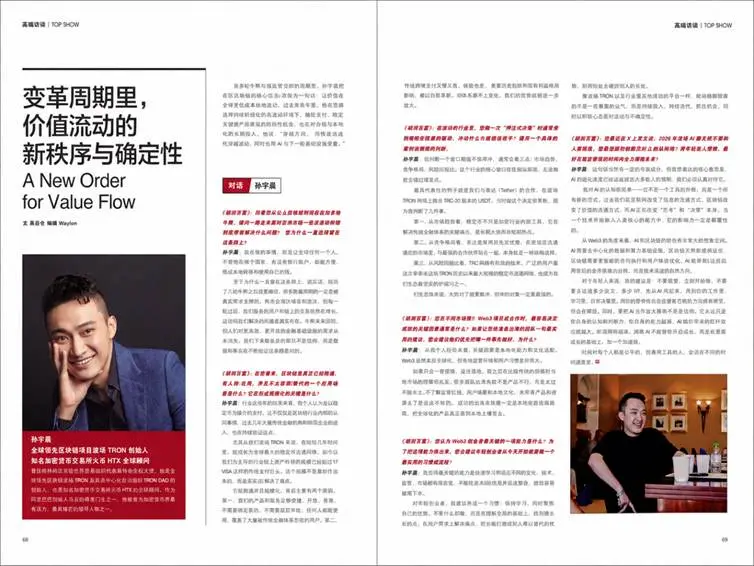
Hurun Report Interview with Justin Sun: New Paradigm of Value Circulation in the Web3 Transformation Cycle

链捕手Publicado a 2026-05-29Actualizado a 2026-05-29

Resumen

In an interview with *Hurun Report*, Justin Sun, founder of TRON, discussed the evolution of the Web3 industry as it transitions from early-stage exploration to large-scale adoption. He emphasized that the fundamental goal of blockchain technology is to build an open and inclusive internet of value, enabling low-cost, efficient fund transfer for anyone globally, regardless of location or access to banking. Sun highlighted stablecoins as the most mature and scalable application within Web3, noting that TRON has grown into one of the world's largest stablecoin networks, with over $86.3 billion in USDT circulation. He attributed this growth to genuine user demand in cross-border payments and daily transactions, reflecting a structural shift where blockchain's openness and efficiency are naturally supplementing traditional financial systems. Regarding strategy, Sun outlined a framework combining data-driven iteration, rapid execution, and user-centricity. He pointed to TRON's partnership with Tether for TRC-20 USDT as a key decision that leveraged market trends and network effects to build a competitive moat. He also stressed the importance of globalization, noting that success in different markets depends on deep local compliance, cultural adaptation, and partnership networks. Sun expressed strong interest in the convergence of AI and blockchain, viewing AI as a transformative force that can enhance blockchain's intelligence and user experience, while blockchain provides dece...

Against the backdrop of the Web3 industry entering a deep-water zone and the accelerated global restructuring of financial infrastructure, blockchain is transitioning from early exploration to large-scale application. As an authoritative institution with extensive influence in business and investment, an in-depth interview by the renowned magazine, Hurun Report, is regarded as a significant industry barometer. Recently, Justin Sun, founder of TRON, in an exclusive interview with Hurun Report, systematically elaborated his judgment on industry evolution and long-term value around core issues such as stablecoin payments, globalization path, and AI integration trends. His views also reflect the critical stage where Web3 infrastructure is moving from "feasibility verification" to "global adoption".
Stablecoins Building a Global Value Circulation Network, Web3 Infrastructure Enters Scaling Phase

In the interview with Hurun Report, Justin Sun summarized the core goal he has long been committed to in extremely concise terms: "To enable any person in the world, regardless of location or whether they have a bank account, to transfer and use their funds at low cost and high efficiency." This statement fundamentally reveals the value essence of blockchain technology — constructing an open and inclusive value internet.

He further pointed out that after the blockchain industry has gone through multiple bull and bear cycles, projects truly capable of weathering these cycles must be built upon real demand and practical usage. The continuous growth of on-chain user scale and transaction volume is an important basis for his judgment of industry direction. In this context, the on-chain payment system centered around stablecoins has become the most mature and capable application scenario for scaling currently.

In the Hurun Report interview, Justin Sun mentioned that TRON has rapidly developed into one of the world's largest stablecoin circulation networks, with its on-chain asset transfer volume even surpassing that of some traditional payment networks. This growth is not driven by short-term market sentiment but based on the continuous use by real users in scenarios such as cross-border transfers, value storage, and daily payments. Official data shows that the current circulation of USDT on the TRON chain has exceeded $86.3 billion, a scale reflecting strong network effects driven by real user demand.

From a structural advantage perspective, the scaling of stablecoin payments benefits from two factors: on one hand, blockchain networks possess openness and permissionless characteristics, enabling them to cover user groups difficult for the traditional financial system to reach; on the other hand, the limitations of traditional cross-border payment systems in efficiency, cost, and user experience provide significant substitution space for new-generation infrastructure. Sun believes this trend is essentially a "natural substitution" of existing financial systems by technological progress, not short-term competition.

Globalization Strategy and Technology Convergence Advance in Parallel, Building Long-term Competitive Advantage for Web3

When discussing enterprise growth and strategic decision-making, Justin Sun presented a highly systematic methodology in the Hurun Report interview. He summarized the success factors as the combination of "data-driven iteration, rapid execution, and user orientation," emphasizing that in a rapidly changing technological environment, single-dimensional capabilities can no longer support long-term competitiveness; the synergy of these three is necessary to achieve efficient trial-and-error and precise decision-making.

At the organizational level, he proposed a management framework of "clear direction, layered support, and a sense of ownership among all members" to avoid deviation and loss of control during rapid expansion. This organizational structure, emphasizing flatness and agility, is seen as an important foundation for Web3 enterprises to maintain competitiveness in highly uncertain environments.

Regarding key strategic decisions, Sun reviewed the case of TRON's partnership with Tether to launch TRC-20 USDT in the Hurun Report interview. He stated that this decision was based on a comprehensive assessment of market trends, competitive landscape, and risk-reward ratio: stablecoins represent a long-term trend in financial system evolution, top assets possess significant network effects, and the upside potential in this field far outweighs the potential risks. It has been proven that this cooperation became a crucial growth engine for the TRON ecosystem and built its core competitive moat in the stablecoin domain.

Regarding global expansion, Sun emphasized that while Web3 has inherent cross-border properties, its actual implementation remains highly dependent on local compliance and cultural adaptation. In the Hurun Report interview, he noted that different markets have significant differences in regulatory frameworks, user habits, and business environments. The success of a project often depends on the depth of understanding of these differences and the ability to build local partnership networks.

Furthermore, Justin Sun expressed a clear judgment on the development of AI technology. In the interview, he stated that AI is not merely a tool upgrade but a reconstruction of "thinking and decision-making capabilities." Its integration with blockchain in data, computing power, and intelligent execution will become a crucial direction for the next stage of technological evolution. Blockchain provides decentralized infrastructure for AI, while AI enhances the intelligence and user experience of blockchain systems; the convergence of the two holds long-term strategic value.

For industry participants and young entrepreneurs, the core advice Justin Sun gave in the Hurun Report interview is: in a highly uncertain environment, continuous learning and rapid adaptation are the most critical abilities. Simultaneously, one should focus investments based on an understanding of the overall industry landscape, building irreplaceable core strengths rather than dispersing resources across multiple tracks.

From early-stage technical verification and market exploration, gradually entering the large-scale application phase represented by stablecoins, and extending towards AI convergence and global compliant implementation. In this process, TRON is continuously advancing the implementation and evolution of the value internet through infrastructure capabilities, globalization strategy, and forward-looking technological layout.


Lecturas Relacionadas

Has the Cryptocurrency Market Hit Bottom? Here's What Institutions Think

"Has the crypto market bottomed out? Major institutions are divided on the outlook, according to a recent analysis by Matt Hougan, Chief Investment Officer of Bitwise. Three prominent research firms published in-depth reports on the topic with differing conclusions. Galaxy Digital argues Bitcoin has not yet found its bottom, pointing to only 4 out of 13 historical bottoming indicators being met. Their analysis suggests a potential bottom range of $30,000 to $54,000. NYDIG adopts a more cautious stance, noting that while metrics are close to historical bear market lows, a classic panic-selling capitulation event is missing. They acknowledge the possibility of a bottom but consider it unlikely, citing structural changes from institutional adoption. In contrast, Standard Chartered Bank asserts the bottom is already in at around $59,000. Their revised bullish view, predicting a year-end target of $100,000, hinges on anticipated reductions in ETF selling pressure linked to events like a potential SpaceX IPO. Despite the surface-level disagreement on the exact price floor, the reports share significant common ground crucial for long-term investors. All three institutions agree that a market bottom will likely form within the current year, that current prices are closer to the bottom than to previous cycle highs, and that Bitcoin is poised for another major bull cycle in the future. The core takeaway is that while the precise bottom level remains debated, the long-term value proposition for Bitcoin remains strong and may even be strengthening. Key supportive trends include rising global debt, persistent inflation, declining trust in traditional institutions, accelerating digitization, and improving market infrastructure. Therefore, for investors with a long-term horizon, the focus should shift from pinpointing the exact bottom to recognizing that the cycle's peak is likely still ahead, making current levels an attractive entry point for substantial potential upside."

Foresight NewsHace 2 min(s)

Has the Cryptocurrency Market Hit Bottom? Here's What Institutions Think

Foresight NewsHace 2 min(s)

2029 Finale Prediction: When Cryptocurrency Completely "Vanishes", Who Can Remain in This Financial Upheaval?

By 2029, the crypto industry will have transformed into a largely invisible but foundational layer for traditional finance. This timeline outlines the key shifts from now until then. By mid-2026, the most sought-after assets on-chain will not be traditional tokens, but synthetic perpetual contracts for private, high-growth companies (like SpaceX, OpenAI). These become primary price discovery tools, highlighting the market's craving for real-world asset value. Most altcoins enter a sustained bear market as their fundamental lack of asset-backed value is exposed. In late 2026, the "AI + Crypto" narrative largely fades as AI giants prove they don't need crypto infrastructure, except for prediction markets betting on model performance. Simultaneously, a quiet but significant wave of tokenization for institutional assets (money market funds, private credit) begins. The industry splits into a noisy speculative economy and a silent institutional one. Throughout 2027, major public blockchain foundations pivot decisively to serve institutional clients, building compliance toolkits and sales teams. However, key sectors hit growth ceilings: private perpetual contracts are legally restricted from public promotion, stable币 growth is capped by looming political uncertainty, and tokenization projects remain cautious. In 2028, following a U.S. election assumed to maintain a regulatory (not prohibitive) stance, a pivotal change occurs. After a major liquidation crisis exposes the flaws of synthetic contracts lacking a real-asset anchor, new regulations allow the *public solicitation* of private security sales (secondary market shares) to accredited investors. This creates a legitimate, direct on-ramp for retail capital into previously illiquid private equity. By 2029, the resulting bull market is driven by trading in real, innovative company shares (biotech, robotics, AI labs), not speculative tokens. "Crypto" as a distinct asset class recedes; it becomes the mundane, unseen plumbing for this new global private markets infrastructure. Tokens that survive are those capturing real cash flows from this infrastructure. Speculation persists but is marginalized. The core questions posed at the start are answered: token value is tied to legally enforceable claims on real assets, frontier tech adoption happens via private market channels, and crypto's absorption into traditional finance is marked by its becoming boring and invisible. The key validation for this entire thesis is whether, by late 2028, a legal pathway exists for ordinary accredited investors to access private assets directly.

marsbitHace 45 min(s)

2029 Finale Prediction: When Cryptocurrency Completely "Vanishes", Who Can Remain in This Financial Upheaval?

marsbitHace 45 min(s)

After the U.S. Banned Fable 5, Zhipu's Stock Soared 47%

On June 15, Chinese AI company Zhipu's stock surged up to 47.6% in Hong Kong, closing with a 32.82% gain. This sharp rise followed two key industry events. On June 12, Anthropic was compelled by a U.S. government export control order to suspend global access to its latest flagship models, Claude Fable 5 and Claude Mythos 5, impacting developers and businesses reliant on them. The next day, Zhipu announced it was opening access to its new open-source flagship model, GLM-5.2, for all Coding Plan users, with API and model weights (under the MIT license) to follow. The Anthropic incident highlighted a critical shift in the AI industry: beyond raw capability, the stability, continuous accessibility, and control over AI models are becoming equally vital, especially as AI integrates deeper into business workflows. Zhipu's move, emphasizing that "frontier intelligence should not belong to a few nor be subject to arbitrary revocation," positioned its open, accessible model as an alternative. GLM-5.2 focuses on "Long Horizon Tasks" with a 1M context window, aiming for consistency in complex, extended projects. Market analysts suggest this event exposes the risk of dependency on closed-source models subject to single jurisdiction policies, potentially accelerating a shift toward domestic base models and localized deployments. The investment response indicates a new valuation metric is emerging—prioritizing which companies can provide AI capabilities that are not only advanced but also reliably and sustainably accessible.

marsbitHace 46 min(s)

After the U.S. Banned Fable 5, Zhipu's Stock Soared 47%

marsbitHace 46 min(s)

PANews Column Registration and Article Submission Guide

"PANews Column Registration and Submission Guide" provides instructions for users to register as columnists and publish articles on the PANews platform. Key application requirements are emphasized: content should focus on in-depth analysis within Crypto, Web3, blockchain, data, and viewpoints. Content primarily for brand/product introductions will not be approved, and heavily AI-generated content will be rejected. Promotional (PR/soft) content is directed to the business channel. **Registration Process:** * **Web:** Go to the official website footer, click "Apply for Column," and register with a phone number or email (login via verification code, no password). Fill in the column name, description, upload an avatar, and submit links to previously published work. * **Mobile:** Navigate to "My" -> "Contribute & Create" and complete the form. **Article Submission Tutorial:** 1. Log in to the PANews website. 2. Access the "Creator Center" from your personal homepage. 3. Use the editor to create and publish articles. **Video Upload:** The platform supports embedding videos from third-party sites (e.g., Bilibili). Copy the embed code from the source video, use the editor's "Insert/Edit media" button, paste the code under the "Embed" tab, and adjust the display size (recommended: width 100%, height 560px). **PANews Skills (AI Agent Tool):** PANews offers an official AI Agent skill set called PANews Skills, enabling AI tools to query platform content, track trends, and publish column articles directly. It includes three main skills: 1. `panews`: For tracking daily must-read lists, popular articles, and funding news. 2. `panews-creator`: For managing columns, publishing articles, and uploading images. 3. `panews-web-viewer`: For parsing PANews webpages into Markdown. These skills are compatible with various AI Agent tools (OpenClaw, Cursor, Claude Code, ChatGPT, Gemini, etc.). To use the `panews-creator` skill, users must obtain a specific authentication value from the PANews website after logging into their columnist account.

marsbitHace 57 min(s)

PANews Column Registration and Article Submission Guide

marsbitHace 57 min(s)

Trading

Spot
Futuros

Artículos destacados

Cómo comprar SUN

¡Bienvenido a HTX.com! Hemos hecho que comprar SUN (SUN) sea simple y conveniente. Sigue nuestra guía paso a paso para iniciar tu viaje de criptos.Paso 1: crea tu cuenta HTXUtiliza tu correo electrónico o número de teléfono para registrarte y obtener una cuenta gratuita en HTX. Experimenta un proceso de registro sin complicaciones y desbloquea todas las funciones.Obtener mi cuentaPaso 2: ve a Comprar cripto y elige tu método de pagoTarjeta de crédito/débito: usa tu Visa o Mastercard para comprar SUN (SUN) al instante.Saldo: utiliza fondos del saldo de tu cuenta HTX para tradear sin problemas.Terceros: hemos agregado métodos de pago populares como Google Pay y Apple Pay para mejorar la comodidad.P2P: tradear directamente con otros usuarios en HTX.Over-the-Counter (OTC): ofrecemos servicios personalizados y tipos de cambio competitivos para los traders.Paso 3: guarda tu SUN (SUN)Después de comprar tu SUN (SUN), guárdalo en tu cuenta HTX. Alternativamente, puedes enviarlo a otro lugar mediante transferencia blockchain o utilizarlo para tradear otras criptomonedas.Paso 4: tradear SUN (SUN)Tradear fácilmente con SUN (SUN) en HTX's mercado spot. Simplemente accede a tu cuenta, selecciona tu par de trading, ejecuta tus trades y monitorea en tiempo real. Ofrecemos una experiencia fácil de usar tanto para principiantes como para traders experimentados.

545 Vistas totalesPublicado en 2024.12.12Actualizado en 2025.03.21

Cómo comprar SUN

Discusiones

Bienvenido a la comunidad de HTX. Aquí puedes mantenerte informado sobre los últimos desarrollos de la plataforma y acceder a análisis profesionales del mercado. A continuación se presentan las opiniones de los usuarios sobre el precio de SUN (SUN).

活动图片