Author: FinTax
Abstract
Entering 2026, the global cryptocurrency industry is undergoing structural changes. In its "2026 Digital Assets Outlook," The Block identifies regulation, infrastructure, stablecoins, DeFi, and institutional participation as key factors influencing the industry's evolution. Fidelity Digital Assets, under the theme "Structural Shifts Beyond Price," suggests that the focus of observation in the digital asset industry is shifting from mere asset price performance to liquidity structures, tokenization applications, and new technological infrastructure. PwC further points out in its "Global Crypto Regulation Report 2026" that stablecoins have become a core topic in global regulatory policy, with various jurisdictions perfecting institutional frameworks around issuer qualifications, reserve assets, redemption arrangements, and ongoing supervision. Citi summarizes stablecoin development as moving "from Web3 to Wall Street," indicating that stablecoin applications are gradually expanding from within the crypto market into traditional financial scenarios such as payments, banking, and corporate treasury management.
From a tax compliance perspective, these series of changes will impact value transfer methods, operational regulatory boundaries, transaction execution entities, and information reporting responsibilities, driving the cryptocurrency industry's further integration into the real-world commercial system. Specifically, the changes in 2026 are mainly reflected in the following four aspects:
- Stablecoins alter value transfer methods;
- Global regulation alters operational boundaries;
- AI alters transaction initiators;
- Tax transparency alters information responsibilities.
I. Stablecoins Move Beyond the Crypto Market, Accelerating Integration of Real-World Payments and On-Chain Settlement
1. Stablecoin Market Continues to Expand, But On-Chain Activities Still Dominate
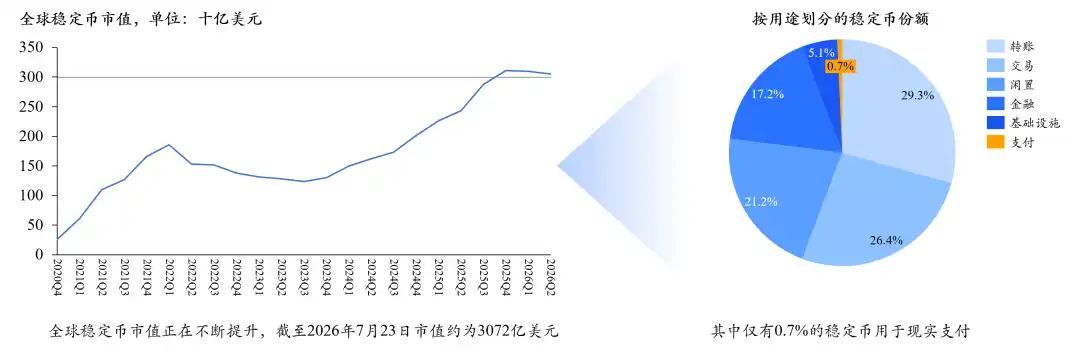
BIS research in 2026 indicates that the stablecoin market has exceeded $300 billion, with approximately 98% of stablecoin value denominated in USD. Stablecoins have gradually expanded from being tools for crypto trading quotes and fund parking to becoming a medium for cross-border value transfer. However, most of their activities remain related to crypto-native activities such as trading, arbitrage, and liquidity management.
Estimates of usage structure published by the Federal Reserve Bank of Kansas City in April 2026 show that approximately 48.8% of stablecoins are used for exchanges, DeFi, and related financial infrastructure, 29.3% for fund transfers, while traditional payments for goods and services account for only about 0.7%. Stablecoins have formed a large-scale on-chain liquidity pool but currently still primarily serve crypto trading, on-chain finance, and fund allocation.
2. Real Payment Volumes Grow, Stablecoins Become Back-End Settlement Tools for Traditional Payment Products
Artemis research on stablecoin payment activities shows that monthly payment volume increased from approximately $1.9 billion in January 2023 to about $10.2 billion in August 2025, roughly a 5.4-fold increase. Growth scenarios include inter-company payments, salary and freelancer settlements, card payments, merchant receipts, and cross-border remittances, with B2B stablecoin payments growing significantly. The adoption of stablecoins doesn't necessarily manifest as consumers directly operating on-chain wallets; a more common form is cards, payment applications, or corporate payment platforms using stablecoins for back-end settlement.
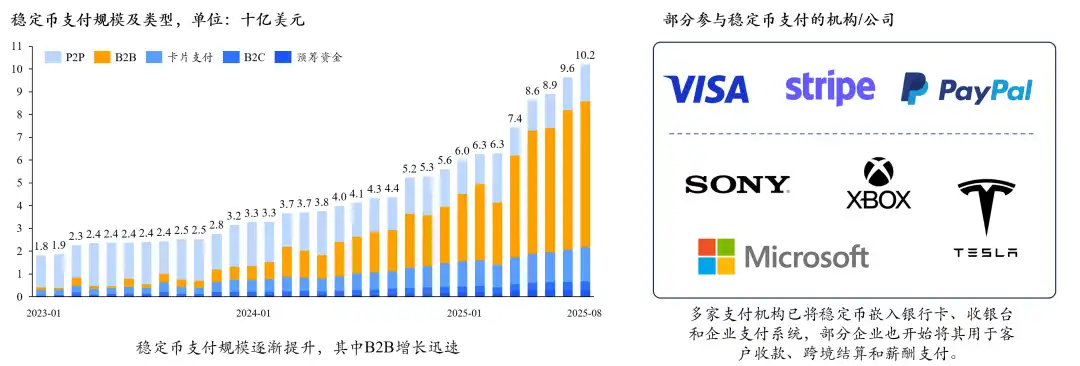
Source: Artemis, "Stablecoin Payments at Scale," January 2026. Chart data shows monthly payment volumes disclosed in the research report.
3. Business Chains Lengthen, Accounting and Tax Treatment Evolve from Point Issues to Full-Process Issues
As stablecoins enter real-world operations, business participants are no longer limited to issuers and trading platforms. They now include reserve custodians, minting and redemption service providers, payment processors, card issuers, wallet providers, and fiat on/off-ramps. The nature of income obtained, tax obligations borne, and data responsibilities differ among these various entities.

II. Global Regulation Enters Implementation Phase, Shifting from Licensing to Ongoing Supervision and Cross-Border Constraints
1. Comprehensive Regulatory Frameworks Accelerate Formation, But Implementation Levels Remain Uneven Across Regions
The latest FSB peer review of 28 jurisdictions shows that as of August 2025, 11 jurisdictions had completed a comprehensive crypto regulatory framework covering financial stability risks, 8 were in the consultation or finalization stage, 3 had partial coverage, and 6 remained in early stages. Among regions with relatively complete CASP frameworks, regulatory data reporting capabilities still lag significantly: out of 19 jurisdictions identified by the FSB as having completed comprehensive CASP frameworks, only 11 had relatively comprehensive regulatory reporting requirements.
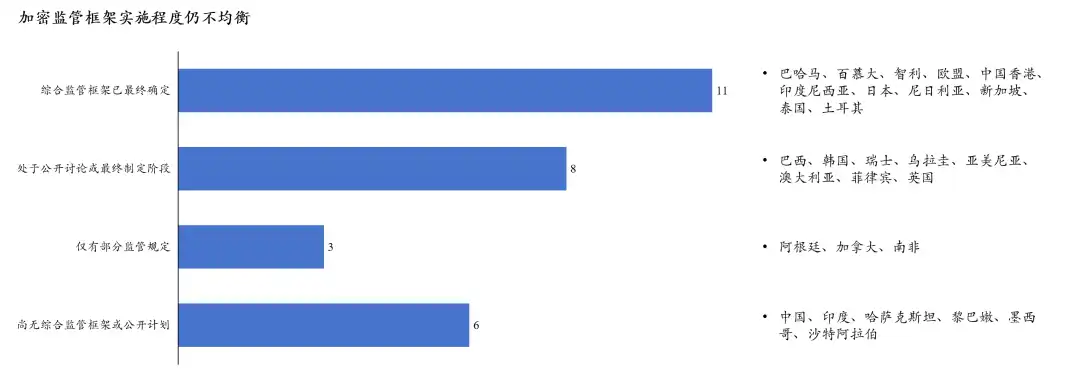
Source: FSB, "Thematic Review on FSB Global Regulatory Framework for Crypto-asset Activities," October 2025.
The FSB conducted a comparable assessment of 28 jurisdictions participating in this peer review (not covering all jurisdictions). The US was not included in the four-stage statistics as it was advancing federal stablecoin legislation and digital asset regulatory policies during the assessment period and did not submit a review questionnaire. However, the report still analyzed US institutional progress based on public information.
2. Represented by MiCA, Licenses Determine Customer Services and Product Continuation
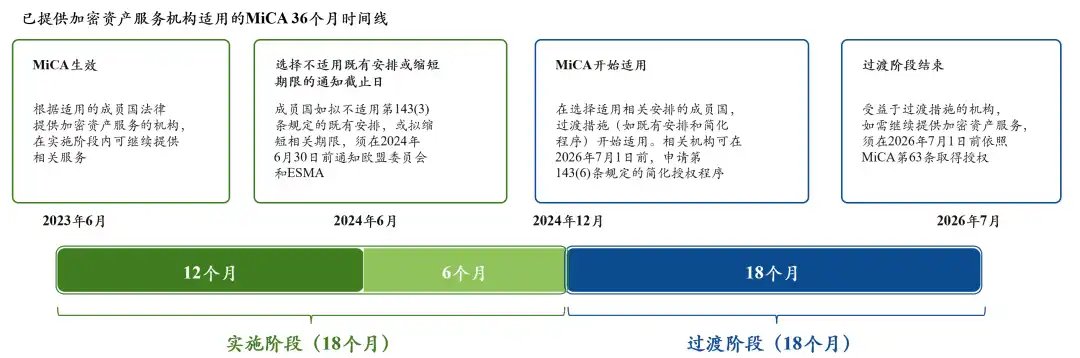
The EU MiCA transition period officially ended on July 1, 2026. ESMA clearly requires entities that continue to provide crypto-asset services to EU customers without MiCA authorization to cease such activities and complete customer migration and business exit in an orderly manner. Regulation has transformed from institutional construction into real operational constraints: a platform's ability to continue acquiring customers, marketing, and providing custody or trading services now depends on its authorization scope and entity arrangements, not merely on historical registration or offshore licenses.
For multinational crypto enterprises, the basic unit of regulatory assessment is also changing. Regulation is shifting from group-wide reviews to entity-specific and business-specific oversight, with different services needing to correspond to specific operating entities and regulatory responsibilities.
3. AML Rule Coverage Increases, Execution and Cross-Border Issues Are Next Stage Focus
FATF's 2026 survey found that 91 out of 109 respondent jurisdictions had enacted laws implementing the Travel Rule, accounting for 83%, an increase from 73% in 2025. However, among the 91 jurisdictions that had enacted legislation, 55 had not yet published inspection conclusions, regulatory directives, or taken relevant enforcement actions. FATF also pointed out that offshore VASPs, non-custodial wallets, P2P transactions, cross-chain tools, and DeFi arrangements remain regulatory challenges.
The EU's Funds Transfer Regulation requires CASPs to transmit payer and payee information in crypto-asset transfers. Australia is phasing in the virtual asset Travel Rule from 2026, requiring institutions to identify counterparties and custodial/non-custodial wallets. For offshore VASPs targeting local customers, some jurisdictions have adopted measures such as mandatory registration, public warnings, app store removals, and restrictions on access to local financial institutions. In the next stage, enterprises will need to address whether their technical systems can exchange payer and payee information, identify cross-border services targeting local residents, and continuously submit complete, consistent, and verifiable data to regulatory authorities.

III. AI Agents Become New Transaction Entities, Machine Payments Reconstruct Transaction Records and Responsibility Chains
1. Stablecoins Provide an Internet-Native Payment Method for AI Agents
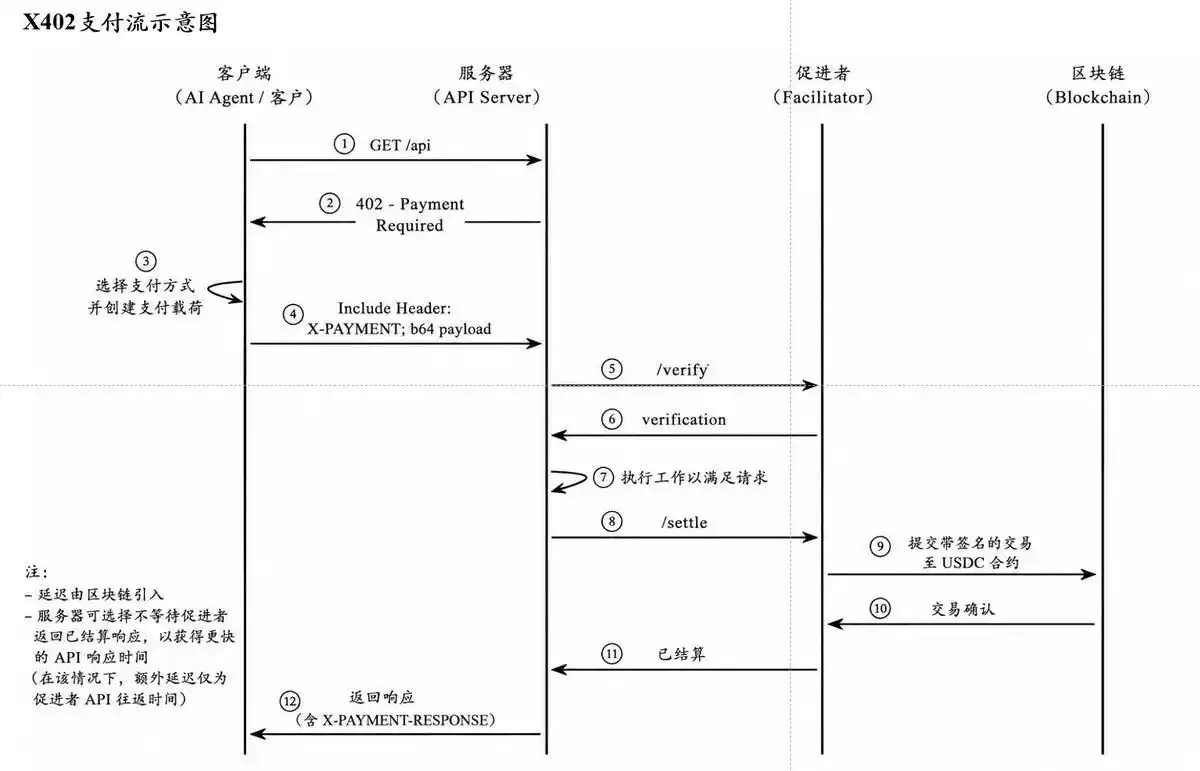
The x402 protocol developed by Coinbase utilizes the HTTP 402 status code, enabling websites or APIs to directly request stablecoin payment upon receiving a request. Clients can complete payment and re-request services without traditional accounts, sessions, or complex authentication processes. This mechanism is suitable for human users and also for AI Agents that need to automatically purchase data, computing power, model inference, or other digital services.
Compared to bank cards and wire transfers, Agent payments are typically characterized by small amounts, high frequency, real-time triggering, and per-use invocation. The programmable transfer and wallet signing mechanisms of stablecoins can be directly integrated with software requests, making them an important technical pathway for machine-to-machine payments.
2. Machine Payments Have Achieved Scale and Exhibit Highly Automated Data Characteristics
Coinbase disclosed in its Q1 2026 results that x402 has cumulatively processed over 100 million payments, with over 99% of transactions using USDC. The x402 official website on July 23, 2026, showed approximately 75.41 million transactions in the last 30 days, with a transaction value of about $24.24 million, involving roughly 94,100 buyers and 22,000 sellers. While the per-transaction amount for machine payments may be low, the number of transactions and participating entities is growing rapidly.
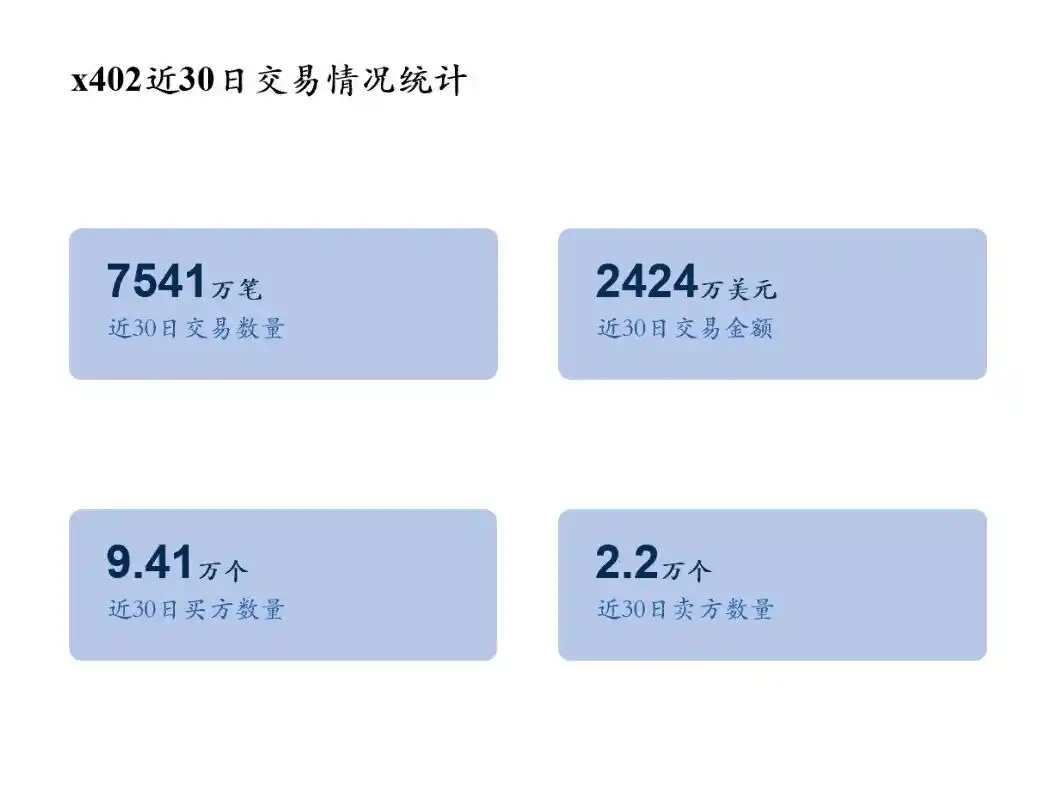
Source: x402.org live page, accessed: July 23, 2026. Metrics change over time.
3. AI Agents Require Redesign of Transaction Authorization, Tax Attribution, and Audit Evidence
When AI Agents autonomously execute transactions on behalf of a company, an on-chain signature can only prove that a particular wallet issued the instruction; it does not automatically prove that the transaction complies with corporate authorization, procurement policies, or tax treatment requirements. At a minimum, companies need to retain records of Agent identity, delegating entity, permission scope, trigger conditions, counterparties, service content, and manual interventions.
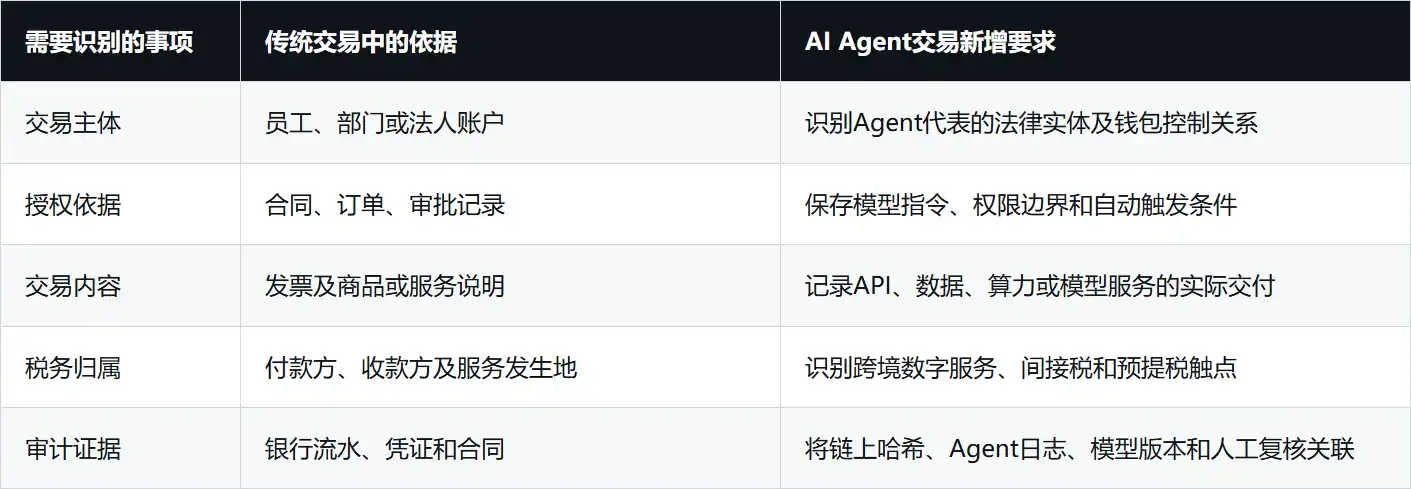
AI can also be used for transaction classification, accounting entry generation, tax event identification, and anomaly detection. However, AI outputs in the tax and finance field must have verifiable data sources, clear judgment rules, complete processing logs, and records of manual adjustments. In the future, companies face a dual task: they must handle the vast volume of machine transactions generated by AI while also proving that the compliance results generated by AI can be audited and reviewed.
IV. Tax Transparency Enters Implementation Phase, Platform Reporting Reshapes Crypto Data Governance
1. CARF Global Implementation Advances, 2026 Becomes Critical Period for System Development and Data Collection
According to the list published by the OECD Global Forum on Transparency and Exchange of Information for Tax Purposes as of June 23, 2026, 76 jurisdictions have formally committed to implementing CARF. Among them, 46 plan the first exchange in 2027, 29 in 2028, and the US plans the first exchange in 2029. For jurisdictions planning the first exchange in 2027, 2026 marks the beginning of the first information collection cycle: competent authorities need to complete domestic legislation and reporting rule implementation, while RCASPs need to initiate user due diligence, transaction classification, data retention, and reporting system modifications. Jurisdictions with first exchanges in 2028 and 2029 will enter their respective preparation stages in the preceding years.
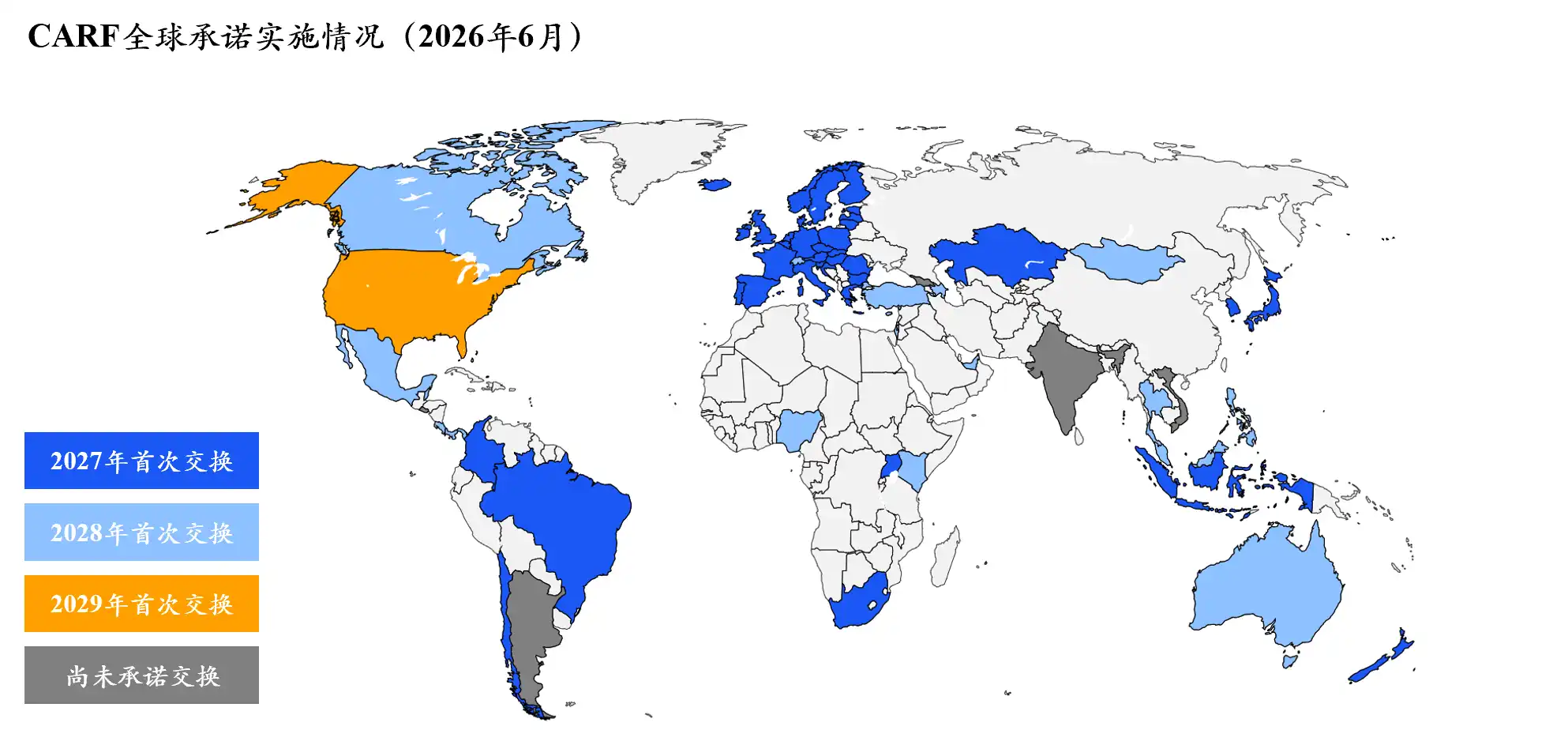
Source: OECD Global Forum on Transparency and Exchange of Information for Tax Purposes, "Jurisdictions committed to implement the CARF," updated June 23, 2026.
2. DAC8 and Form 1099-DA Push Platforms to Assume Direct Reporting Responsibilities
The EU's DAC8 applies from January 1, 2026, incorporating crypto-asset transactions into tax administrative cooperation and automatic information exchange. Reporting Crypto-Asset Service Providers need to identify users and prepare transaction reports. US digital asset brokers need to report transactions via Form 1099-DA: gross proceeds reporting applies to relevant transactions occurring after January 1, 2025, and cost basis reporting for specific covered digital assets gradually applies to transactions occurring after January 1, 2026.
Tax authorities no longer rely solely on individual voluntary disclosure but use platform data to identify taxpayers' asset disposals, income, and cross-border holdings. For platforms, tax obligations are no longer limited to their own corporate income tax but extend to classifying, verifying, and reporting user transactions.
3. Significant Differences Exist Between On-Chain Data and Tax Data
Blockchains can provide addresses, timestamps, token amounts, and transaction hashes but typically cannot directly answer questions like who owns an address, whether a transaction changes ownership, if a transfer is a sale/purchase or internal movement, how cost basis is determined, or which tax residency region a user belongs to. Therefore, tax reporting requires linking on-chain records with platform account information, tax residency self-certification, fiat transaction flows, and product business logic.
When CARF, DAC8, Form 1099-DA, the Travel Rule, corporate accounting, and audits all use the same set of user and transaction data simultaneously, data consistency becomes a new compliance risk. If user identity, asset classification, amounts, and cost basis conflict across different systems, enterprises not only face reporting errors but may also be unable to explain discrepancies between tax returns, financial ledgers, and regulatory reports.
Crypto Compliance Is Becoming Infrastructure
From a crypto tax perspective, the four changes above collectively point to the same trend: crypto business is integrating more deeply into the real-world operational and cross-border regulatory system. Stablecoins expand payment and settlement scenarios, AI Agents increase transaction automation, while regulation and tax systems require that such transactions can be accurately attributed to specific entities and form continuous, verifiable data records.
Against this backdrop, crypto compliance can no longer rely solely on individual legal judgments or year-end filings. Instead, it requires establishing a data and control system that runs throughout daily operations. Only by maintaining consistency across customers, accounts, wallets, transactions, accounting treatments, and reporting calibers can enterprises continuously meet the requirements of cross-border operations, regulatory reporting, and audit verification. In this sense, crypto compliance is becoming a foundational condition supporting ongoing business operations.