OpenAI's Largest Internal Wealth Creation: 600 People Cash Out a Total of $6.6 Billion, 75 Take Home the Maximum $30 Million Each

链捕手Publicado a 2026-05-11Actualizado a 2026-05-11

Resumen

A Wall Street Journal report reveals OpenAI's unprecedented pre-IPO wealth creation. In a single employee stock sale last October, over 600 current and former employees sold shares, collectively cashing out approximately $6.6 billion. Due to high investor demand, the company tripled the individual sale cap to $30 million, with about 75 employees selling the maximum amount. This event represents the largest such transaction in tech industry history for a private company. OpenAI's valuation was $500 billion for this tender offer. Employees with over two years of tenure were eligible, allowing many post-ChatGPT hires their first liquidity event. The company's stock has reportedly grown over 100-fold in seven years. Following a restructuring, employees collectively hold about 26% of OpenAI. The scale of executive wealth is also staggering. In court testimony related to Elon Musk's lawsuit, President and co-founder Greg Brockman confirmed his OpenAI stake is worth around $30 billion. Analysis indicates about 165 current and former employees hold a combined ~$164.9 billion in equity, averaging nearly $1 billion per person in paper wealth. OpenAI's per-employee stock-based compensation is estimated to be 34 times the average of major tech firms before their IPOs. OpenAI continues its rapid ascent, closing a $122 billion funding round at an $852 billion valuation in March. With monthly revenue hitting $2 billion, over 900 million weekly ChatGPT users, and plans for a potential tri...

Author: Claude, Deep Chao TechFlow

Deep Chao Introduction: The Wall Street Journal has revealed the scale of wealth creation inside OpenAI. In an employee stock sale last October, the company raised the individual cash-out cap from $10 million to $30 million. Over 600 current and former employees participated, cashing out a total of $6.6 billion, with about 75 individuals reaching the full $30 million limit each. President Brockman confirmed in court this week that his stake is worth approximately $30 billion. Never in Silicon Valley's history has a pre-IPO company created such a dense concentration of multi-millionaires.

Image source: Wall Street Journal

In the past Silicon Valley, the usual path for ordinary employees to become rich was one: wait for the company to go public. OpenAI is rewriting that rule.

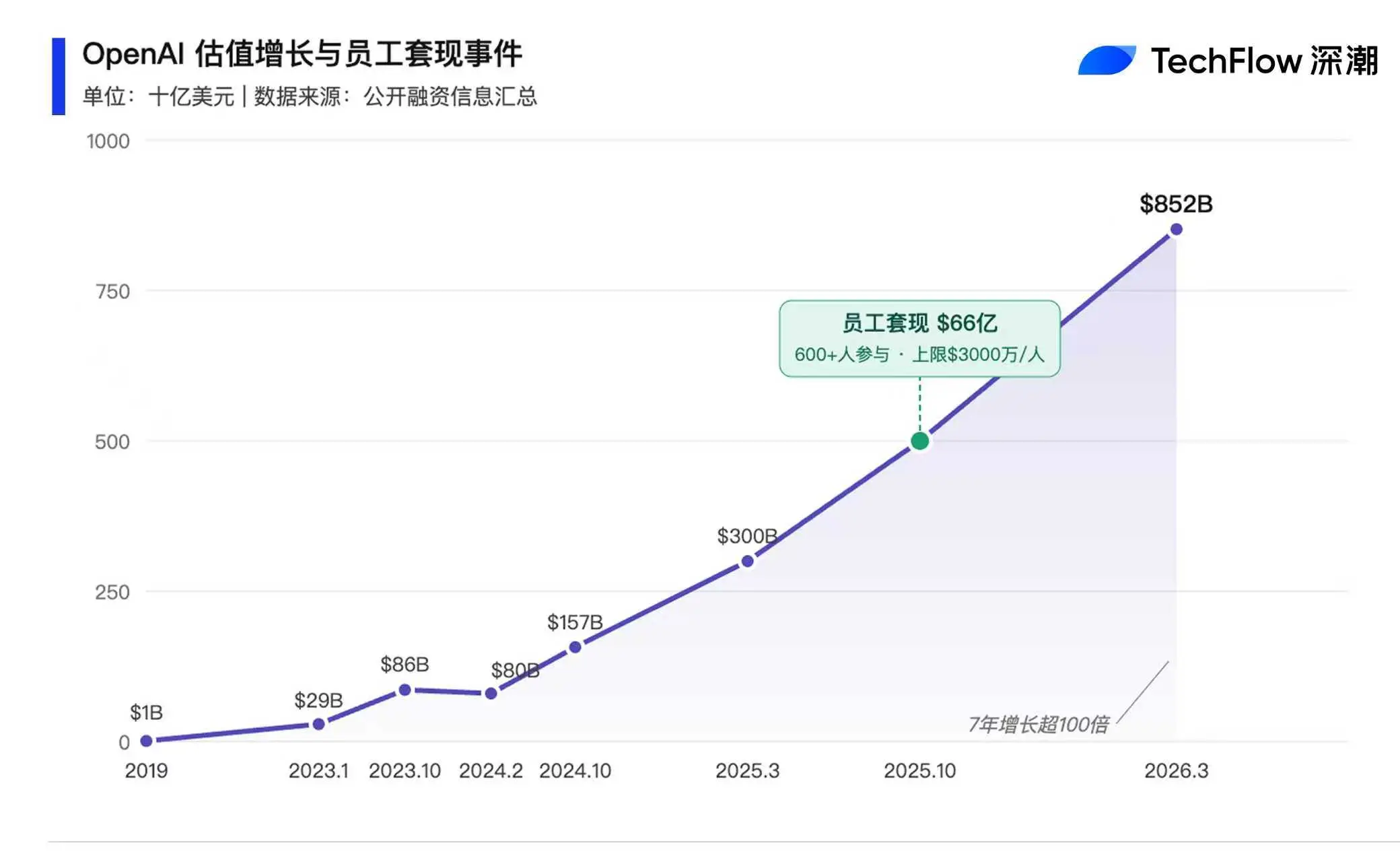
According to The Wall Street Journal, in an internal stock transaction completed last October, OpenAI allowed employees to sell up to $30 million worth of shares each. Over 600 current and former employees participated, cashing out a total of approximately $6.6 billion. Insiders revealed that about 75 of them reached the full $30 million limit each. This is the largest single employee stock sale event in the tech industry to date.

Cash-Out Cap Tripled, External Investor Demand Drove Up Limits

OpenAI originally set a single cash-out cap for employees at $10 million. However, due to external investor demand far exceeding expectations, the company tripled the limit to $30 million last autumn.

The transaction was completed at a valuation of $500 billion, with investors including Thrive Capital, SoftBank, Dragoneer Investment Group, Abu Dhabi MGX, and T. Rowe Price. According to a previous CNBC report, OpenAI initially planned a sale size of about $6 billion, which later expanded to $10.3 billion, but the final transaction settled at about $6.6 billion. Internally, the lower participation rate was interpreted as a vote of confidence by employees in the long-term prospects.

Under OpenAI's rules, employees can sell shares after being with the company for two years. This means many employees who joined only after ChatGPT's launch in late 2022 had their first opportunity to cash out options in this round. OpenAI's stock value has grown over 100 times in the past seven years.
Brockman Confirms $30 Billion Stake in Court, Musk's Lawyer Persistently Questions

The scale of wealth in the hands of executives is even more staggering. According to NBC, OpenAI President and co-founder Greg Brockman confirmed during his court testimony on May 4th that his current OpenAI equity is worth approximately $30 billion.

This figure was disclosed on the fourth day of the Musk v. OpenAI trial. Musk's lawyer, Steven Molo, repeatedly mentioned this number during over two hours of questioning, pressing Brockman on why he had not fulfilled a promised $100,000 donation while sitting on a $30 billion fortune. According to CNBC, Brockman admitted, "It is true, I did not ultimately make the donation."

According to Fortune, Musk's legal team also revealed multi-layered financial connections between Brockman and CEO Sam Altman: Altman provided Brockman with interests worth about $10 million in his family office as early as 2017; Brockman also holds stakes in AI chip startup Cerebras and fusion company Helion Energy. OpenAI had discussed acquiring Cerebras, and Altman has invested hundreds of millions in Helion. Musk's side argues these cross-holdings compromised Brockman's independence as a fiduciary.

Employees Hold 26% Stake, Average Paper Wealth Exceeds Total Returns of Most VC Funds

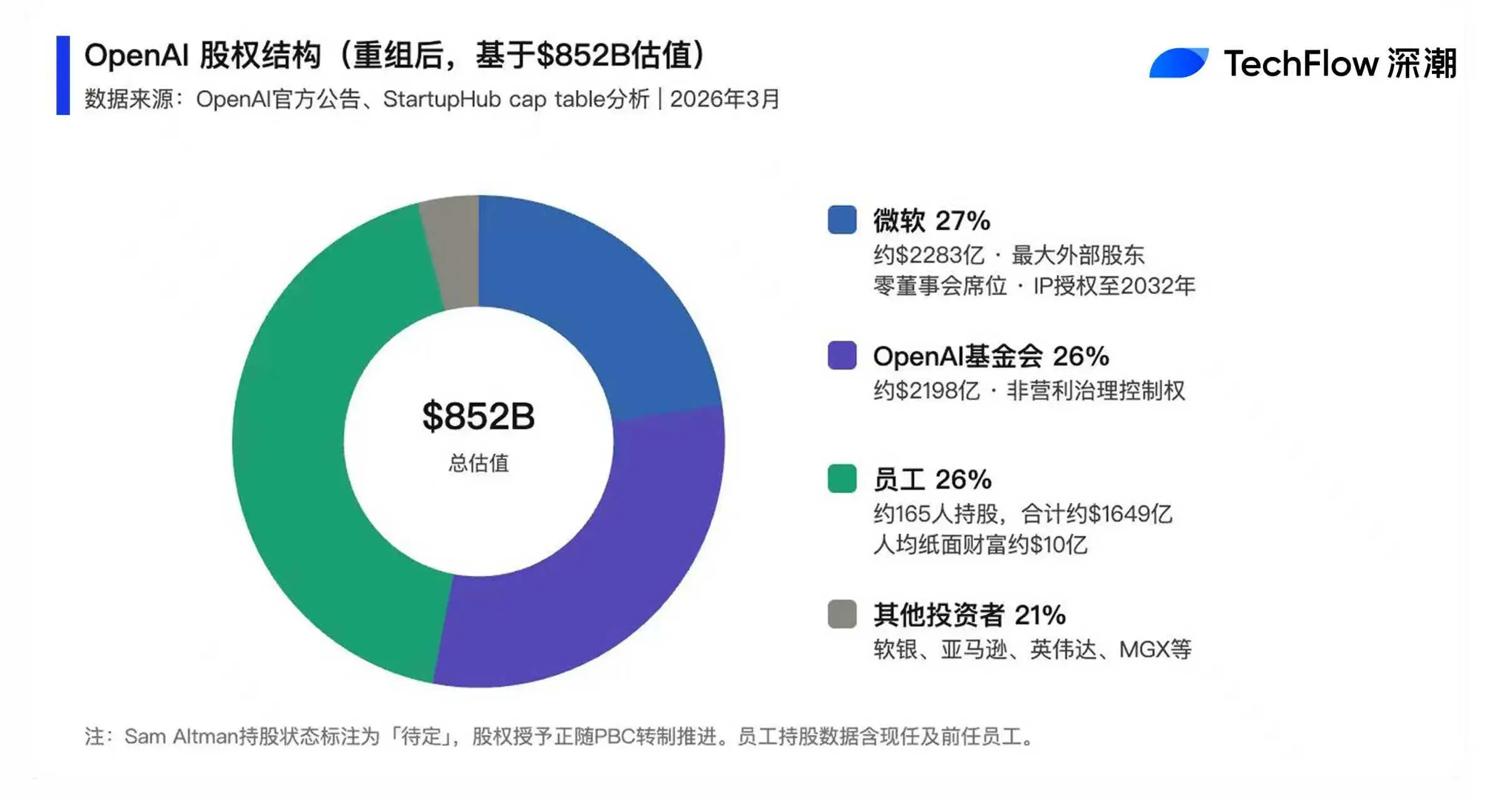
Following a company restructuring completed last October, OpenAI employees collectively hold about 26% of the company's equity.

According to StartupHub's analysis, approximately 165 current and former employees collectively hold equity worth about $164.9 billion, averaging about $1 billion in paper wealth per person, exceeding the total lifetime returns of most venture capital funds.

According to an analysis by The Wall Street Journal and data firm Equilar, OpenAI's per capita stock compensation in 2025 was about $1.5 million, which is over 7 times that of Google's in the year before its 2004 IPO, and 34 times the average of 18 large tech companies in the year before their IPOs over the past 25 years.

The company's equity incentive spending accounts for nearly half of its projected revenue, far exceeding peers like Palantir, Meta, and Salesforce.

$852 Billion Valuation, Trillion-Dollar IPO Ahead, Wealth Creation Machine Far From Stopping

OpenAI completed a $122 billion financing round at an $852 billion valuation on March 31st this year, setting a new record for the largest single private round in Silicon Valley history. Amazon led the investment with $50 billion, while Nvidia and SoftBank each invested $30 billion. The company currently has a monthly revenue of $2 billion, with ChatGPT's weekly active users exceeding 900 million and paid subscribers over 50 million.
According to multiple media reports, OpenAI is preparing to launch an IPO in the fourth quarter of 2026, with a target valuation potentially reaching $1 trillion. If successful, this would become one of the largest tech IPOs in history. CFO Sarah Friar previously stated at Davos that the company plans to allocate a portion of the IPO shares to retail investors.


Preguntas relacionadas

QWhat was the total amount cashed out by OpenAI employees and former employees in the reported stock sale?

AOver 600 current and former employees cashed out a total of approximately $6.6 billion in the reported secondary stock sale.

QTo what amount did OpenAI raise the per-employee cap for the stock sale, and why?

AOpenAI raised the per-employee cap from $10 million to $30 million for the sale due to exceptionally high demand from external investors.

QWhat did OpenAI co-founder Greg Brockman reveal about his OpenAI holdings in court?

ADuring a court testimony, Greg Brockman confirmed that the value of his OpenAI equity holdings is approximately $30 billion.

QWhat is the reported approximate total valuation of OpenAI following its March 2025 funding round?

AFollowing its March 2025 funding round, OpenAI's valuation reached approximately $852 billion.

QWhat is the reported target timeline for OpenAI's potential IPO, and what valuation might it aim for?

AOpenAI is reportedly preparing for a potential IPO in the fourth quarter of 2026, with a target valuation that could reach $1 trillion.

Lecturas Relacionadas

The World Cup is Here: The Battle for Entry into Prediction Markets Has Begun

The 2026 FIFA World Cup has begun, and alongside the on-field competition, a new off-field battleground is emerging: prediction markets. These blockchain-based platforms, which convert crowd wisdom into tradable probabilities, are gaining significant traction. However, their complexity—involving wallets, gas fees, and smart contracts—has historically limited participation to crypto-native users. Centralized exchanges (CEXs), like Gate, are tackling this adoption barrier. By integrating with leading prediction market protocol Polymarket, Gate simplifies the user experience. Users can participate directly with their exchange account and USDT, bypassing complex Web3 steps. Gate offers a streamlined "Prediction Mode" for casual users and a professional "Trading Mode" with advanced tools. Key features include two-way trading (allowing users to buy or sell positions before event resolution), support for diverse markets (sports, crypto, macroeconomics), and a suite of information tools like a "Smart Money" leaderboard, wallet tracking, and AI-powered insights. For the World Cup, Gate launched a dedicated hub aggregating schedules, standings, and relevant markets. This allows fans to seamlessly follow games and trade on outcomes, transforming passive viewing into active participation where they can monetize their predictions and trade on shifting consensus throughout a match. The article argues that prediction markets have proven their value in event forecasting. The next challenge is mass adoption. The competition is shifting from building effective protocols to creating accessible user entry points. By lowering technical barriers and building a complete ecosystem for information and trading, platforms like Gate aim to transition prediction markets from a niche crypto tool to a mainstream platform for expressing and trading on collective intelligence.

Odaily星球日报Hace 11 min(s)

The World Cup is Here: The Battle for Entry into Prediction Markets Has Begun

Odaily星球日报Hace 11 min(s)

Spain Held to a Draw by Cape Verde, Jucom Prediction Market Witnesses Historic Upset

In a major upset at the 2026 FIFA World Cup, tournament favorites Spain were held to a surprising 0-0 draw by debutants Cape Verde in their Group H opener on June 16, Beijing time. Despite dominating possession (74%) and recording 27 shots with an expected goals figure of 2.16, Spain failed to break down a resilient Cape Verde defense, with their 40-year-old goalkeeper Vozinha making 7 saves to earn Man of the Match. Pre-match predictions on the Jucom prediction market had heavily favored Spain, assigning them a 92% win probability. The actual result, a goalless draw, triggered significant volatility across related prediction markets. This outcome forces a market-wide reassessment of several key probabilities, including Spain's likelihood of winning the group and the tournament itself, while Cape Verde's previously near-zero chance of advancing is now being re-evaluated. The event highlights both the efficiency and the inherent limitations of prediction markets. While prices aggregate known information, football's low-scoring, high-variance nature means unquantifiable in-game factors can lead to unlikely results. The core value of such markets lies not in perfect foresight but in their ability to dynamically reflect how new information is incorporated into collective expectations. Platforms like Jucom, which track outcomes from single matches to the final champion, provide a real-time lens into how global consensus evolves with each game.

链捕手Hace 15 min(s)

Spain Held to a Draw by Cape Verde, Jucom Prediction Market Witnesses Historic Upset

链捕手Hace 15 min(s)

Standard Chartered Bank Places a 40x 'Bet', Calls for UNI to Rise to $100

Standard Chartered Bank’s digital asset research head, Geoff Kendrick, initiated coverage on Uniswap with a highly bullish long-term price target of $100 for its UNI token by 2030—a roughly 40-fold increase from its ~$2.60 trading price at the time of the report. The bank’s thesis hinges on the exponential growth of tokenized real-world assets (RWA), projected to surge from ~$340 billion to $4 trillion by 2028. It expects the share of these assets deployed in DeFi to rise from 3.5% to 30%, driving total DeFi TVL to around $2.7 trillion. As the leading decentralized exchange (DEX), Uniswap is positioned to capture a significant portion of this liquidity influx. A key catalyst is Uniswap’s “fee switch,” activated in late 2024, which directs a portion of protocol fees to UNI token buybacks and burns. This transforms UNI from a pure governance token into a yield-generating, deflationary asset, narrowing its valuation gap with centralized exchanges like Coinbase. The report draws an analogy: Coinbase operates like Netflix (centralized, high-cost), while Uniswap functions like YouTube (open, user-generated, network-effect driven). Despite its dominant market share and recent institutional adoption—such as BlackRock’s BUIDL fund and Fidelity’s stablecoin using Uniswap for liquidity—the path faces challenges. Competition from Solana-based DEXs and aggregators threatens user mindshare, while regulatory delays or setbacks in RWA adoption could slow the projected growth. Furthermore, UNI remains down over 92% from its 2021 peak, reflecting persistent market skepticism. Ultimately, Standard Chartered’s report signals a shift in traditional finance’s perception of DeFi, valuing network effects and cash flow potential. However, realizing the $100 target depends on Uniswap successfully navigating intense competition, regulatory hurdles, and the multi-year timeline for massive tokenized asset adoption.

marsbitHace 40 min(s)

Standard Chartered Bank Places a 40x 'Bet', Calls for UNI to Rise to $100

marsbitHace 40 min(s)

Trading

Spot
Futuros

Artículos destacados

Cómo comprar HOME

¡Bienvenido a HTX.com! Hemos hecho que comprar Defi.app (HOME) sea simple y conveniente. Sigue nuestra guía paso a paso para iniciar tu viaje de criptos.Paso 1: crea tu cuenta HTXUtiliza tu correo electrónico o número de teléfono para registrarte y obtener una cuenta gratuita en HTX. Experimenta un proceso de registro sin complicaciones y desbloquea todas las funciones.Obtener mi cuentaPaso 2: ve a Comprar cripto y elige tu método de pagoTarjeta de crédito/débito: usa tu Visa o Mastercard para comprar Defi.app (HOME) al instante.Saldo: utiliza fondos del saldo de tu cuenta HTX para tradear sin problemas.Terceros: hemos agregado métodos de pago populares como Google Pay y Apple Pay para mejorar la comodidad.P2P: tradear directamente con otros usuarios en HTX.Over-the-Counter (OTC): ofrecemos servicios personalizados y tipos de cambio competitivos para los traders.Paso 3: guarda tu Defi.app (HOME)Después de comprar tu Defi.app (HOME), guárdalo en tu cuenta HTX. Alternativamente, puedes enviarlo a otro lugar mediante transferencia blockchain o utilizarlo para tradear otras criptomonedas.Paso 4: tradear Defi.app (HOME)Tradear fácilmente con Defi.app (HOME) en HTX's mercado spot. Simplemente accede a tu cuenta, selecciona tu par de trading, ejecuta tus trades y monitorea en tiempo real. Ofrecemos una experiencia fácil de usar tanto para principiantes como para traders experimentados.

222 Vistas totalesPublicado en 2025.06.10Actualizado en 2026.06.10

Cómo comprar HOME

Discusiones

Bienvenido a la comunidad de HTX. Aquí puedes mantenerte informado sobre los últimos desarrollos de la plataforma y acceder a análisis profesionales del mercado. A continuación se presentan las opiniones de los usuarios sobre el precio de HOME (HOME).

活动图片