Spain Held to a Draw by Cape Verde, Jucom Prediction Market Witnesses Historic Upset

链捕手Publicado a 2026-06-16Actualizado a 2026-06-16

Resumen

In a major upset at the 2026 FIFA World Cup, tournament favorites Spain were held to a surprising 0-0 draw by debutants Cape Verde in their Group H opener on June 16, Beijing time. Despite dominating possession (74%) and recording 27 shots with an expected goals figure of 2.16, Spain failed to break down a resilient Cape Verde defense, with their 40-year-old goalkeeper Vozinha making 7 saves to earn Man of the Match. Pre-match predictions on the Jucom prediction market had heavily favored Spain, assigning them a 92% win probability. The actual result, a goalless draw, triggered significant volatility across related prediction markets. This outcome forces a market-wide reassessment of several key probabilities, including Spain's likelihood of winning the group and the tournament itself, while Cape Verde's previously near-zero chance of advancing is now being re-evaluated. The event highlights both the efficiency and the inherent limitations of prediction markets. While prices aggregate known information, football's low-scoring, high-variance nature means unquantifiable in-game factors can lead to unlikely results. The core value of such markets lies not in perfect foresight but in their ability to dynamically reflect how new information is incorporated into collective expectations. Platforms like Jucom, which track outcomes from single matches to the final champion, provide a real-time lens into how global consensus evolves with each game.

In the early hours of June 16th Beijing time, the biggest upset of the 2026 FIFA World Cup™ H Group's opening round unfolded. Pre-tournament favorites Spain were held to a 0-0 draw by World Cup debutants Cape Verde, despite overwhelming statistical dominance with 27 shots and 74% possession. This was also the first goalless match of the tournament.

Pre-match, global prediction markets were overwhelmingly in favor of a Spanish victory. According to data from the Jucom prediction market, as of June 15th, market funds had priced Spain's win probability as high as 92%, with the draw probability at 6.3% and a shock Cape Verde win at a mere 2.6%. The actual match result, however, stood in stark contrast to this highly convergent market expectation, triggering significant volatility in the prices of all related prediction market topics.

Match Progression vs. Market Expectations

Looking at the match statistics, Spain completed 27 shots, 7 of which were on target, with an expected goals tally of 2.16. Cape Verde had just 27% possession, managing only 5 shots with 1 on target. However, Cape Verde's 40-year-old goalkeeper Vozinha made 7 saves, earning him the Man of the Match award.

Spain's manager, de la Fuente, stated post-match that his team controlled the game but lacked efficiency in front of goal, emphasizing there are still 7 games to play. However, judging from the immediate reaction in the prediction market, market participants' confidence in Spain's subsequent performances has clearly wavered.

Pricing Logic of Prediction Markets in Sporting Events

The core mechanism of prediction markets is to reflect the market's collective judgment on the probability of a specific event through trading prices. In the Spain vs. Cape Verde match, the pre-match 92% win probability meant market participants considered a Spanish victory almost a certainty. However, when a low-probability outcome occurs, all related prediction topics require repricing.

Taking the Jucom prediction market as an example, market expectations in the following dimensions are undergoing significant adjustments after this match:

  • First, Spain's probability of finishing top of the group. Within Group H, Spain was previously considered by the market to have almost no suspense in securing first place. However, after this draw, Spain has only 1 point and still faces Uruguay and Saudi Arabia. The market needs to reassess Spain's competitive position within the group and potential group stage ranking risks.

  • Second, the correlated adjustment to Spain's championship probability. Spain was one of the pre-tournament favorites to win, alongside France. A draw against a lower-ranked team, while not fatal to qualification prospects, prompts the market to re-evaluate the team's offensive efficiency and tournament form. Championship probability pricing will reflect this change.

  • Third, Cape Verde's group stage qualification probability begins to recover from near-zero levels. As a World Cup debutant, Cape Verde secured their historic first point. This result forces the market to reassess the team's competitive potential within Group H, especially given that results from other group matches are not yet fully clear. Expectations for Cape Verde's subsequent matches against Uruguay and Saudi Arabia will also adjust accordingly.

Upset Reveals Market Efficiency and Limitations

The outcome of this match provides a notable case study for participants in prediction markets. When market expectations for a particular result are highly uniform, known information is already fully reflected in the price. However, football matches themselves are characterized by low scoring and high randomness. Factors difficult to quantify before a match—such as on-the-day form, psychological resilience, and marginal referee decisions—can become key variables influencing the actual result.

The value of prediction markets lies not in accurately predicting every single match outcome, but in reflecting, through real-time price changes, how market participants continuously incorporate new information into pricing. Following Spain's draw, the market is rapidly digesting this result and reforming a new consensus regarding Spain's future performances and the Group H qualification picture.

Jucom Prediction Market Reflects Tournament Dynamics in Real-Time

As a prediction market covering numerous dimensions of this World Cup, Jucom provides market trading for topics including single-match results, group stage qualification, knockout round progression, champion prediction, and Golden Boot competition. Users can observe the overall expectations of global market participants regarding tournament developments through price changes.

As the World Cup progresses, the Jucom prediction market is expected to launch more related topics and continue to reflect the adjustments in expectations brought by each match. Spain's draw is just one node in the tournament's progression; subsequent match results will continue to influence market pricing, offering a dynamic perspective on the competition for World Cup followers.

On the pitch, the champion's identity will ultimately be revealed. In the prediction market, the expectations and consensus of global participants are being reshaped in real-time after every single match.


Preguntas relacionadas

QAccording to the Jucom prediction market data mentioned in the article, what was the pre-match probability of Spain winning their World Cup match against Cape Verde?

AAccording to Jucom prediction market data as of June 15th, the market-backed probability of Spain winning was 92%.

QWhat was the key factor in Cape Verde's ability to secure a 0-0 draw against Spain, despite being statistically dominated?

ACape Verde's 40-year-old goalkeeper Vozinha made 7 saves during the match and was subsequently named the player of the match, playing the crucial role in securing the draw.

QWhat three specific areas of market expectations does the article highlight as undergoing significant adjustment after Spain's draw with Cape Verde?

A1. Spain's probability of finishing first in Group H. 2. Spain's probability of winning the World Cup. 3. Cape Verde's probability of advancing from the group stage.

QWhat core principle of prediction markets does the article describe, explaining how they work?

AThe core mechanism of a prediction market is to reflect the collective judgment of the market on the probability of an event occurring through trading prices.

QWhat major event and timeframe does this article report on regarding the Spain vs. Cape Verde match?

AThe article reports on the first Group H match of the 2026 FIFA World Cup, which took place in the early hours of June 16th, Beijing time.

Lecturas Relacionadas

ZEC Price Just Surpassed $490 — Here's What Fueled the Rally

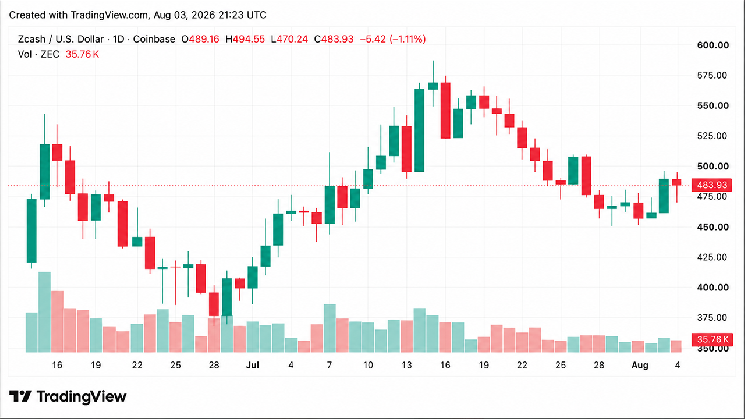
ZEC Surges Past $490, Key Drivers Behind the Rally On August 3, the privacy-focused cryptocurrency Zcash (ZEC) surged nearly 5%, climbing over $20 in a six-hour rally to a session high near $494. This move helped ZEC's market cap reclaim $8 billion, solidifying its position as the most valuable privacy coin and marking an almost 8% gain for the month. While benefiting from a broader market uptrend, ZEC's outperformance was driven by significant fundamental catalysts. The primary driver was the integration by privacy infrastructure project Nym of Zcash's new shielded pool, Ironwood. This enables direct, end-to-end private payments in ZEC for network services, a landmark development for privacy-first decentralized finance. The rally coincides with renewed industry focus on privacy as digital assets mature. Industry observers note privacy is becoming the "next frontier," evolving from Bitcoin's proof-of-concept to Ethereum's programmability and Solana's scalability. Commentary highlighted that true privacy, via zero-knowledge (ZK) technology which is now production-ready, was a foundational goal for early crypto pioneers. Further momentum came from Zcash's progress in decentralized governance, launching a retroactive grant funding (RetroPGF-like) program. This shifts treasury fund distribution from closed committees to direct coin holder voting, pioneering a privacy-native funding mechanism. ZEC's surge helped push the total market capitalization of privacy-focused coins above $30 billion. Other notable gainers included NEAR, ZK, and NOCK. However, losses in coins like ZANO, ZBT, and a significant drop in last week's leader COTI partially offset the sector's overall gains.

cryptonews.ruHace 6 min(s)

ZEC Price Just Surpassed $490 — Here's What Fueled the Rally

cryptonews.ruHace 6 min(s)

Jim Cramer Plans to Dump His Bitcoin, Warns Quantum Firm Will Crack Crypto Soon

CNBC's Jim Cramer announced plans to sell his Bitcoin holdings, citing warnings from IBM's CEO Arvind Krishna that commercially viable quantum computers could break Bitcoin's cryptography within three to four years. This statement triggered the popular "Inverse Cramer" reaction in crypto markets, with many traders viewing it as a bullish signal, and Bitcoin's price remained stable around $63,764. The specific quantum threat targets the ECDSA signature scheme, potentially exposing private keys from public ones for Bitcoin addresses that have been reused or are visible during transaction broadcasts. Researchers estimate around 30% of all BTC, or 6-7 million coins held in older "dormant" wallets, could be vulnerable. While a recent Google Quantum AI paper suggested such an attack might require fewer physical qubits than previously thought, current quantum systems are still orders of magnitude away from the reliable logical qubits needed. Expert timelines for a functional cryptographically relevant quantum computer vary widely, from Krishna's 2028-2029 estimate to more conservative predictions in the 2030s or 2040s. Cramer has a history of shifting his Bitcoin stance, and his latest warning was largely interpreted as a market sentiment indicator rather than a technical analysis. The focus now is on whether Bitcoin's development of quantum-resistant upgrades will outpace the advancement of quantum computing hardware.

cryptonews.ruHace 6 min(s)

Jim Cramer Plans to Dump His Bitcoin, Warns Quantum Firm Will Crack Crypto Soon

cryptonews.ruHace 6 min(s)

Trading

Spot
活动图片