一周代币解锁:ZRO解锁价值约4900万美元代币

marsbitPublicado a 2026-04-18Actualizado a 2026-04-18

Resumen

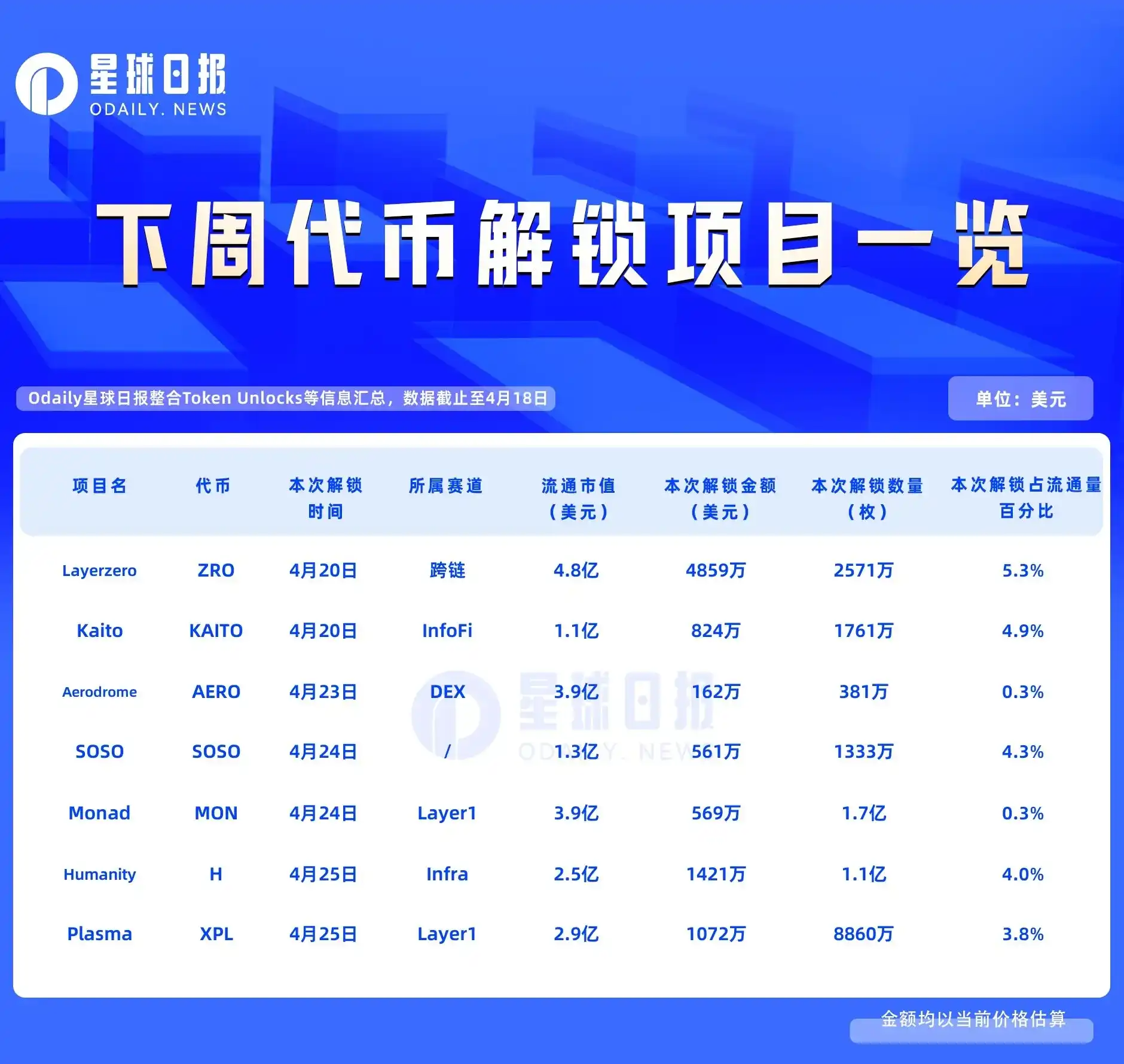
本周多个项目迎来代币解锁,其中LayerZero(ZRO)解锁2571万枚代币,价值约4859万美元,该项目为全链互操作性协议,专注于跨链消息传递。Kaito解锁1761万枚代币,价值约824万美元,是一个AI驱动的Web3信息聚合平台。SoSoValue解锁1333万枚代币,价值约561万美元,提供人工智能投资研究服务。Humanity Protocol解锁1.1亿枚代币,价值约1421美元,致力于人类身份验证和去中心化身份管理。各项目均公布了代币释放曲线。

Layerzero

项目推特:https://x.com/LayerZero_Core

项目官网:https://layerzero.network/

本次解锁数量:2571万枚

本次解锁金额:约4859万美元

LayerZero 是一种全链互操作性协议,专为跨链的轻量级消息传递而设计。LayerZero 提供了可信且有保障的消息传递,并具有可配置的去信任化。

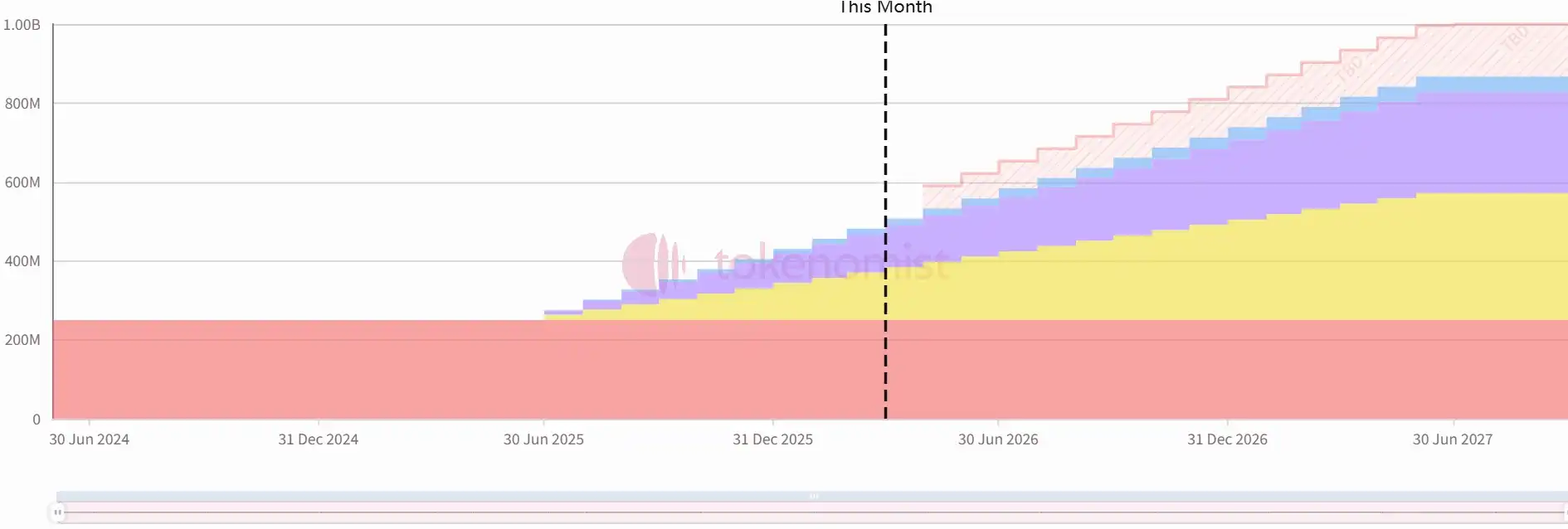
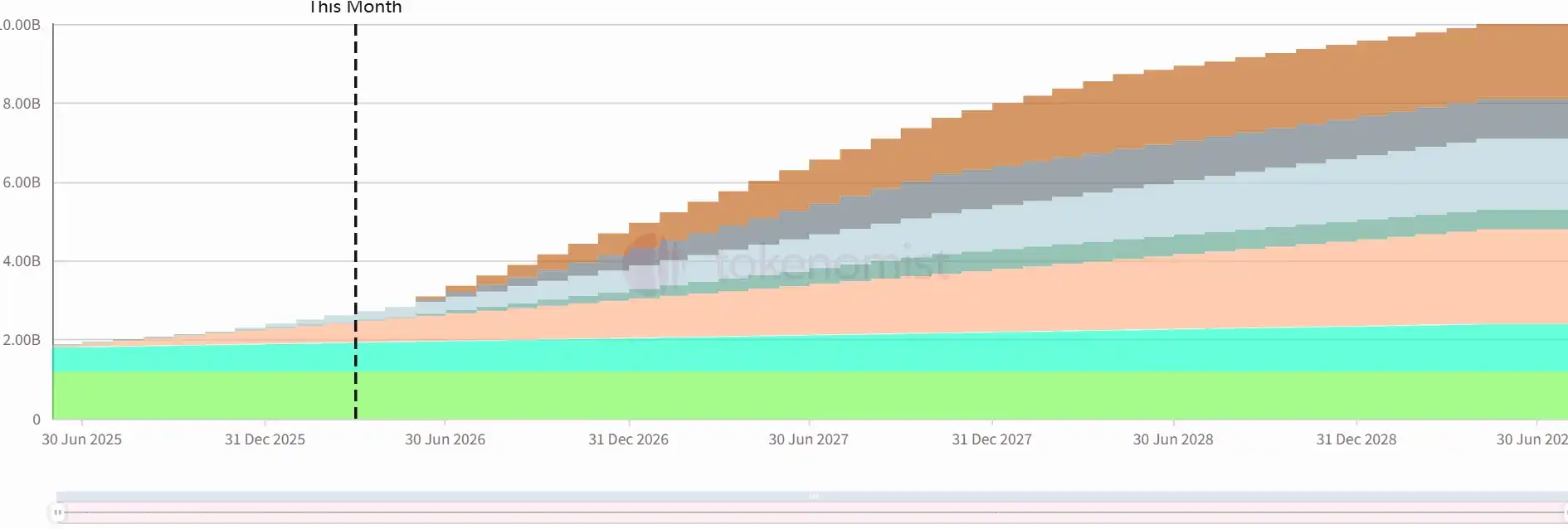
具体释放曲线如下:

Kaito

项目推特:https://x.com/KaitoAI

项目官网:https://www.kaito.ai/

本次解锁数量:1761万枚

本次解锁金额:约824万美元

Kaito是一个AI驱动的Web3信息平台,旨在解决加密行业信息碎片化问题。通过聚合社交媒体、治理论坛等数来源,Kaito利用AI技术提供实时搜索、情绪分析和趋势跟踪。

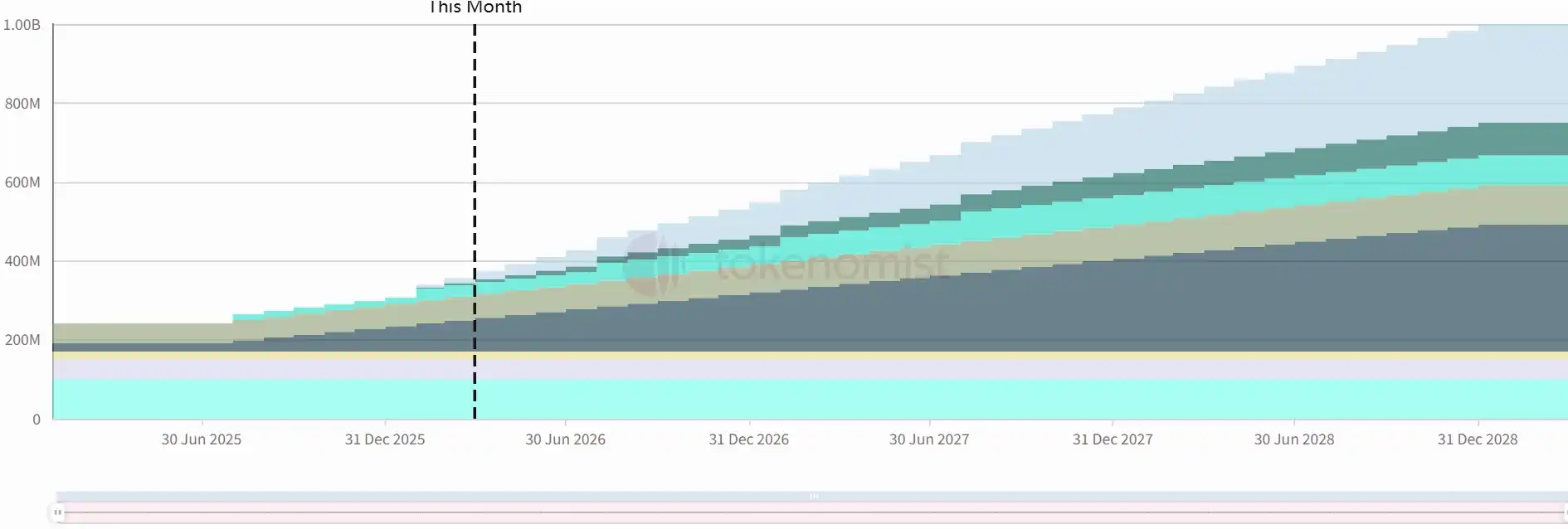
具体释放曲线如下:

SoSoValue

项目推特:https://x.com/SoSoValueCrypto

项目官网:https://sosovalue.com/

本次解锁数量:1333万枚

本次解锁金额:约561万美元

SoSoValue 是一个人工智能驱动的投资研究平台,它将 CeFi 的高效性与 DeFi 的透明性相结合,致力于解决加密货币市场中信息过载和跨链资产管理等挑战。

具体释放曲线如下:

Humanity

项目推特:https://x.com/Humanityprot/

项目官网:https://www.humanity.org/

本次解锁数量:1.1亿枚

本次解锁金额:约1421美元

Humanity Protocol 是一个抗女巫区块链网络,可以为开发人员提供独特的人类身份验证机制,并为用户提供对数据和身份的完整所有权。

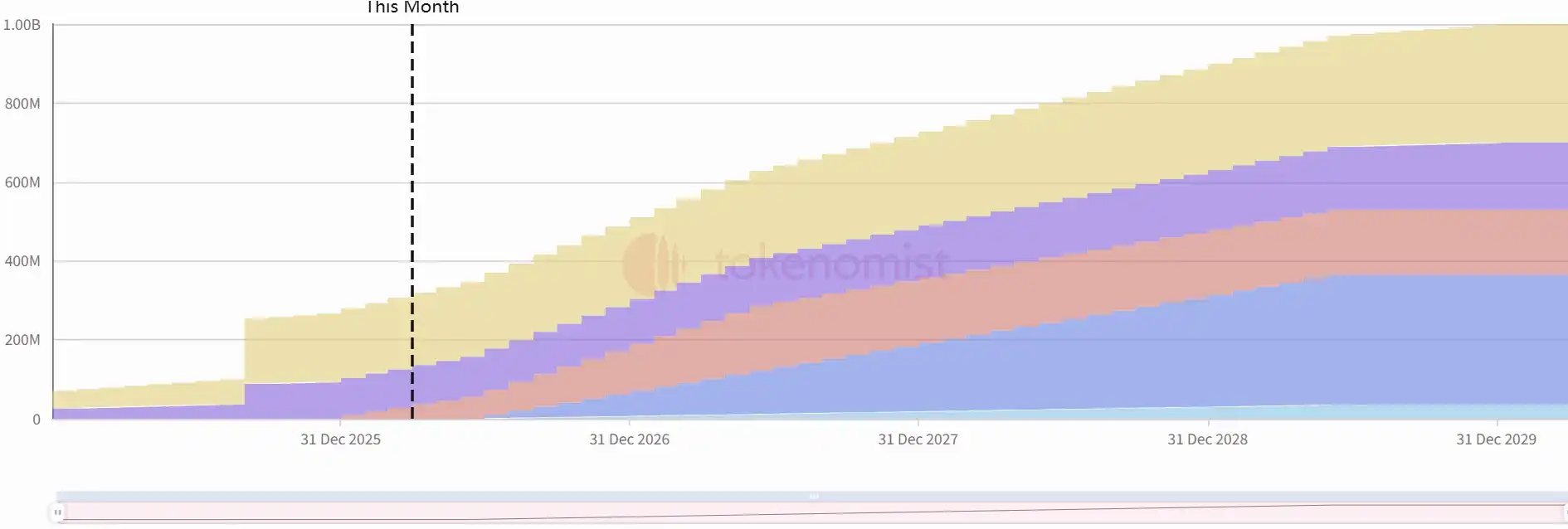
具体释放曲线如下:

Preguntas relacionadas

QLayerZero本次解锁的代币数量和金额是多少?

ALayerZero解锁2571万枚代币,金额约4859万美元。

QKaito项目的主要功能是什么?

AKaito是一个AI驱动的Web3信息平台,通过聚合社交媒体、治理论坛等数据来源,利用AI技术提供实时搜索、情绪分析和趋势跟踪,解决加密行业信息碎片化问题。

QSoSoValue平台结合了哪些金融模式的特点?

ASoSoValue将CeFi的高效性与DeFi的透明性相结合,是一个人工智能驱动的投资研究平台。

QHumanity Protocol的核心技术特点是什么?

AHumanity Protocol是一个抗女巫区块链网络,为开发人员提供独特的人类身份验证机制,并为用户提供对数据和身份的完整所有权。

Q本次解锁中,哪个项目的代币解锁数量最多?

AHumanity Protocol本次解锁1.1亿枚代币,是解锁数量最多的项目。

Lecturas Relacionadas

OpenAI's Hyperliquid Pre-IPO Pricing Venture: Why Did It Last Only Half a Year?

The article discusses the rise and fall of Pre-IPO pricing markets on the Hyperliquid blockchain. Trade.xyz, an anonymous team, successfully built the largest pre-market for SpaceX (SPCX) by launching a contract with a clear anchor: the eventual Nasdaq listing price. This provided inherent price stability and validation. In contrast, Ventuals, a team backed by Paradigm, failed despite holding exclusive contracts for highly sought-after companies like OpenAI and Anthropic. Its key mistake was its pricing mechanism. For companies with no near-term IPO date, Ventuals' oracle relied partly on opaque private market transactions and, critically, partly on its own contract's moving average price. This created a self-referential feedback loop where prices were artificially propped up and detached from genuine supply and demand, leading to illiquid markets. Ventuals shut down after nine months, settling positions at final prices of $1,341.80 for OpenAI and $1,618.90 for Anthropic. Ironically, some employees and late-stage investors of these very companies reportedly used these flawed Ventuals prices for valuation reference, highlighting the acute demand for any price signal in illiquid private markets. The article concludes that while demand for pre-IPO trading is real and growing, with players like Coinbase now entering the space, the fundamental challenge remains: without a public listing to provide a definitive price anchor, these markets struggle to establish truly accurate and liquid pricing. The need for a transparent, self-correcting market is the critical lesson from Ventuals' failure.

marsbitHace 9 min(s)

OpenAI's Hyperliquid Pre-IPO Pricing Venture: Why Did It Last Only Half a Year?

marsbitHace 9 min(s)

With Daily Active Users Reaching 3-4 Times That of the Industry's Second Place, Which Crack in the Office Agent Market Has Tencent's WorkBuddy Torn Open?

Tencent's AI office assistant, WorkBuddy, has achieved daily active users (DAU) 3-4 times that of the industry's second-place product, primarily driven by non-technical users like HR, operations, and administrative staff. Its rapid growth, starting with a public beta in March 2026, highlights a key strategic divergence from competitors like OpenAI's Codex and Anthropic's Claude Code. Unlike those tools, which originated as developer-focused assistants (in command lines or IDEs) and are now expanding towards office scenarios, WorkBuddy was built from the ground up for non-technical office workers. Its development was user-driven, initiated after腾讯云's team observed non-technical employees using their CodeBuddy coding tool for general tasks. WorkBuddy's design is defined by three core decisions aimed at lowering barriers: 1) Using natural language instead of technical concepts, so users describe their goal without needing to understand prompts or agents. 2) Providing pre-packaged "Skill" templates for common office tasks like data processing, content creation, and research. 3) Natively integrating into existing腾讯 ecosystems like腾讯 Docs and WeChat, making the agent a seamless part of the user's workflow rather than a separate tool. This "scenario encapsulation" approach, prioritizing the shortest path for users to get work done, contrasts with the "underlying capability" focus of Codex and Claude, which offer more flexibility but require more technical setup. Analysts confirm WorkBuddy's leading market position in China by mid-2026, with massive user and request growth following its launch. Recognizing the same trend of surging non-technical adoption, OpenAI and Anthropic are now pivoting their products with features like role-based plugins (Codex) and a simplified desktop interface (Claude Cowork). However, adapting tools built for developers requires significant changes to interaction models and integrations. WorkBuddy currently holds an estimated six-month lead in delivering a complete solution for non-technical office users. Its recently launched enterprise version aims to solidify this advantage. The competition underscores two valid paths: embedding agent capabilities directly into familiar work environments versus building powerful, general-purpose agents that users must learn to access. WorkBuddy's early success demonstrates the effectiveness of the former strategy for mainstream office adoption.

marsbitHace 17 min(s)

With Daily Active Users Reaching 3-4 Times That of the Industry's Second Place, Which Crack in the Office Agent Market Has Tencent's WorkBuddy Torn Open?

marsbitHace 17 min(s)

Dalio's Latest Warning: Don't Get Carried Away by AI, Real Returns on US Stocks in the Next 5-10 Years Could Be -5% to -10%

Ray Dalio, founder of Bridgewater Associates, warns investors against excessive concentration in AI stocks. He argues the current market, dominated by a few AI giants, mirrors historical patterns where revolutionary new technologies lead to high risk, volatility, and uncertainty. While acknowledging AI's transformative potential, Dalio emphasizes that most investors fail at this stage of the cycle by over-concentrating in a handful of leading companies. He cites inherent risks: companies cannot accurately forecast investment needs or external shocks (e.g., monetary policy, geopolitics, taxes), face potential disruption from future technologies and international competition (notably from China), and experience significant price swings. Dalio's core advice is diversification, calling it his "Holy Grail of Investing." He presents a mathematical case that a well-diversified portfolio of 15-20 uncorrelated, good bets offers a superior risk-adjusted return compared to a concentrated position. Dalio also offers a cautious outlook, suggesting U.S. stocks may deliver real returns of -5% to -10% over the next 5-10 years based on valuation and bubble indicators. He concludes that in the face of high uncertainty, the prudent strategy is not to avoid betting entirely, but to avoid large, concentrated bets where one lacks sufficient informational edge. Instead, investors should build a strategically balanced, diversified portfolio.

marsbitHace 1 hora(s)

Dalio's Latest Warning: Don't Get Carried Away by AI, Real Returns on US Stocks in the Next 5-10 Years Could Be -5% to -10%

marsbitHace 1 hora(s)

Trading

Spot
Futuros

Artículos destacados

Cómo comprar ZRO

¡Bienvenido a HTX.com! Hemos hecho que comprar LayerZero (ZRO) sea simple y conveniente. Sigue nuestra guía paso a paso para iniciar tu viaje de criptos.Paso 1: crea tu cuenta HTXUtiliza tu correo electrónico o número de teléfono para registrarte y obtener una cuenta gratuita en HTX. Experimenta un proceso de registro sin complicaciones y desbloquea todas las funciones.Obtener mi cuentaPaso 2: ve a Comprar cripto y elige tu método de pagoTarjeta de crédito/débito: usa tu Visa o Mastercard para comprar LayerZero (ZRO) al instante.Saldo: utiliza fondos del saldo de tu cuenta HTX para tradear sin problemas.Terceros: hemos agregado métodos de pago populares como Google Pay y Apple Pay para mejorar la comodidad.P2P: tradear directamente con otros usuarios en HTX.Over-the-Counter (OTC): ofrecemos servicios personalizados y tipos de cambio competitivos para los traders.Paso 3: guarda tu LayerZero (ZRO)Después de comprar tu LayerZero (ZRO), guárdalo en tu cuenta HTX. Alternativamente, puedes enviarlo a otro lugar mediante transferencia blockchain o utilizarlo para tradear otras criptomonedas.Paso 4: tradear LayerZero (ZRO)Tradear fácilmente con LayerZero (ZRO) en HTX's mercado spot. Simplemente accede a tu cuenta, selecciona tu par de trading, ejecuta tus trades y monitorea en tiempo real. Ofrecemos una experiencia fácil de usar tanto para principiantes como para traders experimentados.

212 Vistas totalesPublicado en 2024.12.10Actualizado en 2026.06.02

Cómo comprar ZRO

Discusiones

Bienvenido a la comunidad de HTX. Aquí puedes mantenerte informado sobre los últimos desarrollos de la plataforma y acceder a análisis profesionales del mercado. A continuación se presentan las opiniones de los usuarios sobre el precio de ZRO (ZRO).

活动图片