$407M in buybacks remove 15% of PUMP’s supply – $0.001698 is in sight

ambcryptoPublicado a 2026-07-13Actualizado a 2026-07-13

Resumen

The Pump.fun platform is generating substantial revenue, with annualized earnings reaching $344 million and approximately $944,000 per day. Over $407 million has been used to buy back and remove 15% of the PUMP token's circulating supply, creating consistent demand. The platform maintains strong daily user activity, supporting this buyback model. Technically, the token's price has broken past key resistance and, with indicators suggesting an oversold condition, a continued bullish move toward the next target of $0.001698 is possible. The sustained revenue stream and ongoing supply reduction are key factors for potential future price appreciation.

The Pump.fun business model is making profits at a much quicker pace than it is spending on narratives. According to the recent data, the platform’s annualized revenue has hit $344 million, with the network earning approximately $944,000 every day for the past three months.

Meanwhile, more than $407 million worth of PUMP tokens have already been bought back and removed from circulation.

In simple terms, PUMP is no longer relying solely on speculation. The platform is generating enough cash flow to consistently return value to token holders.


Source: Pump.fun

Approximately half of the revenue is returning

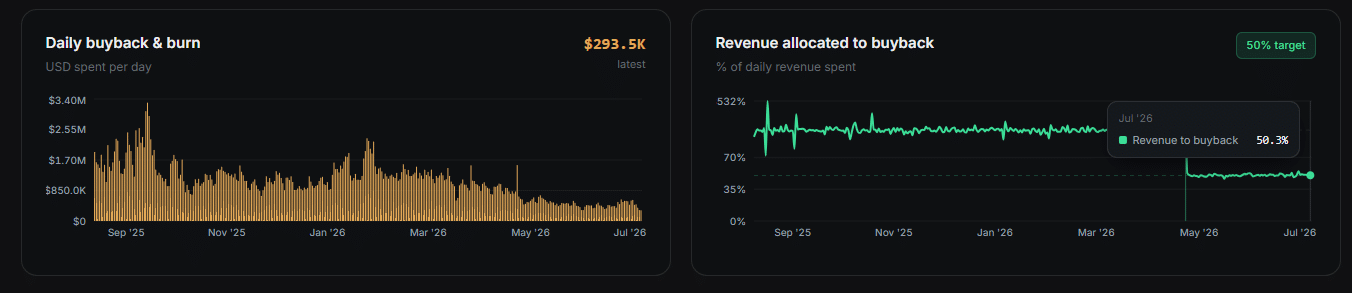
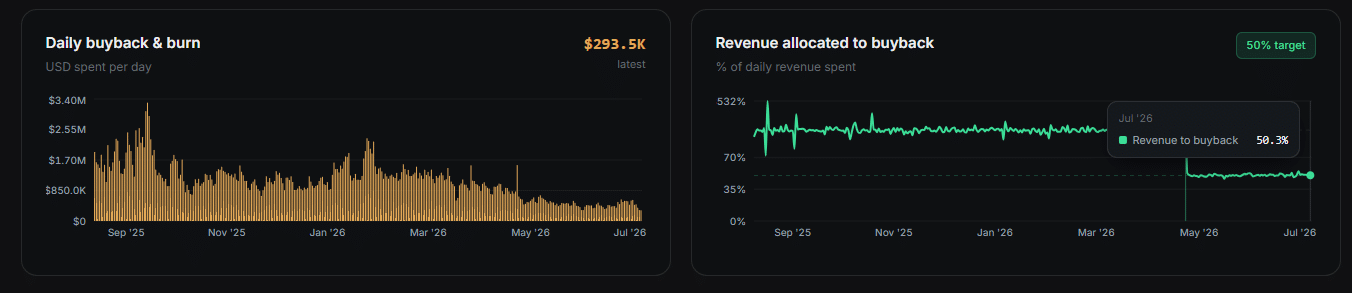
According to AMBCrypto’s close analysis on the network data, over 50% of its revenue is allocated to token buybacks. This cements the network’s long-term project of reducing circulating supply while at the same time boosting its volatility.

Every day when the platform generates income, some part of the income is spent on buying PUMP coins from the market before destroying them.

The impact of the process has been significant. Up until now, 149 billion PUMP tokens have been destroyed, thereby covering almost 15 percent of the entire circulating supply.

The process does not guarantee higher prices. However, it creates a steady source of demand regardless of broader market conditions.
Source: Pump.fun

How are network users reacting to the developments?

Normally, buybacks are only effective if the underlying business continues generating revenue. At least for now, that does not seem to be the case.

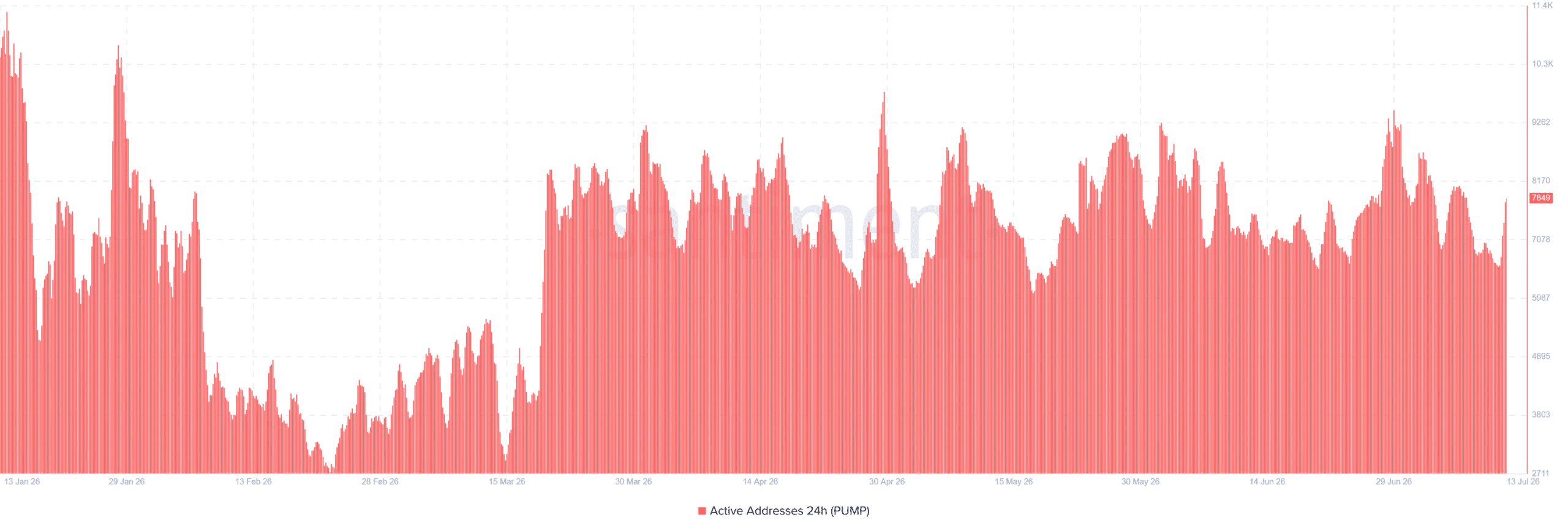
The number of active addresses is still high. In most cases, it has exceeded 7,000 users per day throughout the past few months. The consistency matters since it suggests that the platform’s revenue is being supported by actual network activity rather than a short-lived spike in trading volume.

In other words, the allocation of a bigger proportion of revenue on buyback seems to bear some fruit. If the activity sustains, the current bullish momentum could be accelerated.
Source: Santiment

Is $0.001698 next for PUMP?

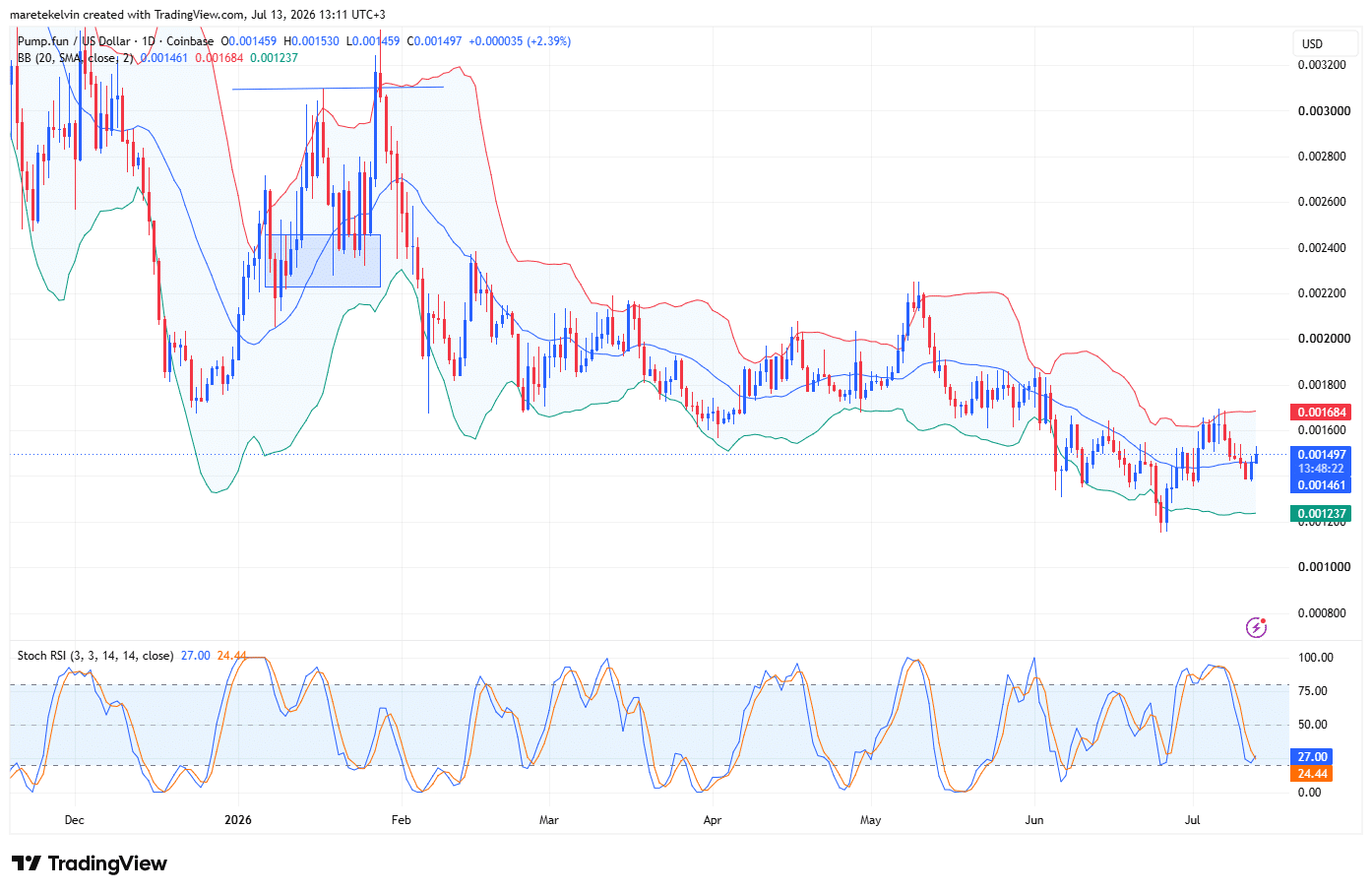
On the daily chart, the token’s price action has just broken past the 20-period Simple Moving Average (20 SMA). The Bollinger Band’s divergence is wide enough, suggesting that the market still has more volatility for a potential explosive move. But the direction is not clear.

However, with the token Stochastic RSI now dropping below 25, which often points to an oversold market, the current bullish push could be prolonged. At press time the token had recorded a 10% surge and was trading at around $0.001495.

The resistance level at $0.001698 stands as the next target for the market buyer if the current bullish run is sustained.

All in all, Pump.fun is already generating nearly $1 million per day. If that pace continues, buybacks will continue removing supply regardless of short-term market sentiment. When combined with positive technicals, the projected bullish run continuation nears certainty.
Source: TradingView

Final Summary

  • Pump.fun’s annualized revenue has surged to $344 million, with the platform generating nearly $944,000 per day over the past three months.
  • More than $407 million has been allocated to buybacks, removing nearly 15% of PUMP’s total supply from circulation.


Criptos en tendencia

Preguntas relacionadas

QWhat is the current annualized revenue of Pump.fun and its daily revenue over the past three months?

APump.fun's annualized revenue has reached $344 million, with the platform earning approximately $944,000 per day over the past three months.

QHow much value has been spent on PUMP token buybacks, and what percentage of the supply has been removed?

AOver $407 million has been spent on PUMP token buybacks, removing nearly 15% of the token's total supply from circulation.

QWhat is the significance of the ongoing buyback program for the PUMP token, according to the article?

AThe buyback program creates a steady source of demand for PUMP by permanently removing tokens from circulation, returning value to holders and potentially boosting price volatility. It shifts the token's value proposition away from pure speculation.

QWhat technical indicator suggests the PUMP market might be oversold, and what is the next key resistance level mentioned?

AThe Stochastic RSI dropping below 25 suggests the market might be oversold. The next key resistance level for PUMP is $0.001698 if the current bullish momentum is sustained.

QWhat does the consistency in active addresses (over 7,000 per day) indicate about Pump.fun's revenue?

AThe consistent high number of active addresses suggests that the platform's substantial revenue is supported by genuine, sustained network activity rather than just short-lived spikes in trading volume.

Lecturas Relacionadas

Vitalik Updates Ethereum Roadmap: From Merge to 'Lean Refactoring', with STARK, AI, and Privacy Reshaping the Technical Foundation

Vitalik Buterin has updated Ethereum's long-term roadmap, outlining a major shift from the post-Merge evolution toward a "Lean Ethereum" vision. The update builds on the 2023 framework but reorders priorities and introduces new concepts. Key continuations include improving consensus (single-slot finality), scaling data availability (larger blobs), simplifying light client verification with SNARKs/STARKs, and protocol simplification. Major adjustments involve significantly prioritizing quantum resistance due to heightened perceived threats, while deprioritizing items like VDFs and some EVM improvements. Technical replacements are planned, such as moving from Verkle trees to a unified Binary Tree and eventually PBTs, and rethinking state management with "New State Types." Notable new additions are: 1. Making **privacy a top-tier priority**, aiming to build it natively into the protocol. 2. **Radical scaling under post-quantum conditions**, using techniques like leanSPHINCS signatures and zkzk frames. 3. **Protocol "Lean-ification" and formal verification**, leveraging modern AI tools to make full formal verification feasible. 4. Exploring **Blob and Gas futures** for future capacity. 5. Developing **Native Rollups**, deeply integrating rollup capabilities into the protocol. 6. **Reimagining the EVM's future**, potentially exposing a simpler, modern instruction set (e.g., leanISA or RISC-V), with EVM becoming a compatibility layer. The core philosophy shifts toward specializing mechanisms for high-load activities (transfers, swaps, privacy) to gain scalability, rather than attempting to infinitely scale all activities. It also elevates **recursive STARKs and AI-assisted formal verification** as foundational infrastructure. In summary, Ethereum is embarking on a systemic "third-generation" redesign—Lean Ethereum—involving replacements or rewrites of major components. The goal is to achieve a quantum-safe, privacy-first, secure, decentralized, and highly scalable network while maintaining a lean and verifiable protocol.

marsbitHace 27 min(s)

Vitalik Updates Ethereum Roadmap: From Merge to 'Lean Refactoring', with STARK, AI, and Privacy Reshaping the Technical Foundation

marsbitHace 27 min(s)

China Monopolizes the Humanoid Market: The U.S. Is Forced to Defend Itself

China's Humanoid Robot Market Domination and US Response According to a report by Smart Analytics Global (SAG), Chinese manufacturers supplied over 97% of the global humanoid robot shipments (approximately 19,100 units) in the first half of 2026, a 272% year-on-year increase. Shanghai-based AGIBOT led with a 44% market share, followed by Unitree Robotics with 31%. Together, these two firms accounted for about 75% of global shipments. China itself represented over 85% of global demand for these devices, with industrial and commercial applications now comprising more than 70% of shipments. Key factors driving China's leadership include strong state support, abundant funding, expanding production capacity, IPO waves for developers, and a vast manufacturing ecosystem for rapid testing and deployment. Furthermore, over 90% of key components for humanoid robots are now sourced domestically. In response, the US Federal Communications Commission (FCC) banned federal agencies and subsidy recipients from purchasing or using foreign "advanced robotic devices," including humanoid and quadruped robots, citing national security concerns in July 2026. SAG forecasts global shipments to approach 60,000 units for full-year 2026, with industry revenue around $1.6 billion, projecting 500,000 units by 2030. The analysis notes potential challenges for Chinese expansion, such as reputational risks from alleged ties to China's defense sector and the precedent of trade disputes seen in solar panels and batteries, potentially triggered by the current low average robot price.

cryptonews.ruHace 45 min(s)

China Monopolizes the Humanoid Market: The U.S. Is Forced to Defend Itself

cryptonews.ruHace 45 min(s)

What's New in Ethereum's Roadmap: Privacy, Quantum Security, Native Rollup?

On August 10, 2024, Ethereum co-founder Vitalik Buterin revealed an updated technical roadmap, highlighting significant changes in priorities and new focus areas. Key new additions include: - **Strong Privacy Protection**: Elevated to a top-tier protocol concern. Proposals like EIP-8250 (keyed nonces for concurrency), EIP-8272 (recent roots for verification), and EIP-8182 (shared protocol-level privacy pools) aim to enable private transfers of ETH and ERC-20s, moving toward default private accounts. - **Quantum Resilience**: Priority increased. The plan addresses risks to ECDSA/BLS signatures, KZG commitments, and ZK systems, exploring solutions like leanSPHINCS signatures, STARK proofs (considered quantum-resistant), and streamlined verification processes. A full L1 upgrade is tentatively targeted for ~2029. - **Native Rollups**: A novel concept where rollups could reuse Ethereum's core validation infrastructure via a new EXECUTE precompile (EIP-8079 draft). This aims to reduce custom code and enhance security for certain L2s, while specialized chains will continue to exist. - **Protocol Simplification & Formal Verification**: Leveraging AI tools to make full-protocol formal verification feasible, aiming for more rigorous and machine-verifiable specifications. Other notable shifts: - State storage is evolving from Verkle trees to a Partitioned Binary Tree (PBT, EIP-8347 draft). - Some 2023 items like VDFs and certain EVM improvements were deprioritized. - Long-term discussions include blob/gas futures and non-EVM instruction sets (e.g., RISC-V). The "Strawmap" outlines potential upgrades through ~2029 but is a directional guide, not a firm timeline. Key milestones to watch include the Glamsterdam (Q4 2026) and Hegotá (2027) forks. Many proposals remain in draft or research phases.

marsbitHace 1 hora(s)

What's New in Ethereum's Roadmap: Privacy, Quantum Security, Native Rollup?

marsbitHace 1 hora(s)

Hyperliquid Trading Volume Soars, So Why Are Profits Falling?

Hyperliquid, a leading decentralized perpetuals trading platform, has seen its open interest surge to a record high above $11 billion, capturing roughly 9% of the global market share. Trading volume remains robust, nearing $178 billion over 30 days, driven largely by the explosive growth of third-party markets offering tokenized real-world assets (RWAs) like stocks and commodities. Despite this growth, the platform's protocol revenue has declined for four consecutive quarters, falling 43% from its Q3 2025 peak of $357 million to approximately $202 million in Q2 2026. This divergence is primarily attributed to the HIP-3 governance proposal, which allows external developers to launch their own markets and keep up to half of the generated fees. These third-party markets now account for nearly 50% of total volume. Consequently, the share of revenue redistributed to developers, market makers, and the treasury has tripled from 6% to 18% in a year. This directly reduces the funds allocated to the platform's buyback-and-burn mechanism for its native HYPE token, weakening a key price support. HYPE's price has fallen 28% from its all-time high. The platform's growth is also heavily concentrated, with a single entity, Trade.xyz, responsible for over 90% of HIP-3 open interest, introducing systemic risk. Additionally, the ecosystem lacks diversity beyond HYPE, faces ongoing token unlocks adding sell pressure, and is encountering increased regulatory scrutiny and new competition from platforms like Robinhood Chain. While still a major revenue generator in crypto, Hyperliquid's model of sharing fees to fuel expansion is currently compressing its own earnings and token economics.

marsbitHace 1 hora(s)

Hyperliquid Trading Volume Soars, So Why Are Profits Falling?

marsbitHace 1 hora(s)

Trading

Spot

Artículos destacados

Cómo comprar PUMP

¡Bienvenido a HTX.com! Hemos hecho que comprar Pump.fun (PUMP) sea simple y conveniente. Sigue nuestra guía paso a paso para iniciar tu viaje de criptos.Paso 1: crea tu cuenta HTXUtiliza tu correo electrónico o número de teléfono para registrarte y obtener una cuenta gratuita en HTX. Experimenta un proceso de registro sin complicaciones y desbloquea todas las funciones.Obtener mi cuentaPaso 2: ve a Comprar cripto y elige tu método de pagoTarjeta de crédito/débito: usa tu Visa o Mastercard para comprar Pump.fun (PUMP) al instante.Saldo: utiliza fondos del saldo de tu cuenta HTX para tradear sin problemas.Terceros: hemos agregado métodos de pago populares como Google Pay y Apple Pay para mejorar la comodidad.P2P: tradear directamente con otros usuarios en HTX.Over-the-Counter (OTC): ofrecemos servicios personalizados y tipos de cambio competitivos para los traders.Paso 3: guarda tu Pump.fun (PUMP)Después de comprar tu Pump.fun (PUMP), guárdalo en tu cuenta HTX. Alternativamente, puedes enviarlo a otro lugar mediante transferencia blockchain o utilizarlo para tradear otras criptomonedas.Paso 4: tradear Pump.fun (PUMP)Tradear fácilmente con Pump.fun (PUMP) en HTX's mercado spot. Simplemente accede a tu cuenta, selecciona tu par de trading, ejecuta tus trades y monitorea en tiempo real. Ofrecemos una experiencia fácil de usar tanto para principiantes como para traders experimentados.

389 Vistas totalesPublicado en 2024.12.12Actualizado en 2026.07.09

Cómo comprar PUMP

Discusiones

Bienvenido a la comunidad de HTX. Aquí puedes mantenerte informado sobre los últimos desarrollos de la plataforma y acceder a análisis profesionales del mercado. A continuación se presentan las opiniones de los usuarios sobre el precio de PUMP (PUMP).

活动图片