Ethena rallies 14.5% in a day, but THIS will limit further gains

ambcryptoPublicado a 2026-04-09Actualizado a 2026-04-09

Resumen

Ethena (ENA) rallied 14.6% in 24 hours, extending gains from earlier in the week, partly driven by a broader crypto market boost following former President Trump's ceasefire announcement. The project's plan to diversify its USDe stablecoin reserves into non-crypto assets has also contributed to positive momentum, aiming to address declining yields and supply since the October 2025 market downturn. Despite the recent surge, ENA's overall trend remains bearish. Technical analysis on the 1-day chart shows lower highs, with the RSI below 50 and declining OBV, indicating sustained selling pressure. The price has struggled to break the key $0.095-$0.10 resistance zone, where a cluster of short liquidations is located. The 4-hour chart structure is also bearish, and a break above $0.095 is needed to shift momentum bullishly. Traders are advised to consider taking profits near current levels, as the relief rally may be over, and a downward move could follow. The resistance band remains a significant barrier to further gains.

Ethena [ENA] has rallied 14.6% over the past 24 hours, extending the gains it made on Monday, the 6th of April. The crypto market saw a bullish boost from the short liquidations that followed President Trump’s ceasefire announcement.

Ethena plans to diversify its USDe reserve assets into non-crypto assets, which is why ENA has been rallying even before the announcement. The crypto rout since October 2025 saw declining USDe supply and yield.

The protocol’s founder, Gary Young, had said that Ethena was poorly positioned since that crash. Including non-crypto reserve assets will boost its falling yield and aid market performance.

ENA’s trend remains bearishly poised
Source: ENA/USDT on TradingView

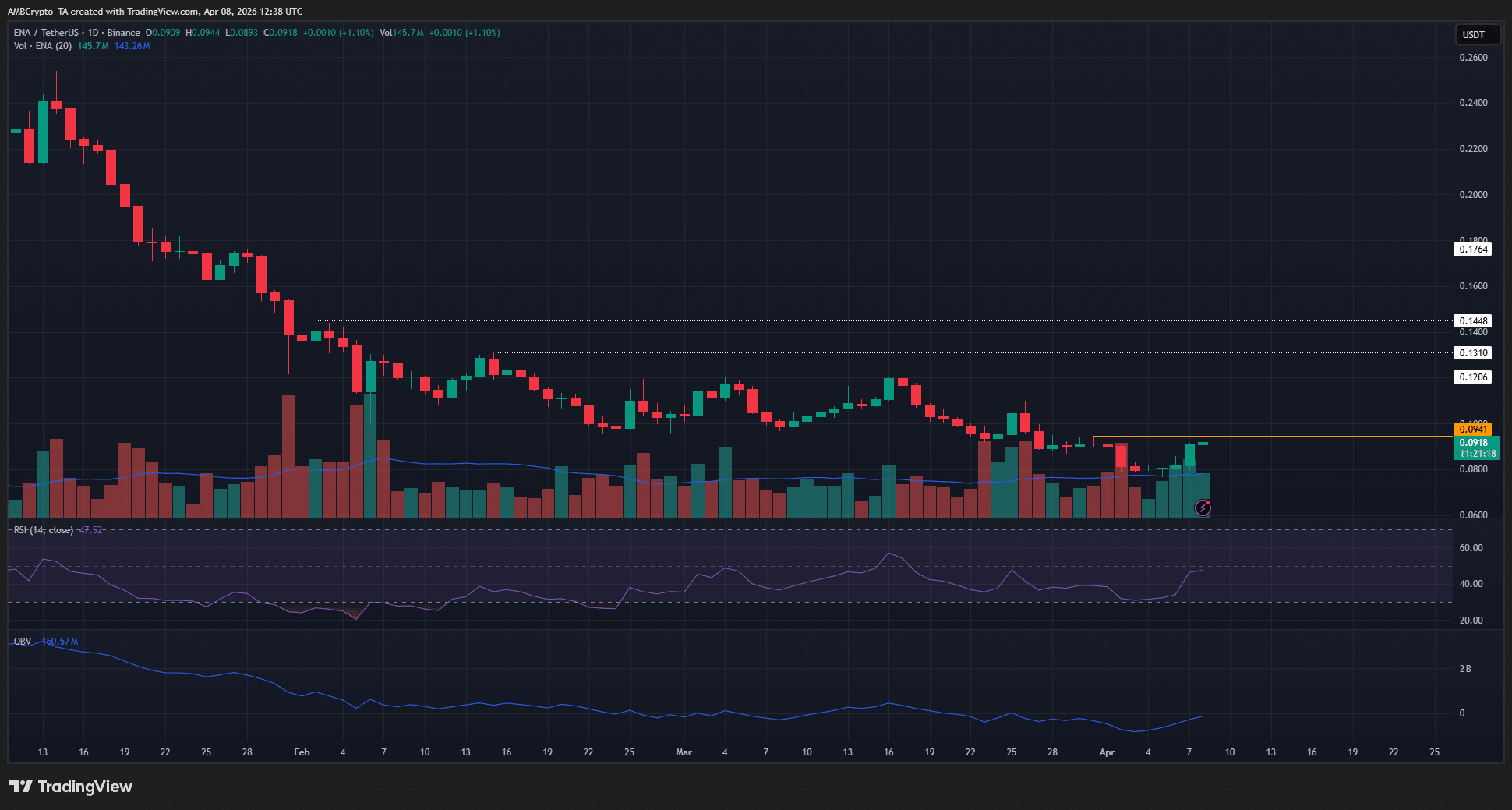
The lower highs on the 1-day timeframe, highlighted in white, showed that Ethena continued to labor under a bearish trend. The RSI was below neutral 50, and the OBV was in a slump, too.

This showed that the trend, selling pressure, and market structure were all in favor of the sellers. Even the rally in recent days, though it was high-volume, was unable to convincingly smash past the $0.094 local highs.

This was a complication for ENA bulls. Or, in a way, some pessimistic participants would say it makes the picture clearer. The sweep of the $0.095-$0.10 local highs means that the Ethena relief rally is over.

A new leg downward can commence from these liquidity pockets.

Traders’ call to action – Sell
Source: CoinGlass

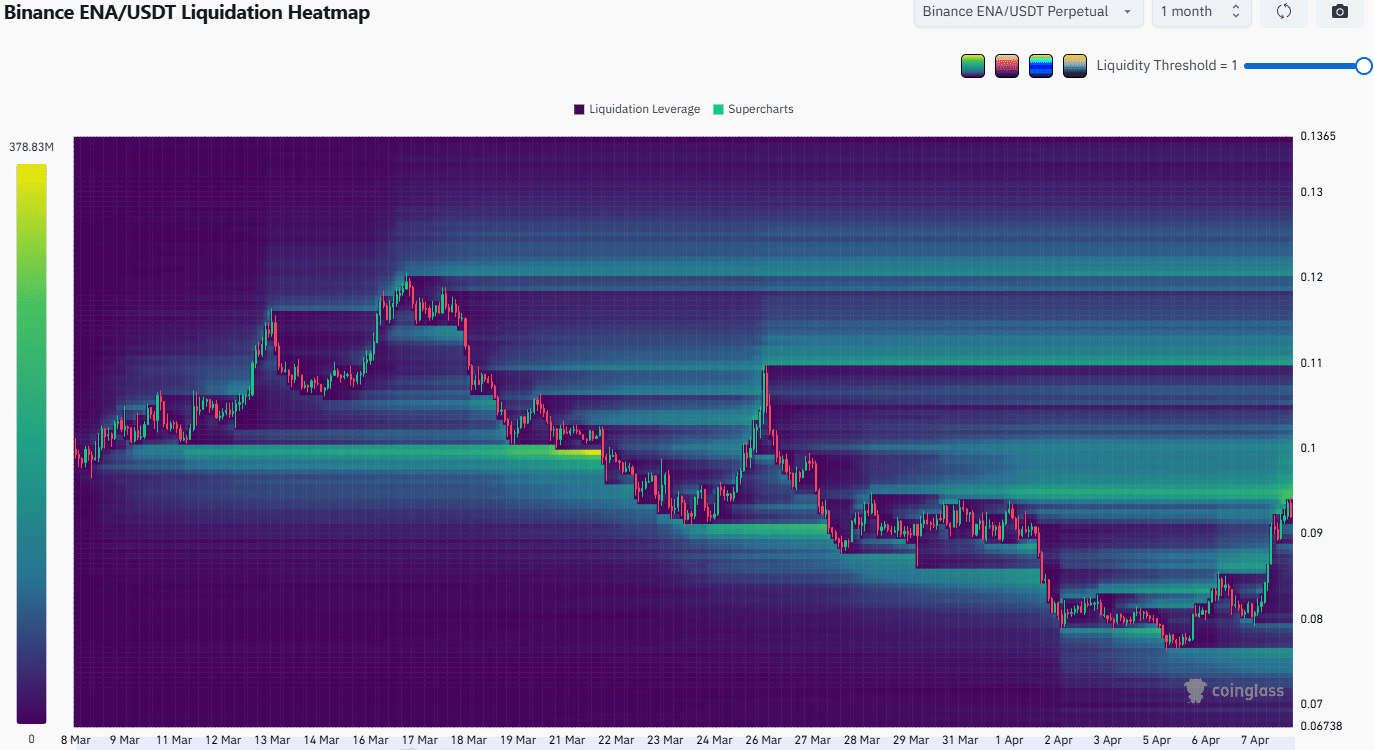
The past month’s liquidation heatmap showed a cluster of short liquidations from $0.094 to $0.10. This was the same band of resistance that the price has struggled to clear in the past 12 hours of trading.
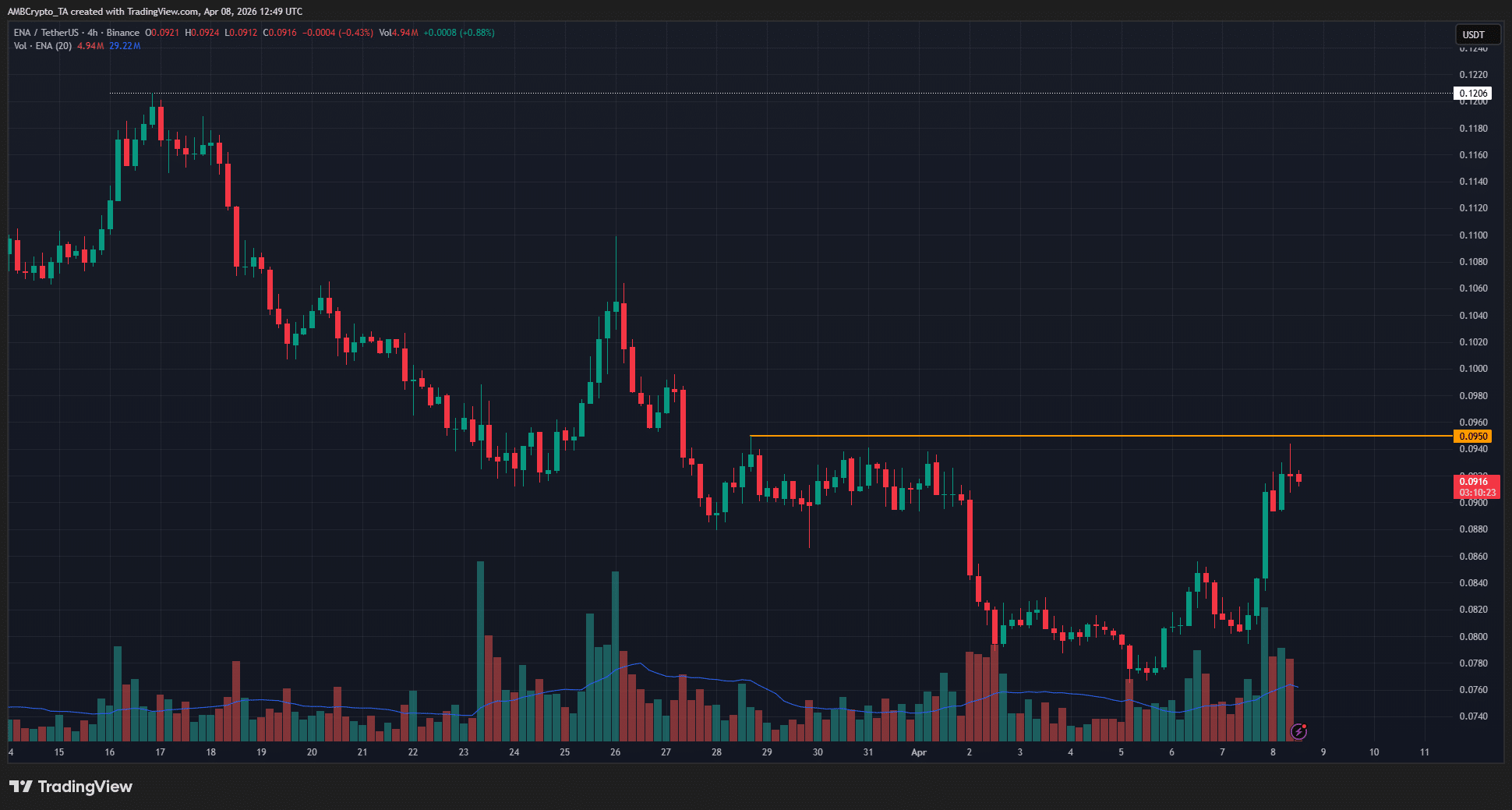
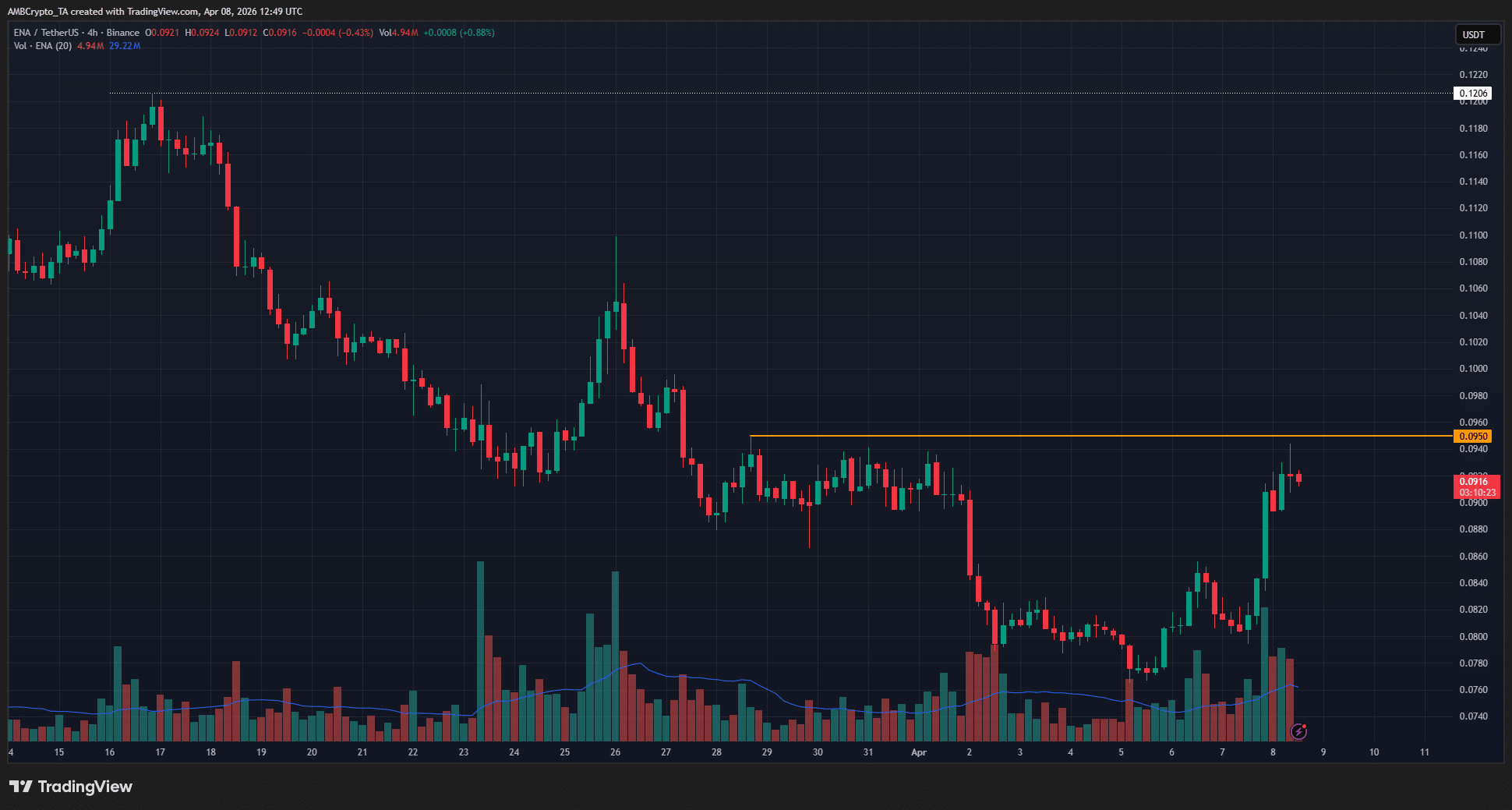
Source: ENA/USDT on TradingView

The 4-hour timeframe’s structure remained bearish. The $0.095 level must be beaten for the swing structure to shift bullishly. A breakout and retest as support can inform bulls that the momentum might continue.

Until then, traders can maintain a bearish bias and look to take profits from the bounce.


Final Summary

  • Ethena has racked up sizeable gains since the start of the week and was aided by the ceasefire announcement and crypto market bounce.
  • The $0.095-$0.10 resistance level remained in place, and traders should be prepared to take profits in this area as the swing structure remained bearish.


Preguntas relacionadas

QWhat was the main reason behind Ethena's 14.6% price rally in the past 24 hours?

AThe rally was primarily driven by a bullish boost from short liquidations following President Trump's ceasefire announcement, as well as Ethena's plan to diversify its USDe reserve assets into non-crypto assets.

QWhy is Ethena planning to diversify its USDe reserve assets into non-crypto assets?

AThe diversification aims to boost Ethena's falling yield and improve market performance, as the crypto rout since October 2025 led to declining USDe supply and yield, leaving the protocol poorly positioned.

QWhat key resistance level is ENA struggling to break, according to the technical analysis?

AENA is struggling to break the $0.095-$0.10 resistance level, which has been a significant barrier despite recent high-volume rallies.

QWhat do the RSI and OBV indicators suggest about ENA's market trend?

AThe RSI is below the neutral 50 level, and the OBV is in a slump, indicating that the trend, selling pressure, and market structure are all in favor of sellers.

QWhat trading bias does the article recommend for ENA based on its current market structure?

AThe article recommends maintaining a bearish bias and taking profits from the bounce, as the swing structure remains bearish unless ENA convincingly breaks and holds above $0.095.

Lecturas Relacionadas

Under the Shock of Oil Prices and Inflation, Which Country Will Be the First to Sell Off Its Gold Reserves?

The article draws a parallel between the 2003 North American blackout and the potential collapse of the global financial system, framing the US dollar and Treasury market as the world's economic "power grid." It argues that the closure of the Strait of Hormuz is creating a shockwave, starting with oil-importing emerging markets like Turkey, India, and Indonesia. As oil prices rise, these nations are forced to sell dollar-denominated assets—first US Treasuries, then potentially their gold reserves—to afford fuel. Turkey is highlighted as a key case, having sold nearly 90% of its Treasuries and begun tapping gold reserves when oil was between $70-$105/barrel. The article warns that if prices spike to $150-$160/barrel, global buffers like oil inventories and strategic reserves will be depleted. This could trigger a cascade: vulnerable nations, having exhausted assets, could face economic and political collapse (like Sri Lanka in 2022). Their forced asset sales would drive US Treasury yields higher, potentially past a critical threshold (around 5%), forcing the US to choose between a bond market crash or hyperinflation through massive money printing. Ultimately, the piece posits that the dollar's long-term decline is inevitable. The first domino to fall will likely be a fragile emerging market, signaling the start of a chain reaction that eventually threatens the core of the dollar system. The conclusion advises holding tangible assets like gold and energy, which cannot be printed, as a hedge against currency devaluation.

marsbitHace 16 min(s)

Under the Shock of Oil Prices and Inflation, Which Country Will Be the First to Sell Off Its Gold Reserves?

marsbitHace 16 min(s)

Behind HYPE's Repeated Record Highs, the 'Minions' in the Ecosystem Can't Keep Up

While HYPE, the native token of the Hyperliquid ecosystem, surges to new all-time highs above $76 and attracts significant institutional ETF inflows, a starkly different reality unfolds within its HyperEVM application layer. Multiple core DeFi protocols across lending, NFTs, stablecoins, and DEXs have announced shutdowns between May and June. The article argues HYPE functions more like an "application stock" than a traditional ecosystem token. Its value is anchored to the trading fees from Hyperliquid's core perpetual contracts platform (HyperCore), which boasts a diversified revenue stream from crypto, commodities, and indices. Approximately 97% of protocol fees fund buybacks and burns of HYPE. This means HYPE's price is largely decoupled from the health of projects built on HyperEVM. The closures of significant projects like lending protocol HypurrFi (peak TVL >$300M) and NFT marketplace Drip.Trade highlight a structural tension. Hyperliquid's minimalist philosophy offers infrastructure without official grants, liquidity support, or marketing coordination for HyperEVM projects. This forces protocols into a fiercely competitive environment from day one. Furthermore, the success of HyperCore creates a liquidity vacuum, and mechanisms like HIP-3 (allowing direct perpetual market deployment) divert user attention and capital away from application-layer projects. The stronger the core perpetual trading business becomes, the more difficult it is for peripheral "DeFi lego" projects to survive and capture value, despite the flagship token's rising price.

Foresight NewsHace 1 hora(s)

Behind HYPE's Repeated Record Highs, the 'Minions' in the Ecosystem Can't Keep Up

Foresight NewsHace 1 hora(s)

Conversation with Arthur Hayes: AI Has Drained Market Liquidity, BTC Will Be Below 100k by Year-End

In this June 2026 podcast interview, BitMEX co-founder Arthur Hayes explains his decision to sell his major crypto holdings (HYPE, NEAR, Worldcoin, Zcash). His rationale is based on a macro view linking oil prices, the Iran conflict, US politics, and an impending AI bubble burst. Hayes argues that high oil prices, driven by the ongoing war, will pressure domestic US inflation. To salvage the Republican Party's chances in the midterm elections, he believes Donald Trump may pivot to a populist, anti-AI stance—advocating for taxes and regulation—which would deflate the AI investment narrative. He sees the AI sector, particularly massive capital expenditure on data centers, as having absorbed nearly all excess market liquidity (around $1.5 trillion in debt issuance since 2025), starving other assets like Bitcoin. He highlights the upcoming SpaceX IPO at a ~$1.8 trillion valuation and 100x price-to-sales ratio as a potential tipping point. If these hyped IPOs underperform, it could shatter market confidence in AI. In such a scenario, all risk assets, including crypto, would fall together as correlations converge to 1 during a broad correction. Hayes has moved his portfolio into Treasuries and energy stocks (like ExxonMobil), predicting Bitcoin will be below $100k by year-end. He sees a potential crypto bull market only after the AI frenzy cools, liquidity stops flowing exclusively into AI, and possibly after a significant market downturn prompts new monetary stimulus.

marsbitHace 1 hora(s)

Conversation with Arthur Hayes: AI Has Drained Market Liquidity, BTC Will Be Below 100k by Year-End

marsbitHace 1 hora(s)

Trading

Spot
Futuros
活动图片