TRON activity surges with 2.6mln users – But can TRX sustain upside?

ambcryptoPublicado a 2026-03-31Actualizado a 2026-03-31

Resumen

TRON (TRX) has demonstrated significant growth, with an 11.32% increase in Total Value Locked (TVL) and 2.62 million active addresses, indicating strong capital retention and user engagement. The price has been recovering, forming a higher low near $0.27 and advancing toward the $0.322 resistance level. The MACD indicator shows strengthening momentum with sustained buying strength. However, exchange inflows have turned positive, suggesting potential profit-taking near resistance, which could slow upward momentum. Liquidation data indicates a reset in leveraged long positions, creating a more stable market environment. For a sustained breakout, buyers must absorb selling pressure and push above $0.322; otherwise, consolidation may continue.

TRON [TRX] recorded an 11.32% rise in Total Value Locked [TVL] over the past month, signaling steady capital retention.

Network usage also intensified, with 2.62 million Active Addresses and $1.06 million in daily fees. This placed TRX ahead of competing chains in activity.

That combination reflected sustained demand building across the TRX network.

Such growth in liquidity and participation pointed to a structurally active ecosystem.

TRX presses resistance after strong recovery structure

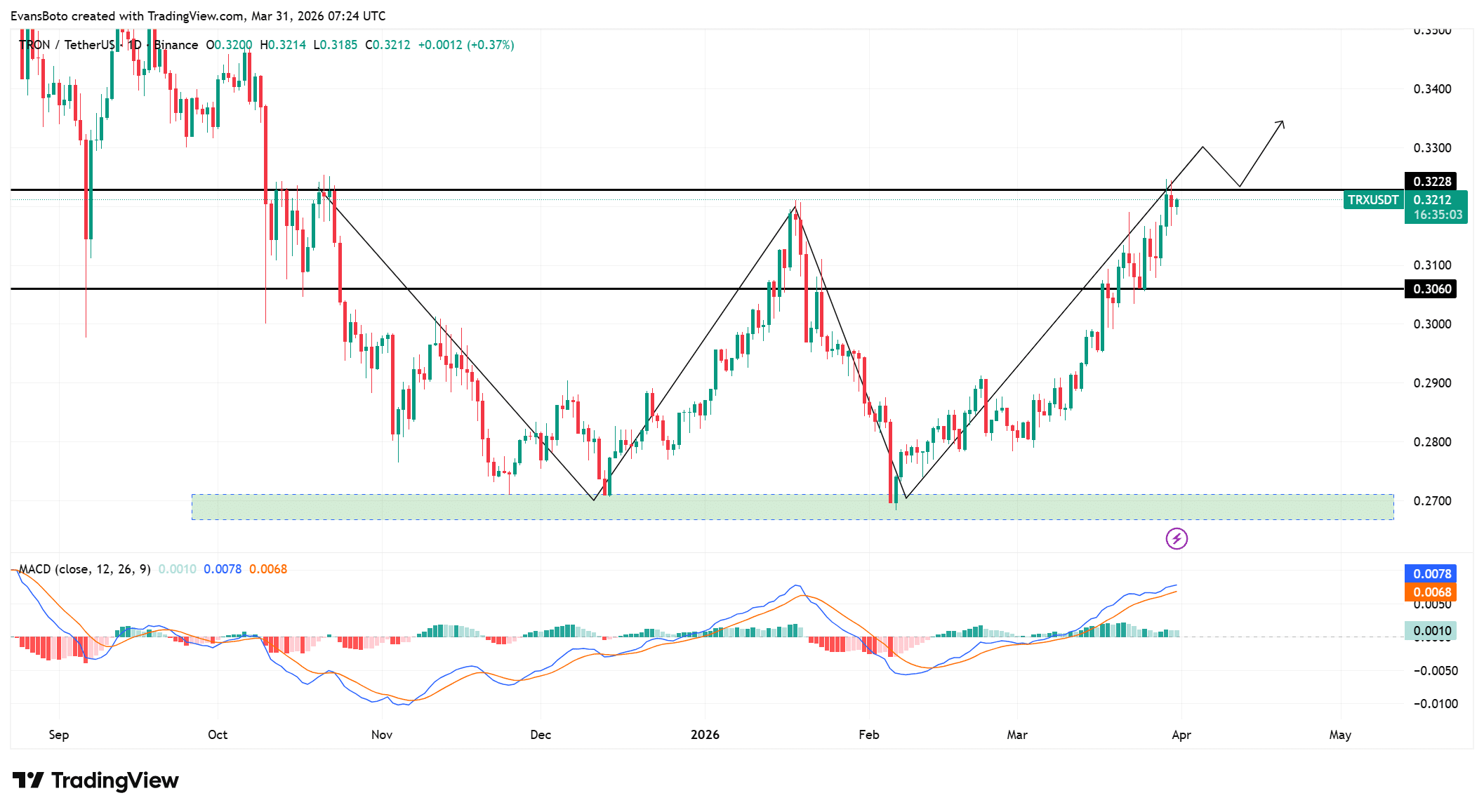
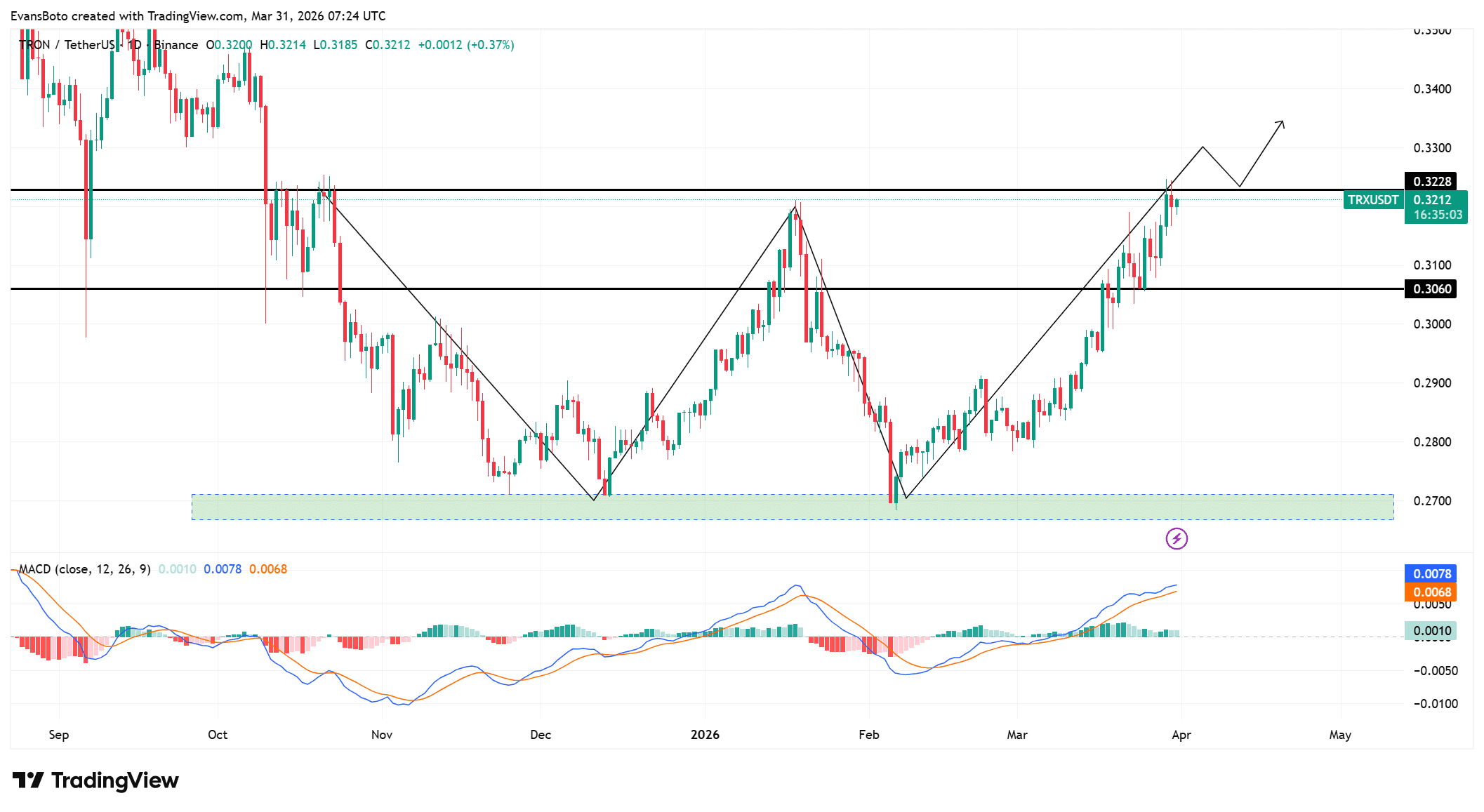
TRX formed a higher low near the $0.27 demand zone, supporting the ongoing recovery.

Price advanced toward the $0.322 resistance, forming a rising structure that showed stronger buyer control.

Each pullback held above prior lows, reinforcing the uptrend.

However, this level remained a key decision point, as prior rejections appeared near this zone. If buyers held above the $0.306 support, the structure could stay intact.

A move above $0.322 would confirm strength, while hesitation could trigger short consolidation.

The MACD crossed above the signal line and widened, indicating strengthening bullish momentum. Histogram bars stayed positive, showing sustained buying strength after the crossover.

This suggested demand remained consistent rather than driven by a single impulse.
Source: TradingView

Exchange inflows rise as selling risk builds

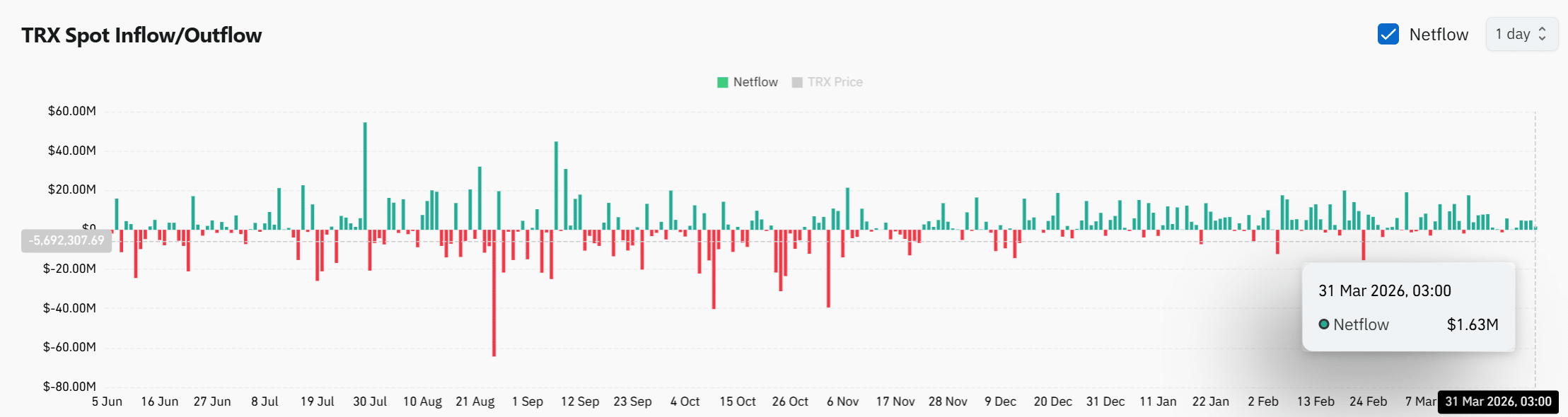
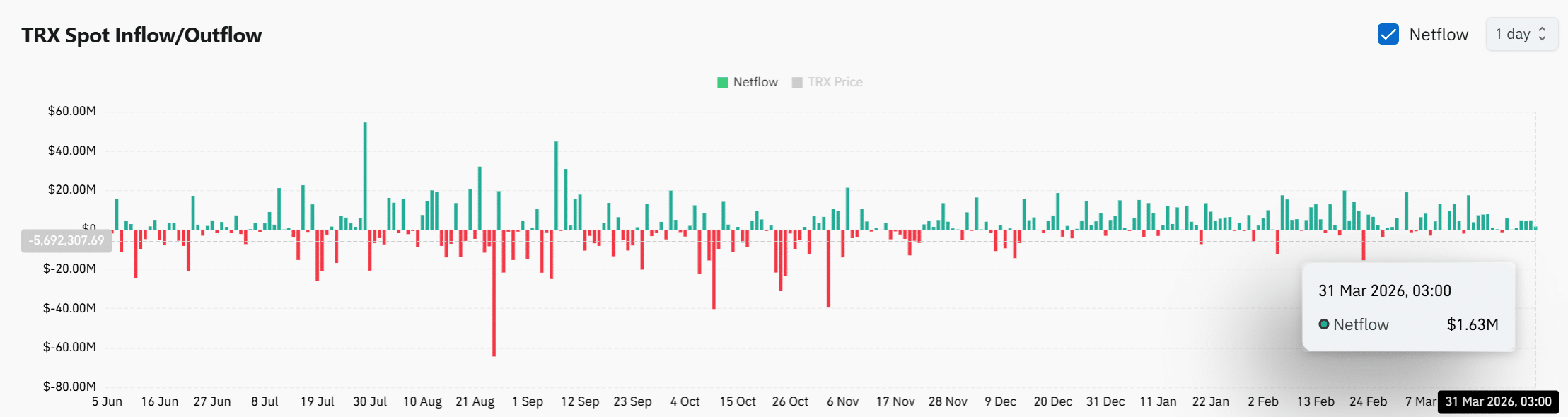
Spot Netflows flipped positive, with $1.63M in inflows, signaling increased exchange deposits. That shift indicated a behavioral change, as earlier outflows reduced sell-side pressure.

Now, rising deposits suggested some traders were prepared to take profits near resistance.

However, inflows alone did not confirm selling and could reflect repositioning.

If price held steady, demand could absorb the incoming supply. By contrast, rising balances near $0.322 could increase rejection risk.
Source: CoinGlass

TRX liquidations show leverage reset during volatility

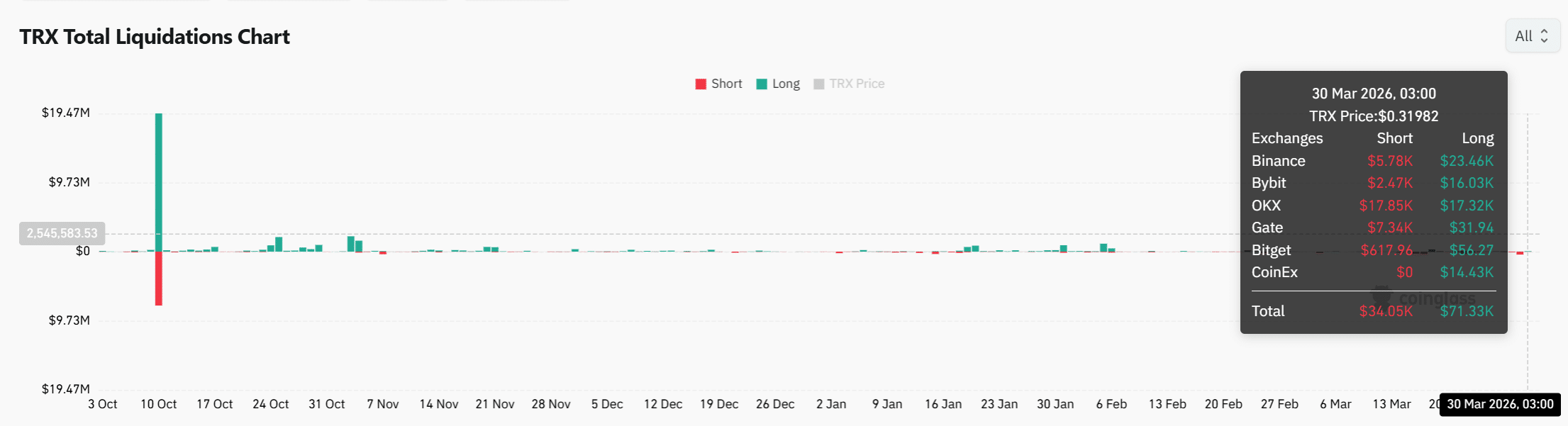
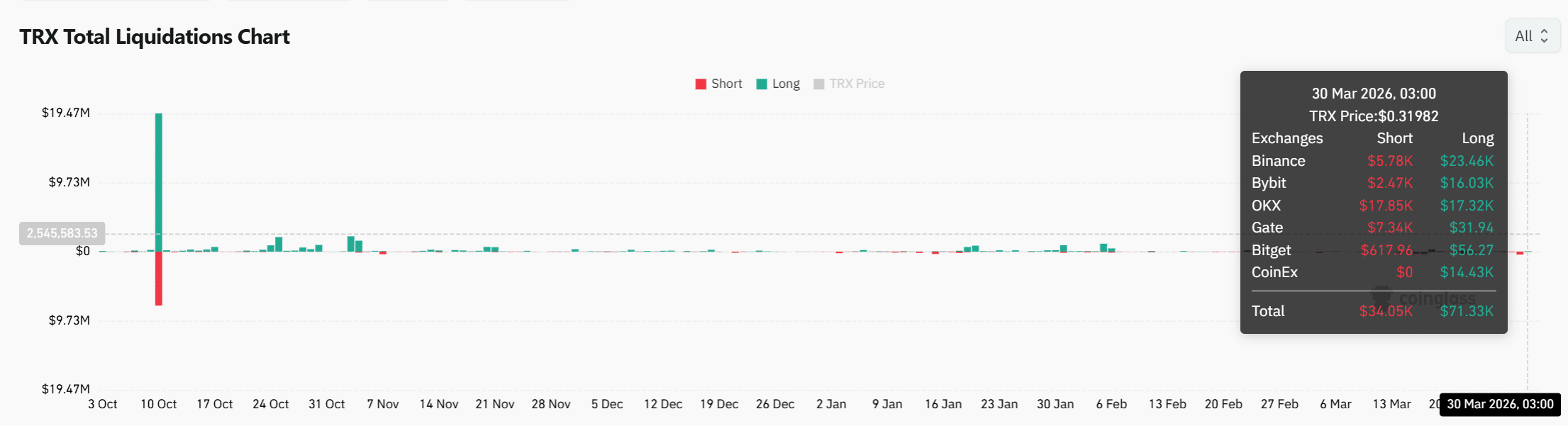
Liquidation data showed long positions absorbed the most recent wipes. About $71.33K in longs cleared, compared to $34.05K in shorts.

This imbalance indicated volatility flushed overleveraged long positions.

That reset reduced excessive leverage across the market. As a result, the structure appeared cleaner, with fewer crowded positions.

This often creates a more stable environment for continuation. Even so, aggressive leverage buildup could bring volatility back.

For now, the liquidation profile suggested a stabilized market.
Source: CoinGlass

TRX has shown strong alignment between rising network activity and improving price structure, which suggests underlying strength continues building.

However, resistance at $0.322 remains the defining barrier.

If buyers sustain pressure and absorb exchange inflows, a breakout would likely follow. Otherwise, price may continue consolidating as fundamentals gradually catch up.


Final Summary

  • Strong network growth continues supporting TRX, yet price still faces pressure near a key resistance zone.
  • Price structure remains bullish, but rising exchange inflows could slow momentum before any sustained breakout attempt.


Preguntas relacionadas

QWhat was the percentage increase in TRON's Total Value Locked (TVL) over the past month, and what does it signal?

ATRON recorded an 11.32% rise in Total Value Locked (TVL) over the past month, signaling steady capital retention.

QHow many active addresses and daily fees did the TRON network have, and what did this activity level indicate?

AThe TRON network had 2.62 million active addresses and $1.06 million in daily fees, which placed it ahead of competing chains and reflected sustained demand building across the ecosystem.

QWhat is the key resistance level for TRX's price mentioned in the article, and what is required for a confirmed breakout?

AThe key resistance level for TRX is $0.322. A move above this level would confirm strength and a likely breakout.

QWhat did the shift to positive Spot Netflows indicate about trader behavior?

AThe shift to positive Spot Netflows, with $1.63 million in inflows, indicated increased exchange deposits and suggested that some traders were preparing to take profits near the resistance level.

QAccording to the liquidation data, which type of positions were cleared more, and what was the implication for the market?

ALong positions were cleared more, with $71.33K in longs compared to $34.05K in shorts. This indicated that volatility flushed overleveraged long positions, which reduced excessive leverage and created a more stable market environment.

Lecturas Relacionadas

PANews Column Registration and Article Submission Guide

"PANews Column Registration and Submission Guide" provides instructions for users to register as columnists and publish articles on the PANews platform. Key application requirements are emphasized: content should focus on in-depth analysis within Crypto, Web3, blockchain, data, and viewpoints. Content primarily for brand/product introductions will not be approved, and heavily AI-generated content will be rejected. Promotional (PR/soft) content is directed to the business channel. **Registration Process:** * **Web:** Go to the official website footer, click "Apply for Column," and register with a phone number or email (login via verification code, no password). Fill in the column name, description, upload an avatar, and submit links to previously published work. * **Mobile:** Navigate to "My" -> "Contribute & Create" and complete the form. **Article Submission Tutorial:** 1. Log in to the PANews website. 2. Access the "Creator Center" from your personal homepage. 3. Use the editor to create and publish articles. **Video Upload:** The platform supports embedding videos from third-party sites (e.g., Bilibili). Copy the embed code from the source video, use the editor's "Insert/Edit media" button, paste the code under the "Embed" tab, and adjust the display size (recommended: width 100%, height 560px). **PANews Skills (AI Agent Tool):** PANews offers an official AI Agent skill set called PANews Skills, enabling AI tools to query platform content, track trends, and publish column articles directly. It includes three main skills: 1. `panews`: For tracking daily must-read lists, popular articles, and funding news. 2. `panews-creator`: For managing columns, publishing articles, and uploading images. 3. `panews-web-viewer`: For parsing PANews webpages into Markdown. These skills are compatible with various AI Agent tools (OpenClaw, Cursor, Claude Code, ChatGPT, Gemini, etc.). To use the `panews-creator` skill, users must obtain a specific authentication value from the PANews website after logging into their columnist account.

marsbitHace 9 min(s)

PANews Column Registration and Article Submission Guide

marsbitHace 9 min(s)

I Built Myself an Investment Workbench Using AI

For the past two weeks, I've been immersed in Vibe Coding—using AI to write code from natural language descriptions. This process has enabled me to quickly build functional tools that address long-standing personal ideas. Previously, I had many concepts but found execution too cumbersome. Key ideas included a unified dashboard for assets across US stocks, Crypto, HK stocks, and A-shares; a real-time alert system for price movements; an investment map visualizing sector relationships; and a tool to correlate prediction market bets with news and market data. Traditional development hurdles meant these often remained unrealized. Using AI (Codex, Claude Code, and DeepSeek API), I built four initial tools: 1. A **Cross-Market Asset Dashboard** showing total assets, daily P&L, and holdings by market, with added features for alerts and sector mapping. It's deployed locally for privacy. 2. A **Prediction Market (PM) Monitor** tracking bets on events (e.g., company valuations) and correlating probability shifts with news and market movements. I categorize bets by conviction to filter noise. 3. A **Simple Operations Backend** for managing my writing workflow (topics, progress, publishing). It's cloud-deployed for mobile access. 4. A **One-Click Formatting Tool** that automates converting drafts into various platform-specific formats, saving manual effort. While these tools are basic, they represent a significant shift: AI lowers the barrier to creating personalized systems. I believe individual investors can now feasibly build core systems for: * **Asset Observation** (tracking holdings and changes) * **Signal Monitoring** (watching for key market shifts) * **Sector Mapping** (understanding network relationships within a sector) * **Performance Review** (documenting rationale and outcomes) The power of Vibe Coding is its fast feedback loop. Ideas can be implemented, tested, and iterated on rapidly, turning "want-to-do" into "done." This marks the start of my new phase, where I'll share investment thoughts, tool tests, on-chain operations, and educational Web3 content.

marsbitHace 25 min(s)

I Built Myself an Investment Workbench Using AI

marsbitHace 25 min(s)

After Tokenization of Assets, How to Exit?

Title: How to Exit After Asset Tokenization? Author: Symbiotic Compiled by: Hu Tao, ChainCatcher Summary: Tokenization addresses how assets go on-chain but largely leaves the redemption question unresolved. While tokenized assets can settle instantly, the underlying redemption for assets like treasuries, private credit, or real estate can take from T+1 to 180 days. This gap hinders DeFi adoption of Real World Assets (RWAs). Three emerging models aim to provide instant exit liquidity, differing primarily in their capital structure and efficiency: 1. **Balance Sheet Model (e.g., Grove Basin):** A single entity (like Sky) provides immediate liquidity from its balance sheet, acting as a bridge during the settlement period. It offers simplicity and deep initial liquidity but is constrained by a single entity's capacity and risk appetite. 2. **Asset-Specific Vault Model (e.g., Upshift Clear):** Independent liquidity providers fund dedicated vaults for each supported asset, earning fees. It decentralizes capital sources but isolates liquidity and capital per asset, leading to potential fragmentation. 3. **Shared Liquidity Layer Model (e.g., Symbiotic Liquid Lane):** A shared capital pool supports multiple RWA types simultaneously. Funds remain productive between redemptions (e.g., earning yield in lending markets). Exits are settled via a competitive RFQ market. This model aims for higher capital efficiency, scalability across assets, and serves longer-duration assets like private credit. Key differentiators are: 1) Source of capital and risk bearer, 2) Redemption pricing mechanism, 3) Capital efficiency, 4) Scalability to new asset types, and 5) Composability. The shared liquidity layer model represents a move from piecemeal solutions toward scalable infrastructure, enabling T+0 exits by pooling capital, maintaining yield, and using competitive pricing, thus enhancing RWA utility in DeFi.

marsbitHace 38 min(s)

After Tokenization of Assets, How to Exit?

marsbitHace 38 min(s)

After Tokenizing Assets, How to Exit?

After tokenization, a key unresolved issue is providing holders with a reliable exit mechanism, as underlying asset settlement (taking days to months) lags far behind on-chain token settlement. Three primary models for instant liquidity have emerged, differing in their capital structure and efficiency: 1. **Balance Sheet Model (e.g., Grove Basin):** A single, well-capitalized entity (like Sky) provides immediate liquidity from its own reserves. This offers simplicity and deep initial liquidity but is constrained by that single balance sheet's capacity and risk appetite, limiting scalability. 2. **Dedicated Vault Model (e.g., Upshift Clear):** Independent liquidity providers (LPs) fund separate vaults for each supported asset. This decentralizes capital sources but isolates liquidity and capital, which becomes inefficient as the number of tokenized assets grows. 3. **Shared Liquidity Layer Model (Symbiotic Liquid Lane):** Independent capital providers fund shared vaults that can support multiple tokenized assets simultaneously. Capital remains productive between redemptions (e.g., earning yield in DeFi markets). Exits are settled via a competitive RFQ market where market makers bid. The article argues that the shared layer model offers superior capital efficiency and scalability. It transforms exit liquidity from an asset-specific patch into shared market infrastructure, allowing liquidity capacity to grow with overall market participation rather than being fragmented per asset. This is particularly valuable for longer-duration assets like private credit, where reliable T+0 exits can significantly enhance their utility in DeFi.

链捕手Hace 52 min(s)

After Tokenizing Assets, How to Exit?

链捕手Hace 52 min(s)

Trading

Spot
Futuros

Artículos destacados

Cómo comprar TRX

¡Bienvenido a HTX.com! Hemos hecho que comprar TRON (TRX) sea simple y conveniente. Sigue nuestra guía paso a paso para iniciar tu viaje de criptos.Paso 1: crea tu cuenta HTXUtiliza tu correo electrónico o número de teléfono para registrarte y obtener una cuenta gratuita en HTX. Experimenta un proceso de registro sin complicaciones y desbloquea todas las funciones.Obtener mi cuentaPaso 2: ve a Comprar cripto y elige tu método de pagoTarjeta de crédito/débito: usa tu Visa o Mastercard para comprar TRON (TRX) al instante.Saldo: utiliza fondos del saldo de tu cuenta HTX para tradear sin problemas.Terceros: hemos agregado métodos de pago populares como Google Pay y Apple Pay para mejorar la comodidad.P2P: tradear directamente con otros usuarios en HTX.Over-the-Counter (OTC): ofrecemos servicios personalizados y tipos de cambio competitivos para los traders.Paso 3: guarda tu TRON (TRX)Después de comprar tu TRON (TRX), guárdalo en tu cuenta HTX. Alternativamente, puedes enviarlo a otro lugar mediante transferencia blockchain o utilizarlo para tradear otras criptomonedas.Paso 4: tradear TRON (TRX)Tradear fácilmente con TRON (TRX) en HTX's mercado spot. Simplemente accede a tu cuenta, selecciona tu par de trading, ejecuta tus trades y monitorea en tiempo real. Ofrecemos una experiencia fácil de usar tanto para principiantes como para traders experimentados.

1.8k Vistas totalesPublicado en 2024.12.10Actualizado en 2026.06.02

Cómo comprar TRX

Discusiones

Bienvenido a la comunidad de HTX. Aquí puedes mantenerte informado sobre los últimos desarrollos de la plataforma y acceder a análisis profesionales del mercado. A continuación se presentan las opiniones de los usuarios sobre el precio de TRX (TRX).

活动图片