Ethena Berjuang Saat Pendapatan Turun 32% – Bisakah Permintaan Menyelamatkan ENA di $0.089?

ambcryptoPublicado a 2026-03-28Actualizado a 2026-03-28

Resumen

Ethena (ENA) mengalami penurunan harga signifikan menjadi $0.089, seiring dengan melemahnya performa keuangan protokol. Pendapatan kotor turun 32% menjadi $65.06 juta pada Q1 2026, mencerminkan berkurangnya aktivitas minting dan staking. Total Value Locked (TVL) juga terus menurun, dengan penurunan sekitar $130 juta sejak awal Maret, menunjukkan arus keluar modal yang berkelanjutan. Meskipun laba kotor meningkat sedikit, angka tersebut masih jauh di bawah kinerja kuartal sebelumnya. Pengguna aktif harian pun turun ke level terendah sejak Desember. Di tengah tekanan fundamental ini, aktivitas spot market menunjukkan ketahanan dengan adanya akumulasi pembelian senilai $3.41 juta dalam tiga hari terakhir, yang dapat membantu membatasi penurunan lebih lanjut dan mendukung stabilitas harga. Namun, tanpa pemulihan dalam aktivitas pengguna dan pendapatan, potensi kenaikan harga mungkin tetap terbatas.

Harga Ethena [ENA] kini tampak selaras dengan kinerja keuangannya yang melemah. Dalam 24 jam terakhir, aset ini mencatat penurunan dua digit, turun ke $0.089 pada waktu press time.

Meskipun angka-angka tersebut mencerminkan tekanan yang meningkat, evaluasi yang lebih luas terhadap kondisi pasar diperlukan untuk menentukan apakah penurunan ini menandai awal koreksi yang lebih dalam atau hanya penyesuaian sementara.

Momentum Ethena Melemah di Berbagai Metrik Kunci

Data on-chain menunjukkan bahwa ENA telah underperform di berbagai lini sejak awal Q1 2026, terutama jika dibandingkan dengan kinerjanya di dua kuartal sebelumnya.

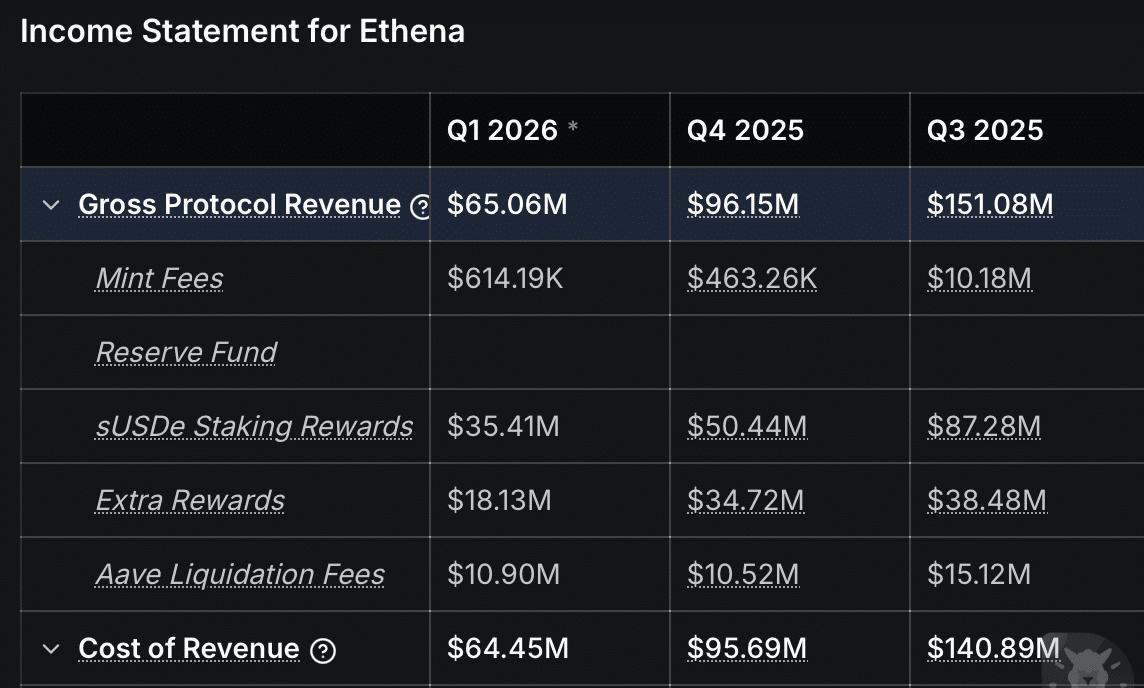
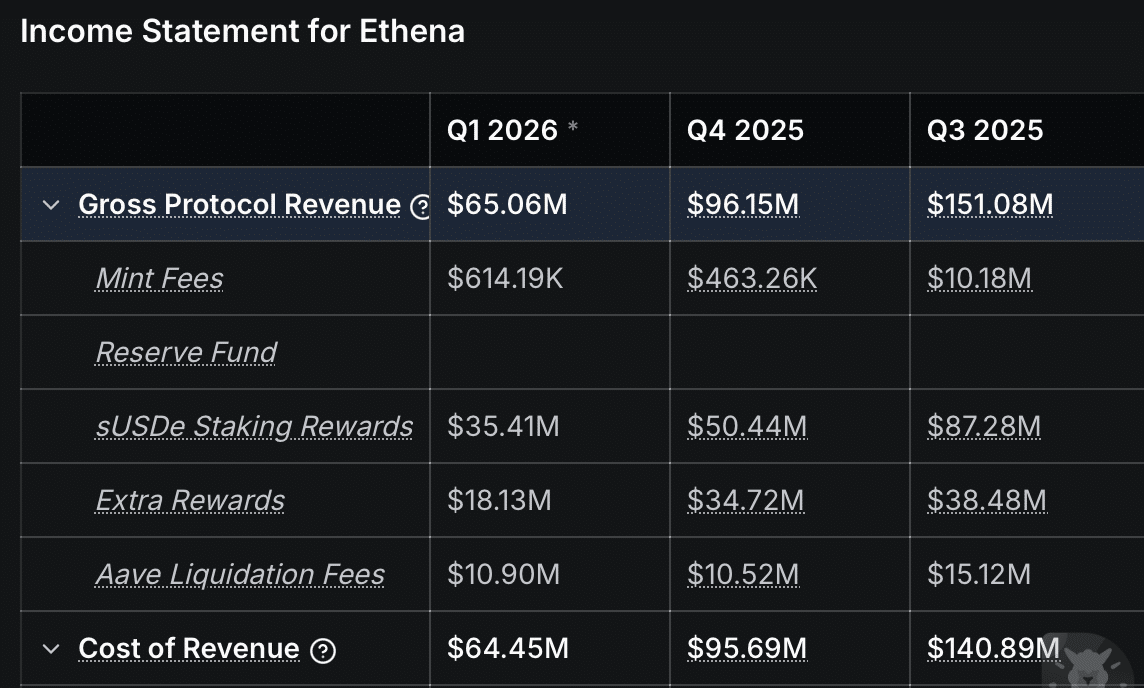
Area perhatian utama adalah efisiensi pendapatan. Pendapatan Kotor Protokol turun menjadi $65,06 juta, turun dari $96,15 juta di Q4 2025, yang mewakili penurunan sebesar 32%. Penurunan ini menjadi lebih terasa lagi jika dibandingkan dengan Q3 2025.

Kontraksi ini mengindikasikan aktivitas minting yang lebih lemah dan imbalan staking yang berkurang, yang keduanya menunjukkan penurunan partisipasi on-chain.
Sumber: DeFiLlama

Dalam pasar yang relatif stabil dibandingkan dengan siklus Oktober–Desember 2025, underperformance ini memunculkan kekhawatiran tentang melemahnya permintaan pengguna, bukan tekanan eksternal.

Kondisi likuiditas memperkuat tren ini. Total Value Locked (TVL), indikator inti kesehatan protokol dan komitmen pengguna, terus menurun secara stabil.

Sejak awal Maret 2026, TVL telah turun sekitar $130 juta, membawanya ke sekitar $6,66 miliar pada saat penulisan. Hanya dalam 24 jam terakhir, sekitar $16 juta telah di-unstaked, menandakan kelanjutan eksit modal dari protokol.

Bisakah Keuntungan Saja Mempertahankan Minat Pengguna?

Meskipun terjadi perlambatan yang lebih luas, Ethena mencatat peningkatan kecil dalam laba kotor.

Pada Q1 2026, protokol telah menghasilkan $614.190 dalam laba kotor, dibandingkan dengan $463.200 di Q4 2025. Meskipun ini mencerminkan peningkatan marginal, hal ini sedikit membantu untuk mengimbangi penurunan tajam dari tingkat kinerja sebelumnya.

Sebagai perbandingan, Q3 2025 mencatat $10,18 juta dalam laba kotor, kira-kira 16,5 kali lebih tinggi dari angka saat ini. Kesenjangan ini menyoroti penurunan struktural dalam potensi penghasilan, bahkan ketika profitabilitas jangka pendek menunjukkan perbaikan minor.

Implikasinya jelas, karena pertumbuhan laba yang modest saja mungkin tidak cukup untuk mempertahankan pengguna, terutama dalam lingkungan DeFi yang kompetitif di mana modal dengan cepat berputar menuju peluang berimbal hasil lebih tinggi.

Data aktivitas pengguna mendukung pandangan ini. Menurut Artemis, Pengguna Aktif Harian telah turun menjadi sekitar 1.200, level terendah yang tercatat sejak Desember.

Permintaan Spot Menawarkan Sinyal Kontra

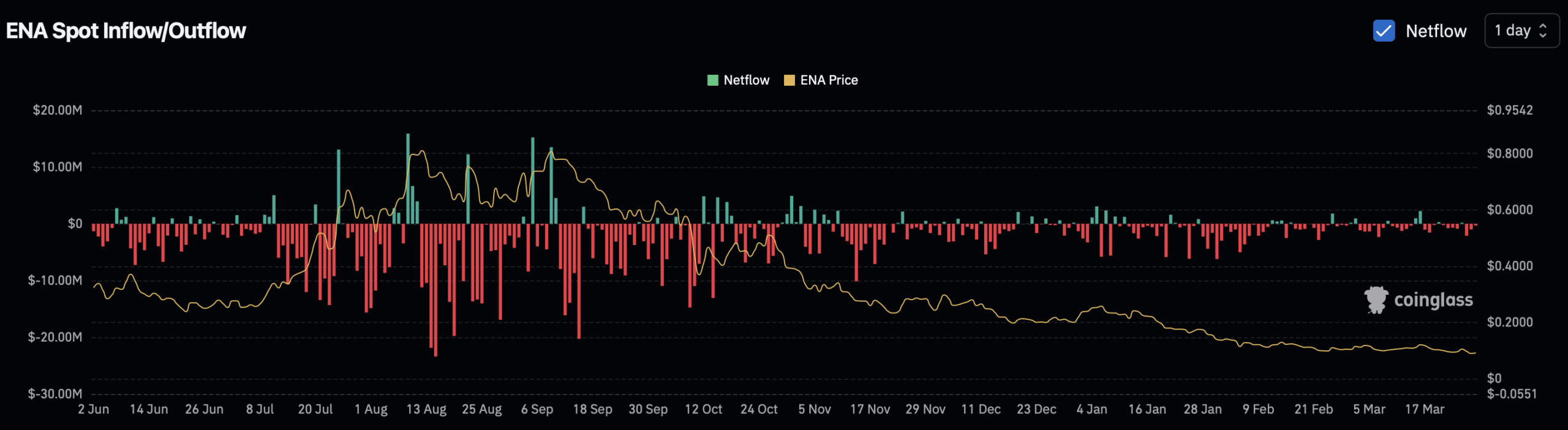
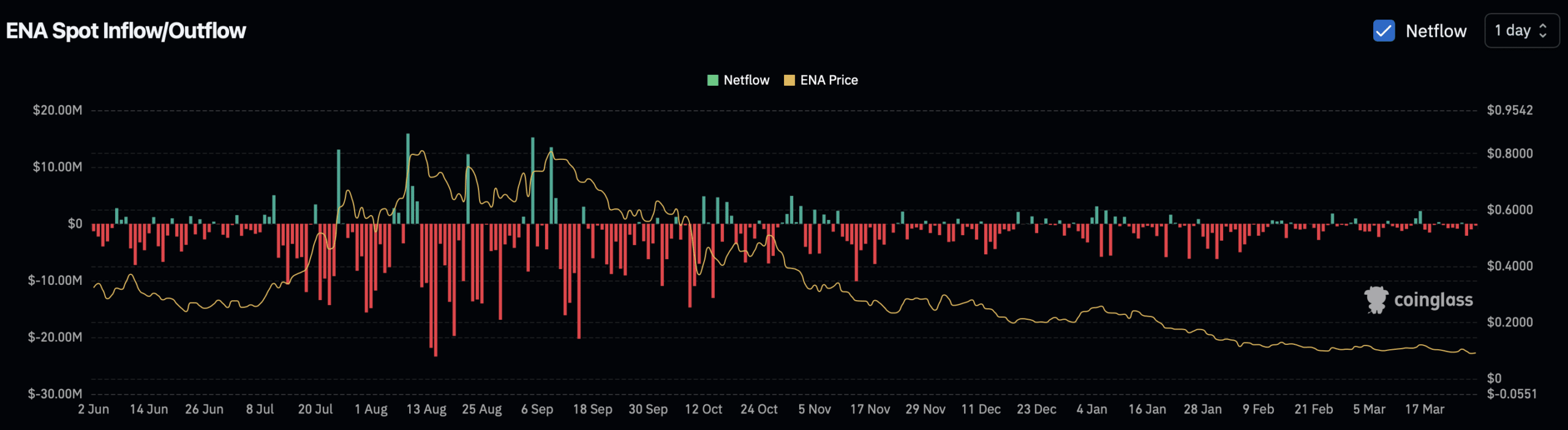
Meskipun fundamental melemah dan likuiditas menurun, aktivitas pasar spot menyajikan gambaran yang lebih resilien. Data netflow exchange menunjukkan bahwa tekanan beli telah meningkat baru-baru ini. Dalam 24 jam terakhir, arus masuk bersih ke posisi spot mencapai sekitar $303.000.

Yang lebih penting, ini bukanlah peristiwa yang terisolasi. Dalam tiga hari terakhir, pembelian kumulatif telah naik menjadi sekitar $3,41 juta, menunjukkan akumulasi yang konsisten.
Sumber: CoinGlass

Permintaan yang terus-menerus seperti ini menunjukkan bahwa investor terus menyerap tekanan penjualan, bahkan ketika modal keluar dari lapisan protokol.

Jika tren akumulasi ini bertahan, hal ini dapat membatasi penurunan lebih lanjut dan mendukung stabilisasi harga. Namun, tanpa pemulihan dalam fundamental inti, khususnya aktivitas pengguna dan generasi pendapatan, setiap kenaikan mungkin tetap terbatas dalam kisaran yang sempit.


Ringkasan Akhir

  • Kinerja protokol Ethena memburuk di Q1 2026, meskipun kondisi pasar yang lebih luas relatif stabil.
  • Investor spot terus mengakumulasi, meskipun ada arus keluar likuiditas yang meningkat dan penurunan TVL.


Preguntas relacionadas

QBagaimana kinerja keuangan Ethena (ENA) pada kuartal pertama tahun 2026?

AKinerja keuangan Ethena melemah secara signifikan pada Q1 2026. Pendapatan Kotor Protokol turun menjadi $65,06 juta, mencatat penurunan sebesar 32% dari $96,15 juta di Q4 2025. Laba kotor juga masih jauh lebih rendah dibandingkan kinerja sebelumnya, hanya sebesar $614.190.

QApa yang ditunjukkan oleh penurunan Total Value Locked (TVL) Ethena?

APenurunan TVL sebesar sekitar $130 juta sejak Maret 2026, menjadi $6,66 miliar, menandakan keluar modal yang berkelanjutan dari protokol. Hal ini mengindikasikan melemahnya kesehatan protokol dan komitmen pengguna, dengan $16 juta tidak di-staking hanya dalam 24 jam terakhir.

QMeskipun kinerja melemah, sinyal positif apa yang terlihat dari pasar spot?

AData aliran bersih pertukaran menunjukkan peningkatan tekanan beli. Dalam 24 jam terakhir, arus masuk bersih ke posisi spot mencapai sekitar $303.000, dan akumulasi kumulatif selama tiga hari terakhir mencapai sekitar $3,41 juta, yang menunjukkan akumulasi yang konsisten oleh investor.

QMengapa peningkatan laba kotor yang kecil tidak cukup untuk mempertahankan minat pengguna?

APeningkatan laba kotor yang marginal (dari $463.200 di Q4 2025 menjadi $614.190 di Q1 2026) sangat kecil dibandingkan dengan laba $10,18 juta di Q3 2025. Dalam lingkungan DeFi yang kompetitif, pertumbuhan laba yang sederhana tidak cukup untuk mempertahankan pengguna karena modal dapat dengan cepat beralih ke peluang dengan hasil yang lebih tinggi.

QApa implikasi dari penurunan Pengguna Aktif Harian (Daily Active Users) Ethena?

AJumlah Pengguna Aktif Harian telah turun menjadi sekitar 1.200, level terendah yang tercatat sejak Desember. Ini memperkuat kekhawatiran tentang melemahnya permintaan dan partisipasi pengguna secara on-chain, yang merupakan tantangan fundamental bagi protokol meskipun ada akumulasi di pasar spot.

Lecturas Relacionadas

Won't US Stocks Ever Fall Again? The 'Great Melt-up' Trap in the Era of High Debt

The article analyzes a popular theory circulating online that the U.S. stock market may be mathematically incapable of a true, sustained decline due to the country's massive and growing national debt. The argument suggests that the government's only path to managing this debt is through inflation and money printing, which would nominally lift asset prices like stocks, creating a perpetual "melt-up." The author places this idea within the historical context of market melt-ups, such as the dot-com bubble and Japan's asset bubble, where prices detach from fundamentals driven by momentum and FOMO. While acknowledging that a high-debt environment creates incentives for inflation, which is generally favorable for assets over cash, the article refutes key claims of the online theory. It clarifies that interest payments are not about to exceed GDP, that printing money is not the only option for the government, and that stocks do not reliably rise in lockstep with hyperinflation, citing historical examples from Germany, Zimbabwe, and Venezuela. The more probable outcome, according to the author, is a prolonged period of financial repression—moderate inflation above interest rates that slowly erodes debt and cash purchasing power, leading to nominally higher asset prices but potentially lower real returns. The core warning is that while long-term market trends may be upward, this does not eliminate the risk of significant interim crashes (30%, 40%, or more) or guarantee real wealth creation during inflationary times. The conclusion advises against betting one's entire financial future on a smooth, perpetually rising market narrative. Instead, it recommends a disciplined, diversified strategy involving productive assets (stocks, real estate, some gold, short-term bonds) and an adequate cash buffer to avoid forced selling during downturns. The key takeaway is to avoid extreme concentration in expensive assets and leverage, and not to base investment decisions on the hope that every market dip will inevitably be rescued.

marsbitHace 8 min(s)

Won't US Stocks Ever Fall Again? The 'Great Melt-up' Trap in the Era of High Debt

marsbitHace 8 min(s)

The Fate of Digital Banks: No Fancy App Can Outshine a Banking License

The Fate of Digital Banks: A Flashy App is No Match for a Banking License The article argues that despite attracting billions of users with fee-free checking accounts and sleek apps, most "neobanks" struggle to be profitable because their core business—transaction fees—is inherently low-margin. The real profit engine of banking is lending (credit), which generates interest income. However, many early neobanks operated without their own banking licenses, which restricted their ability to lend at scale. Examples like Nubank, Revolut, and Chime illustrate the point. While they gained users with free accounts, their eventual profitability came from rolling out credit products. The piece highlights systemic risks for neobanks that rely on third-party infrastructure, citing the Synapse bankruptcy, which froze user funds and revealed the fragility of such models. The solution, according to the author, is obtaining a formal banking license, like the U.S. OCC's national trust charter. This provides regulatory backing, allows direct custody of funds, and eliminates dependency on intermediary partners. The trend is now evident in the crypto sector, where companies like Kraken, SoFi, and others are actively pursuing such licenses. The article concludes that while technology changes, the fundamental business logic of banking—profiting from lending—remains constant. Successful digital banks ultimately conform to this old model, just with better interfaces and fairer terms.

Foresight NewsHace 16 min(s)

The Fate of Digital Banks: No Fancy App Can Outshine a Banking License

Foresight NewsHace 16 min(s)

In the Name of Charity, For the Benefit of the Family: How the Trump Family Turns Philanthropy into Profit?

Charity for Profit: How the Trump Family Turned Philanthropy into Personal Gain Amid a recent controversy over misleading claims about his cryptocurrency company American Bitcoin, Eric Trump invoked his children's cancer charity as evidence of his good intentions. While his Curetivity foundation (formerly the Eric Trump Foundation) has donated over $25 million to St. Jude Children's Research Hospital, an investigation reveals a pattern of self-dealing and opaque practices that benefited the Trump family business. Internal documents show that from 2011 to 2016, over $500,000 from the charity was funneled back to Trump-owned properties for event costs, transactions often omitted from tax filings. This created clear conflicts of interest, with figures like former club manager and current White House aide Dan Scavino involved on both sides. Public claims of "one of the lowest expense ratios" were contradicted by records showing significant spending on entertainment, auctions, and transportation. Facing scrutiny in 2017, Eric Trump distanced himself from the board and rebranded the foundation. After a state investigation shifted focus to compliance rather than enforcement, he returned as the public face. Fundraising events, now less transparent, continue at Trump venues. Estimates suggest these events have directed over $1 million to the Trump Organization over two decades. The same playbook of optimistic claims and obscured financial realities is now evident in Eric Trump's role at American Bitcoin. He promoted it as a highly profitable venture with low mining costs, but reports indicate most Bitcoin was purchased with funds from constant stock issuance, not mined, with actual costs far higher than claimed. While the company's stock has crashed nearly 90% from its peak, Eric Trump's personal stake remains valuable. The recurring pattern involves aggressive public defense, legal maneuvering to bury records, making minimal changes to satisfy regulators, and eventually repackaging the venture to regain trust, often successfully.

marsbitHace 25 min(s)

In the Name of Charity, For the Benefit of the Family: How the Trump Family Turns Philanthropy into Profit?

marsbitHace 25 min(s)

Bernstein Report: Agentic AI Will Transform CPU from Supporting Role to Leading Role, Bullish on Hygon Information

Bernstein research report: Agentic AI will turn CPUs from supporting players to leading roles, bullish on Hygon Information. Analysts led by David Dai argue that AI is transitioning from the chatbot era to the agentic AI era. Unlike simple query-response models, agentic AI involves complex workflows including retrieval, planning, tool calling, and multi-step reasoning. This shift dramatically increases the demand for CPU compute to orchestrate these tasks, manage memory, and prevent expensive GPU idling. The report forecasts that the GPU-to-CPU ratio in inference clusters will reverse from 8:1 in 2025 to 1:1 by 2029. In agentic AI workloads, CPUs could account for 50% of the compute, on par with GPUs. Consequently, the server CPU Total Addressable Market (TAM) is projected to surge from $37 billion in 2025 to $223 billion by 2030, representing a 6x expansion. Arm is identified as a key beneficiary due to its superior performance-per-watt and a strategic shift from IP licensing to designing its own chips, targeting $15 billion in chip revenue by 2030. Bernstein raises Arm's price target to $500. For x86 vendors, the report is Overweight on AMD (target $600) and Hygon Information (target CNY 450), citing leadership and strong growth in the Chinese market respectively. Intel's target is raised to $100, reflecting upgraded earnings assumptions. The analysis acknowledges significant supply-side risks, questioning whether foundry and memory capacity can support such rapid CPU growth. The optimistic demand forecast also heavily relies on Nvidia's guidance for over $1 trillion in annual AI infrastructure spend by 2027.

marsbitHace 33 min(s)

Bernstein Report: Agentic AI Will Transform CPU from Supporting Role to Leading Role, Bullish on Hygon Information

marsbitHace 33 min(s)

Trading

Spot
Futuros

Artículos destacados

Cómo comprar ENA

¡Bienvenido a HTX.com! Hemos hecho que comprar Ethena (ENA) sea simple y conveniente. Sigue nuestra guía paso a paso para iniciar tu viaje de criptos.Paso 1: crea tu cuenta HTXUtiliza tu correo electrónico o número de teléfono para registrarte y obtener una cuenta gratuita en HTX. Experimenta un proceso de registro sin complicaciones y desbloquea todas las funciones.Obtener mi cuentaPaso 2: ve a Comprar cripto y elige tu método de pagoTarjeta de crédito/débito: usa tu Visa o Mastercard para comprar Ethena (ENA) al instante.Saldo: utiliza fondos del saldo de tu cuenta HTX para tradear sin problemas.Terceros: hemos agregado métodos de pago populares como Google Pay y Apple Pay para mejorar la comodidad.P2P: tradear directamente con otros usuarios en HTX.Over-the-Counter (OTC): ofrecemos servicios personalizados y tipos de cambio competitivos para los traders.Paso 3: guarda tu Ethena (ENA)Después de comprar tu Ethena (ENA), guárdalo en tu cuenta HTX. Alternativamente, puedes enviarlo a otro lugar mediante transferencia blockchain o utilizarlo para tradear otras criptomonedas.Paso 4: tradear Ethena (ENA)Tradear fácilmente con Ethena (ENA) en HTX's mercado spot. Simplemente accede a tu cuenta, selecciona tu par de trading, ejecuta tus trades y monitorea en tiempo real. Ofrecemos una experiencia fácil de usar tanto para principiantes como para traders experimentados.

206 Vistas totalesPublicado en 2024.12.10Actualizado en 2026.06.02

Cómo comprar ENA

Discusiones

Bienvenido a la comunidad de HTX. Aquí puedes mantenerte informado sobre los últimos desarrollos de la plataforma y acceder a análisis profesionales del mercado. A continuación se presentan las opiniones de los usuarios sobre el precio de ENA (ENA).

活动图片












