PIPPIN se desploma un 33% en un día: ¿Qué desencadenó la venta masiva?

ambcryptoPublicado a 2026-03-26Actualizado a 2026-03-26

Resumen

El token PIPPIN sufrió una caída del 33% en un día, eliminando $37.35 millones de su capitalización de mercado. La liquidación masiva de posiciones largas ($1.62 millones) y el volumen colapsado en derivados indican presión vendedora. Factores como la acumulación de posiciones cortas y el sentimiento bajista general exacerbado por la crisis en Oriente Medio contribuyeron al colapso. En gráficos de 4 horas, PIPPIN muestra señales de rebote tras tocar el soporte clave de $0.0427, nivel que mantiene desde noviembre de 2026. Si se mantiene arriba de este nivel, podría recuperarse un 81%; de lo contrario, la tendencia bajista continuaría. El indicador ADX en 45 sugiere fuerte momentum direccional.

Pippin [PIPPIN] está causando revuelo, atrayendo la atención de los entusiastas de las criptomonedas tras desplomarse más de un 33%. Se borraron $37.35 millones de su capitalización de mercado en un solo día, cayendo de $94.15 millones a $57.80 millones.

¿Por qué está cayendo el precio de PIPPIN?

PIPPIN registró recientemente una gran acumulación de posiciones cortas antes de este colapso, como compartió la herramienta de análisis Stalkchain. La publicación en X también señaló que el volumen perpetuo del activo parecía estar colapsando.
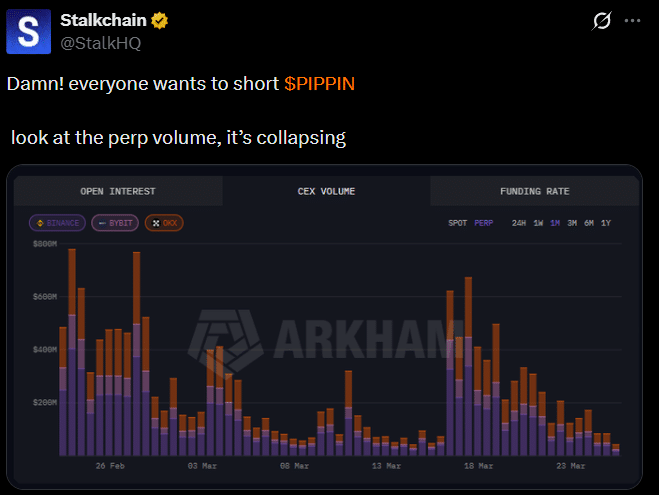
Fuente: X/StalkHQ

De hecho, la herramienta de derivados CoinGlass reveló que en las últimas 24 horas, los Futuros de PIPPIN han registrado liquidaciones masivas por un total de $2.62 millones.

De esto, $1.91 millones provinieron de posiciones largas apalancadas, mientras que las posiciones cortas registraron solo $707.89K en liquidaciones durante el mismo período.

Esta ola de liquidaciones tiene un fuerte potencial para influir en los participantes del mercado y puede desencadenar una presión de venta adicional.
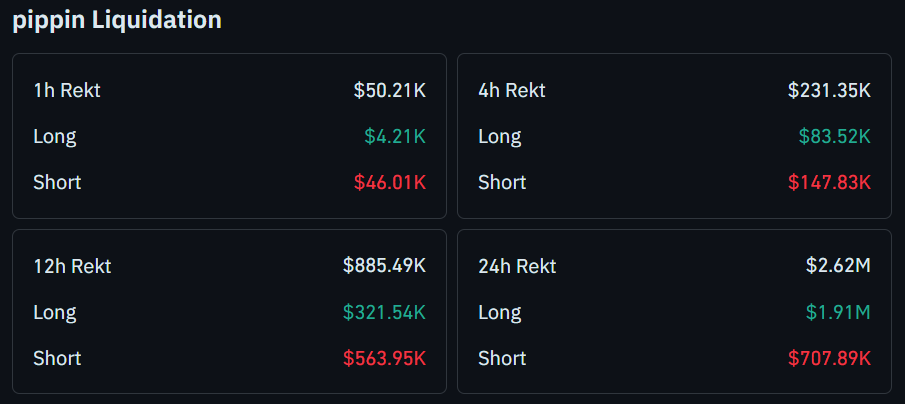
Fuente: CoinGlass

$0.0551 (soporte) y $0.0609 (resistencia) son niveles clave donde los operadores parecen estar fuertemente sobreapalancados. En estos niveles, los operadores han construido $658K en posiciones largas y $935.29K en posiciones cortas, lo que indica que los vendedores aún tienen el control.
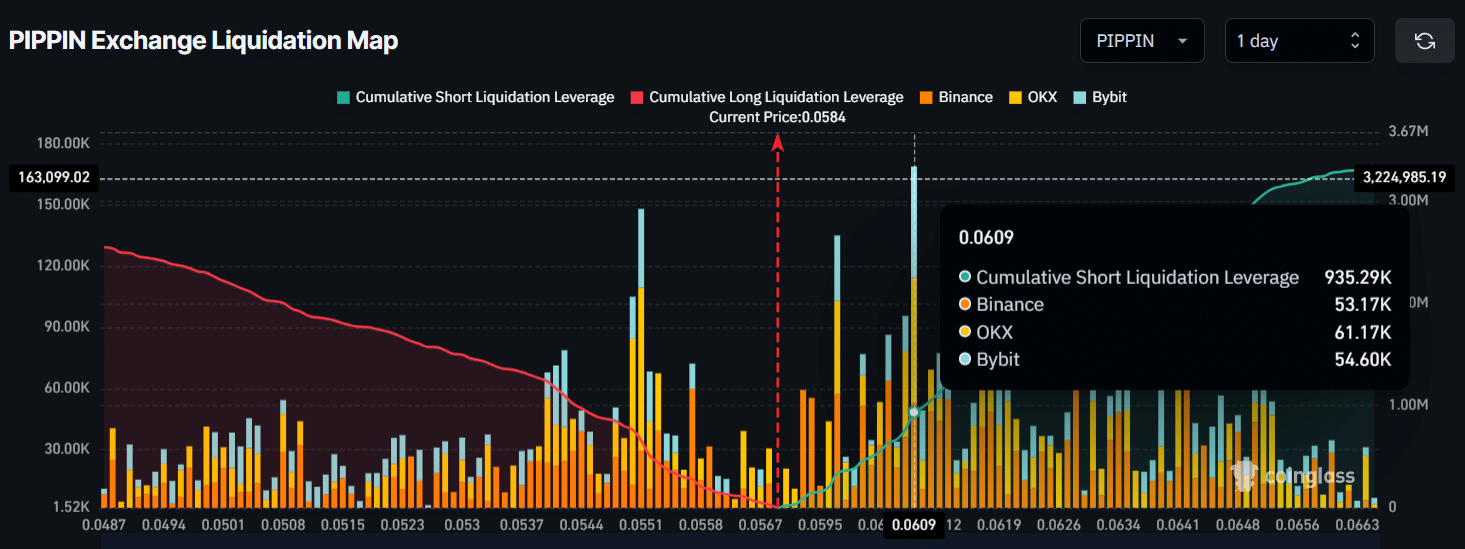
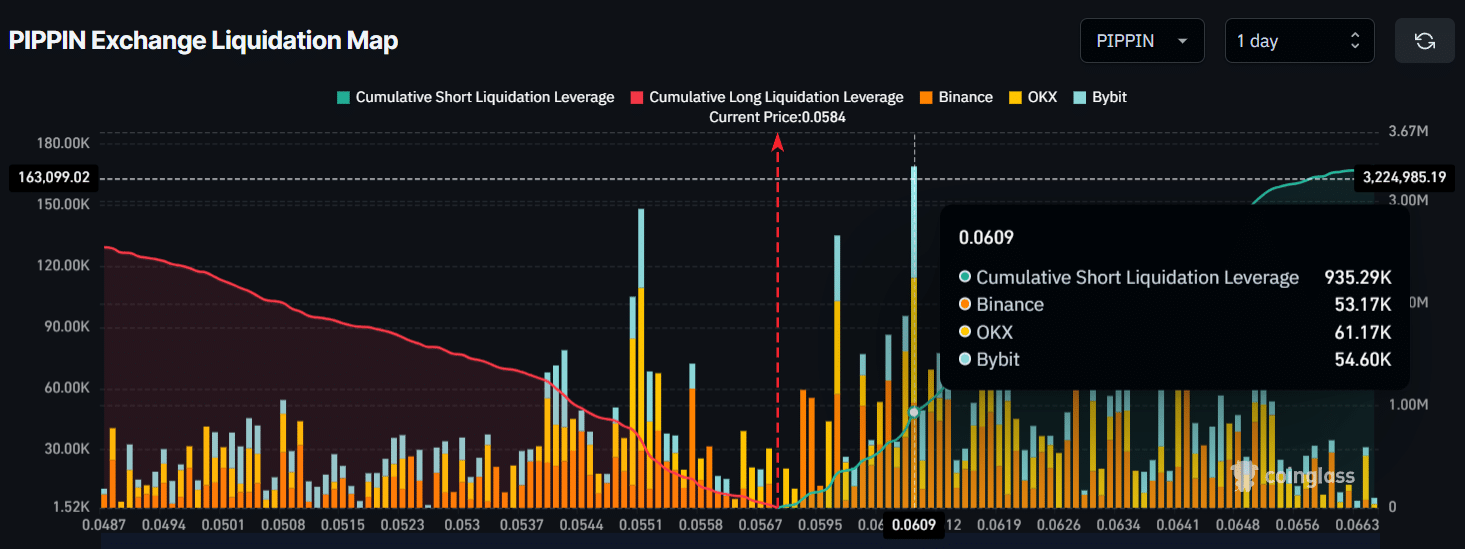
Fuente: CoinGlass

Otro factor importante detrás de la masiva caída del precio parece ser el sentimiento más amplio del mercado, que sigue siendo bajista debido a la crisis en curso en Asia Occidental.

Mientras tanto, la tendencia general de PIPPIN se mantuvo a la baja en el momento de redactar este artículo, una estructura que ha mantenido desde el 26 de febrero de 2026. Actualmente, ha perdido más del 92% de su valor, mientras que su capitalización de mercado se ha desplomado en más de $783.12 millones.

PIPPIN: El gráfico diario señala una posible reversión

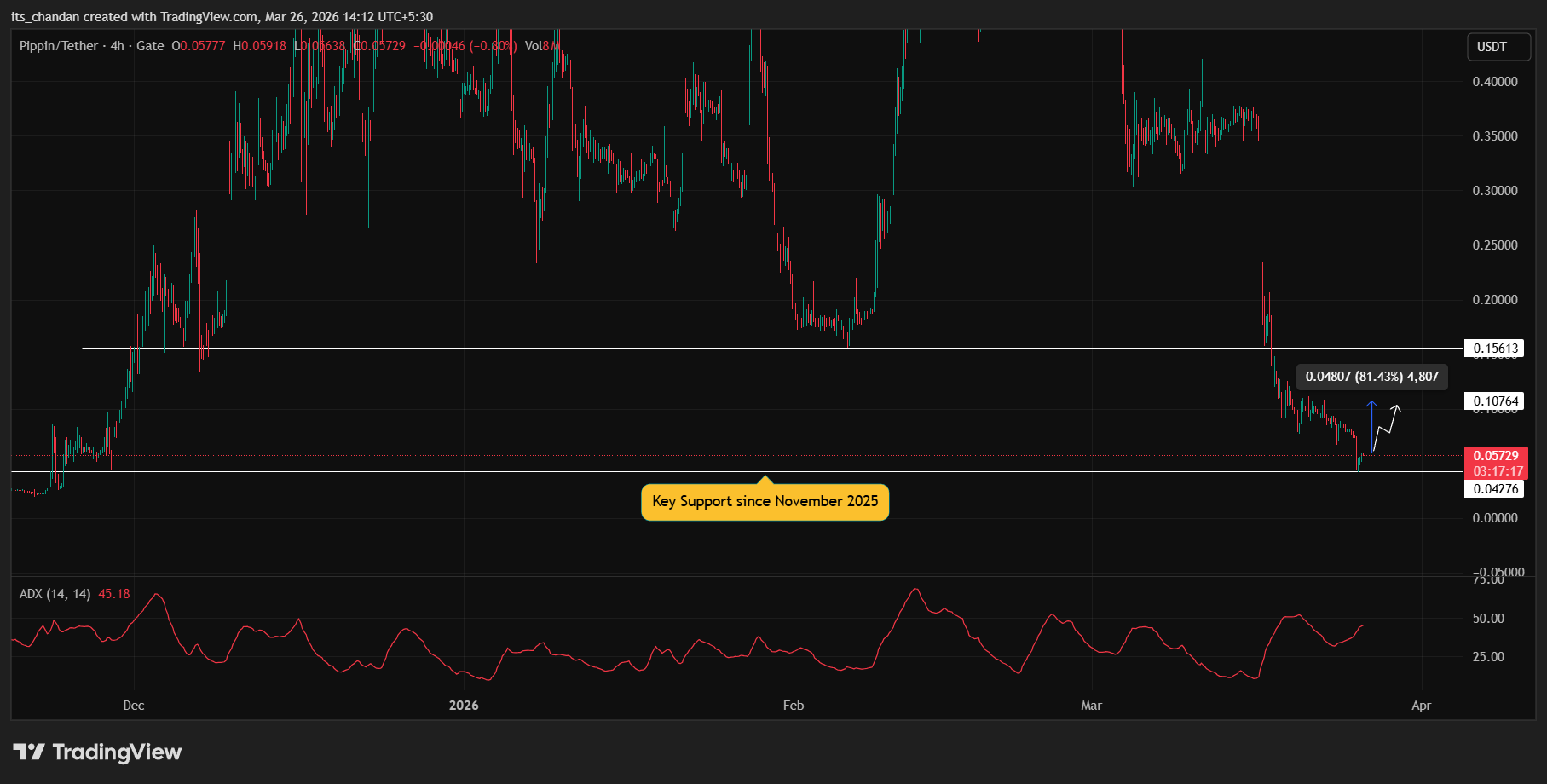
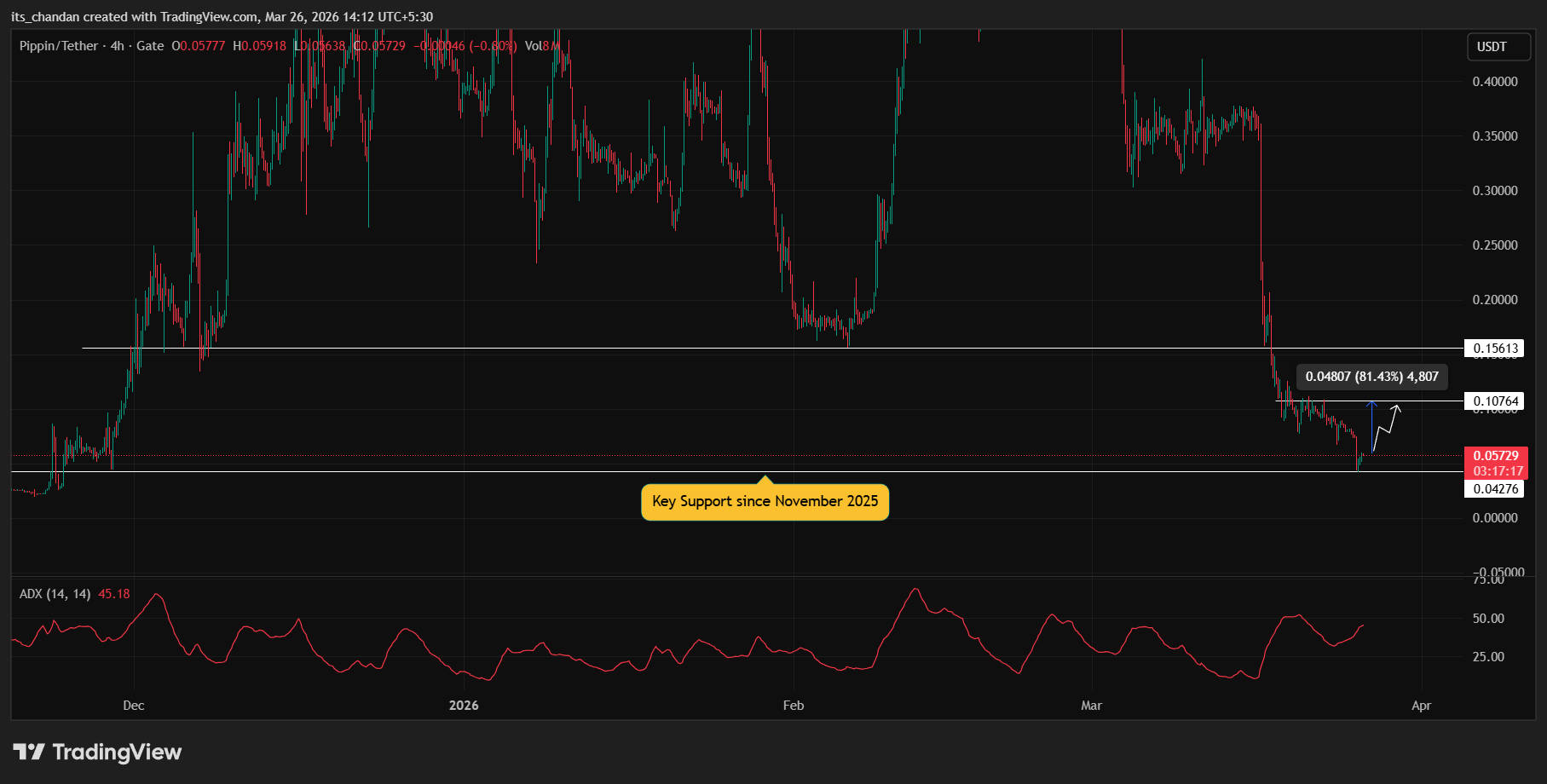
En el gráfico de cuatro horas, PIPPIN parecía estar rebotando, ya que el precio parecía revertirse después de alcanzar el nivel de soporte clave de $0.0427, que ha estado manteniendo desde noviembre de 2026.

El 26 de marzo marca la primera vez que el precio revisita este nivel desde noviembre de 2026, cuando anteriormente se disparó significativamente desde la misma zona.
Fuente: TradingView

Si PIPPIN se mantiene por encima del nivel de $0.0427, las posibilidades de un posible rebote del mercado son altas. Si eso sucede, el activo podría experimentar un fuerte aumento de precio de más del 81% y podría alcanzar el nivel de $0.107.

Cabe destacar que el precio ya ha saltado más del 36% hoy desde el nivel de soporte clave de $0.0427.

Por otro lado, la caída del precio podría continuar si PIPPIN no logra mantener este nivel de soporte clave.

A partir de ahora, el indicador técnico Índice Direccional Promedio (ADX), que mide la fuerza de la tendencia, ha alcanzado 45, muy por encima del umbral clave de 25, lo que indica un fuerte impulso direccional.


Resumen Final

  • Con una caída de precio del 33%, PIPPIN ha perdido un masivo 92% de su valor en el último mes.
  • La acción del precio sugiere una posible reversión si PIPPIN se mantiene por encima del nivel de $0.0427.


Criptos en tendencia

Preguntas relacionadas

Q¿Por qué cayó el precio de PIPPIN un 33% en un día?

ALa caída se debió a una acumulación masiva de posiciones cortas antes del colapso, liquidaciones de futuros por valor de 2,62 millones de dólares (principalmente de posiciones largas), y el sentimiento bajista del mercado amplio debido a la crisis de Asia Occidental.

Q¿Cuánto valor ha perdido PIPPIN en el último mes?

APIPPIN ha perdido más del 92% de su valor en el último mes, con una caída total de su capitalización de mercado de más de 783,12 millones de dólares.

Q¿Qué nivel de soporte clave es crucial para una posible recuperación de PIPPIN?

AEl nivel de soporte clave es 0,0427 dólares. Si el precio se mantiene por encima de este nivel, existe una alta probabilidad de un rebote del mercado.

Q¿Qué indicó el Índice de Dirección Media (ADX) sobre la tendencia de PIPPIN?

AEl indicador ADX alcanzó un valor de 45, muy por encima del umbral clave de 25, lo que indica un fuerte impulso direccional en la tendencia actual.

Q¿Cuáles fueron los niveles de precio donde los operadores estaban muy apalancados?

ALos operadores estaban muy apalancados en los niveles de 0,0551 dólares (soporte) y 0,0609 dólares (resistencia), con 658.000 dólares en posiciones largas y 935.290 dólares en posiciones cortas, lo que muestra que los vendedores aún tenían el control.

Lecturas Relacionadas

UNI Doubles in Two Months Against the Trend: A 5-Year-Overdue Value Realization

Amidst a generally stagnant crypto market in June and July, UNI, the governance token of Uniswap, saw a significant surge, nearly doubling in price from around $2.3 to $4.6. This rally represents a delayed but significant value reassessment, triggered by the practical implementation of its long-debated "fee switch" mechanism. The key turning point was the on-chain execution of the UNIfication proposal in December 2025. It activated a protocol fee on select pools, directed Unichain sequencer revenue (net of costs) to a communal treasury, executed a one-time burn of 100 million UNI, and established a system where all protocol revenue flows into a "TokenJar" contract. This treasury has a single exit: purchasing and permanently burning UNI via a "Firepit" contract. Initially, the market reacted tepidly as the generated revenue and corresponding burn rate were modest. The narrative shifted dramatically in July 2025 with two major developments. First, the launch of Robinhood Chain, tailored for tokenized stocks, rapidly became a primary source of volume and fees for Uniswap, at one point contributing nearly half of its weekly fees. Second, governance votes successfully expanded the fee mechanism to v4 pools and initiated a temperature check for fees on Robinhood Chain. The activation of v4 fees caused the protocol's daily revenue earmarked for UNI burns to nearly triple. The core of UNI's recent price action is the transition from a pure governance token to a cash-flow asset with a permanent, protocol-funded buyer. Its effectiveness is amplified by UNI's mature and widely distributed supply, with no major impending unlocks to dilute the impact of the buybacks. The sustainability of this rally now hinges on whether the transaction volume, particularly on Robinhood Chain, persists after its initial gas subsidies expire, determining if this is a genuine value realization or a subsidy-fueled spike.

marsbitHace 2 min(s)

UNI Doubles in Two Months Against the Trend: A 5-Year-Overdue Value Realization

marsbitHace 2 min(s)

Breaking: Google Earth Urgently Pulls Back Nano Banana 2 Image Generation Feature!

Google Earth's newly launched "Create image" feature, powered by the Nano Banana 2 AI image generation model, was abruptly withdrawn shortly after its release due to being "played" by users. The feature allowed users to generate and overlay AI-created visuals directly onto real-world satellite and 3D maps in Google Earth. The tool enabled creative applications like historical recreations (e.g., visualizing ancient Pompeii), generating informational graphics for landmarks, and envisioning architectural projects or futuristic cityscapes on real terrain. It operated under "geospatial grounding," meaning the AI respected the underlying geography, topography, and perspective of the chosen map view. The model also integrated with Gemini to retrieve relevant factual information. However, upon release, users quickly tested its limits. A prominent example involved reimagining Philadelphia's historic Independence Hall as a post-apocalyptic ruin overrun by "happy" zombies, evil clowns, and giant alien mechs. This highlighted both the feature's playful potential and its risks regarding the generation of inappropriate or misleading content on realistic maps, leading to its swift temporary removal. Google stated it would re-release the feature after implementing "enhanced guardrails." Analysts note this move strategically leverages Google's vast proprietary geospatial data, positioning its AI not just for artistic generation but for spatially accurate world visualization—a unique advantage in the competitive AI image generation landscape.

marsbitHace 1 hora(s)

Breaking: Google Earth Urgently Pulls Back Nano Banana 2 Image Generation Feature!

marsbitHace 1 hora(s)

Altman Admits: Overestimated AI Snatching Jobs! Huang Renxun: The Unemployment Narrative Is Completely Backwards

Sam Altman has revised his earlier predictions about AI rapidly replacing jobs, admitting he overestimated the speed at which AI would eliminate entry-level white-collar roles. Speaking on the "Invest Like the Best" podcast, he stated that people do not truly want an AI CEO, as accountability and human connection remain critical. He found that individuals prefer interacting with people who can be held responsible for decisions. Similarly, NVIDIA's Jensen Huang argued that the narrative of AI destroying jobs is misguided. He distinguishes between tasks and jobs, noting that while AI can automate specific tasks, entire jobs—encompassing communication, judgment, coordination, and accountability—are not eliminated. He cited examples like radiologists and software engineers, where demand for these roles has increased as AI handles repetitive tasks, allowing for business expansion and the creation of more positions. Data from a University of Maryland and LinkUp study supports this, showing that U.S. job postings for new graduates have actually risen, countering the fear of vanishing entry-level roles. However, a significant shift is occurring: the traditional entry-level tasks that help newcomers gain experience are being automated, making initial career access more challenging. The key insight is that as AI takes over standardized tasks, the enduring value of human work shifts toward areas of responsibility, trust-building, and final decision-making—aspects that AI cannot replicate. The real "moat" for professionals lies in these irreplaceable human elements.

marsbitHace 1 hora(s)

Altman Admits: Overestimated AI Snatching Jobs! Huang Renxun: The Unemployment Narrative Is Completely Backwards

marsbitHace 1 hora(s)

Weekly Editor's Picks (0725-0731)

Weekly Editor's Picks (0725-0731) provides a curated selection of deep analysis, filtering out market noise. Key themes from this week include: **Macro & Policy:** The Federal Reserve's upcoming meeting is marked by high uncertainty, balancing cooling inflation data against persistent price pressures. Meanwhile, the U.S. crypto regulatory Clarity Act faces critical political hurdles, with its 2026 passage probability seen as low. **Investing & Crypto:** Analysis suggests long-term crypto success depends on conviction through volatile cycles, focusing on assets like Bitcoin and core smart contract platforms. A trend noted is the increasing similarity between global equity markets (especially tech) and crypto, driven by narrative and leverage. Several major crypto protocols show strong revenue growth, but this isn't always translating to token price appreciation due to sell pressure and structural factors. **AI & Semiconductors:** Nvidia's rising credit default swap rates signal market concern over AI infrastructure financing risks. The storage sector experienced volatility as markets began pricing in potential 2027 oversupply. Despite a record profitable quarter, SK Hynix's results were deemed "below expectations," reflecting heightened investor demands for future growth visibility. **Markets & DeFi:** TradeXYZ demonstrated remarkable accuracy in pre-market pricing for a major A股 listing. The token ONDO saw gains, linked to its growing role in the on-chain tokenized stock ecosystem. **Ethereum:** Post-Pectra upgrade, a major structural shift is underway as Lido begins migrating millions of ETH to new validator architectures designed for capital efficiency. **Also Highlighted:** Butian's bullish stock market move; OpenAI's Altman promising major advances; Samsung and SK Hynix securing large AI chip deals; Apple reaching a $5T market cap; and ongoing discussions around exchange security following Poolin's bankruptcy case.

marsbitHace 2 hora(s)

Weekly Editor's Picks (0725-0731)

marsbitHace 2 hora(s)

Trading

Spot

Artículos destacados

Cómo comprar PIPPIN

¡Bienvenido a HTX.com! Hemos hecho que comprar pippin (PIPPIN) sea simple y conveniente. Sigue nuestra guía paso a paso para iniciar tu viaje de criptos.Paso 1: crea tu cuenta HTXUtiliza tu correo electrónico o número de teléfono para registrarte y obtener una cuenta gratuita en HTX. Experimenta un proceso de registro sin complicaciones y desbloquea todas las funciones.Obtener mi cuentaPaso 2: ve a Comprar cripto y elige tu método de pagoTarjeta de crédito/débito: usa tu Visa o Mastercard para comprar pippin (PIPPIN) al instante.Saldo: utiliza fondos del saldo de tu cuenta HTX para tradear sin problemas.Terceros: hemos agregado métodos de pago populares como Google Pay y Apple Pay para mejorar la comodidad.P2P: tradear directamente con otros usuarios en HTX.Over-the-Counter (OTC): ofrecemos servicios personalizados y tipos de cambio competitivos para los traders.Paso 3: guarda tu pippin (PIPPIN)Después de comprar tu pippin (PIPPIN), guárdalo en tu cuenta HTX. Alternativamente, puedes enviarlo a otro lugar mediante transferencia blockchain o utilizarlo para tradear otras criptomonedas.Paso 4: tradear pippin (PIPPIN)Tradear fácilmente con pippin (PIPPIN) en HTX's mercado spot. Simplemente accede a tu cuenta, selecciona tu par de trading, ejecuta tus trades y monitorea en tiempo real. Ofrecemos una experiencia fácil de usar tanto para principiantes como para traders experimentados.

688 Vistas totalesPublicado en 2025.01.11Actualizado en 2026.06.02

Cómo comprar PIPPIN

Discusiones

Bienvenido a la comunidad de HTX. Aquí puedes mantenerte informado sobre los últimos desarrollos de la plataforma y acceder a análisis profesionales del mercado. A continuación se presentan las opiniones de los usuarios sobre el precio de PIPPIN (PIPPIN).

活动图片