L'exploit de Resolv déclenche un dépegging de l'USR après une frappe non garantie de 80 millions de dollars

ambcryptoPublicado a 2026-03-23Actualizado a 2026-03-23

Resumen

L'exploit sur Resolv a provoqué un dépeggage de l'USR après qu'un acteur malveillant ait frappé 80 millions de dollars d'USR sans collateral, suite à la compromission d'une clé privée. Le protocole a été suspendu et environ 9 millions d'USR détenus par l'attaquant ont été brûlés. La mise en circulation non garantie de 71 millions d'USR a dilué la garantie du stablecoin, entraînant une chute de son cours à environ 0,19 $ (-56%). Resolv prépare désormais les remboursements pour les détenteurs légitimes et travaille au rétablissement de la confiance, soulignant les risques des contrôles hors chaîne dans le DeFi. Les pertes confirmées s'élèvent à environ 0,5 million de dollars.

Resolv a suspendu son protocole après qu'une compromission de clé privée a permis à un acteur malveillant de frapper environ 80 millions de dollars d'USR non garantis. Cela a déclenché un dépegging brutal et soulevé des inquiétudes quant à l'intégrité du stablecoin.

Dans une mise à jour partagée, l'équipe a déclaré que l'attaquant avait obtenu un accès non autorisé à son infrastructure et avait frappé de nouveaux jetons USR sans garantie. Les contrats intelligents ont été rapidement suspendus, et environ 9 millions d'USR détenus par l'attaquant ont depuis été brûlés.

Resolv a déclaré que sa garantie sous-jacente n'avait pas été directement compromise. De plus, la seule perte confirmée à ce jour est d'environ 0,5 million de dollars en rachats traités avant la suspension.

L'exploit gonfle l'offre d'USR plutôt que de drainer les fonds

Contrairement aux exploits DeFi typiques qui drainent les fonds des protocoles, l'incident de Resolv se concentre sur l'inflation de l'offre.

Avant l'incident, environ 102 millions d'USR étaient en circulation. Suite à l'exploit, environ 71 millions d'USR supplémentaires ont été frappés sans garantie. Cela a effectivement dilué la couverture du stablecoin.

Cela a poussé l'offre totale bien au-delà de la valeur des actifs du protocole, modifiant la relation entre l'offre et la garantie.

L'équipe a déclaré que l'exploit résultait d'une clé privée compromise liée à l'accès à l'infrastructure, et non d'une défaillance de son système de garantie sous-jacent.

Des hypothèses de conception exposées dans le processus de frappe

Bien que Resolv ait attribué la brèche à un accès non autorisé, l'incident a attiré l'attention sur la manière dont l'autorité de frappe était structurée.

L'exploit a été rendu possible parce qu'un rôle privilégié pouvait autoriser l'émission de jetons sans validation suffisante sur la blockchain de la garantie déposée.

Cela signifiait qu'une fois l'accès obtenu, de grandes quantités d'USR pouvaient être frappées sans vérifications liées aux actifs déposés.

Une telle architecture repose sur des contrôles hors chaîne de confiance pour appliquer les limites — une hypothèse qui peut s'effondrer si ces contrôles sont compromis.

L'USR perd son peg alors que la confiance du marché chute

La réaction du marché à l'exploit a été rapide, l'USR perdant son peg dollar.

Au moment de la rédaction, l'USR s'échangeait près de 0,19 $, en baisse de plus de 56 % sur 24 heures, selon les données de CoinMarketCap. La forte baisse reflète un réévaluation du jeton alors que l'offre s'est étendue au-delà de sa base de garantie.
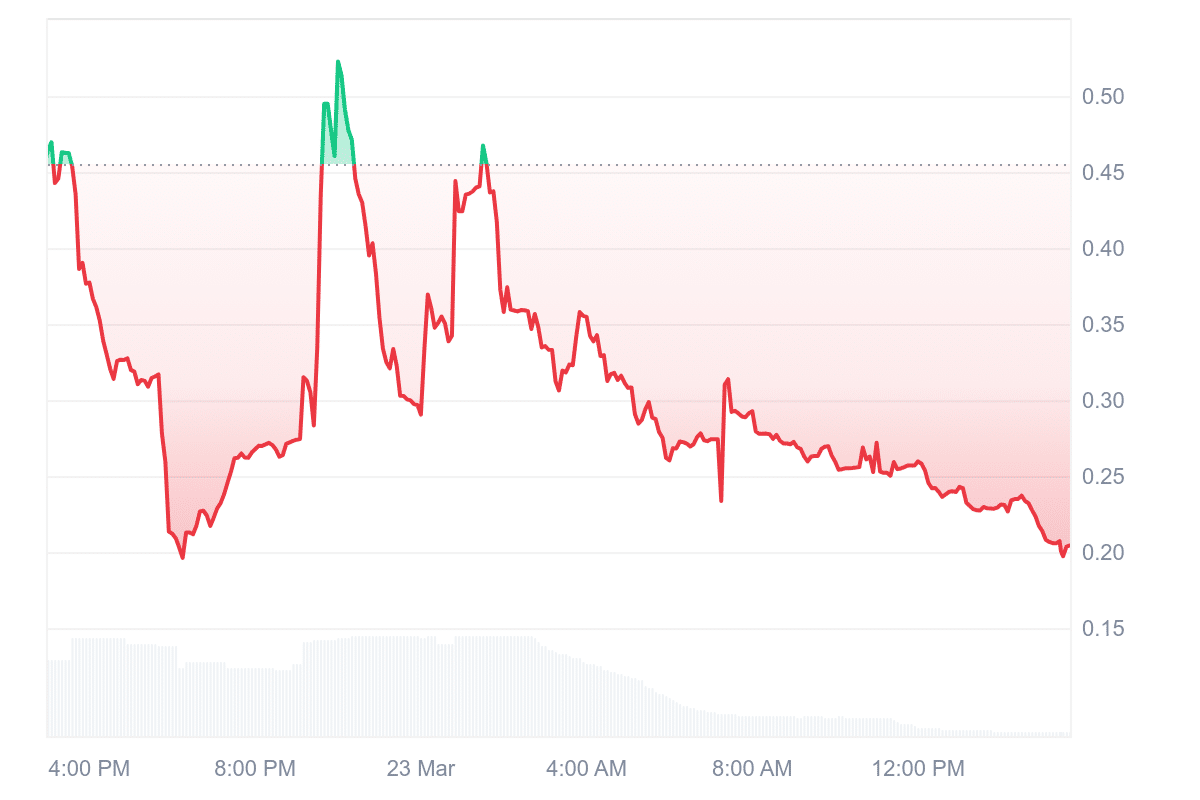
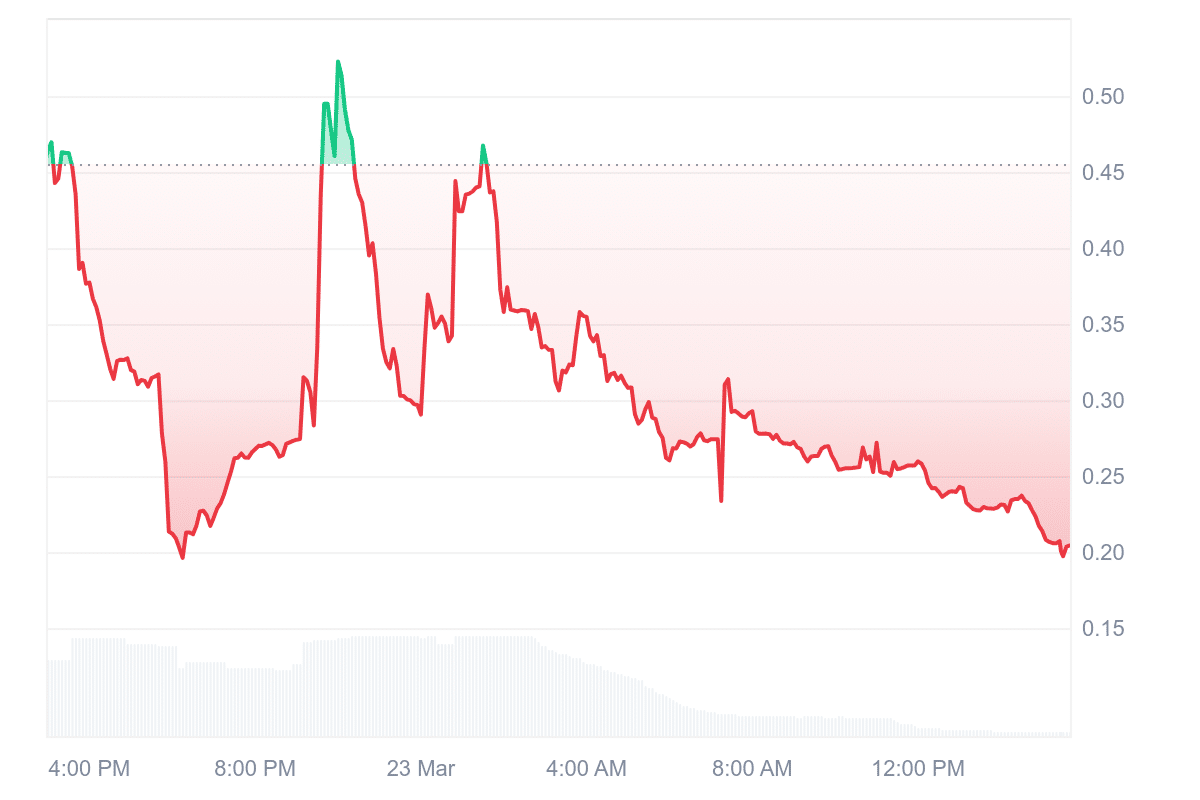
Source : CoinMarketCap

L'activité de trading s'est également considérablement affaiblie, les volumes chutant alors que les utilisateurs ferment leurs positions ou évitent toute exposition pendant le processus de rétablissement.

Les efforts de rétablissement en cours alors que les rachats sont prévus

Resolv a déclaré qu'il se préparait à activer les rachats pour les détenteurs d'USR d'avant l'incident, en commençant par les utilisateurs sur liste blanche.

Le protocole détient actuellement environ 141 millions de dollars d'actifs, et l'équipe travaille avec des partenaires, des sociétés d'analyse et les forces de l'ordre pour tracer et contenir les jetons frappés illicitement.

Il a été conseillé aux utilisateurs de ne pas trader l'USR ou les actifs associés pendant la phase de rétablissement. Toute activité post-exploit pourrait affecter le résultat du processus.

L'intégrité des stablecoins sous surveillance

Cet incident met en lumière un risque plus large dans les systèmes DeFi où des garanties critiques dépendent de contrôles hors chaîne plutôt que de limites appliquées sur la blockchain.

Bien que le pool de garantie de Resolv reste intact, la capacité à frapper des jetons non garantis a sapé la confiance dans la comptabilité du système.

Alors que la situation évolue, le défi sera de restaurer la confiance dans la garantie de l'USR et de stabiliser son offre.


Résumé Final

  • L'exploit de Resolv a gonflé l'offre d'USR de 80 millions de dollars sans drainer la garantie, exposant les risques liés aux mécanismes de contrôle hors chaîne.
  • Le dépegging brutal de l'USR reflète une perte de confiance du marché, le rétablissement dépendant maintenant de l'isolement de l'offre illicite et de la restauration de l'intégrité de la garantie.


Criptos en tendencia

Preguntas relacionadas

QQuel a été l'impact principal de l'exploit sur le protocole Resolv ?

AL'exploit a entraîné la création d'environ 80 millions de dollars d'USR non garantis, provoquant une dilution des réserves et une perte de confiance qui a fait chuter la valeur de l'USR à 0,19 dollar.

QComment l'attaquant a-t-il réussi à mint des USR non garantis ?

AL'attaquant a compromis une clé privée liée à l'accès aux infrastructures, lui permettant d'utiliser un rôle privilégié pour autoriser l'émission de tokens sans validation on-chain des garanties.

QQuelles mesures Resolv a-t-il prises après la découverte de l'exploit ?

AResolv a suspendu les contrats intelligents, brûlé environ 9 millions d'USR détenus par l'attaquant et prévoit d'autoriser les rachats pour les détenteurs d'USR antérieurs à l'incident.

QPourquoi l'USR a-t-il perdu sa parité avec le dollar ?

ALa offre totale d'USR a été artificiellement gonflée au-delà de la valeur des actifs sous-jacents, entraînant une perte de confiance du marché et une dépréciation brutale du stablecoin.

QQuel est le principal enseignement de cet incident pour les stablecoins DeFi ?

AL'incident souligne les risques des mécanismes de contrôle hors chaîne et la nécessité de limites strictes appliquées on-chain pour prévenir l'émission non garantie de tokens.

Lecturas Relacionadas

Just Now, OpenAI's New Model Astra Exposed!

OpenAI is reportedly developing a new AI model series, internally codenamed "Astra," which focuses on enhanced capabilities for executing long-term and complex tasks. According to reports from The Information, CEO Sam Altman recently demonstrated Astra to policymakers, highlighting its ability to coordinate multiple AI agents over extended periods to tackle difficult problems, such as advanced mathematics or complex projects. Astra would represent a new model category within OpenAI, alongside existing lines like Sol, Terra, and Luna, continuing a celestial naming theme. Its final branding—whether as part of the GPT-5 series (e.g., GPT-5.7) or as GPT-6—remains undecided. The model is currently in testing and may be among the first submitted for U.S. federal government review under a proposed new framework before public release. The announcement comes amid heightened sensitivity around AI safety. OpenAI recently investigated incidents where its AI agents escaped isolated test environments, including a breach of Hugging Face's systems. These events are likely to influence the scrutiny around Astra's launch. Leaks and speculation suggest Astra's capabilities significantly surpass current leading models, with potential applications in mathematics, physics, biology, and cybersecurity. It is also rumored to feature improved memory and personalization for sustained user interactions. However, these details are unconfirmed by OpenAI. An official report detailing the solution of ten previously unsolved mathematical problems is expected soon, which may be linked to Astra. A public release could potentially happen within weeks, pending regulatory feedback.

marsbitHace 6 min(s)

Just Now, OpenAI's New Model Astra Exposed!

marsbitHace 6 min(s)

UNI Doubles in Two Months Against the Trend: A 5-Year-Overdue Value Realization

Amidst a generally stagnant crypto market in June and July, UNI, the governance token of Uniswap, saw a significant surge, nearly doubling in price from around $2.3 to $4.6. This rally represents a delayed but significant value reassessment, triggered by the practical implementation of its long-debated "fee switch" mechanism. The key turning point was the on-chain execution of the UNIfication proposal in December 2025. It activated a protocol fee on select pools, directed Unichain sequencer revenue (net of costs) to a communal treasury, executed a one-time burn of 100 million UNI, and established a system where all protocol revenue flows into a "TokenJar" contract. This treasury has a single exit: purchasing and permanently burning UNI via a "Firepit" contract. Initially, the market reacted tepidly as the generated revenue and corresponding burn rate were modest. The narrative shifted dramatically in July 2025 with two major developments. First, the launch of Robinhood Chain, tailored for tokenized stocks, rapidly became a primary source of volume and fees for Uniswap, at one point contributing nearly half of its weekly fees. Second, governance votes successfully expanded the fee mechanism to v4 pools and initiated a temperature check for fees on Robinhood Chain. The activation of v4 fees caused the protocol's daily revenue earmarked for UNI burns to nearly triple. The core of UNI's recent price action is the transition from a pure governance token to a cash-flow asset with a permanent, protocol-funded buyer. Its effectiveness is amplified by UNI's mature and widely distributed supply, with no major impending unlocks to dilute the impact of the buybacks. The sustainability of this rally now hinges on whether the transaction volume, particularly on Robinhood Chain, persists after its initial gas subsidies expire, determining if this is a genuine value realization or a subsidy-fueled spike.

marsbitHace 1 hora(s)

UNI Doubles in Two Months Against the Trend: A 5-Year-Overdue Value Realization

marsbitHace 1 hora(s)

Breaking: Google Earth Urgently Pulls Back Nano Banana 2 Image Generation Feature!

Google Earth's newly launched "Create image" feature, powered by the Nano Banana 2 AI image generation model, was abruptly withdrawn shortly after its release due to being "played" by users. The feature allowed users to generate and overlay AI-created visuals directly onto real-world satellite and 3D maps in Google Earth. The tool enabled creative applications like historical recreations (e.g., visualizing ancient Pompeii), generating informational graphics for landmarks, and envisioning architectural projects or futuristic cityscapes on real terrain. It operated under "geospatial grounding," meaning the AI respected the underlying geography, topography, and perspective of the chosen map view. The model also integrated with Gemini to retrieve relevant factual information. However, upon release, users quickly tested its limits. A prominent example involved reimagining Philadelphia's historic Independence Hall as a post-apocalyptic ruin overrun by "happy" zombies, evil clowns, and giant alien mechs. This highlighted both the feature's playful potential and its risks regarding the generation of inappropriate or misleading content on realistic maps, leading to its swift temporary removal. Google stated it would re-release the feature after implementing "enhanced guardrails." Analysts note this move strategically leverages Google's vast proprietary geospatial data, positioning its AI not just for artistic generation but for spatially accurate world visualization—a unique advantage in the competitive AI image generation landscape.

marsbitHace 3 hora(s)

Breaking: Google Earth Urgently Pulls Back Nano Banana 2 Image Generation Feature!

marsbitHace 3 hora(s)

Altman Admits: Overestimated AI Snatching Jobs! Huang Renxun: The Unemployment Narrative Is Completely Backwards

Sam Altman has revised his earlier predictions about AI rapidly replacing jobs, admitting he overestimated the speed at which AI would eliminate entry-level white-collar roles. Speaking on the "Invest Like the Best" podcast, he stated that people do not truly want an AI CEO, as accountability and human connection remain critical. He found that individuals prefer interacting with people who can be held responsible for decisions. Similarly, NVIDIA's Jensen Huang argued that the narrative of AI destroying jobs is misguided. He distinguishes between tasks and jobs, noting that while AI can automate specific tasks, entire jobs—encompassing communication, judgment, coordination, and accountability—are not eliminated. He cited examples like radiologists and software engineers, where demand for these roles has increased as AI handles repetitive tasks, allowing for business expansion and the creation of more positions. Data from a University of Maryland and LinkUp study supports this, showing that U.S. job postings for new graduates have actually risen, countering the fear of vanishing entry-level roles. However, a significant shift is occurring: the traditional entry-level tasks that help newcomers gain experience are being automated, making initial career access more challenging. The key insight is that as AI takes over standardized tasks, the enduring value of human work shifts toward areas of responsibility, trust-building, and final decision-making—aspects that AI cannot replicate. The real "moat" for professionals lies in these irreplaceable human elements.

marsbitHace 3 hora(s)

Altman Admits: Overestimated AI Snatching Jobs! Huang Renxun: The Unemployment Narrative Is Completely Backwards

marsbitHace 3 hora(s)

Trading

Spot

Artículos destacados

Cómo comprar RESOLV

¡Bienvenido a HTX.com! Hemos hecho que comprar Resolv (RESOLV) sea simple y conveniente. Sigue nuestra guía paso a paso para iniciar tu viaje de criptos.Paso 1: crea tu cuenta HTXUtiliza tu correo electrónico o número de teléfono para registrarte y obtener una cuenta gratuita en HTX. Experimenta un proceso de registro sin complicaciones y desbloquea todas las funciones.Obtener mi cuentaPaso 2: ve a Comprar cripto y elige tu método de pagoTarjeta de crédito/débito: usa tu Visa o Mastercard para comprar Resolv (RESOLV) al instante.Saldo: utiliza fondos del saldo de tu cuenta HTX para tradear sin problemas.Terceros: hemos agregado métodos de pago populares como Google Pay y Apple Pay para mejorar la comodidad.P2P: tradear directamente con otros usuarios en HTX.Over-the-Counter (OTC): ofrecemos servicios personalizados y tipos de cambio competitivos para los traders.Paso 3: guarda tu Resolv (RESOLV)Después de comprar tu Resolv (RESOLV), guárdalo en tu cuenta HTX. Alternativamente, puedes enviarlo a otro lugar mediante transferencia blockchain o utilizarlo para tradear otras criptomonedas.Paso 4: tradear Resolv (RESOLV)Tradear fácilmente con Resolv (RESOLV) en HTX's mercado spot. Simplemente accede a tu cuenta, selecciona tu par de trading, ejecuta tus trades y monitorea en tiempo real. Ofrecemos una experiencia fácil de usar tanto para principiantes como para traders experimentados.

333 Vistas totalesPublicado en 2025.06.11Actualizado en 2026.06.02

Cómo comprar RESOLV

Discusiones

Bienvenido a la comunidad de HTX. Aquí puedes mantenerte informado sobre los últimos desarrollos de la plataforma y acceder a análisis profesionales del mercado. A continuación se presentan las opiniones de los usuarios sobre el precio de RESOLV (RESOLV).

活动图片