Filecoin rebounds 13%: Will $1.10 trigger a FIL short squeeze?

ambcryptoPublicado a 2026-02-27Actualizado a 2026-02-27

Resumen

Filecoin (FIL) surged 13% to $1.05, supported by a significant increase in trading volume reaching $314.6 million. This rebound follows a breakdown from a bearish pennant pattern and a drop toward the $0.87 support level. The recovery is further reinforced by Filecoin’s strategic shift toward real on-chain demand and improved network economics under its 2026 roadmap. Key resistance lies at $1.10, a level that may trigger a short squeeze if breached, with further upside potential toward $1.60. Technical indicators, including MACD, show early bullish momentum, while spot market data reflects aggressive buying activity. Liquidity clusters suggest that holding above $1.00 is critical for continued upward movement, while a failure to sustain gains could lead to a retest of the $0.95 zone. The current structure favors a bullish outlook, provided the price remains above the $1.00 support level.

Filecoin [FIL] has surged 13% to $1.05, at press time, as trading volume exploded to $314.6 million in 24 hours. This expansion aligns with the 2026 ecosystem strategy that prioritizes paid on-chain deals and stronger network economics.

The network has shifted its focus toward driving real demand rather than relying solely on capacity metrics. As a result, market capitalization has risen to about $769 million, accompanied by growing participation.

Buyers have stepped in aggressively after the recent breakdown phase. However, FIL still trades within a broader corrective environment.

The alignment between strategic narrative and capital inflows now strengthens the recovery case. Price expansion backed by $314.6 million in volume signals conviction rather than a low-liquidity bounce.

Pennant breakdown sparks rebound

After breaking down from a bearish pennant formation, Filecoin extended its decline toward the $0.87 support band. Sellers pushed the price below the lower channel boundary, confirming short-term weakness.

However, bulls have reclaimed ground quickly and driven a rebound toward $1.05. This reaction suggests strong demand absorption near the highlighted support.

The price now approaches the $1.10 resistance zone, which previously acted as structural support. If buyers sustain pressure above $1.05 and reclaim the resistance zone, upside continuation toward $1.6 becomes plausible.

Still, failure to hold above $1 could invite renewed selling pressure. The rebound currently challenges the bearish continuation thesis that followed the pennant breakdown.

At the time of writing, MACD readings reflected early bullish convergence as downside pressure eases on the daily timeframe.

The MACD line has crossed upward toward -0.044, while the histogram has turned positive near 0.022. These shifts suggest improving internal strength despite the broader downtrend.

Although the signal line remains below equilibrium at -0.066, buyers are gradually regaining control. This transition does not yet confirm a full reversal, but it underscores that selling intensity has weakened significantly since the pennant breakdown.

Filecoin spot buyers reclaim control

The 90-day Spot Taker CVD has flipped into Taker Buy dominance as of writing, confirming sustained aggressive buying activity.

This shift reflects cumulative buy-side volume exceeding sell pressure over an extended horizon. Such positioning suggests conviction rather than short-term speculation.

Additionally, trading volume has expanded by over 200% in 24 hours, reinforcing participation strength.

Buyers now actively lift offers instead of waiting passively. This development strengthens the rebound narrative.

However, sustained dominance must continue for the price to challenge higher resistance clusters. If aggressive spot flows persist, FIL could build a stronger structural base above $1.00.

Liquidity clusters frame the next move

The Binance liquidation heatmap shows dense leverage clusters above $1.10 and around $0.95. Notably, around 322.69K in liquidation leverage appears near the $0.98–$1.00 zone.

Overhead liquidity around $1.10–$1.14 creates a magnet for price expansion if buyers maintain pressure. At the same time, sub-$0.95 liquidity forms a downside trigger if support fails.

This structure sets up a potential squeeze dynamic. Should price break above $1.10, short liquidations could accelerate upside movement.

Conversely, rejection near resistance may expose $0.95 quickly. Liquidity positioning now defines the immediate battlefield between bulls and bears.

Can Filecoin extend recovery?

Filecoin currently challenges its breakdown narrative as strategic demand focus aligns with aggressive buying and improving technical structure.

Price has rebounded strongly from support, and indicators show weakening downside pressure. Liquidity clusters now frame the next directional move.

If buyers clear $1.10 decisively, upside continuation toward higher resistance would likely follow. For now, the rebound carries credibility, and the structure increasingly favors recovery over renewed breakdown for as long as the price doesn’t fall below $1.


Final Summary

  • Filecoin challenged its bearish narrative as buyers defended key support and pressed toward overhead liquidity.
  • Sustained strength above $1.00 would increasingly favor upside continuation over renewed breakdown pressure ahead.


Criptos en tendencia

Preguntas relacionadas

QWhat was the percentage increase in Filecoin's price and what did it reach at press time?

AFilecoin surged 13% to $1.05 at press time.

QWhat key resistance level does the article identify as a potential trigger for a short squeeze?

AThe article identifies the $1.10 resistance zone as a potential trigger for a short squeeze.

QWhat technical indicator showed early signs of bullish convergence, according to the analysis?

AThe MACD indicator showed early signs of bullish convergence, with the MACD line crossing upward and the histogram turning positive.

QWhat does the flip in the 90-day Spot Taker CVD indicate?

AThe flip in the 90-day Spot Taker CVD into Taker Buy dominance indicates sustained aggressive buying activity and conviction from buyers.

QAccording to the Binance liquidation heatmap, what are the two key liquidity clusters that frame the price's next potential move?

AThe key liquidity clusters are above $1.10 (around $1.10–$1.14) and around $0.95, with significant leverage near the $0.98–$1.00 zone.

Lecturas Relacionadas

a16z: From Companies to DAOs, DUNA May Become the Next Generation Organizational Form

This article, "From Companies to DAOs: How DUNA Could Become the Next Organizational Form," traces the 500-year evolution of business collaboration. It begins with medieval structures like the *commenda* and Florentine *compagnia*, which exposed partners to personal risk. The modern corporation, exemplified by the Dutch East India Company (VOC), was a revolutionary leap, enabling large-scale, capital-intensive ventures by offering limited liability and reducing coordination costs. However, corporations introduced new challenges like principal-agent problems and bureaucratic overhead. The piece argues that software and internet-native protocols are now reducing these traditional overheads. Decentralized Autonomous Organizations (DAOs) emerged as a new model for coordination without centralized management. Yet, DAOs face a significant legal vacuum: they lack legal recognition, leaving members exposed to unlimited personal liability, and their tokens are vulnerable to being classified as securities under unclear regulations (e.g., the Howey Test). This has forced projects into suboptimal workarounds like offshore foundations. The article identifies the Decentralized Unincorporated Nonprofit Association (DUNA) as a potential solution. Recently legalized in states like Wyoming, the DUNA provides a legal wrapper for decentralized networks. It grants key protections—legal personality, limited liability, and perpetual existence—to a group without imposing a traditional hierarchical management structure. This allows token-holder communities to govern, hold assets, and contract as a single legal entity, aligning with their decentralized nature. While DUNA doesn't solve all governance challenges or magically resolve securities law questions, it represents a crucial step. It fills the legal recognition gap, offering a native legal form for internet-scale, decentralized collaboration and extending the separation of personal risk from organizational venture into a new domain.

marsbitHace 39 min(s)

a16z: From Companies to DAOs, DUNA May Become the Next Generation Organizational Form

marsbitHace 39 min(s)

2026 Mid-Year Report On-Chain RWA: Tokenized Stock Market Cap Doubles in a Year, But 90% of Rights Are Hollow Shells

The 2026 Mid-Year Report on On-Chain RWA highlights a significant growth in tokenized stock market capitalization, which nearly doubled from $951 million in March to $1.89 billion by July. However, the report reveals a fundamental contradiction in this "layer 2.5" ecosystem: products with the strongest legal foundation (like regulated U.S. infrastructure) lack liquidity and distribution, while freely tradable offshored wrapper products often lack substantive ownership rights. The increase is driven largely by a few products (SECZ, FGRS, STRCx) and platforms (Ondo, xStocks, Securitize collectively hold over 85% share). While distributed value across networks like Ethereum, Solana, and BNB Chain has grown, the market remains fragmented. Products referencing the same underlying asset (e.g., Apple stock) are distinct legal liabilities with different intermediaries and jurisdictional rules, offering varying degrees of legal claim. The report cautions that headline numbers are misleading, as they reflect changes in distributed token value—driven by issuance, conversions, and price movements—not pure investor inflows. True "canonical shares" with legal ownership, wide wallet distribution, institutional liquidity, and independent on-chain price discovery do not yet exist at scale. Tokenized treasuries show stronger product-market fit, and ETFs may be easier to scale than single stocks. The core takeaway is a trade-off: legal certainty versus liquidity and composability.

marsbitHace 1 hora(s)

2026 Mid-Year Report On-Chain RWA: Tokenized Stock Market Cap Doubles in a Year, But 90% of Rights Are Hollow Shells

marsbitHace 1 hora(s)

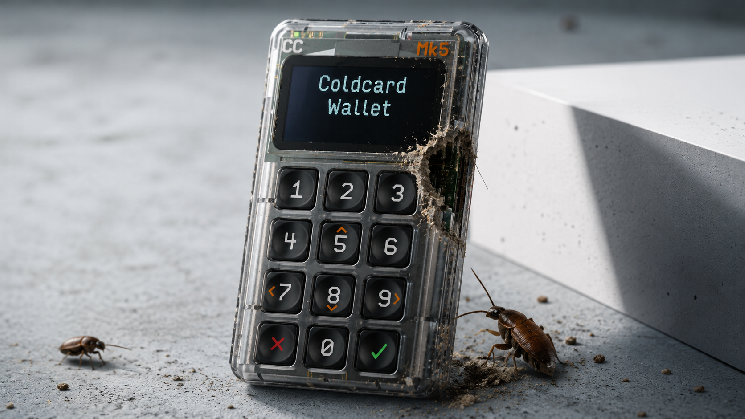
Coldcard Hardware Wallet Hacked: 594 Bitcoin Withdrawn in 25 Minutes

The Coldcard hardware wallet has been compromised, with hackers stealing approximately 594.5 Bitcoin (~$40 million) from 500 addresses in just 25 minutes. The root cause was a critical software bug, undetected for five years, which disabled the device's secure chip for generating true random numbers. This led to the creation of private keys based on predictable data like the processor's serial number, drastically reducing cryptographic security. The attackers exploited this offline by brute-forcing possible seed phrases, finding active addresses on the public ledger, and signing transactions. Initially, Coinkite (Coldcard's maker) claimed only older models were at risk but later admitted all devices running the compromised firmware were vulnerable. CEO Rodolphe Novak (NVK) apologized but ruled out financial compensation for affected users. To secure funds, owners must urgently update their firmware to specific safe versions, generate a completely new seed phrase on the updated device, and transfer all assets to new addresses created with that new seed. While a BIP-39 passphrase can help, it does not replace this migration process. Other Coinkite products like TAPSIGNER were not affected. This incident underscores that even specialized hardware requires rigorous, independent code audits, especially for cryptographic functions. It parallels past failures, like a 2006 OpenSSL bug in Debian, and raises questions about whether automated code analysis can ever fully replace human scrutiny in critical security areas.

cryptonews.ruHace 3 hora(s)

Coldcard Hardware Wallet Hacked: 594 Bitcoin Withdrawn in 25 Minutes

cryptonews.ruHace 3 hora(s)

Trading

Spot

Artículos destacados

Cómo comprar FIL

¡Bienvenido a HTX.com! Hemos hecho que comprar Filecoin (FIL) sea simple y conveniente. Sigue nuestra guía paso a paso para iniciar tu viaje de criptos.Paso 1: crea tu cuenta HTXUtiliza tu correo electrónico o número de teléfono para registrarte y obtener una cuenta gratuita en HTX. Experimenta un proceso de registro sin complicaciones y desbloquea todas las funciones.Obtener mi cuentaPaso 2: ve a Comprar cripto y elige tu método de pagoTarjeta de crédito/débito: usa tu Visa o Mastercard para comprar Filecoin (FIL) al instante.Saldo: utiliza fondos del saldo de tu cuenta HTX para tradear sin problemas.Terceros: hemos agregado métodos de pago populares como Google Pay y Apple Pay para mejorar la comodidad.P2P: tradear directamente con otros usuarios en HTX.Over-the-Counter (OTC): ofrecemos servicios personalizados y tipos de cambio competitivos para los traders.Paso 3: guarda tu Filecoin (FIL)Después de comprar tu Filecoin (FIL), guárdalo en tu cuenta HTX. Alternativamente, puedes enviarlo a otro lugar mediante transferencia blockchain o utilizarlo para tradear otras criptomonedas.Paso 4: tradear Filecoin (FIL)Tradear fácilmente con Filecoin (FIL) en HTX's mercado spot. Simplemente accede a tu cuenta, selecciona tu par de trading, ejecuta tus trades y monitorea en tiempo real. Ofrecemos una experiencia fácil de usar tanto para principiantes como para traders experimentados.

1.4k Vistas totalesPublicado en 2024.12.11Actualizado en 2026.06.02

Cómo comprar FIL

Discusiones

Bienvenido a la comunidad de HTX. Aquí puedes mantenerte informado sobre los últimos desarrollos de la plataforma y acceder a análisis profesionales del mercado. A continuación se presentan las opiniones de los usuarios sobre el precio de FIL (FIL).

活动图片