Predicción del precio de Jupiter [JUP]: Por qué podría venir una subida del 20% en enero

ambcryptoPublicado a 2026-01-02Actualizado a 2026-01-02

Resumen

El token JUP, nativo de la plataforma de trading descentralizado en Solana, subió un 6,9% en las últimas 24 horas, con un volumen de trading diario aumentado en un 32%. Este repunte se atribuye al lanzamiento de Jupiter Mobile V3 y a que el protocolo DeFi generó la segunda mayor cantidad de tarifas en 2025. Sin embargo, la tendencia a largo plazo sigue siendo bajista. La resistencia clave de $0,20 ha sido un obstáculo desde diciembre. Si los alcistas logran convertirla en soporte, un rebote hacia $0,224 o $0,239 sería posible, ofreciendo una oportunidad de compra a corto plazo. Los traders deben establecer niveles estrictos de toma de beneficios, ya que la tendencia general sigue siendo negativa.

Jupiter [JUP], el token nativo de la plataforma de trading descentralizado en Solana, subió un 6,9% en las últimas 24 horas. Según CoinMarketCap, el volumen de negociación diario del token aumentó un 32%.

Estas ganancias probablemente fueron impulsadas por el lanzamiento de Jupiter Mobile V3. Se trata de una actualización importante de su aplicación móvil, la "primera plataforma móvil de trading profesional completamente nativa", anunciada en una publicación en X.

El protocolo DeFi ocupó el segundo lugar más alto en generación de tarifas totales en 2025, según otra publicación de CryptoDiffer. Estos desarrollos podrían haber reforzado la confianza a corto plazo en JUP, inspirando la rápida subida.

La tendencia de Jupiter en marcos de tiempo superiores no ha cambiado

El movimiento de oscilación a la baja desde $0,258 a $0,169 en diciembre mostró que la tendencia y estructura a más largo plazo se ha mantenido bajista. El rebote de precio de las últimas 24 horas fue parte de un impulso alcista de Jupiter.

Este rebote desafiaba la resistencia psicológica de $0,2 en el momento de redactar este artículo.

El indicador MACD mostró cierto impulso alcista a corto plazo, pero el indicador aún estaba por debajo de cero y subrayaba la prevalencia bajista. El indicador A/D también rebotó al alza durante las últimas dos semanas. Por el contrario, la presión compradora ha sido relativamente decepcionante.

El escenario bajista para JUP

La resistencia de $0,20 también ha servido como zona de oferta desde mediados de diciembre. Fue probada la semana pasada, y los alcistas de Jupiter no lograron superarla. Un resultado similar podría producirse una vez más.

Llamada a la acción para traders: Posible oportunidad de compra en $0,2

El indicador A/D mostró una mayor presión compradora durante el movimiento alcista reciente y un impulso más fuerte. Si bien la estructura de 1 día era bajista, los niveles de retroceso de Fibonacci mostraron que un rebote a $0,224 y $0,239 aún era posible.

Por lo tanto, los traders de marcos de tiempo más bajos tienen razones para tomar posiciones largas si la resistencia de $0,2 se convierte en soporte, apuntando a esos niveles de resistencia como objetivos de toma de ganancias.


Reflexiones finales

  • La acción del precio del token Jupiter será alcista a corto plazo, especialmente si logra convertir la resistencia de número redondo en soporte.
  • Los traders deben recordar que la tendencia a más largo plazo sigue siendo bajista y deben establecer niveles estrictos de toma de ganancias.

Descargo de responsabilidad: La información presentada no constituye asesoramiento financiero, de inversión, comercial ni de ningún otro tipo y es únicamente la opinión del autor.


Criptos en tendencia

Preguntas relacionadas

Q¿Por qué el precio de Jupiter (JUP) subió un 6,9% en las últimas 24 horas?

ALas ganancias probablemente fueron estimuladas por el lanzamiento de Jupiter Mobile V3, una actualización importante de su aplicación móvil anunciada como 'la primera plataforma móvil de trading profesional completamente nativa', anunciada en una publicación de X.

Q¿Qué indicador mostró un impulso alcista a corto plazo pero aún subrayó la prevalencia bajista?

AEl indicador MACD mostró cierto impulso alcista a corto plazo, pero aún se mantenía por debajo de cero, lo que subrayaba la prevalencia bajista.

QSegún el artículo, ¿cuál es un posible objetivo de toma de ganancias para los operadores si la resistencia de $0,20 se convierte en soporte?

ALos objetivos de toma de ganancias posibles para los operadores serían los niveles de resistencia en $0,224 y $0,239, según los niveles de retroceso de Fibonacci.

Q¿Cómo se describe la tendencia a más largo plazo para JUP a pesar del repunte reciente?

ALa tendencia y estructura a más largo plazo se ha mantenido bajista, como lo demostró el movimiento de oscilación a la baja desde $0,258 a $0,169 en diciembre.

Q¿Qué advertencia importante incluye el artículo al final para los traders?

AEl artículo incluye una exención de responsabilidad que indica que la información presentada no constituye asesoramiento financiero, de inversión, comercial o de otro tipo y es únicamente la opinión del escritor.

Lecturas Relacionadas

Gate Research Institute: Analysis of Chart Patterns and Breakout Trading Strategies

Gate Research Institute: Chart Pattern Analysis and Breakout Trading Strategies Chart patterns are crucial tools in technical analysis for observing market supply and demand shifts, trend continuations, and reversals. This analysis involves a comprehensive evaluation of trend, volume, support/resistance, time cycles, and breakout validity, not just rote pattern recognition. Patterns are broadly categorized into reversal patterns (e.g., Double Tops/Bottoms, Head and Shoulders) and continuation patterns (e.g., Flags, Triangles, Rectangles). An effective breakout, key for trading, requires clear support/resistance, prolonged consolidation, a prevailing trend backdrop, and volume confirmation. However, breakouts are not guaranteed, as false breakouts are common. Risk must be managed through position sizing, stop-loss orders, pullback confirmations, and profit-taking in stages. Key pattern types discussed include: * **Rectangle Patterns:** Indicate market indecision within parallel support and resistance, with breakouts projecting a move equal to the pattern's width. * **Flag & Pennant Patterns:** Short-term continuation patterns following sharp price moves ("flagpoles"). * **Triangle Patterns:** Symmetrical, Ascending (bullish bias), and Descending (bearish bias) triangles, representing consolidation before a directional move. * **Head and Shoulders Patterns:** Major reversal patterns signaling trend exhaustion. The article details breakout trading strategies, defining valid breakouts by price closing beyond a key level with increased volume and minimal immediate re-entry into the prior range. It contrasts range trading with breakout trading and outlines entry methods (immediate entry, pullback entry, scaling in), stop-loss placement (based on pattern failure), and profit-taking techniques (target-based, structure-based, trend-following). It further classifies breakout outcomes: 1. **Valid Breakouts:** Strong, sustained moves in the breakout direction. 2. **Pullback Breakouts:** Price breaks out, retests the breakout level as support/resistance, then resumes the trend—offering a lower-risk entry. 3. **False Breakouts:** Price briefly breaches a level but quickly reverses back into the prior range, a common risk managed by strict stop-losses. Key validation tools for breakouts include volume analysis, the principle of support/resistance role reversal, and momentum indicators like ATR, Moving Averages, Bollinger Bands, and RSI. In conclusion, while chart patterns and breakout analysis provide a structured framework, their effectiveness relies on multiple confirming factors—trend context, volume, and proper risk management. They should be integrated into a broader trading system rather than used as standalone signals.

marsbitHace 24 min(s)

Gate Research Institute: Analysis of Chart Patterns and Breakout Trading Strategies

marsbitHace 24 min(s)

Joseph Chalom: Ethereum is Becoming the "Settlement Layer of Trust" for Global Finance

In a speech titled "The Industrialization of Trust," Sharplink CEO Joseph Chalom (former BlackRock digital assets head) discussed the future transformation of global finance. Drawing from 20 years at BlackRock, where he led the launch of Bitcoin/ETH ETFs and tokenized funds, Chalom highlighted the immense hidden costs of establishing trust in traditional finance—estimated at over $9.3 trillion annually in the US alone due to fragmented systems, multi-day settlements, and countless reconciliations. He argued that Ethereum is emerging as the global financial "settlement layer for trust," with its robust, decentralized infrastructure securing over $300 billion in on-chain assets and most stablecoins and tokenized assets. The future, he stated, will be driven by three accelerating pillars: stablecoins (evolving beyond crypto gateways to become efficient cross-border payment rails), tokenized assets (enabling 24/7 trading and reshaping capital markets), and DeFi (providing automated, accessible financial services). A potential game-changer, Chalom added, is the fourth pillar: "Agentic Finance," where AI agents autonomously execute programmable financial transactions via smart contracts and stablecoins. He envisions individuals soon having AI-powered "CFOs in their pockets" to optimize idle capital and manage tokenized portfolios. This shift, facilitated by Ethereum's trustless settlement, could multiply on-chain transaction volume 1000x within a year, moving finance toward a seamless, digitized future.

marsbitHace 24 min(s)

Joseph Chalom: Ethereum is Becoming the "Settlement Layer of Trust" for Global Finance

marsbitHace 24 min(s)

STRC Severely Unpegged, What Risks Is the Market Pricing In?

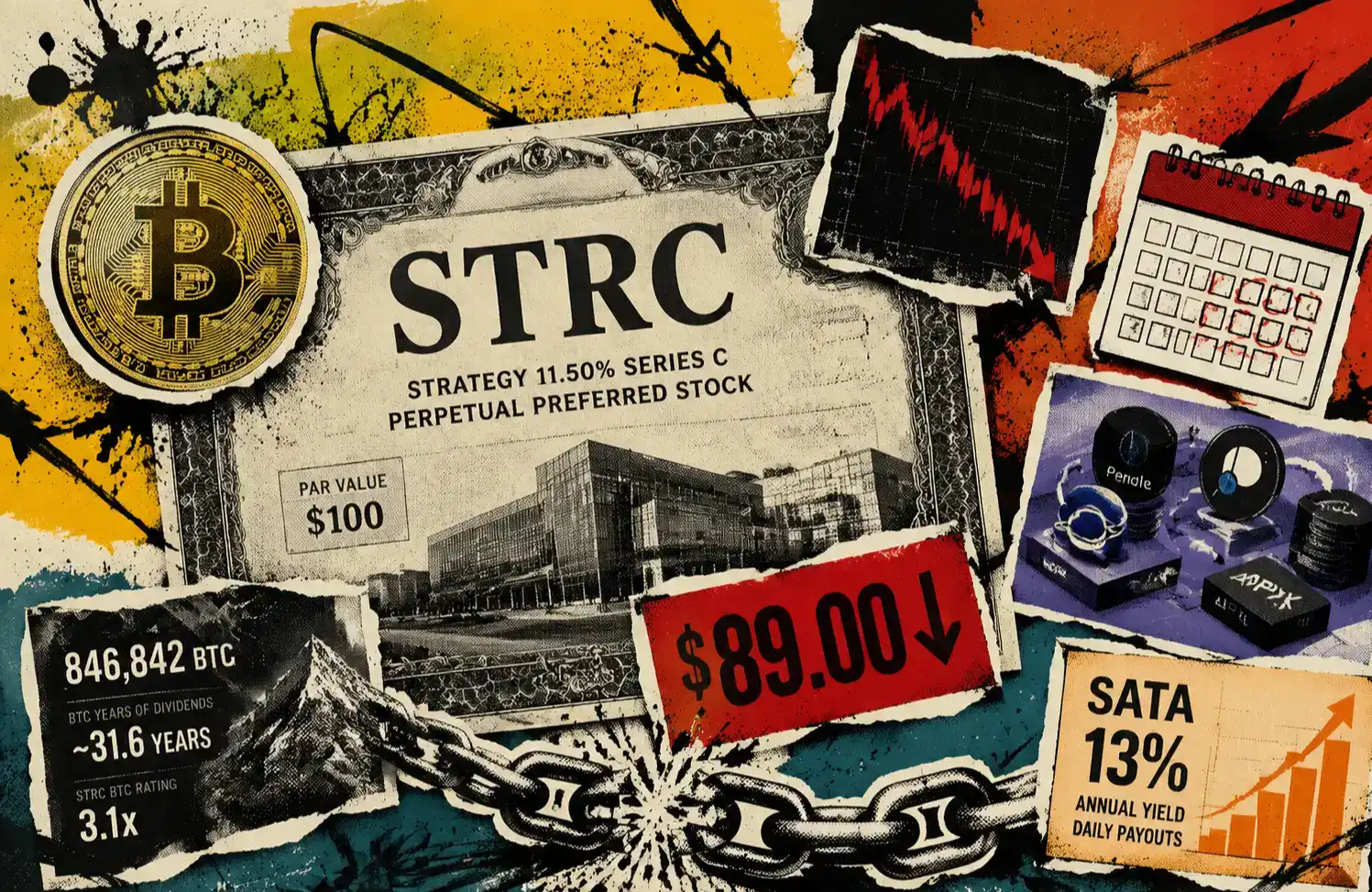
The article analyzes the recent significant de-pegging of Strategy's perpetual preferred stock, STRC, whose price fell to approximately $89, far below its $100 face value. This discount has pushed its simple yield to around 12.9%, creating a paradox. The stock was designed as a high-yield instrument trading near par, and Strategy maintains an 11.5% annual dividend, even recently switching to semi-monthly payments to support the price. The author explores several reasons why the high yield hasn't attracted enough buying pressure to restore the par value. A key factor is potential reverse deleveraging from carry trades, where leveraged investors may be forced to sell due to margin calls as the price falls, creating a self-reinforcing downward spiral. Additionally, the tokenization and integration of STRC into DeFi protocols (like Apyx, Saturn, Pendle) have introduced faster, more transparent, and potentially more volatile price adjustment mechanisms through leverage and yield-splitting products. The emergence of a competing product, Strive's SATA, offering a 13% yield with daily dividends, has also changed the yield benchmark, challenging STRC's unique high-yield narrative. Furthermore, the market is questioning the distinction between Strategy's substantial Bitcoin reserves, which provide long-term balance sheet coverage, and the certainty of stable near-term cash flow for dividends. Ultimately, the price dip represents a stress test for this type of BTC-backed, high-yield financing tool. The future path of STRC depends on whether Strategy acts to reinforce the $100 peg (e.g., by adjusting dividends), whether DeFi-related leverage unwinds further, and how investors ultimately price the risks of leverage, competition, and cash flow uncertainty against the offered yield.

marsbitHace 35 min(s)

STRC Severely Unpegged, What Risks Is the Market Pricing In?

marsbitHace 35 min(s)

LIT Token Hits Six-Month High: How Long Can the Buyback Flywheel Keep Burning Fuel?

The LIT token of decentralized perpetual exchange Lighter surged to a six-month high above $1.90 on June 18th, with a market cap of $425 million. After a price correction earlier this year, the recent rebound is attributed to its core "buyback flywheel" mechanism. All protocol fee revenue is used for programmatic, hourly market buybacks of LIT. Since its TGE in December 2025, approximately 15 million LIT (6% of circulating supply) has been repurchased for around $21 million. Additional price support comes from the LLP (Lighter Liquidity Pool), where providers must stake LIT worth 10% of their deposited USDC, locking significant token supply. However, challenges persist. Trading volume has declined amidst a sluggish market, with total volume at $1.68 trillion, significantly lower than leading competitor Hyperliquid's $4.37 trillion. While Lighter focuses on perpetual contracts, RWA, and Pre-IPO markets, Hyperliquid has expanded into prediction markets and boasts a U.S. spot ETF, attracting institutional investment and influencer endorsements like from Arthur Hayes. In contrast, LIT currently lacks similar high-profile backing. With 75% of LIT's total 1 billion supply still locked (team and investor tokens begin a 3-year linear unlock in December 2026), there is no immediate unlock selling pressure. The token's future performance hinges on sustaining trading volume growth, successful product iteration, and executing its transparent buyback strategy against a dominant competitor.

Foresight NewsHace 55 min(s)

LIT Token Hits Six-Month High: How Long Can the Buyback Flywheel Keep Burning Fuel?

Foresight NewsHace 55 min(s)

Trading

Spot
Futuros

Artículos destacados

Cómo comprar JUP

¡Bienvenido a HTX.com! Hemos hecho que comprar Jupiter (JUP) sea simple y conveniente. Sigue nuestra guía paso a paso para iniciar tu viaje de criptos.Paso 1: crea tu cuenta HTXUtiliza tu correo electrónico o número de teléfono para registrarte y obtener una cuenta gratuita en HTX. Experimenta un proceso de registro sin complicaciones y desbloquea todas las funciones.Obtener mi cuentaPaso 2: ve a Comprar cripto y elige tu método de pagoTarjeta de crédito/débito: usa tu Visa o Mastercard para comprar Jupiter (JUP) al instante.Saldo: utiliza fondos del saldo de tu cuenta HTX para tradear sin problemas.Terceros: hemos agregado métodos de pago populares como Google Pay y Apple Pay para mejorar la comodidad.P2P: tradear directamente con otros usuarios en HTX.Over-the-Counter (OTC): ofrecemos servicios personalizados y tipos de cambio competitivos para los traders.Paso 3: guarda tu Jupiter (JUP)Después de comprar tu Jupiter (JUP), guárdalo en tu cuenta HTX. Alternativamente, puedes enviarlo a otro lugar mediante transferencia blockchain o utilizarlo para tradear otras criptomonedas.Paso 4: tradear Jupiter (JUP)Tradear fácilmente con Jupiter (JUP) en HTX's mercado spot. Simplemente accede a tu cuenta, selecciona tu par de trading, ejecuta tus trades y monitorea en tiempo real. Ofrecemos una experiencia fácil de usar tanto para principiantes como para traders experimentados.

122 Vistas totalesPublicado en 2024.12.12Actualizado en 2026.06.02

Cómo comprar JUP

Discusiones

Bienvenido a la comunidad de HTX. Aquí puedes mantenerte informado sobre los últimos desarrollos de la plataforma y acceder a análisis profesionales del mercado. A continuación se presentan las opiniones de los usuarios sobre el precio de JUP (JUP).

活动图片