Brevis Sắp Phát Hành Token: Khuyến Khích Cộng Đồng Chiếm 32.2%, Đăng Ký Airdrop Sắp Mở

Odaily星球日报Publicado a 2025-12-25Actualizado a 2025-12-25

Resumen

Brevis sắp ra mắt token BREV với tổng nguồn cung 1 tỷ token. Mô hình phân bổ như sau: 37% cho phát triển hệ sinh thái, 32.2% cho kích thích cộng đồng (bao gồm airdrop), 20% cho đội ngũ và 10.8% cho nhà đầu tư. Token hệ sinh thái và kích thích cộng đồng sẽ được mở khóa tuyến tính trong 24 tháng sau TGE, với 14.5% và 10.5% được lưu hành ngay khi TGE. Brevis, một engine tính toán off-chain bằng zero-knowledge proof, được Vitalik Buterin đánh giá cao và đã huy động 7.5 triệu USD trong vòng gọi vốn hạt giống. Sàn Coinbase cũng đã thêm BREV vào lộ trình niêm yết. Hiện tại, Brevis sắp mở đăng ký nhận airdrop. Người dùng vẫn có thể tham gia kiếm điểm trong Giai đoạn 1 tại trang proving-grounds.brevis.network bằng cách kết nối ví, làm nhiệm vụ và sử dụng mã mời (ví dụ: IABsdu) để nhận thưởng.

Bài gốc | Odaily Planet Daily (@OdailyChina)

Tác giả | Asher (@Asher_ 0210)
Hôm qua, Brevis - dự án được Vitalik ưu ái - đã đăng bài trên nền tảng X công bố mô hình kinh tế token, với tổng nguồn cung token BREV là 1 tỷ đồng, phân bổ cụ thể như sau:

  • Phát triển hệ sinh thái: Chiếm 37% tổng nguồn cung token, tức 370 triệu đồng, dùng cho phát triển hệ sinh thái, R&D, đối tác chiến lược, xây dựng thị trường ban đầu và mở rộng giao thức dài hạn;
  • Khuyến khích cộng đồng: Chiếm 32.2% tổng nguồn cung token, tức 322 triệu đồng, dùng để thưởng cho người xác thực, người staking và người đóng góp cộng đồng, bao gồm phân phối airdrop ban đầu cho các thành viên và người đóng góp đủ điều kiện;
  • Đội ngũ: Chiếm 20% tổng nguồn cung token, tức 200 triệu đồng, phân bổ cho các nhà phát triển và người đóng góp cốt lõi hiện tại và tương lai của Brevis;
  • Nhà đầu tư: Chiếm 10.8% tổng nguồn cung token, tức 108 triệu đồng, phân bổ cho các nhà đầu tư vòng hạt giống của Brevis.

Trong đó, kế hoạch phát triển hệ sinh thái và khuyến khích cộng đồng sẽ được mở khóa tuyến tính trong vòng 24 tháng sau TGE, với lần lượt 14.50% và 10.50% token được lưu thông tại thời điểm TGE. Phần phân bổ cho đội ngũ và nhà đầu tư bị khóa hoàn toàn trong năm đầu tiên sau TGE, không có mở khóa ban đầu, sau đó cũng được phân bổ theo lịch trình mở khóa tuyến tính 24 tháng.

Ngoài ra, đội ngũ Brevis cho biết cổng đăng ký airdrop sắp được mở. Kết hợp với thông báo từ Coinbase Markets trên nền tảng X vào ngày 20 tháng 12 rằng Brevis (BREV) đã được đưa vào lộ trình niêm yết, có thể thấy Brevis sắp tiến hành TGE.
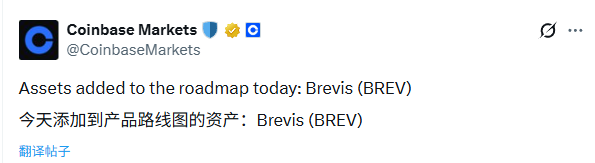
Coinbase đưa Brevis (BREV) vào lộ trình niêm yết

Brevis: “Công cụ thông minh” với khái niệm “Lớp tính toán vô hạn”

Brevis là một công cụ tính toán off-chain được xây dựng dựa trên bằng chứng không kiến thức (zero-knowledge proof), định vị là “Lớp tính toán vô hạn cho Web3 và mọi thứ”. Nói một cách đơn giản, Brevis có thể làm cho hợp đồng thông minh “thông minh hơn”, chuyển từ thực thi thụ động sang tính toán chủ động, vừa tiết kiệm chi phí tính toán, vừa nâng cao hiệu quả tính toán, từ đó giúp người dùng tương tác với giao thức dễ dàng hơn, tăng cường lưu giữ tài sản và thúc đẩy tỷ lệ áp dụng giao thức. Brevis có sức hút thảo luận cao trong cộng đồng nhờ được Vitalik “hậu thuẫn”.
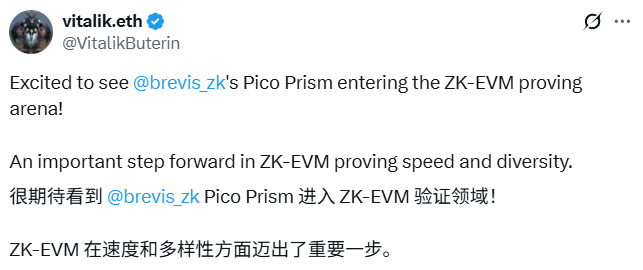
Brevis được Vitalik “hậu thuẫn”

Brevis đã từng hoàn thành vòng gọi vốn hạt giống 7.5 triệu USD vào tháng 11 năm ngoái, do Polychain và Yzi Labs dẫn đầu (Có thể đọc thêm: Brevis: Được Vitalik ưu ái, gọi vốn 7.5 triệu USD, Công cụ tính toán off-chain mở khóa mô hình mới cho Ethereum như thế nào?).

Nhiệm vụ Giai đoạn 1 vẫn đang diễn ra

Hiện tại, 11 nhiệm vụ của Giai đoạn 2 Brevis đã kết thúc, nhưng các nhiệm vụ Giai đoạn 1 vẫn đang diễn ra và chưa công bố thời điểm chụp ảnh nhanh (snapshot), đáng để “kiếm điểm miễn phí” và nắm bắt cơ hội cuối cùng.

BƯỚC 1: Truy cập trang web tương tác (Liên kết: https://proving-grounds.brevis.network/) và kết nối ví.
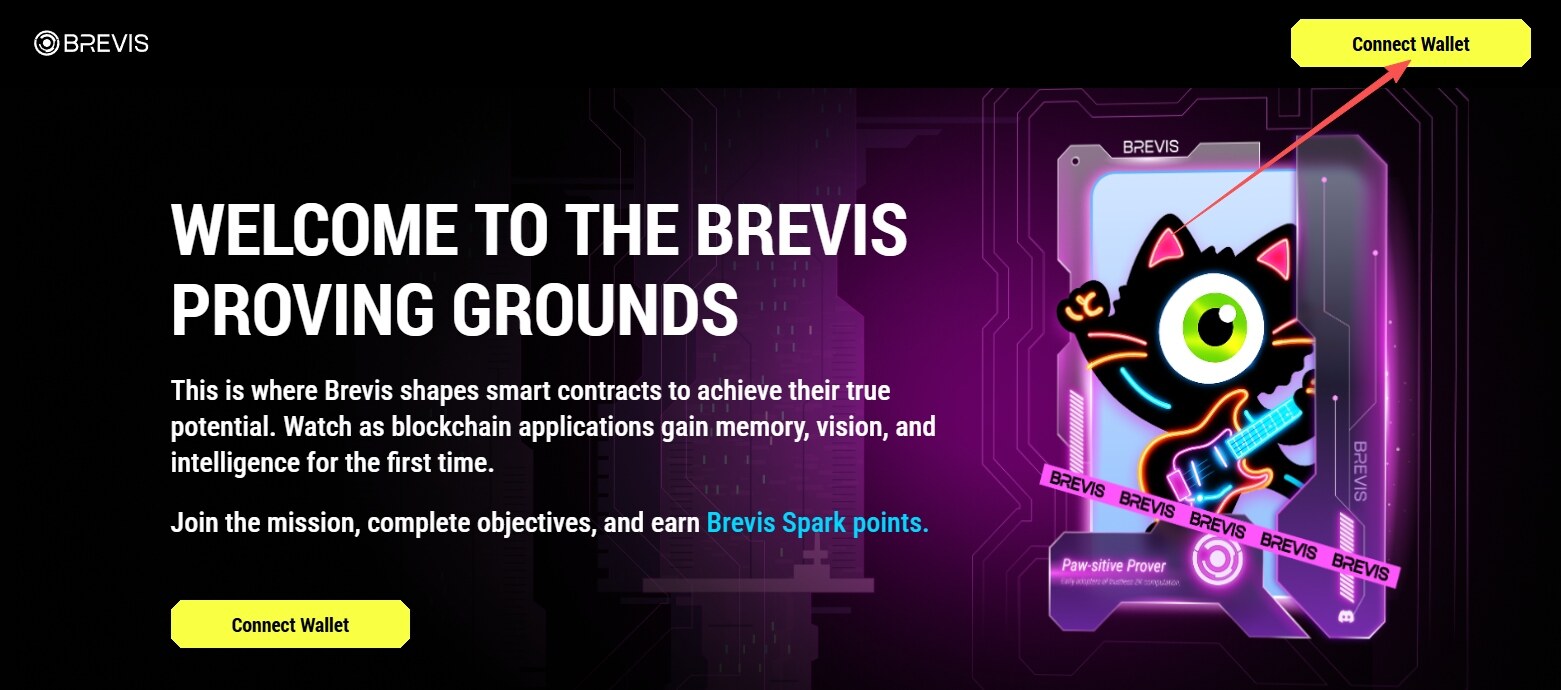
BƯỚC 2: Đầu tiên liên kết tài khoản cá nhân, sau đó theo dõi tài khoản X chính thức và tham gia Discord chính thức. Nhập mã mời để nhận 50 điểm (Có thể điền mã mời: IABsdu).

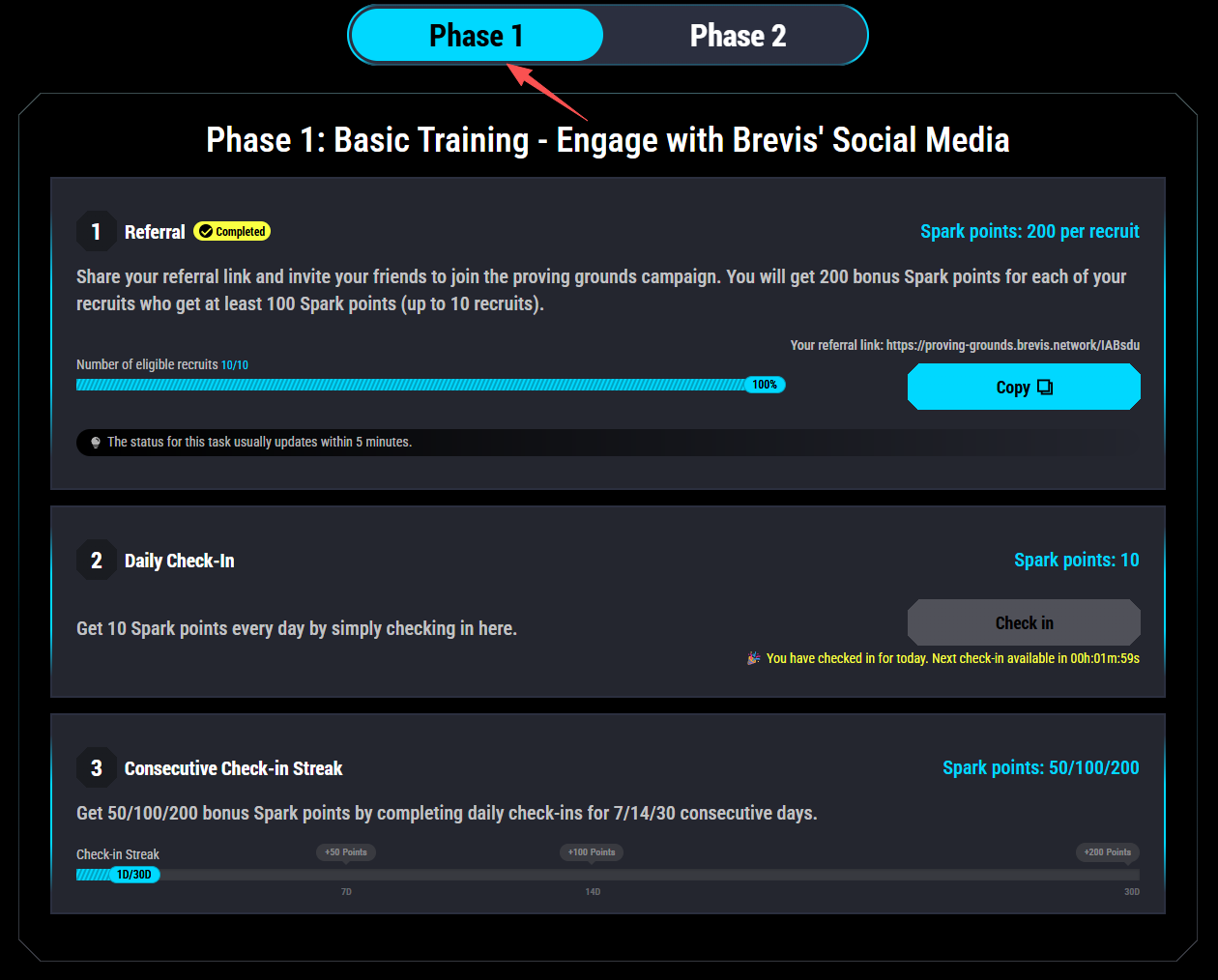
BƯỚC 3: Nhấp vào “Phase 1”, các nhiệm vụ vẫn có thể kiếm điểm bao gồm nhiệm vụ mời và nhiệm vụ điểm danh hàng ngày.
Preguntas relacionadas

QTổng nguồn cung token BREV của Brevis là bao nhiêu và cách phân bổ như thế nào?

ATổng nguồn cung token BREV là 1 tỷ token, được phân bổ như sau: Phát triển hệ sinh thái 37% (370 triệu token), Khuyến khích cộng đồng 32.2% (322 triệu token), Đội ngũ 20% (200 triệu token), Nhà đầu tư 10.8% (108 triệu token).

QTỷ lệ token được mở khóa khi TGE (Token Generation Event) cho các hạng mục Phát triển hệ sinh thái và Khuyến khích cộng đồng là bao nhiêu?

ATại thời điểm TGE, 14.50% token từ hạng mục Phát triển hệ sinh thái và 10.50% token từ hạng mục Khuyến khích cộng đồng sẽ được mở khóa và lưu thông.

QBrevis là gì và tại sao nó được cộng đồng chú ý?

ABrevis là một động cơ tính toán off-chain được xây dựng dựa trên zero-knowledge proof, định vị là 'lớp tính toán vô hạn cho Web3 và mọi thứ'. Dự án thu hút sự chú ý lớn từ cộng đồng vì nhận được sự ủng hộ ('đứng台') từ Vitalik Buterin, người đồng sáng lập Ethereum.

QLàm thế nào để tham gia kiếm điểm (points) trong Giai đoạn 1 (Phase 1) của Brevis?

AĐể kiếm điểm trong Giai đoạn 1, người dùng cần: 1) Truy cập trang web tương tác (https://proving-grounds.brevis.network/) và kết nối ví. 2) Liên kết tài khoản cá nhân, theo dõi X (Twitter) chính thức và tham gia Discord chính thức, nhập mã mời (ví dụ: IABsdu) để nhận 50 điểm. 3) Trong 'Phase 1', vẫn có thể thực hiện các nhiệm vụ mời người khác và nhiệm vụ điểm danh hàng ngày để kiếm điểm.

QBrevis đã huy động được bao nhiêu tiền trong vòng gọi vốn seed round và ai là nhà đầu tư dẫn đầu?

ABrevis đã huy động được 7.5 triệu USD trong vòng gọi vốn seed round vào tháng 11 năm ngoái. Vòng này được dẫn dắt bởi Polychain và Yzi Labs.

Lecturas Relacionadas

The 'Chip' Challenge and Breakthroughs in China's Optical Industry Chain

China's Photonics Industry: Bottlenecks and Breakthroughs In the global AI race, computing chips dominate the narrative, but the underlying bottleneck increasingly defining the scale of AI clusters is light—or more specifically, optical connectivity. Optical modules, which translate electrical signals to light and vice versa, are crucial for connecting thousands of GPUs in AI data centers, preventing data congestion and ensuring efficient model training. High-speed modules (800G, 1.6T) are now standard, with performance hinging on advanced DSP (Digital Signal Processor) chips. This is where a critical dependency lies. Two US giants—Marvell and Broadcom—collectively dominate over 90% of the high-end DSP chip market. Chinese optical module leaders like Zhongji Innolight and Eoptolink rely on these chips to manufacture modules for overseas AI customers, primarily in North America. While this creates a supply chain vulnerability, complete decoupling is difficult. Marvell derives over half its revenue from Greater China, and the US firms depend on Chinese partners for chip packaging and optical components. The risk from laser chips (e.g., from Lumentum), another key component, is considered more manageable due to multiple global suppliers and faster progress in domestic alternatives from companies like YOFC and Accelink. To mitigate risks, China's industry is pursuing a multi-pronged strategy: diversifying supply chains and locking in long-term orders; fostering a domestic market ecosystem to adopt homegrown DSPs from firms like Huawei HiSilicon and CETC; accelerating R&D in high-speed DSPs and advanced packaging; and investing in next-gen technologies like silicon photonics and Co-Packaged Optics (CPO) to reduce reliance on discrete DSPs. The ultimate solution lies not in short-term博弈 but in persistent advancement of domestic high-end chip R&D and manufacturing. While challenges remain in performance, certification, and ecosystem building, China's vast domestic market and manufacturing base provide a crucial buffer, buying time for the industry to achieve greater technological independence.

marsbitHace 2 min(s)

The 'Chip' Challenge and Breakthroughs in China's Optical Industry Chain

marsbitHace 2 min(s)

Behind SpaceX's $2 Trillion Market Cap: Why Does Musk Always Have the Next Move Planned?

On June 12th, SpaceX debuted on the Nasdaq, reaching a valuation that briefly touched $2 trillion. This marked the culmination of a 24-year journey from its founding in 2002, driven by Elon Musk's frustration at the high cost of buying rockets. The company's path was defined by early failures, with its first three Falcon 1 launches ending in explosions before a successful 2008 flight opened the era of commercial spaceflight. Key to its model was a fixed-price NASA contract, incentivizing cost reduction. SpaceX mastered rocket reusability, first achieving a Falcon 9 landing in 2015, which drastically cut launch costs. This enabled its profitable Starlink satellite internet constellation, envisioned years before reusability was proven, to create an internal market for frequent launches. Similarly, the next-generation Starship rocket was in development long before its first flight, with its business case evolving from Mars colonization to supporting the emerging concept of in-orbit data centers for AI—a story now central to its valuation. The company's recent IPO, a reversal of its long-standing "no IPO" stance, is funding this ambitious "space-based compute" vision. While major tech players like Google, Blue Origin, and others are investing heavily, significant technical and cost hurdles remain. Ultimately, SpaceX's history is one of creating its own demand: first with Starlink and now with space-based AI compute, betting that its next rocket will enable its next giant market.

marsbitHace 5 min(s)

Behind SpaceX's $2 Trillion Market Cap: Why Does Musk Always Have the Next Move Planned?

marsbitHace 5 min(s)

When Crypto Meets the World Cup: CoinW and Modrić's Art of "Navigating Cycles"

When Encryption Meets the World Cup: CoinW and Modrić's "Transcending Cycles" Philosophy In the context of the 2026 FIFA World Cup and its massive global audience, the crypto exchange CoinW announced football legend Luka Modrić as its global brand ambassador. This move is framed not merely as a marketing tactic, but as a strategic experiment in user profile migration. It targets mature, financially stable football fans—particularly in Europe, Southeast Asia, and Latin America—who traditionally have low crypto awareness but value trusted, time-tested authority figures like Modrić. The article draws parallels between Modrić's enduring, disciplined career—marked by consistency and success at the highest level over two decades—and CoinW's own development path. Founded in 2017 during a volatile industry period, CoinW focused on building robust infrastructure and risk management. It weathered the 2022 industry crisis without major security incidents, subsequently earning recognition like "Europe's Most Trusted Exchange" and growing to over 20 million registered users. This "long-termism" is translated into user-centric products. CoinW Academy lowers the initial knowledge barrier. Its integrated ecosystem (CoinW, GemW, DeriW, PropW) and the recent launch of a TradFi section—offering perpetual contracts on traditional assets like stocks, gold, and oil—aim to create a unified platform for diverse assets. For the World Cup, CoinW launched the "We Are The Game" campaign, collaborating with Alchemy Pay to offer zero-fee deposits and local payment options, aiming to transform spectators into participants and lower entry barriers. Ultimately, CoinW's sports partnerships and product strategy are presented as a concerted effort to build trust and accessibility for the "silent majority" still outside crypto—shifting the industry narrative toward inclusivity and long-term value.

Foresight NewsHace 11 min(s)

When Crypto Meets the World Cup: CoinW and Modrić's Art of "Navigating Cycles"

Foresight NewsHace 11 min(s)

A Panoramic View of the Solana Privacy Ecosystem: The Complete Privacy Stack from Computation to AI

**Solana Privacy Ecosystem: A Comprehensive Overview from Computation to AI** Solana's privacy ecosystem, while nascent, is rapidly evolving to address key challenges across multiple layers. Key figures like Helius CEO Mert acknowledge that Solana has lagged in privacy but highlight its unique potential for scalable, composable privacy protocols, potentially leveraging technologies like ZK compression without persistent rollups. The foundational layer is **Private Compute**, addressed by providers like Arcium and Magic Block. Arcium utilizes Multi-Party Computation (MPC) networks to process encrypted data off-chain with final settlement on Solana, supporting use cases like confidential payments (via its C-SPL token standard) and encrypted data analysis. Magic Block employs Trusted Execution Environments (TEEs) to create private, ephemeral rollups, offering confidentiality, scalability, and composability. Both enable private order books, dark pools, and DeFi rails. Building on this infrastructure are applications for **Private Transfers and Balances**. Umbra, built on Arcium, offers encrypted token accounts with amount, balance, and sender-receiver linkage privacy, plus compliance features. Privacy Cash uses Tornado-style shielded pools for SOL, while Hush provides private staking and trading with integrated swaps via Jupiter. To eliminate **On-Chain Trails** from everyday activities like trading, protocols like encifherio and VanishTrade are emerging. encifherio privately routes swaps through Jupiter by encrypting transaction details within TEEs. VanishTrade routes trades through shielded liquidity pools. Darklake offers a ZK-native "blind slippage" AMM and private perpetuals to hide trading intent and prevent front-running. More advanced applications include **Private Prediction Markets**. Platforms like Melee Markets use Arcium's MPC to encrypt order books, allowing participants to place hidden bets without revealing their market position until settlement. Finally, the ecosystem is expanding into **Private AI**. Loyal leverages both Magic Block and Arcium to create a decentralized protocol where user-AI interactions, queries, and preferences are encrypted on-chain, giving users ownership and control over their data while enabling private transactions and yield generation. In summary, Solana's privacy stack is developing from core compute and transfer privacy towards sophisticated applications in DeFi, prediction markets, and AI, aiming for a future where Fully Homomorphic Encryption (FHE) and Zero-Knowledge (ZK) proofs combine for a complete privacy solution.

marsbitHace 13 min(s)

A Panoramic View of the Solana Privacy Ecosystem: The Complete Privacy Stack from Computation to AI

marsbitHace 13 min(s)

Trading

Spot
Futuros

Artículos destacados

Cómo comprar SOON

¡Bienvenido a HTX.com! Hemos hecho que comprar SOON (SOON) sea simple y conveniente. Sigue nuestra guía paso a paso para iniciar tu viaje de criptos.Paso 1: crea tu cuenta HTXUtiliza tu correo electrónico o número de teléfono para registrarte y obtener una cuenta gratuita en HTX. Experimenta un proceso de registro sin complicaciones y desbloquea todas las funciones.Obtener mi cuentaPaso 2: ve a Comprar cripto y elige tu método de pagoTarjeta de crédito/débito: usa tu Visa o Mastercard para comprar SOON (SOON) al instante.Saldo: utiliza fondos del saldo de tu cuenta HTX para tradear sin problemas.Terceros: hemos agregado métodos de pago populares como Google Pay y Apple Pay para mejorar la comodidad.P2P: tradear directamente con otros usuarios en HTX.Over-the-Counter (OTC): ofrecemos servicios personalizados y tipos de cambio competitivos para los traders.Paso 3: guarda tu SOON (SOON)Después de comprar tu SOON (SOON), guárdalo en tu cuenta HTX. Alternativamente, puedes enviarlo a otro lugar mediante transferencia blockchain o utilizarlo para tradear otras criptomonedas.Paso 4: tradear SOON (SOON)Tradear fácilmente con SOON (SOON) en HTX's mercado spot. Simplemente accede a tu cuenta, selecciona tu par de trading, ejecuta tus trades y monitorea en tiempo real. Ofrecemos una experiencia fácil de usar tanto para principiantes como para traders experimentados.

154 Vistas totalesPublicado en 2025.05.23Actualizado en 2026.06.02

Cómo comprar SOON

Discusiones

Bienvenido a la comunidad de HTX. Aquí puedes mantenerte informado sobre los últimos desarrollos de la plataforma y acceder a análisis profesionales del mercado. A continuación se presentan las opiniones de los usuarios sobre el precio de SOON (SOON).

活动图片













