Galaxy dự đoán stablecoin sẽ vượt qua khối lượng giao dịch ACH vào năm 2026

cointelegraphPublicado a 2025-12-19Actualizado a 2025-12-19

Resumen

Theo dự báo từ Galaxy Research, khối lượng giao dịch stablecoin có thể vượt hệ thống ACH của Mỹ vào năm 2026 nhờ sự rõ ràng về quy định và mức độ chấp nhận ngày càng tăng. Báo cáo chỉ ra rằng giao dịch stablecoin hiện đã vượt mạng lưới thẻ tín dụng lớn như Visa và bằng khoảng một nửa khối lượng của ACH. Nguồn cung stablecoin tiếp tục tăng trưởng 30-40% mỗi năm, đồng thời Đạo luật GENIUS dự kiến có hiệu lực vào đầu 2026 sẽ thúc đẩy hơn nữa việc sử dụng stablecoin. Thị trường stablecoin hiện đạt vốn hóa 309 tỷ USD, với sự tham gia ngày càng nhiều của các tổ chức tài chính như Western Union, Sony và SoFi. Dự báo cũng cho rằng Bitcoin có thể chạm 250.000 USD vào cuối 2027.

Stablecoin có thể xử lý khối lượng giao dịch nhiều hơn hệ thống Automated Clearing House (ACH) của Mỹ vào năm 2026, khi sự rõ ràng về quy định và mức độ chấp nhận ngày càng tăng mở rộng phạm vi sử dụng của chúng, theo một dự báo mới.

Galaxy Research, bộ phận nghiên cứu của công ty tài sản kỹ thuật số Galaxy Digital, đã chỉ ra dữ liệu giao dịch hiện có và các diễn biến quy định để hỗ trợ dự đoán của mình, lưu ý rằng "các giao dịch stablecoin đã vượt qua các mạng lưới thẻ tín dụng lớn như Visa và hiện xử lý khoảng một nửa khối lượng giao dịch của hệ thống automated clearing house (ACH)".

Thad Pinakiewicz, phó chủ tịch nghiên cứu, cho biết nguồn cung stablecoin tiếp tục tăng trưởng với tốc độ tăng trưởng kép hàng năm (CAGR) 30%–40%, với khối lượng giao dịch tăng cùng với việc phát hành. Galaxy cũng trích dẫn việc triển khai dự kiến các định nghĩa theo Đạo luật GENIUS vào đầu năm 2026 như một yếu tố hỗ trợ tăng trưởng hơn nữa trong việc sử dụng stablecoin.
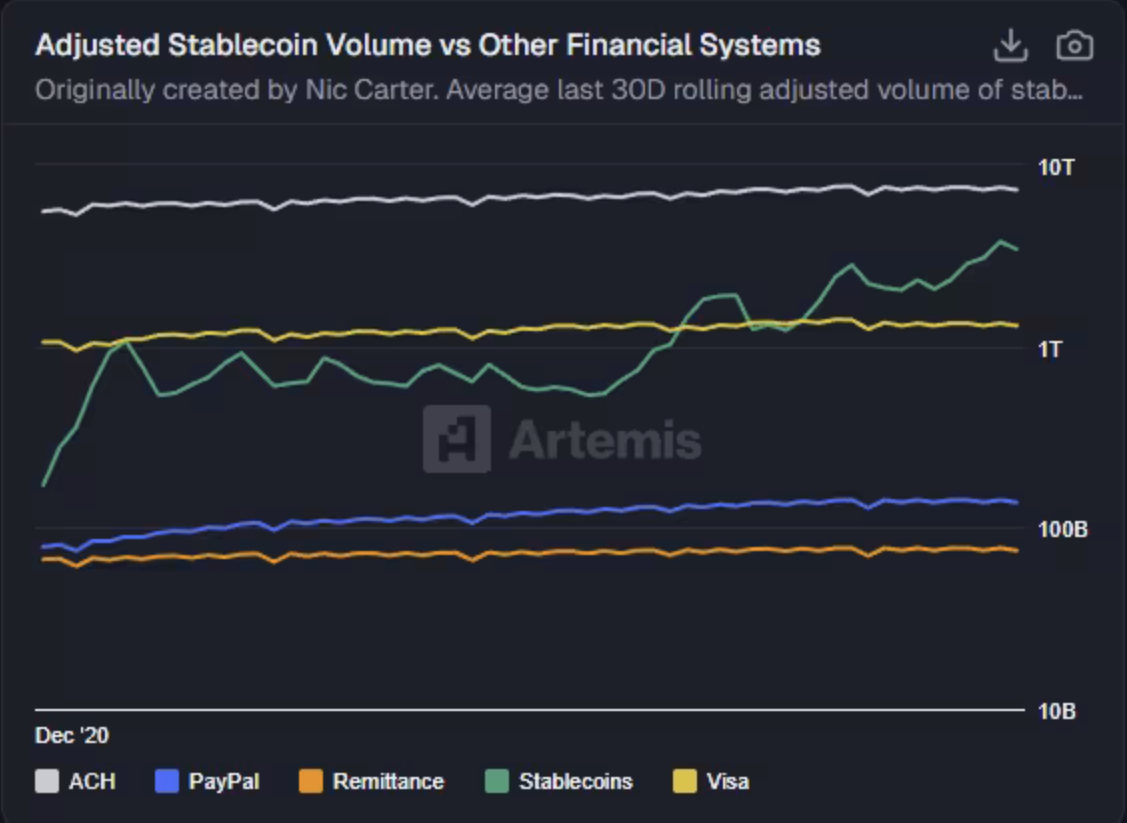
Khối lượng stablecoin so với các hệ thống tài chính khác. Nguồn: Galaxy Digital

Báo cáo cũng đưa ra dự đoán về giá của Bitcoin (BTC), viết rằng nó có thể đạt 250.000 USD vào cuối năm 2027. Theo Alex Thorn, người đứng đầu nghiên cứu toàn công ty tại Galaxy Research, năm 2026 "quá hỗn loạn để dự đoán, mặc dù Bitcoin lập mức cao mới mọi thời đại trong năm 2026 vẫn có thể xảy ra".

Liên quan: Coinbase 'lạc quan thận trọng' về năm 2026 khi crypto tiến gần đến điểm bùng phát thể chế

Thị trường stablecoin neo theo USD mở rộng

Theo dữ liệu từ DefiLlama, vốn hóa thị trường stablecoin hiện ở mức khoảng 309 tỷ USD. Trong khi USDt (USDT) của Tether và USDC (USDC) của Circle tiếp tục thống trị, ngày càng nhiều tổ chức tài chính và công ty thanh toán đã tham gia vào cuộc đua stablecoin trong những tháng gần đây.
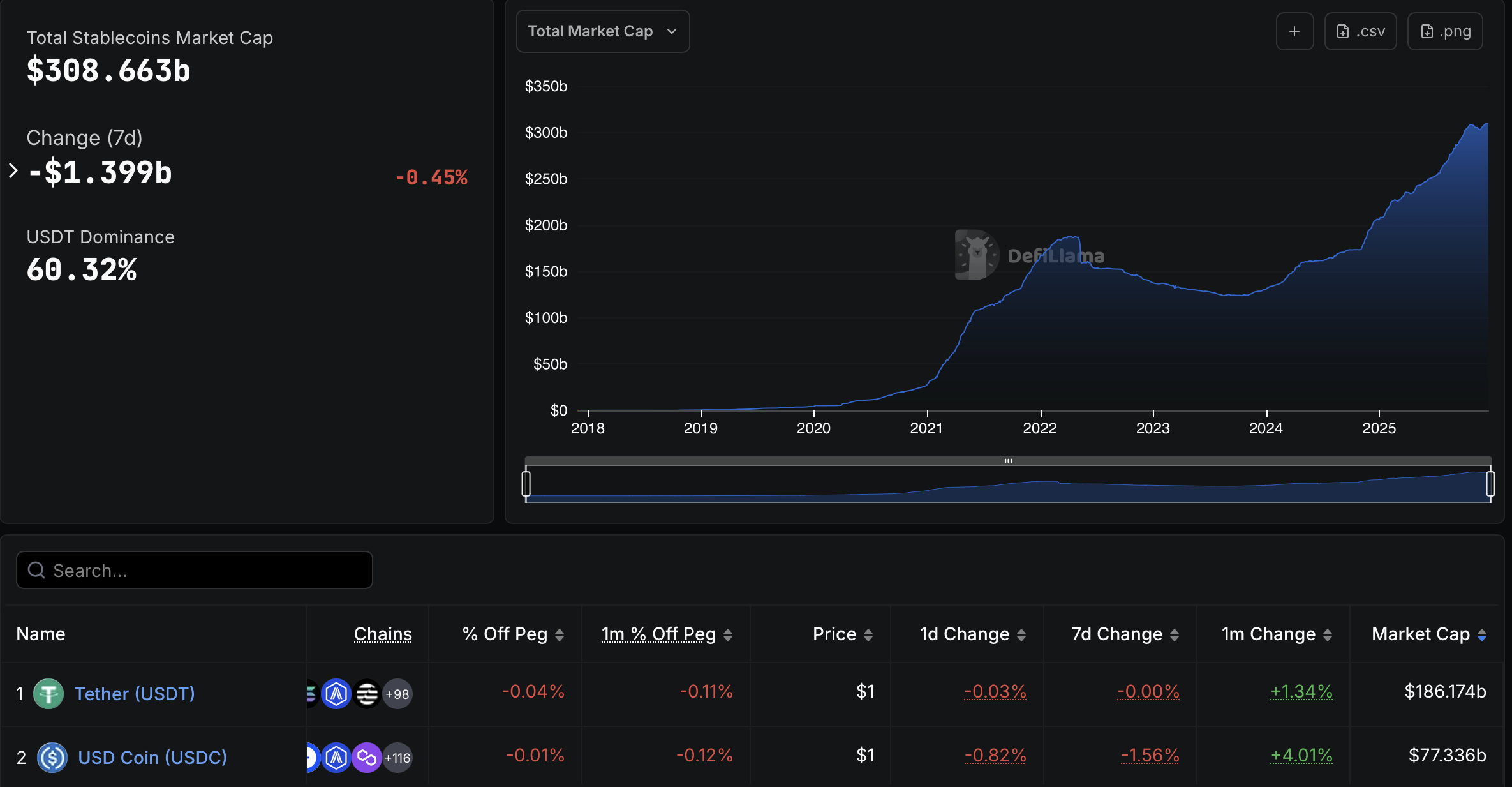
Vốn hóa thị trường stablecoin. Nguồn: DefiLlama

Vào tháng 10, Western Union đã công bố kế hoạch ra mắt stablecoin neo theo đồng USD của riêng mình, US Dollar Payment Token, sẽ được xây dựng trên blockchain Solana và do Anchorage Digital Bank phát hành như một phần của mạng lưới thanh toán tài sản kỹ thuật số rộng lớn hơn.

Sony Bank được cho là đang chuẩn bị một stablecoin neo theo đồng USD để sử dụng trên toàn bộ hệ sinh thái Mỹ của Sony, bao gồm trò chơi PlayStation, đăng ký và nội dung anime. Stablecoin này dự kiến ra mắt vào năm 2026.

Vào thứ Năm, SoFi Technologies đã ra mắt SoFiUSD, một stablecoin USD được dự trữ hoàn toàn do công ty con ngân hàng của nó, SoFi Bank, phát hành. Công ty cho biết token sẽ ra mắt trên Ethereum và được thiết kế để hỗ trợ thanh toán chi phí thấp cho các ngân hàng, công ty fintech và nền tảng doanh nghiệp.

Jianing Wu, cộng tác viên nghiên cứu tại Galaxy Research, cho biết cô kỳ vọng các stablecoin được hợp tác với TradFi sẽ củng cố vào năm 2026, vì người dùng và thương nhân khó có thể chấp nhận một danh sách dài các đồng đô la kỹ thuật số và thay vào đó sẽ ủng hộ một hoặc hai đồng có "mức độ chấp nhận rộng rãi nhất".

Tạp chí: Tấn công lượng tử vào Bitcoin sẽ là lãng phí thời gian: Kevin O’Leary

Criptos en tendencia

Preguntas relacionadas

QTheo dự báo của Galaxy Research, khi nào stablecoin có thể vượt qua khối lượng giao dịch của hệ thống ACH?

ATheo dự báo của Galaxy Research, stablecoin có thể xử lý khối lượng giao dịch nhiều hơn hệ thống ACH của Mỹ vào năm 2026.

QTốc độ tăng trưởng hàng năm kép (CAGR) của nguồn cung stablecoin là bao nhiêu?

ANguồn cung stablecoin đã tiếp tục tăng trưởng với tốc độ tăng trưởng hàng năm kép (CAGR) từ 30% đến 40%.

QDự đoán giá Bitcoin (BTC) có thể đạt mức nào vào cuối năm 2027 theo báo cáo?

ATheo báo cáo, giá Bitcoin (BTC) có thể đạt 250.000 USD vào cuối năm 2027.

QHai stablecoin nào hiện đang thống trị thị trường theo dữ liệu từ DefiLlama?

ATheo dữ liệu từ DefiLlama, Tether’s USDt (USDT) và Circle’s USDC (USDC) tiếp tục thống trị thị trường stablecoin.

QCông ty nào đã công bố kế hoạch phát hành stablecoin neo theo đồng đô la Mỹ trên blockchain Solana?

AWestern Union đã công bố kế hoạch phát hành stablecoin neo theo đồng đô la Mỹ có tên US Dollar Payment Token trên blockchain Solana.

Lecturas Relacionadas

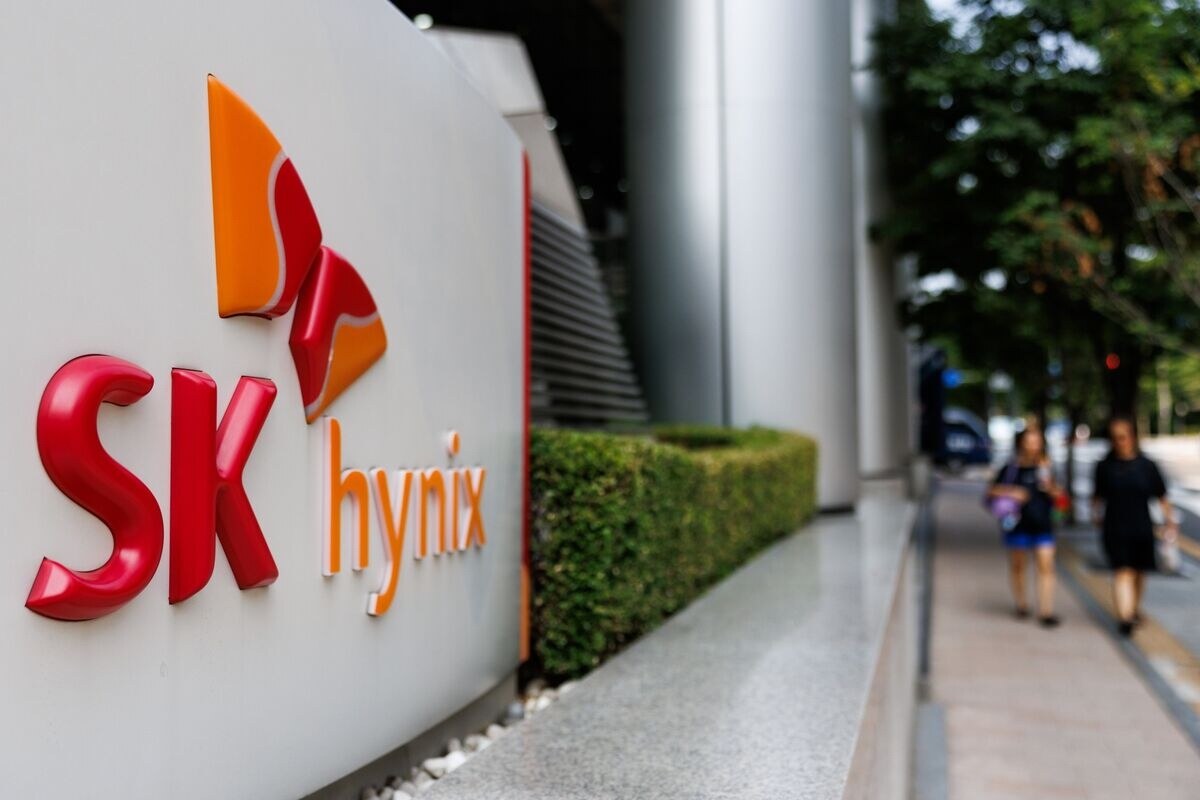
Sevenfold Oversubscription, Can SK Hynix Save the Semiconductor Industry This Time?

SK Hynix's planned US ADR listing is drawing intense interest, with its offering reportedly oversubscribed by over seven times, potentially making it the largest foreign listing in US history. The fundraising of approximately $24.5 billion is intended for expanding its Korean production capacity, including advanced packaging and EUV equipment. This massive demand from long-term funds and prominent institutions like Baillie Gifford and Situational Awareness Partners (led by noted investor Leopold Aschenbrenner) presents a stark contrast to the recent downturn in the broader semiconductor sector. The sector has faced a significant correction, with SK Hynix's own stock falling nearly 30% from its June high. This sell-off was triggered by concerns that major tech giants might slow their AI infrastructure spending, following signals like Meta's reported plan to sell surplus computing capacity. The strong ADR appetite suggests long-term investors still believe in the AI investment cycle's fundamentals, viewing the recent decline more as a valuation reset than a demand collapse. Some market speculation even suggests the pre-IPO price drop could be strategic, setting the stage for a stronger post-listing performance. While SK Hynix's successful listing may act as a short-term positive catalyst for market sentiment, the article argues the true signal for a sustained semiconductor recovery will come from upcoming earnings reports of tech giants like Microsoft, Google, Meta, and Amazon. Their future capital expenditure plans will be crucial in determining whether the AI-driven growth cycle can continue.

Odaily星球日报Hace 19 min(s)

Sevenfold Oversubscription, Can SK Hynix Save the Semiconductor Industry This Time?

Odaily星球日报Hace 19 min(s)

Breaking News: Musk Delivers the Most Powerful Grok 4.5, Slashes Price of Top-tier Opus Intelligence Drastically

**Elon Musk Launches Grok 4.5: A Cost-Effective, High-Performance AI Rival** SpaceXAI, in collaboration with Cursor, has released Grok 4.5, its new flagship AI model designed specifically for coding and agentic tasks. Trained on tens of thousands of NVIDIA GB300 GPUs using massive, high-quality data filtered from trillions of Cursor developer interactions, the model emphasizes "per-token intelligence." In benchmark performance, Grok 4.5 is highly competitive. It scores 64.7% on SWE Bench Pro (surpassing GPT-5.5's 58.6% and Opus 4.7's 64.3%), 83.3% on Terminal Bench 2.1 (nearly matching GPT-5.5), and 62.0% on DeepSWE 1.0 (beating Opus 4.8). Overall, it ranks fourth in AAAI official tests and first in the Harvey legal agent benchmark. The model's key advantage is its combination of speed, efficiency, and low cost. It generates responses at 80 tokens per second and, crucially, uses far fewer tokens to complete tasks—4.2 times fewer than Opus 4.8 on SWE Bench Pro. It is priced at $2 per million input tokens and $6 per million output tokens, significantly undercutting competitors. Musk stated it is "roughly equivalent to Opus 4.7, but much faster." Early user tests show Grok 4.5 can generate functional code for applications like 3D solar system simulators and basic games from simple prompts, though some note it still lags behind top models in certain creative tasks. Musk has hinted at a major update next month, leveraging real-world engineering data from his companies, with an even larger 2-trillion parameter version reportedly in development. Grok 4.5 positions itself not as the absolute strongest model, but as a highly efficient and affordable alternative in the top tier.

marsbitHace 24 min(s)

Breaking News: Musk Delivers the Most Powerful Grok 4.5, Slashes Price of Top-tier Opus Intelligence Drastically

marsbitHace 24 min(s)

Today, The Hong Kong Exchange Was Once Again Overwhelmed

Hong Kong's stock exchange witnessed an exceptionally busy day on July 9, with a record seven companies conducting initial public offerings (IPOs) simultaneously. The list included major firms such as Luxshare Precision, which launched the largest Hong Kong IPO of the year, and other notable names like Tri-Ring Group and Qiyunshan Food. However, the market reception was sharply divided on the first trading day. While Qiyunshan Food's shares surged over 110%, several other newcomers, including Luxshare Precision, Dingtai High-Tech, and Rigol Technologies, opened below their issue prices, with some falling nearly 20%. This event highlights a broader, bustling IPO scene in Hong Kong for 2024, with 82 Chinese companies listing in the first half alone—more than double the figure from the same period last year. A significant portion of this activity comes from dual "A+H" listings, where mainland China-listed firms seek secondary listings in Hong Kong. These larger companies have accounted for nearly 60% of total fundraising. Despite the high volume, recent trends show a cooling market sentiment for many new listings. Several IPOs in early July, including that of Tongrentang Healthcare, debuted with significant losses, indicating increased investor caution and selectivity. The market narrative is shifting, with capital increasingly concentrating on high-growth sectors like artificial intelligence, robotics, and semiconductors, while traditional manufacturing and consumer goods face greater pressure and volatility. This divergence underscores a market where success is no longer guaranteed by merely listing, but depends heavily on a company's growth prospects and sector appeal.

marsbitHace 28 min(s)

Today, The Hong Kong Exchange Was Once Again Overwhelmed

marsbitHace 28 min(s)

Glassnode: Crypto Market Enters Later Stages of Bottoming Phase

Glassnode: Crypto Market Enters Later Stages of Bottom Formation Bitcoin has traded below the true market average and the short-term holder cost basis for five consecutive months, indicating a deep undervaluation. On-chain data reveals a significant shift in selling pressure, with long-term holders now accounting for 43% of all realized losses. Daily realized losses for this group recently peaked at $280 million, the highest level since December 2022. While this large-scale capitulation is a hallmark of bear market bottoms, a sustained decline in this metric is a prerequisite for a sustained recovery. Institutional demand remains weak. US spot Bitcoin ETFs continue to see monthly net outflows, although the pace has moderated from June's peak. Furthermore, average daily ETF trading volumes have contracted by approximately 80% from their October 2025 peak, reflecting subdued institutional participation. Derivatives markets present a mixed picture. Overall positioning has shifted to cautiously bullish, with the put/call ratio dropping to a yearly low. However, the options volatility skew remains elevated, signaling that traders are still paying a premium for downside protection. The spot price also trades below the gamma "max pain" level. In summary, multiple indicators suggest the market is in the later phases of a bottoming process, characterized by long-term holder capitulation and weak institutional inflows. However, key confirmation signals for a durable trend reversal—a sustained drop in long-term holder selling pressure, stabilization of ETF flows, and a price recovery above key cost bases—are still pending.

Foresight NewsHace 55 min(s)

Glassnode: Crypto Market Enters Later Stages of Bottoming Phase

Foresight NewsHace 55 min(s)

Trading

Spot

Artículos destacados

Cómo comprar ACH

¡Bienvenido a HTX.com! Hemos hecho que comprar Alchemy Pay (ACH) sea simple y conveniente. Sigue nuestra guía paso a paso para iniciar tu viaje de criptos.Paso 1: crea tu cuenta HTXUtiliza tu correo electrónico o número de teléfono para registrarte y obtener una cuenta gratuita en HTX. Experimenta un proceso de registro sin complicaciones y desbloquea todas las funciones.Obtener mi cuentaPaso 2: ve a Comprar cripto y elige tu método de pagoTarjeta de crédito/débito: usa tu Visa o Mastercard para comprar Alchemy Pay (ACH) al instante.Saldo: utiliza fondos del saldo de tu cuenta HTX para tradear sin problemas.Terceros: hemos agregado métodos de pago populares como Google Pay y Apple Pay para mejorar la comodidad.P2P: tradear directamente con otros usuarios en HTX.Over-the-Counter (OTC): ofrecemos servicios personalizados y tipos de cambio competitivos para los traders.Paso 3: guarda tu Alchemy Pay (ACH)Después de comprar tu Alchemy Pay (ACH), guárdalo en tu cuenta HTX. Alternativamente, puedes enviarlo a otro lugar mediante transferencia blockchain o utilizarlo para tradear otras criptomonedas.Paso 4: tradear Alchemy Pay (ACH)Tradear fácilmente con Alchemy Pay (ACH) en HTX's mercado spot. Simplemente accede a tu cuenta, selecciona tu par de trading, ejecuta tus trades y monitorea en tiempo real. Ofrecemos una experiencia fácil de usar tanto para principiantes como para traders experimentados.

113 Vistas totalesPublicado en 2024.12.10Actualizado en 2026.06.02

Cómo comprar ACH

Discusiones

Bienvenido a la comunidad de HTX. Aquí puedes mantenerte informado sobre los últimos desarrollos de la plataforma y acceder a análisis profesionales del mercado. A continuación se presentan las opiniones de los usuarios sobre el precio de ACH (ACH).

活动图片