World Cup Quarterfinals Are About to Kick Off, Who Did the AIs Vote to Advance?

Odaily星球日报Publicado a 2026-07-09Actualizado a 2026-07-09

Resumen

The 2026 World Cup quarter-finals are set, with AI models unanimously predicting France, Spain, England, and Argentina to advance to the semi-finals, though they differ on match details. All six AI models (ChatGPT, Claude, Gemini, DeepSeek, Qwen, and Grok) forecast France will defeat Morocco in regulation time, with predicted scores of 2-0 or 2-1. Spain is also favored to beat Belgium, with most AIs predicting a 2-0 or 2-1 win in regular time, though Gemini suggests a possible 1-1 draw leading to a Spanish victory on penalties. The Norway vs. England match is considered the most unpredictable due to Erling Haaland's threat. While all AIs ultimately pick England to advance, predictions range from a 2-1 regulation win to a 2-2 draw requiring extra time. For Argentina vs. Switzerland, AIs predict an Argentine victory, with scores varying from 2-0 to 2-1 in regulation, though Claude and ChatGPT warn the disciplined Swiss could force extra time or a penalty shootout. The core consensus is a final four of France, Spain, England, and Argentina, with the primary disagreements centering on match scores and whether games will require extra time or penalties.

Original | Odaily Planet Daily (@OdailyChina)

Author | Asher (@Asher_ 0210)

With the World Cup quarterfinalists set, the real knockout stage has just begun.

France has maintained a strong team posture, with stable offensive firepower and key players stepping up at crucial moments; Morocco continues its dark horse run, eliminating Canada 3-0 in the round of 16, proving once again they are not a flash in the pan. Spain plays the most steadily, with defensive discipline and possession-based control in place, clinching a last-gasp victory over Portugal in the round of 16 to keep Cristiano Ronaldo out of the quarterfinals; Belgium has reasserted its offensive presence with a resounding 4-1 win over the United States.

On the other side, Norway has become the tournament's biggest surprise, with Erling Haaland leading the team to a 2-1 victory over Brazil, creating the most shocking upset of the knockout stage so far; England, despite a bumpy journey, narrowly defeated Mexico 3-2 thanks to squad depth. Argentina's advancement was the most dramatic, coming back from 0-2 down against Egypt to win 3-2; Switzerland dragged Colombia into a penalty shootout, advancing to the quarterfinals in the most typical "tough nut" fashion.
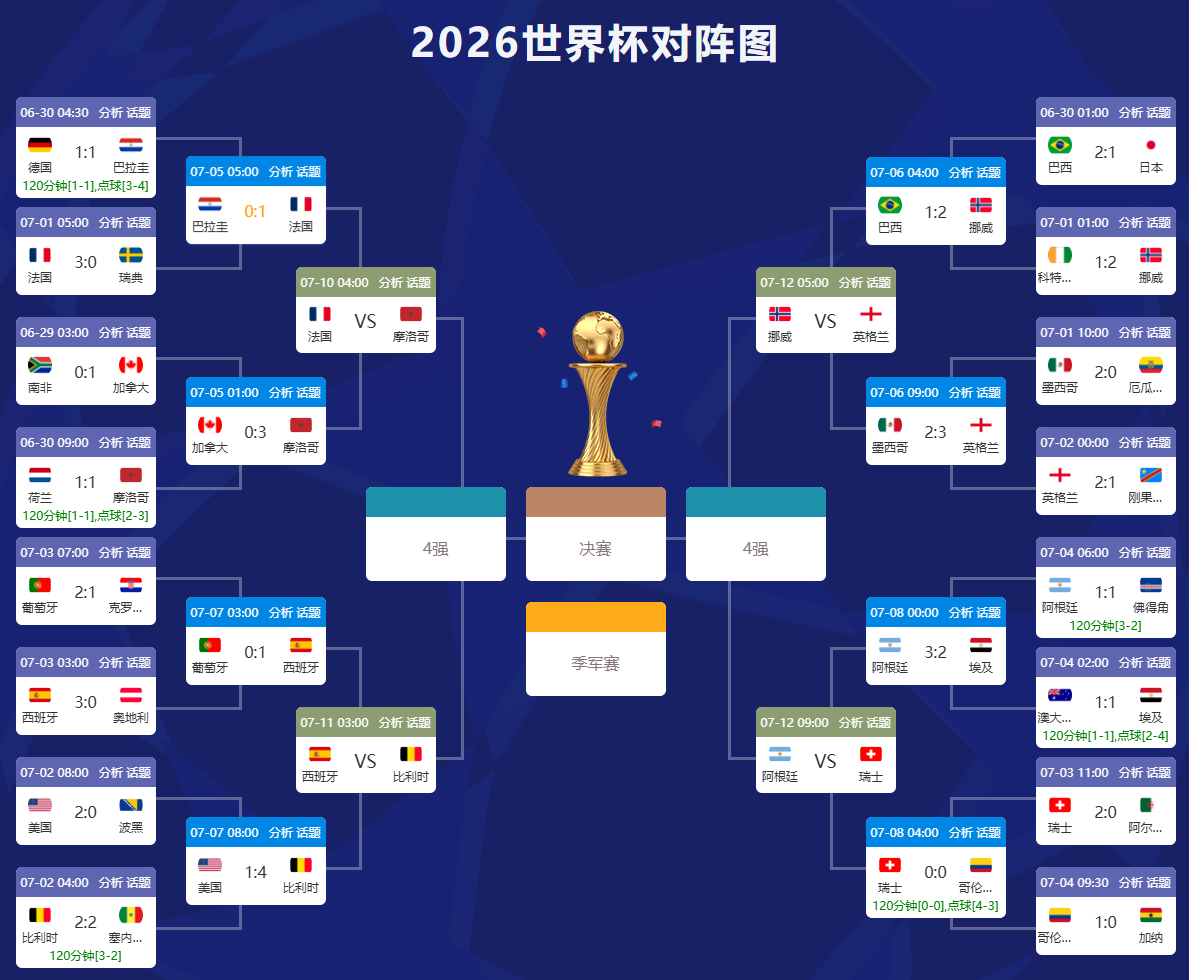
To provide reference for upcoming predictions related to the four quarterfinal matches, I asked ChatGPT, Claude, Gemini, DeepSeek, Qwen, and Grok separately, requesting them to predict the winner, scoreline, and whether each match would go into extra time or penalties for every game.

Looking at the results, the AIs are aligned on the direction of advancement for the four quarterfinal matches, giving the same final four answer: France, Spain, England, and Argentina. The real differences mainly appear in the details such as scores, extra time, and penalties.

AIs All Predict France to Advance, Morocco Unlikely to Repeat Dark Horse Miracle

The first quarterfinal of this World Cup is France vs. Morocco, scheduled for 4:00 AM Beijing Time on July 10th. According to predict.fun data, in regular time, France has a 63% probability of winning; draw probability is 25%; Morocco has a 14% probability of winning. Furthermore, including extra time and penalties, France's advancement probability is 79%, while Morocco's is 22%.
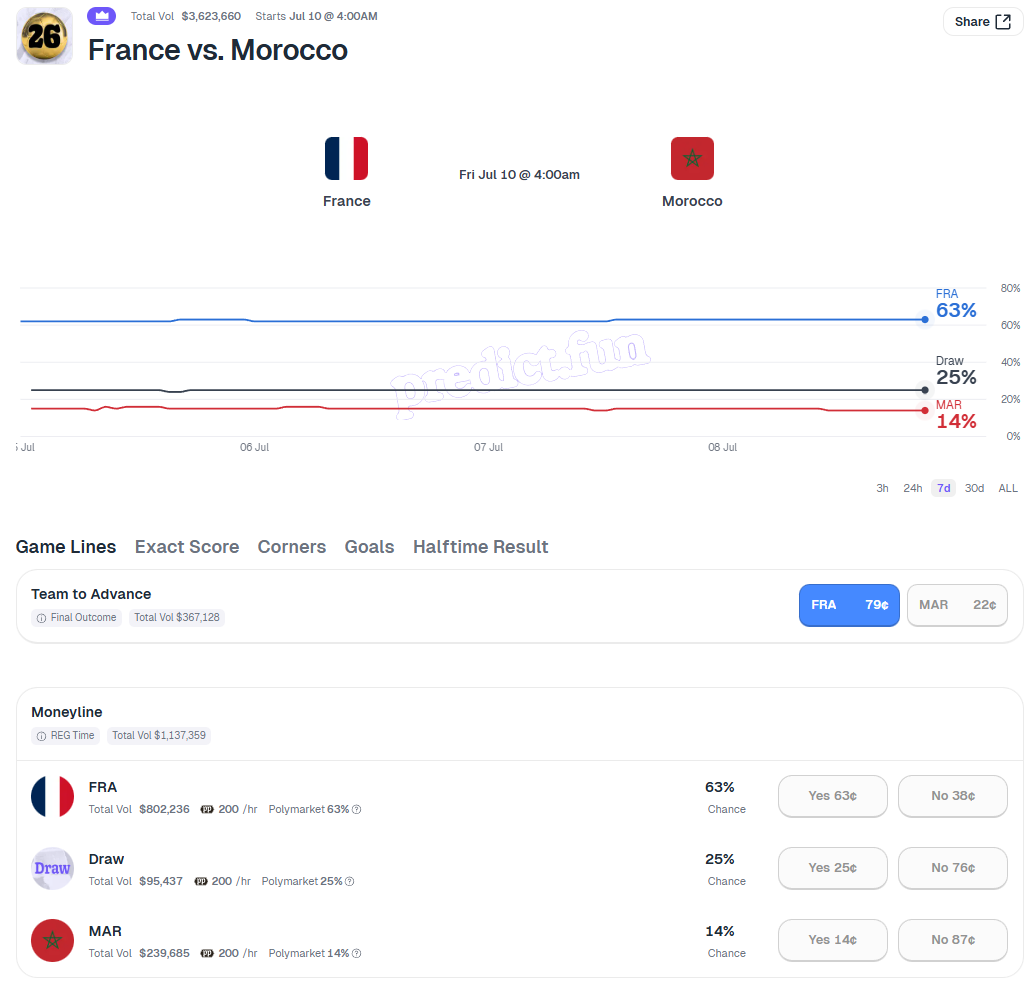
This is also the quarterfinal with the least disagreement among the six AI models. ChatGPT, Claude, Gemini, DeepSeek, Qwen, and Grok all favor France to advance. The only differences lie in whether France will win 2:0 or 2:1, and whether Morocco can score a goal.

Claude and Qwen both predict a 2:0 victory for France. They believe France is the team closest to the championship template this tournament, with forwards like Mbappé, Dembélé, and Olise continuously creating impact, and midfielders like Kanté, Tchouaméni, and Rabiot providing support. France is more complete than Morocco in both offense and defense. While Morocco has proven it's no ordinary dark horse, its squad depth and individual ability are still unlikely to match France head-on.

DeepSeek, Gemini, Grok, and ChatGPT lean more towards a 2:1 win for France. Their judgment is that Morocco won't be easily broken down and still has a chance to create threats through counter-attacks, set pieces, or wing play. However, the issue is that Morocco will find it difficult to consistently contain France's attacking stars for the full 90 minutes. Once the match enters the second half, France's individual quality and bench depth will become increasingly evident.

Overall, the AI models unanimously believe that France will advance within regular time, unlikely to need extra time or penalties.

AIs Place More Trust in Spain, Belgium's Counter-Attack as the Only Variable

The second quarterfinal of this World Cup is Spain vs. Belgium, scheduled for 3:00 AM Beijing Time on July 11th. According to predict.fun data, in regular time, Spain has a 61% probability of winning; draw probability is 25%; Belgium has a 17% probability of winning. Furthermore, including extra time and penalties, Spain's advancement probability is 79%, while Belgium's is 22%.
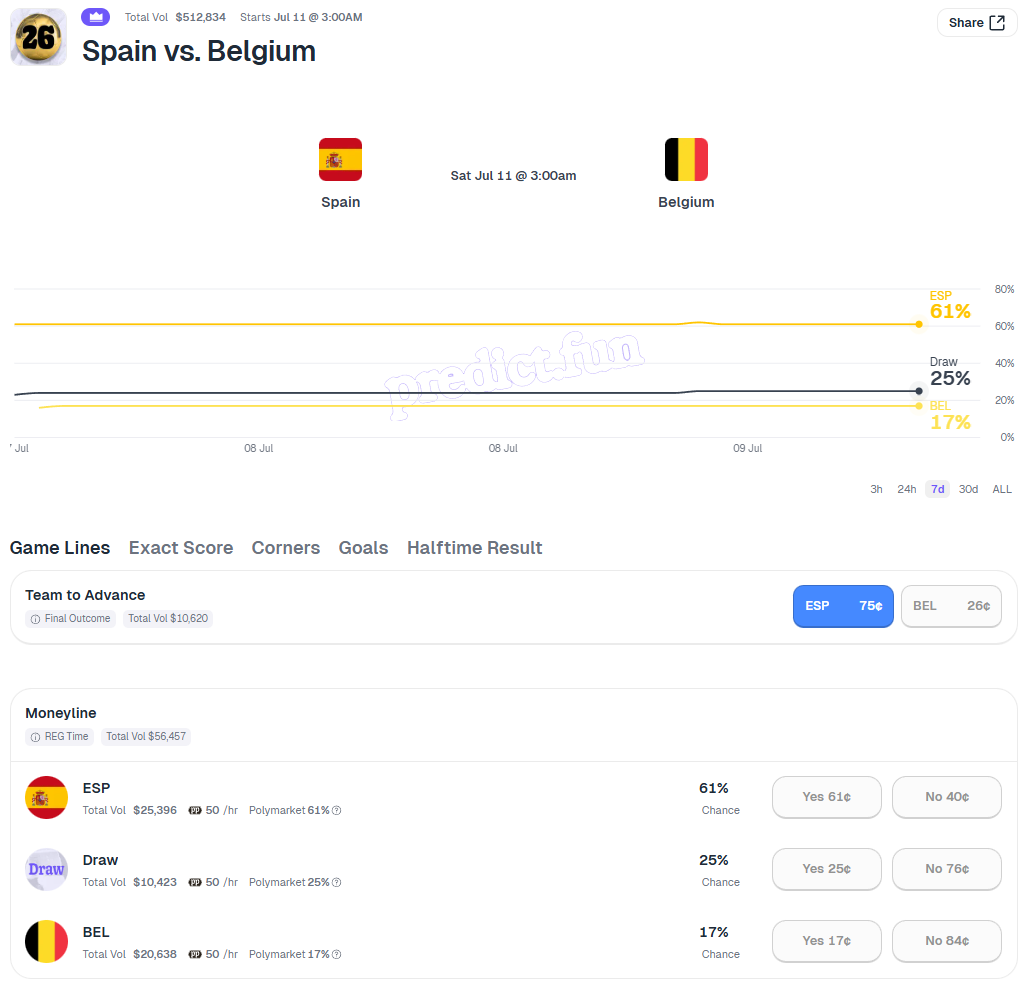
For this match, the six AI models also all favor Spain to advance, but disagreements over the match process are more pronounced than in the France vs. Morocco game.

Claude, Qwen, DeepSeek, and Grok all believe Spain is highly likely to secure victory within regular time, with predicted scores concentrated around 2:0 or 2:1. Their core reasoning is that Spain currently has stronger collective play, with possession, pressing, and defensive discipline all stable, and the match tempo is highly likely to be dictated by Spain.

ChatGPT's prediction is more conservative, favoring a 1:0 win for Spain. It suggests this won't be an open attacking battle but more of a contest between "system stability" and "offensive explosiveness." Spain might not score many goals but is more likely to win the match through possession-based attrition, wing play variations, or a set-piece opportunity.

The only model suggesting extra time and penalties is Gemini. It predicts a 1:1 draw in regular time, with no change in score during extra time, and Spain advancing via a penalty shootout. The key to this prediction is that if Belgium can seize a counter-attack opportunity to score first, Spain could be dragged into a more exhausting, grinding match.

The Match with Greatest AI Disagreement, Haaland Becomes England's Biggest Headache

The third quarterfinal of this World Cup is Norway vs. England, scheduled for 5:00 AM Beijing Time on July 12th. According to predict.fun data, in regular time, Norway has a 23% probability of winning; draw probability is 27%; England has a 53% probability of winning. Furthermore, including extra time and penalties, Norway's advancement probability is 36%, while England's is 66%.
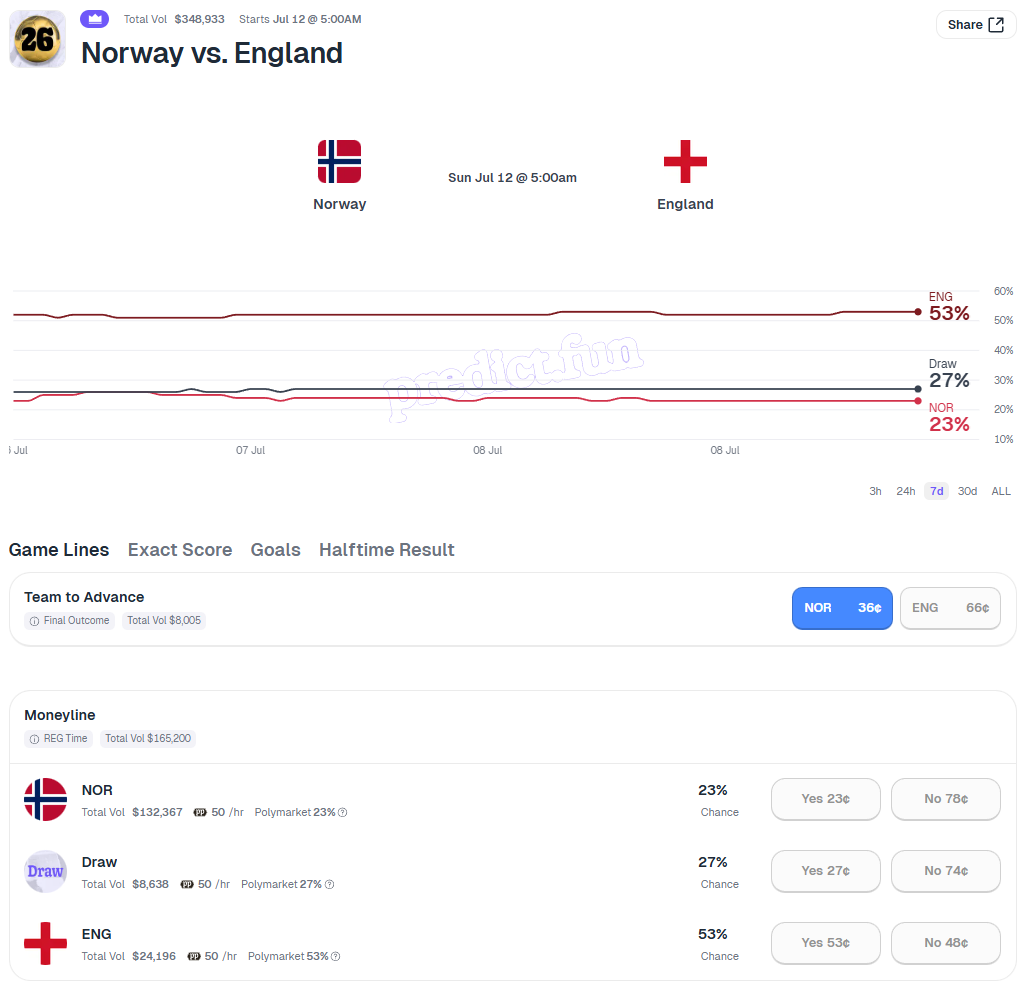
The presence of Haaland makes this knockout match the quarterfinal most likely to produce an upset. Although all six AIs ultimately voted for England to advance, the predictions are noticeably less certain than for the first two matches. Norway's 2:1 victory over Brazil in the previous round is no longer a question of "can they pull off an upset?"—they just did. More importantly, a player like Haaland doesn't need overall dominance; just one opportunity could plunge England into trouble.

Qwen, DeepSeek, and Grok all believe England is highly likely to win 2:1 within regular time. England has better squad depth, with players like Bellingham, Kane, Saka, and Foden all capable of deciding the match. In contrast, Norway's attack relies more heavily on the link-up between Haaland and Ødegaard. Once that connection is cut, Norway's offensive threat will significantly decrease.

However, Claude, Gemini, and ChatGPT are all clearly hedging against the possibility of extra time. Claude thinks England might narrowly win in regular time or be dragged into extra time by Norway; Gemini predicts a 2:2 draw in regular time, with England clinching victory in extra time thanks to bench depth; ChatGPT gives a prediction of 1:1 after 90 minutes, with England advancing 2:1 in extra time.

AIs Favor Argentina to Advance, Switzerland May Drag Match to Penalties

The fourth quarterfinal of this World Cup is Argentina vs. Switzerland, scheduled for 9:00 AM Beijing Time on July 12th. According to predict.fun data, in regular time, Argentina has a 58% probability of winning; draw probability is 28%; Switzerland has a 17% probability of winning. Furthermore, including extra time and penalties, Argentina's advancement probability is 74%, while Switzerland's is 27%.
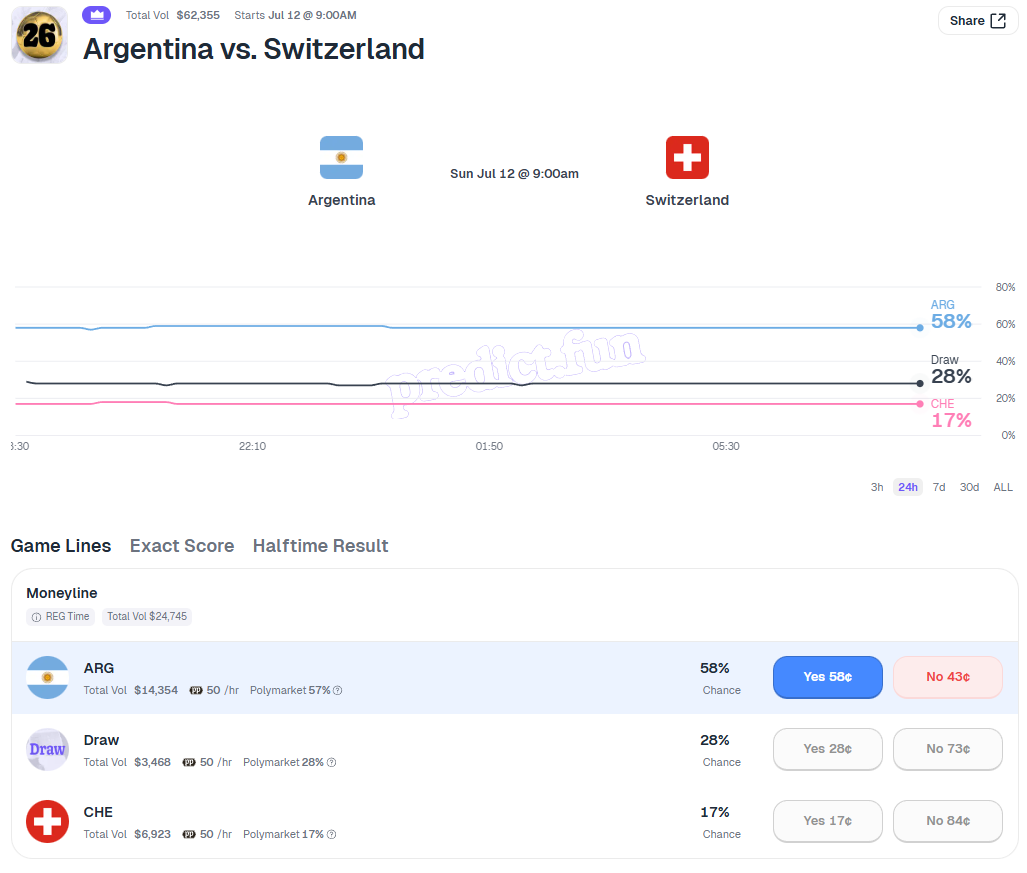
For this match, the AIs unanimously believe Argentina will advance. Unlike the more "dominant favorite" predictions for France and Spain, Argentina vs. Switzerland seems more like a match of patience.

Qwen and Gemini offer the most optimistic predictions, both favoring a 2:0 win for Argentina in regular time. Argentina's comeback from 0:2 down to win 3:2 against Egypt in the previous round has already revitalized the team's form and morale. Facing a team like Switzerland, which isn't particularly prolific in attack, Argentina, as long as they minimize defensive errors, has a chance to settle the match within 90 minutes.

DeepSeek and Grok are more cautious, leaning towards a 2:1 win for Argentina. Switzerland is organized defensively, disciplined, and won't be easily broken down by Argentina. However, the problem lies in Switzerland's lack of sustained offensive pressure. Once Argentina scores first, Switzerland will find it difficult to consistently pull the match back into their preferred rhythm for an extended period.

Those hedging for extra time and penalties are Claude and ChatGPT. Claude believes an opponent like Switzerland could easily force Argentina into a tough battle, possibly leading to a 1:1 draw and extra time, ultimately decided by penalties. ChatGPT directly predicts Argentina advancing via penalties, believing Switzerland has the ability to turn the match into a low-scoring war of attrition, dragging it to the end before relying on goalkeeping and penalty quality.

Related Content

World Cup Kicks Off, Some AI Prediction Models Become Prophets, Others Flop

Predicting World Cup Knockout Matches, Why Such a Big Difference in AI Performance?

Preguntas relacionadas

QAccording to the article, which four teams did all the AI models unanimously predict to reach the semi-finals of the World Cup?

AAccording to the article, all the AI models (ChatGPT, Claude, Gemini, DeepSeek, Qwen, and Grok) unanimously predicted France, Spain, England, and Argentina to reach the semi-finals.

QWhich quarter-final match did the AI models have the least disagreement about regarding the outcome?

AThe AI models had the least disagreement about the France vs Morocco quarter-final match. All models predicted France would advance without needing extra time or penalties.

QWhy did the article state that the Norway vs England match was the quarter-final with the greatest potential for an upset?

AThe article stated that the Norway vs England match had the greatest potential for an upset because of Erling Haaland's presence. His ability to decide a game with a single chance, coupled with Norway's recent 2-1 upset over Brazil, made the match highly unpredictable despite most AI models still favoring England.

QFor the Spain vs Belgium match, which AI model provided a prediction that involved a penalty shootout?

AFor the Spain vs Belgium match, the Gemini model provided a prediction that involved a penalty shootout. It predicted a 1-1 draw in regular time, no goals in extra time, and Spain advancing via penalties.

QIn the Argentina vs Switzerland match, which AI models predicted the possibility of the game going to extra time or penalties?

AFor the Argentina vs Switzerland match, Claude and ChatGPT predicted the possibility of the game going to extra time or penalties. Claude suggested a 1-1 draw leading to a penalty shootout, while ChatGPT predicted Argentina would advance via penalties.

Lecturas Relacionadas

Sevenfold Oversubscription, Can SK Hynix Save the Semiconductor Industry This Time?

SK Hynix's planned US ADR listing is drawing intense interest, with its offering reportedly oversubscribed by over seven times, potentially making it the largest foreign listing in US history. The fundraising of approximately $24.5 billion is intended for expanding its Korean production capacity, including advanced packaging and EUV equipment. This massive demand from long-term funds and prominent institutions like Baillie Gifford and Situational Awareness Partners (led by noted investor Leopold Aschenbrenner) presents a stark contrast to the recent downturn in the broader semiconductor sector. The sector has faced a significant correction, with SK Hynix's own stock falling nearly 30% from its June high. This sell-off was triggered by concerns that major tech giants might slow their AI infrastructure spending, following signals like Meta's reported plan to sell surplus computing capacity. The strong ADR appetite suggests long-term investors still believe in the AI investment cycle's fundamentals, viewing the recent decline more as a valuation reset than a demand collapse. Some market speculation even suggests the pre-IPO price drop could be strategic, setting the stage for a stronger post-listing performance. While SK Hynix's successful listing may act as a short-term positive catalyst for market sentiment, the article argues the true signal for a sustained semiconductor recovery will come from upcoming earnings reports of tech giants like Microsoft, Google, Meta, and Amazon. Their future capital expenditure plans will be crucial in determining whether the AI-driven growth cycle can continue.

Odaily星球日报Hace 33 min(s)

Sevenfold Oversubscription, Can SK Hynix Save the Semiconductor Industry This Time?

Odaily星球日报Hace 33 min(s)

Breaking News: Musk Delivers the Most Powerful Grok 4.5, Slashes Price of Top-tier Opus Intelligence Drastically

**Elon Musk Launches Grok 4.5: A Cost-Effective, High-Performance AI Rival** SpaceXAI, in collaboration with Cursor, has released Grok 4.5, its new flagship AI model designed specifically for coding and agentic tasks. Trained on tens of thousands of NVIDIA GB300 GPUs using massive, high-quality data filtered from trillions of Cursor developer interactions, the model emphasizes "per-token intelligence." In benchmark performance, Grok 4.5 is highly competitive. It scores 64.7% on SWE Bench Pro (surpassing GPT-5.5's 58.6% and Opus 4.7's 64.3%), 83.3% on Terminal Bench 2.1 (nearly matching GPT-5.5), and 62.0% on DeepSWE 1.0 (beating Opus 4.8). Overall, it ranks fourth in AAAI official tests and first in the Harvey legal agent benchmark. The model's key advantage is its combination of speed, efficiency, and low cost. It generates responses at 80 tokens per second and, crucially, uses far fewer tokens to complete tasks—4.2 times fewer than Opus 4.8 on SWE Bench Pro. It is priced at $2 per million input tokens and $6 per million output tokens, significantly undercutting competitors. Musk stated it is "roughly equivalent to Opus 4.7, but much faster." Early user tests show Grok 4.5 can generate functional code for applications like 3D solar system simulators and basic games from simple prompts, though some note it still lags behind top models in certain creative tasks. Musk has hinted at a major update next month, leveraging real-world engineering data from his companies, with an even larger 2-trillion parameter version reportedly in development. Grok 4.5 positions itself not as the absolute strongest model, but as a highly efficient and affordable alternative in the top tier.

marsbitHace 38 min(s)

Breaking News: Musk Delivers the Most Powerful Grok 4.5, Slashes Price of Top-tier Opus Intelligence Drastically

marsbitHace 38 min(s)

Today, The Hong Kong Exchange Was Once Again Overwhelmed

Hong Kong's stock exchange witnessed an exceptionally busy day on July 9, with a record seven companies conducting initial public offerings (IPOs) simultaneously. The list included major firms such as Luxshare Precision, which launched the largest Hong Kong IPO of the year, and other notable names like Tri-Ring Group and Qiyunshan Food. However, the market reception was sharply divided on the first trading day. While Qiyunshan Food's shares surged over 110%, several other newcomers, including Luxshare Precision, Dingtai High-Tech, and Rigol Technologies, opened below their issue prices, with some falling nearly 20%. This event highlights a broader, bustling IPO scene in Hong Kong for 2024, with 82 Chinese companies listing in the first half alone—more than double the figure from the same period last year. A significant portion of this activity comes from dual "A+H" listings, where mainland China-listed firms seek secondary listings in Hong Kong. These larger companies have accounted for nearly 60% of total fundraising. Despite the high volume, recent trends show a cooling market sentiment for many new listings. Several IPOs in early July, including that of Tongrentang Healthcare, debuted with significant losses, indicating increased investor caution and selectivity. The market narrative is shifting, with capital increasingly concentrating on high-growth sectors like artificial intelligence, robotics, and semiconductors, while traditional manufacturing and consumer goods face greater pressure and volatility. This divergence underscores a market where success is no longer guaranteed by merely listing, but depends heavily on a company's growth prospects and sector appeal.

marsbitHace 42 min(s)

Today, The Hong Kong Exchange Was Once Again Overwhelmed

marsbitHace 42 min(s)

Glassnode: Crypto Market Enters Later Stages of Bottoming Phase

Glassnode: Crypto Market Enters Later Stages of Bottom Formation Bitcoin has traded below the true market average and the short-term holder cost basis for five consecutive months, indicating a deep undervaluation. On-chain data reveals a significant shift in selling pressure, with long-term holders now accounting for 43% of all realized losses. Daily realized losses for this group recently peaked at $280 million, the highest level since December 2022. While this large-scale capitulation is a hallmark of bear market bottoms, a sustained decline in this metric is a prerequisite for a sustained recovery. Institutional demand remains weak. US spot Bitcoin ETFs continue to see monthly net outflows, although the pace has moderated from June's peak. Furthermore, average daily ETF trading volumes have contracted by approximately 80% from their October 2025 peak, reflecting subdued institutional participation. Derivatives markets present a mixed picture. Overall positioning has shifted to cautiously bullish, with the put/call ratio dropping to a yearly low. However, the options volatility skew remains elevated, signaling that traders are still paying a premium for downside protection. The spot price also trades below the gamma "max pain" level. In summary, multiple indicators suggest the market is in the later phases of a bottoming process, characterized by long-term holder capitulation and weak institutional inflows. However, key confirmation signals for a durable trend reversal—a sustained drop in long-term holder selling pressure, stabilization of ETF flows, and a price recovery above key cost bases—are still pending.

Foresight NewsHace 1 hora(s)

Glassnode: Crypto Market Enters Later Stages of Bottoming Phase

Foresight NewsHace 1 hora(s)

Private Credit in US Dollar

Stablecoins are evolving into a new type of money market fund, channeling crypto deposits into the $2 trillion private credit market. This mirrors the 1970s innovation where money market funds pooled small deposits to buy high-yield government securities, bypassing bank restrictions. Today, platforms like Apollo's ACRED tokenized fund and Figure's on-chain lending system allow stablecoin holders to access institutional private credit strategies with no minimum investment, offering yields of 8-12%. On-chain tokenization enables greater liquidity and DeFi composability (e.g., using tokens as collateral for leveraged positions) compared to traditional, locked-up private credit funds. Consequently, on-chain private credit has grown 15x in a year to $5.87 billion, though it remains a tiny fraction (0.3%) of the global market. However, this model carries significant risks, as illustrated by the failure of Goldfinch. Launched in 2021, it directed crypto deposits to motorcycle loans in Kenya and Nigeria. Critical issues included a lack of local oversight, leading to unauthorized fund transfers and borrower defaults. With $56 million now trapped in non-performing loans, its collapse highlights that while blockchain streamlines capital transfer, the essential 90% of lending—underwriting, monitoring, and recovery—remains a costly, localized challenge. Success requires robust, traditional credit infrastructure, not just on-chain execution.

marsbitHace 1 hora(s)

Private Credit in US Dollar

marsbitHace 1 hora(s)

Trading

Spot
活动图片