How This Cardano Holder Lost $6.09 Million In Minutes Due To On-Chain Liquidity Issues

bitcoinistPublicado a 2025-11-19Actualizado a 2025-11-19

Resumen

A Cardano holder has experienced a staggering financial blow this week, losing over $6 million worth of ADA in just...

Trusted Editorial content, reviewed by leading industry experts and seasoned editors. Ad Disclosure

A Cardano holder has experienced a staggering financial blow this week, losing over $6 million worth of ADA in just minutes due to on-chain liquidity issues. The funds, which had been sitting dormant for nearly five years, vanished almost instantly during the massive swap. The incident raises alarm regarding the risks involved in using Decentralized Exchanges (DEXs) and the importance of understanding liquidity and slippage before executing large trades. 

Cardano Holder Loses Over $6 Million ADA In Minutes

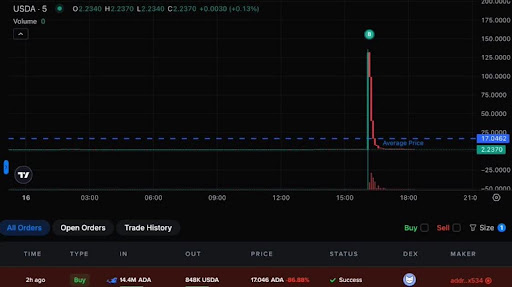
A new report from a famous on-chain sleuth, ZachXBT, revealed a jaw-dropping loss for a Cardano investor. The user had swapped 14.4 million ADA, valued at approximately $6.9 million, for 847,000 USDA, a stablecoin pegged to ADA.  The transaction occurred just two hours before the report became public, revealing that the investor had lost approximately $6.05 million, wiping out more than 80% of his initial investment. 

ZachXBT has said that the dramatic loss was likely due to extremely thin liquidity in the trading pool, which caused the price of ADA to spike temporarily during the swap. Vladimir S., a threat researcher who shared ZachXBT’s findings on X from his Telegram group, speculated that the Decentralized Exchange interface where the transaction occurred probably did not provide clear, low-liquidity warnings for a swap of that magnitude. 
Cardano
Source: Chart from ZachXBT on X

Vladimir suggested that an Over-The-Counter (OTC) deal would have been a much safer alternative for a $6.9 million ADA swap. Notably, this case highlights how even long-term crypto holders can suffer major losses when they do not fully understand how DEXs work.

Community Weighs In On Liquidity Issues And Slippage Warnings

ZachXBT’s report sparked extensive discussions among crypto traders and analysts, who pointed out that the $6.9 million ADA swap carried a staggering high price impact of 87.433%. Many in the community noted that the transaction was executed on the Minswap DEX, where users are required to actively acknowledge and consent to high slippage warnings to confirm trades.

Some members argued that the $6.05 million loss could have been avoided if the user paid attention to the interface and the obvious warnings displayed for transactions exceeding typical slippage thresholds. Responding to Vladimir’s speculation about a lack of clear liquidity warnings, other community members confirmed that Minswap always provides visible alerts for low liquidity swaps. Large slippage percentages, typically above 3-5%, are displayed in bright red texts, making it almost impossible for traders to miss. 

Some observers suggested that the Cardano holder may have misunderstood the interface, possibly due to language barriers or a lack of familiarity with decentralized finance mechanisms. Regardless of the reasons, this incident serves as a clear reminder for crypto users to pay attention to liquidity and slippage alerts when executing high-value swaps.

Cardano
ADA trading at $0.46 on the 1D chart | Source: ADAUSDT on Tradingview.com
Featured image from Adobe Stock, chart from Tradingview.com
Editorial Process for bitcoinist is centered on delivering thoroughly researched, accurate, and unbiased content. We uphold strict sourcing standards, and each page undergoes diligent review by our team of top technology experts and seasoned editors. This process ensures the integrity, relevance, and value of our content for our readers.

Scott Matherson is a leading crypto writer at Bitcoinist, who possesses a sharp analytical mind and a deep understanding of the digital currency landscape. Scott has earned a reputation for delivering thought-provoking and well-researched articles that resonate with both newcomers and seasoned crypto enthusiasts. Outside of his writing, Scott is passionate about promoting crypto literacy and often works to educate the public on the potential of blockchain.

Lecturas Relacionadas

Auto Research Era: 47 Tasks Without Standard Answers Become the Must-Test Leaderboard for Agent Capabilities

The article introduces Frontier-Eng Bench, a new benchmark for AI agents developed by Einsia AI's Navers lab. Unlike traditional tests with clear answers, this benchmark presents 47 complex, real-world engineering tasks—such as optimizing underwater robot stability, battery fast-charging protocols, or quantum circuit noise control—where there is no single correct solution, only continuous optimization towards a limit. It shifts AI evaluation from static knowledge retrieval to a dynamic "engineering closed-loop": the AI must propose solutions, run simulations, interpret errors, adjust parameters, and re-run experiments to iteratively improve performance. This process tests an agent's ability to learn and evolve through long-term feedback, much like a human engineer tackling trade-offs between power, safety, and performance. Key findings from the benchmark reveal two patterns: 1) Improvements follow a power-law decay, becoming harder and smaller as optimization progresses, and 2) While exploring multiple solution paths (breadth) helps, sustained depth in a single path is crucial for breakthrough innovations. The research suggests this marks a step toward "Auto Research," where AI systems can autonomously conduct continuous, tireless optimization in scientific and engineering domains. Humans would set high-level goals, while AI agents handle the iterative experimentation and refinement. This could fundamentally change research and development workflows.

marsbitHace 22 min(s)

Auto Research Era: 47 Tasks Without Standard Answers Become the Must-Test Leaderboard for Agent Capabilities

marsbitHace 22 min(s)

Wall Street's 'Compliance Hunt': The Great Stablecoin Reserve Migration

In a concentrated move over the past week, several Wall Street giants have advanced their tokenized money market fund initiatives, signaling a strategic shift driven by impending U.S. stablecoin regulations. JPMorgan Chase launched its second such fund, JLTXX, on Ethereum, explicitly targeting future stablecoin issuer reserve needs. Concurrently, Franklin Templeton partnered with Kraken to integrate its BENJI tokenized funds onto the exchange platform for use as collateral and cash management tools. BlackRock further solidified its position by filing for two new tokenized funds with the SEC, aiming to convert its massive traditional stablecoin custody business into a tokenized model. These parallel developments represent a multi-pronged institutional "compliance hunt" to capture future crypto liquidity. BlackRock and JPMorgan are focusing on the backend, preparing to serve as the core reserve and settlement infrastructure for compliant stablecoins as outlined by the GENIUS Act. This act defines strict "qualified reserve asset" requirements for stablecoin backing while prohibiting interest payments to holders. Franklin Templeton and Kraken, however, are exploiting a potential regulatory gap. By offering a tokenized fund (BENJI) that is not a stablecoin, they aim to provide yield-bearing, collateralizable digital cash instruments, circumventing GENIUS Act's ban on stablecoin yield. The impending CLARITY Act, which will delineate digital asset market structure, is seen as a complementary piece to GENIUS. Its treatment of passive income could solidify the niche for instruments like BENJI. With conservative market size estimates for tokenized money market funds reaching hundreds of billions by 2030, Wall Street institutions are positioning themselves early, using on-chain settlement as a key competitive differentiator to offer superior liquidity and composability for the next generation of dollar reserves.

marsbitHace 2 hora(s)

Wall Street's 'Compliance Hunt': The Great Stablecoin Reserve Migration

marsbitHace 2 hora(s)

Trading

Spot
Futuros

Artículos destacados

Cómo comprar ADA

¡Bienvenido a HTX.com! Hemos hecho que comprar Cardano (ADA) sea simple y conveniente. Sigue nuestra guía paso a paso para iniciar tu viaje de criptos.Paso 1: crea tu cuenta HTXUtiliza tu correo electrónico o número de teléfono para registrarte y obtener una cuenta gratuita en HTX. Experimenta un proceso de registro sin complicaciones y desbloquea todas las funciones.Obtener mi cuentaPaso 2: ve a Comprar cripto y elige tu método de pagoTarjeta de crédito/débito: usa tu Visa o Mastercard para comprar Cardano (ADA) al instante.Saldo: utiliza fondos del saldo de tu cuenta HTX para tradear sin problemas.Terceros: hemos agregado métodos de pago populares como Google Pay y Apple Pay para mejorar la comodidad.P2P: tradear directamente con otros usuarios en HTX.Over-the-Counter (OTC): ofrecemos servicios personalizados y tipos de cambio competitivos para los traders.Paso 3: guarda tu Cardano (ADA)Después de comprar tu Cardano (ADA), guárdalo en tu cuenta HTX. Alternativamente, puedes enviarlo a otro lugar mediante transferencia blockchain o utilizarlo para tradear otras criptomonedas.Paso 4: tradear Cardano (ADA)Tradear fácilmente con Cardano (ADA) en HTX's mercado spot. Simplemente accede a tu cuenta, selecciona tu par de trading, ejecuta tus trades y monitorea en tiempo real. Ofrecemos una experiencia fácil de usar tanto para principiantes como para traders experimentados.

1.4k Vistas totalesPublicado en 2024.12.10Actualizado en 2025.03.21

Cómo comprar ADA

Discusiones

Bienvenido a la comunidad de HTX. Aquí puedes mantenerte informado sobre los últimos desarrollos de la plataforma y acceder a análisis profesionales del mercado. A continuación se presentan las opiniones de los usuarios sobre el precio de ADA (ADA).

活动图片