Bitcoin Maintains $20K, Ethereum Soared to 9-Day High (Market Watch)

CryptoPotatoPublicado a 2022-07-07Actualizado a 2022-07-07

Resumen

While bitcoin continues to stand tall above $20,000, ether went on a roll and briefly exceeded $1,200.

While bitcoin continues to stand tall above $20,000, ether went on a roll and briefly exceeded $1,200.

Despite the recent volatility, bitcoin has managed to sustain above the coveted $20,000 line. Most altcoins are also slightly in the green today, with ETH spiking towards a near 10-day high at $1,200.

Bitcoin Sustains Above $20K

Last week ended on a highly volatile note in which bitcoin skyrocketed by over $2,000 in minutes to just under $21,000. However, that turned out to be a fake breakout as the cryptocurrency retraced just as quickly.

Following such enhanced price fluctuations, the asset calmed at around $19,000 when the weekend came, and given the fact that July 4 was the national US holiday, not much happened in terms of price action on Monday either.

The landscape changed on Tuesday when BTC spiked to and beyond $20,000 before experiencing another roller-coaster, in which it dropped to $19,250 and shot back up to $20,600.

Following another retracement to sub-$20K levels, bitcoin jumped back above that line and remains there as of now. As such, its market cap is close to $400 billion, while the dominance over the alts sits tight at 42.4%.
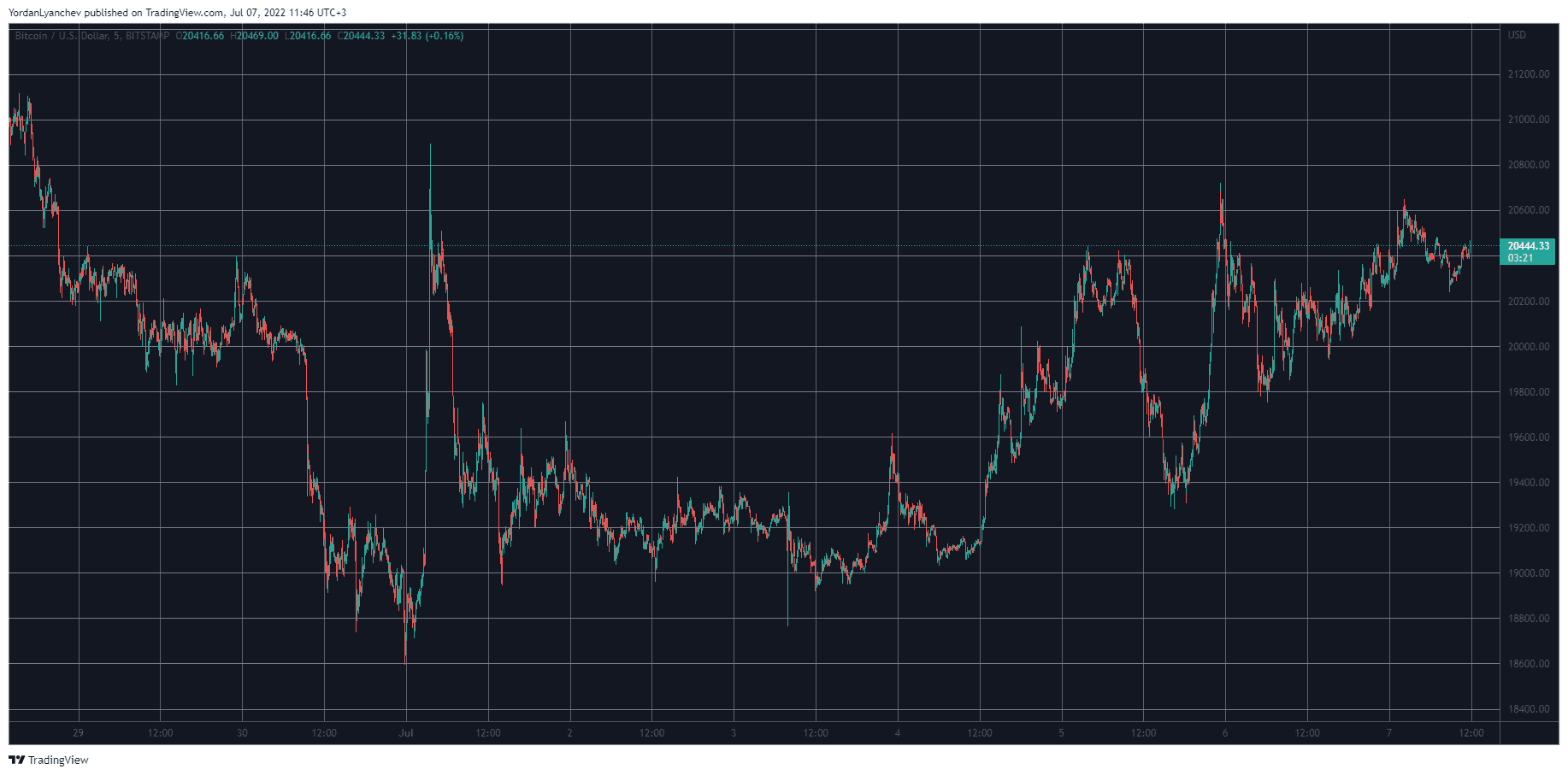
BTCUSD. Source: TradingView

ETH Sees Local Peak

Most altcoins also went through similar price movements lately but are slightly in the green on a daily scale.

Ethereum stands tall with a 3% increase since yesterday. Moreover, the second-largest asset jumped to just over $1,200 hours ago, which became a 9-day high. As of now, though, ETH trades just under that level.

BNB, Ripple, Cardano, Solana, Dogecoin, Polkadot, Shiba Inu, and Avalanche have charted insignificant daily increases. TRON, on the other hand, is just slightly in the red.

Most lower- and mid-cap altcoins are also quite still on a daily scale. As a result, the overall market cap of all crypto assets stands calm at just over $900 billion.
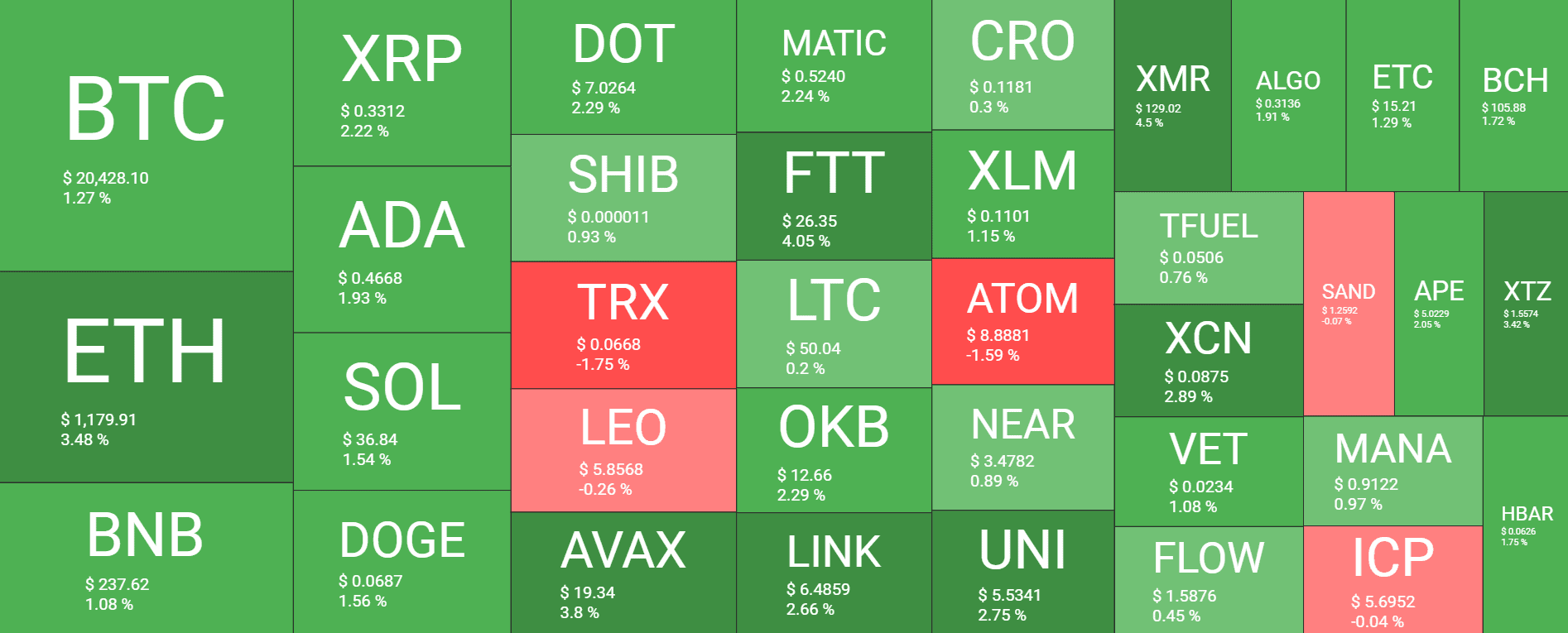
Cryptocurrency Market Overview. Source: Quantify Crypto

Industry News

The CEO of FTX – Sam Bankman-Fried – said his company still has “a few billion” left to bail out other struggling crypto firms.

One of the companies that Elon Musk runs – Boring – will start accepting Dogecoin (DOGE) for various payments.

Following the meltdown of the Terra ecosystem, the authorities of the US and South Korea noted that they will start sharing data with each other.

Sepolia, a public testnet of Ethereum, has become just the second one to implement the Merge upgrade.

Uprise Investment Fund admitted to losing over $20 million of its customers and own funds by shorting LUNA in May.


Lecturas Relacionadas

Will the Next Crypto Bull Run Start with On-Chain Trading of SpaceX?

This article presents a scenario-based forecast for the crypto industry from 2026 to 2029, arguing that the next major cycle will be driven not by technological narratives but by legal access to real-world assets. The author predicts that by mid-2026, pre-IPO perpetual contracts for top private companies like SpaceX, OpenAI, and Anthropic on platforms like Hyperliquid will become the primary gateway for accessing quality assets, as most crypto-native tokens fail to capture real value. The much-hyped AI x Crypto intersection largely fails except for prediction markets, which thrive on betting on AI model supremacy. By 2027, public blockchain foundations are forced to choose between catering to retail speculation or building compliant infrastructure for institutions, with many opting for the latter. Growth in stablecoins and tokenized private credit/equity hits a "triple ceiling" due to regulatory and political uncertainty rather than market demand. The pivotal shift is forecast for 2028. A major liquidation event in pre-IPO perpetuals exposes the structural flaw of synthetic markets lacking a real underlying asset anchor. In response, regulatory changes finally allow the public solicitation of private securities resales to verified accredited investors. This creates a legitimate secondary market for real company equity, which then becomes the core asset class of the new bull market, relegating synthetic perps to a niche role. By 2029, the industry becomes "boring" but foundational. Tokens without claims on real cash flows or assets cease trading. Stablecoin growth is steady but politically capped. Crypto infrastructure fades from view as it gets absorbed into traditional finance backends. The article's central thesis is that the key bottleneck for crypto's next phase is legal and regulatory channels for real asset ownership, not technology.

marsbitHace 32 min(s)

Will the Next Crypto Bull Run Start with On-Chain Trading of SpaceX?

marsbitHace 32 min(s)

The Value Distribution of Stablecoins

**Summary: The Value Distribution of Stablecoins** The article argues that stablecoins are evolving from mere trading tools into broader channels for dollar access. It divides the stablecoin ecosystem into four layers to analyze how value is distributed: 1. **Issuance Layer:** Mints stablecoins, holds reserve assets, and captures the spread between reserve yield and user costs (e.g., Tether, Circle). This layer currently earns the largest profit margin. 2. **Infrastructure Layer:** Connects stablecoins to the traditional financial system, handling fiat on/off-ramps, banking integration, compliance (KYC/AML), and asset management (e.g., Bridge, BVNK). This is the "unglamorous" but critical work, building the essential bridges between crypto and real-world finance. 3. **Acquiring/Distribution Layer:** Integrates stablecoins into merchant systems, manages payment flows, and provides enterprise financial software (e.g., Stripe, Coinbase). They act as the access point for businesses. 4. **Application Layer:** The end-users and businesses that ultimately use stablecoins for payments, settlements, or as a store of value. They benefit from convenience but have little pricing power. The core thesis is that while the issuance layer currently dominates profits, the often-overlooked **infrastructure layer holds significant long-term potential**. The real challenge and barrier to mass adoption is not the on-chain transfer of stablecoins (which is simple), but the complex "last mile" integration into existing business workflows, banking systems, and regulatory frameworks across different countries. Companies in this layer are currently in a "land grab" phase, investing heavily to build networks, secure bank partnerships, and establish compliance pathways. While their position is currently pressured by the profitable issuers above and distribution platforms below, the article suggests that if stablecoins become a default financial rail for businesses, the infrastructure providers who have done the hard work of integration will ultimately gain strong pricing power and become entrenched, essential players.

marsbitHace 7 hora(s)

The Value Distribution of Stablecoins

marsbitHace 7 hora(s)

The Value Distribution of Stablecoins

The Value Distribution of Stablecoins The article argues that stablecoins are evolving from a mere trading tool into a broad "dollar channel." It analyzes the industry's value chain through four layers: 1. **Issuance Layer (e.g., Tether, Circle):** The top layer that mints stablecoins, holds reserve assets, and captures the thickest interest rate spread. 2. **Infrastructure Layer (e.g., Bridge, BVNK):** Connects stablecoins to the traditional financial system, handling critical but complex "dirty work" like fiat on/off-ramps, banking integration, compliance (KYC/AML), and cross-border settlement. 3. **Acquiring/Distribution Layer (e.g., Stripe, Coinbase):** Embeds stablecoins into merchant systems, manages payment flows, and integrates with enterprise software. 4. **Application Layer:** End-users and businesses that ultimately use stablecoins for payments, settlement, or storing value. The author posits that while the issuance layer currently captures the most profit, the most overlooked and potentially critical layer is infrastructure. The core challenge for stablecoin adoption isn't the on-chain transfer (which is simple), but bridging the gap between blockchain and the real-world financial system. This involves solving practical problems for businesses: fiat conversion, reconciliation, tax handling, and user onboarding. Infrastructure companies are currently in a difficult "land-grab" phase—building networks, securing banking relationships, and achieving compliance country-by-country. They face pressure from both the profitable issuance layer above and distribution platforms below. However, the author suggests this layer is building a crucial moat. Once stablecoins become a default business rail, the infrastructure players who have done the hard work of integration may gain significant, durable value and pricing power.

链捕手Hace 7 hora(s)

The Value Distribution of Stablecoins

链捕手Hace 7 hora(s)

Trading

Spot
Futuros
活动图片


