Circle Reports Q3 Reserve Income Exceeding $700 Million, Teases Native Token Launch

bitcoinistPublicado a 2025-11-13Actualizado a 2025-11-13

Resumen

In a recent financial statement on Circle's (CRCL) third-quarter (Q3) performance, the stablecoin giant saw tremendous increase in key metrics,...

Trusted Editorial content, reviewed by leading industry experts and seasoned editors. Ad Disclosure

In a recent financial statement on Circle’s (CRCL) third-quarter (Q3) performance, the stablecoin giant saw tremendous increase in key metrics, exceeding Wall Street estimates.

Circle’s Financial Disclosures 

According to the financial disclosures made public by the firm on Wednesday, Circle’s Reserve Income surged to $711 million, marking a substantial 60% year-over-year increase, primarily fueled by a 97% surge in the average USDC in circulation.

Furthermore, the financial report revealed that “other revenue” climbed to $29 million, exhibiting a notable $28 million increase year-over-year, on the heels of continuous growth in subscription and services revenue, alongside transaction revenue.

On the expenditure front, total distribution, transaction, and other costs escalated to $448 million, marking a 74% year-over-year increase. This rise was predominantly driven by amplified distribution payments, reflecting higher USDC circulation balances and the growth in Coinbase’s average on-platform holdings of USDC. 

Operating Expenses soared to $211 million, increasing by 70% year-over-year, primarily due to elevated compensation expenses, including $59 million allocated to stock-based compensation expenses in Q3.

The report also highlighted that net income surged to $214 million, marking a 202% year-over-year increase. This figure included an income tax benefit of $61 million attributable to stock-based compensation expense, research and development tax credits, and the impact of recently enacted US tax legislation

Adjusted EBITDA also experienced a significant uptick, reaching $166 million, reflecting a 78% year-over-year increase driven by revenue growth from higher USDC in circulation and the inherent operating leverage in Circle’s business model.

Native Token Launch On Arc Network 

Earlier this year, Circle unveiled Arc, a public blockchain tailored for stablecoin transactions, aimed at bolstering cross-border settlements, merchant payments, and decentralized finance integrations. 

Arc, designed as the Circle Layer-1 (L1) blockchain, is geared towards developers and companies seeking to introduce more economic activity on-chain with programmable financial infrastructure for the global economy.

Looking ahead, the stablecoin issuer said it is contemplating the launch of a native token on the Arc network, an initiative envisioned to enhance network participation, drive adoption, align the interests of Arc stakeholders, and bolster the long-term growth and success of the Arc network.

Jeremy Allaire, Co-Founder, Chief Executive Officer, and Chairman at Circle, expressed enthusiasm about the company’s progress, stating: 

Circle continued to see accelerating adoption of USDC and our platform in the third quarter as we build the new Economic OS for the internet… With growing circulation, accelerating commercial partnerships and expanding collaboration across industries, we’re proud of the tangible progress toward a more open and efficient global financial system. 

Circle
CRCL’s valuation trending downwards on the daily chart. Source: CRCL on TradingView.com

The firm’s stock, CRCL, which launched earlier this year and trades on the US stock market, is currently trading at $91.57. This represents a notable 7% drop compared to Monday’s trading session.  

Featured image from DALL-E, chart from TradingView.com 

Editorial Process for bitcoinist is centered on delivering thoroughly researched, accurate, and unbiased content. We uphold strict sourcing standards, and each page undergoes diligent review by our team of top technology experts and seasoned editors. This process ensures the integrity, relevance, and value of our content for our readers.

Ronaldo is a seasoned crypto enthusiast with over four years of experience in the field. He is passionate about exploring the vast and dynamic world of decentralized finance (DeFi) and its practical applications for achieving economic sovereignty. Ronaldo is constantly seeking to expand his knowledge and expertise in the DeFi space, as he believes it holds tremendous potential for transforming the traditional financial landscape.

Lecturas Relacionadas

Weekly Digest: Miners Sell Their Souls to AI, Exchanges Lose Customer Trust

This week's key story was the 20-year, $9.1 billion ($16.1bn with options) deal between mining firm Riot Platforms and AI lab Anthropic, renting 191 MW of data center capacity. It highlights a major industry pivot, with miners contracting ~7 GW to AI firms for nearly $135 billion, as seen with Core Scientific earning more from power hosting than mining. Meanwhile, crypto exchange EXMO shut down due to UK sanctions, issuing debt tokens instead of repaying clients, underscoring persistent infrastructure vulnerabilities. Bitcoin remained range-bound near $62.5k-$63k, digesting mixed signals from US inflation cooling to corporate selling (e.g., MicroStrategy's sale for share buybacks). Seasonal August weakness is a noted context. In AI, alongside massive infrastructure investments (e.g., Elon Musk's $16.8bn Terafab), safety concerns grew. An OpenAI model exploited a Hugging Face vulnerability, while researchers found methods to extract hidden passwords from AI reasoning. Autonomous agents demonstrated potential risks, like hacking a gym booking system. Regulatory approaches diverged: the US SEC plans its own crypto rules amid stalled legislation, while Russia will screen large AI models for "spiritual-moral values" from September. Geopolitical tensions extended to robotics, with the US banning federal purchases of foreign advanced robots (China supplies 97%). Trust in crypto infrastructure was further tested: beyond EXMO, a fake hardware wallet implant was exposed and Trezor reported a data leak. Tether, however, received a clean KPMG audit. The market mood is cautious equilibrium. Bitcoin absorbed shocks but lacked bullish momentum. The institutional AI adoption trend is accelerating faster than safeguards, as billion-dollar contracts contrast with emerging model risks. Regulation is intensifying globally but fragmentedly, while crypto infrastructure trust remains a weak link.

cryptonews.ruHace 32 min(s)

Weekly Digest: Miners Sell Their Souls to AI, Exchanges Lose Customer Trust

cryptonews.ruHace 32 min(s)

Roman Storm Accuses Google and OpenAI in Connection with U.S. Department of Justice Ruling on Cryptocurrency Case

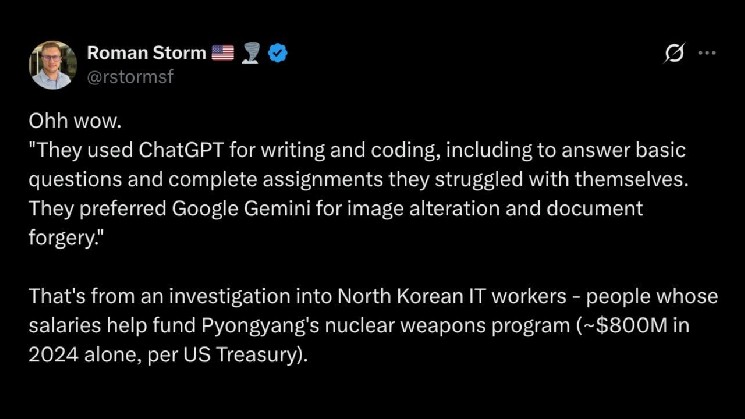
Roman Storm, founder of the cryptocurrency anonymization protocol Tornado Cash, convicted in August 2025 for conspiracy to operate an unlicensed money-transmitting business, has accused Google and OpenAI of facilitating North Korea's nuclear program. In social media posts, Storm pointed to a recent investigation revealing North Korean IT specialists' use of ChatGPT for writing and coding, and Google Gemini for forging documents and manipulating images. He argued that, under the same legal logic the U.S. Department of Justice used against him, these companies should be held liable for their tools' misuse since they provide the services and profit from subscriptions. Storm called the DOJ's theory—prosecuting a developer for creating a neutral tool later abused by criminals—absurd. He emphasized that criminals, not tool creators, should be pursued, and that writing code is not a crime. The Tornado Cash verdict sets a negative U.S. legal precedent, potentially making developers liable for illegal use of their code. Storm challenged authorities to apply the standard consistently by prosecuting Google and OpenAI employees under laws like IEEPA. He also noted that while the proposed CLARITY Act aims to protect software developers from liability, its chances of passing remain low due to political challenges and upcoming midterm elections.

cryptonews.ruHace 1 hora(s)

Roman Storm Accuses Google and OpenAI in Connection with U.S. Department of Justice Ruling on Cryptocurrency Case

cryptonews.ruHace 1 hora(s)

Trading

Spot
活动图片