Solana Foundation Exec Slams XRP Hype: ‘Show Me the Data’

bitcoinistPublicado a 2025-11-03Actualizado a 2025-11-03

Resumen

Solana Foundation executive Vibhu Norby ignited a fresh round of cross-ecosystem debate this weekend, challenging XRP supporters to ground their...

Trusted Editorial content, reviewed by leading industry experts and seasoned editors. Ad Disclosure

Solana Foundation executive Vibhu Norby ignited a fresh round of cross-ecosystem debate this weekend, challenging XRP supporters to ground their bullish narratives in verifiable network metrics rather than aspiration. In a series of posts on X, Norby said he “want[s] Ripple and XRP to succeed at an insane degree,” but argued that “the community does not argue with facts, even though the data is readily available.” He added: “as a longtime engineer and truth seeker, that bothers me.”

Norby Says XRP Growth Stalled

The core claim is that—measured by on-chain activity—the XRP Ledger’s growth has been “extremely mediocre” relative to faster-growing chains, most notably Solana. Citing XRPScan, he said the “active daily accounts shows no 3-year improvement, hovering around 25,000 daily active accounts,” while “this year, Solana is averaging over 2.5 million daily active accounts. That’s 100x.” Short of debating sentiment or distant roadmaps, he framed the discussion as empirical: “The fiction is very far ahead of the facts.”
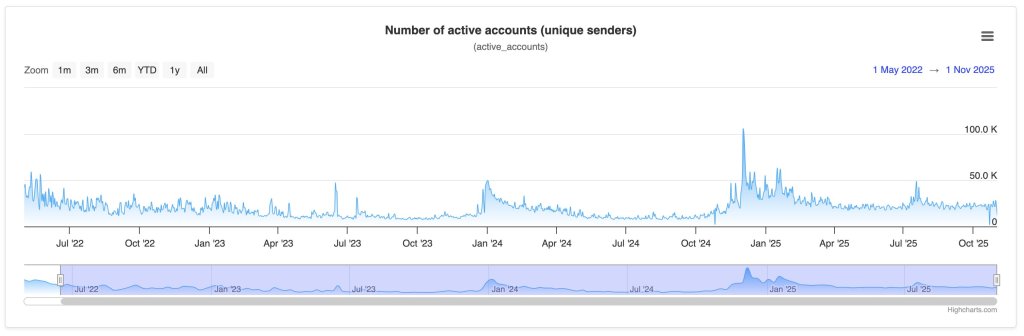
Number of active XRP Ledger accounts
Number of active accounts | Source: X @vibhu

The activity gap was a through-line in Norby’s posts. On throughput, he pointed to XRP’s roughly 1–1.5 million daily transactions and contrasted that with Solana’s order-of-magnitude higher traffic: “the total daily transactions, around 1.5 million per day, is outclassed by Solana which is handling about 100 million per day.”
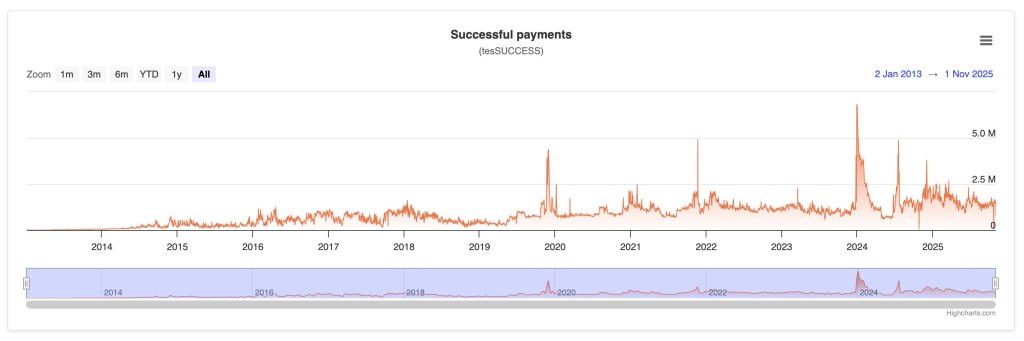
XRP successful payments
Successful payments | Source: X @vibhu

While exact daily figures vary with market conditions and data providers, independent dashboards corroborate the broad picture: XRP’s transactions typically sit in the low-single-digit millions per day, while Solana’s effective user-facing throughput has been documented near the ~1,000 TPS range with peaks far higher under stress; counting all transaction types, Solana’s raw transaction count regularly dwarfs legacy chains. “Currently, XRPL is handling about 17 TPS, according to XRPScan. Solana executes 1000 non-vote TPS on mainnet, and often more,” Norby said.

Norby also trained attention on value transfer rather than just message count. “XRP’s transfer volume today is about $50–60 billion per month. However, Solana’s October stablecoin transfer volume alone, which is a small subset of all network assets, was almost $2 trillion,” he wrote.

Anticipating the most common rejoinder—“oh it’s all fake, bots, etc.”—Norby argued that the Solana-side data excludes wash behavior in the stablecoin tallies he referenced and that fee structures are not a sufficient explanation for alleged bot asymmetry. “Given both XRPL and Solana have similarly low transaction fees, there’s no reason why Solana would uniquely attract bots that XRPL wouldn’t,” he wrote, adding that the on-chain payments edge in Solana remains “a huge measurable margin” even after obvious noise filters.

The exchange quickly broadened beyond raw counters to product-market fit. One defender asserted that “XRP isn’t for retail and memecoins. Financial institutions are heavily regulated and slow to adopt.” Norby rebutted that premise bluntly: “They haven’t been slow to adopt – lol. They’re just adopting stablecoins, not XRP.”

In a separate reply to a question about what’s driving Solana’s relative outperformance, Norby’s answer was a one-word thesis: “Technology.” He later summarized the posture of the XRP army he believes the data supports with a pointed quip: “Solana is a bridge currency.”

Norby also dismissed the idea that RippleNet’s progress should be conflated with on-chain traction: “One cannot have a view on RippleNet because it appears to be simply a private business. Therefore it’s hard to argue it has any bearing on XRP.”

That distinction echoes long-standing commentary that RippleNet, as an enterprise messaging and settlement network, can operate independently of XRP unless specific corridors use On-Demand Liquidity mechanisms. “Offchain connections are entirely commoditized,” Norby added, casting political or banking relationships as insufficient substitutes for measurable on-chain usage.

As the thread grew, community pushback coalesced around two counterclaims: that XRP’s design goal is institutional settlement rather than retail-heavy app ecosystems, and that a “HODL-heavy” holder base naturally depresses daily active address counts. Norby responded that Solana, too, is held by large numbers of passive investors—“Believe it or not, many people also just buy SOL and hold”—but “the difference is that people also actually use Solana.”

He concluded with a challenge: “Open offer to any community member or Ripple executive: let’s do a livestream debate right here on X. You bring facts, I bring facts. Facts are important. Let the internet decide who wins.” He also hosted a public X Space to continue the discussion.

None of the above makes Ripple’s endgame impossible. Norby repeatedly allows that “it is very possible that XRPL wins,” framing his argument as a present-tense snapshot rather than a terminal verdict. But his counsel to investors is unsparing: “If you hold XRP as an investment, you need to seriously consider how much longer it’s worth waiting around.”

At press time, XRP traded at $2.40.
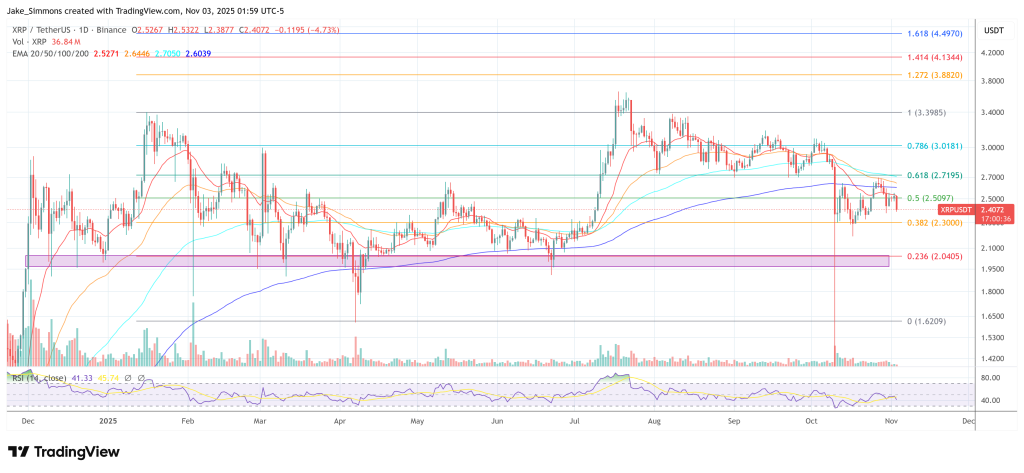
XRP price
XRP falls below the 0.5 Fib, 1-day chart | Source: XRPUSDT on TradingView.com
Featured image created with DALL.E, chart from TradingView.com
Editorial Process for bitcoinist is centered on delivering thoroughly researched, accurate, and unbiased content. We uphold strict sourcing standards, and each page undergoes diligent review by our team of top technology experts and seasoned editors. This process ensures the integrity, relevance, and value of our content for our readers.

Jake Simmons has been a Bitcoin enthusiast since 2016. Ever since he heard about Bitcoin, he has been studying the topic every day and trying to share his knowledge with others. His goal is to contribute to Bitcoin's financial revolution, which will replace the fiat money system. Besides BTC and crypto, Jake studied Business Informatics at a university. After graduation in 2017, he has been working in the blockchain and crypto sector. You can follow Jake on Twitter at @realJakeSimmons.

Criptos en tendencia

Lecturas Relacionadas

Will This Trigger Panic in the $1.8 Trillion Bitcoin Market? A Prominent CEO Voices Opinion, Urges Preparation!

Amid Bitcoin's recent sideways trend, rising global bond yields are capturing crypto investors' attention. Sean Farrell, Fundstrat's Head of Digital Asset Strategy, notes Bitcoin's current volatility is historically low, suggesting sharper price swings could occur in the coming months. Historically, after similar low-volatility periods, Bitcoin's price has experienced median absolute moves of around 30% over 60-day periods. A key market concern is the rapid surge in global bond yields, with US Treasury yields reaching multi-decade highs. Farrell attributes this to factors like the growing US budget deficit, high AI infrastructure investment, elevated oil prices, and monetary policy uncertainty. This bond market turbulence has sparked discussions about a potential "panic" scenario affecting roughly $1.8 trillion in the global financial system, which could trigger significant volatility in high-risk assets like Bitcoin. Analysts note the focus is shifting beyond just Fed rate cuts to factors like long-term yields, energy prices, inflation risks, and the global risk premium for pricing assets like Bitcoin. While no true panic is currently observed, markets are watching bond investors closely. Koinly CEO Robin Singh warns not to ignore the possibility of another sharp Bitcoin drop in coming months, suggesting it could fall to around $50,000 in a negative scenario. He indicates that if historical cycles repeat, investors may need to endure a final wave of panic selling before Bitcoin potentially bottoms in the current cycle.

cryptonews.ruHace 22 min(s)

Will This Trigger Panic in the $1.8 Trillion Bitcoin Market? A Prominent CEO Voices Opinion, Urges Preparation!

cryptonews.ruHace 22 min(s)

Trading

Spot

Artículos destacados

Qué es XRP 2.0

XRP 2.0: Una Nueva Frontera en el Panorama de las Criptomonedas Introducción a XRP 2.0 En el siempre cambiante ámbito de las criptomonedas, nuevos proyectos surgen continuamente, compitiendo por atención y adopción. Una de estas iniciativas prometedoras es XRP 2.0, un nuevo proyecto de criptomoneda diseñado para aprovechar la tecnología blockchain avanzada y metodologías de encriptación robustas. Aunque el nombre establece paralelismos con el XRP de Ripple, es crucial señalar que XRP 2.0 opera de manera independiente, enfocándose en mejorar la seguridad de las transacciones, la privacidad y la escalabilidad. A medida que el panorama financiero digital abraza cada vez más soluciones descentralizadas, XRP 2.0 busca contribuir de manera significativa a web3 y a la expansión general de los proyectos de criptomonedas. ¿Qué es XRP 2.0? En esencia, XRP 2.0 es un proyecto de criptomoneda que busca crear un ecosistema de moneda digital seguro y descentralizado. Su tecnología fundamental integra principios avanzados de blockchain con técnicas de encriptación de vanguardia. El objetivo principal de XRP 2.0 es establecerse como una plataforma confiable y eficiente que permita la ejecución rápida de transacciones mientras prioriza la protección de la privacidad de sus usuarios. El proyecto se promociona como una solución a muchas limitaciones enfrentadas por las criptomonedas existentes, proponiendo un sistema que puede manejar un mayor volumen de transacciones con mejor velocidad y privacidad. Esta versatilidad posiciona a XRP 2.0 como un competidor significativo en un mercado plagado de diversas monedas digitales. ¿Quién es el Creador de XRP 2.0? La identidad del creador detrás de XRP 2.0 ha sido señalada como 'Wilbur.' Sin embargo, los detalles completos sobre Wilbur o su entidad asociada siguen siendo elusivos. La anonimidad de muchos creadores de criptomonedas no es un fenómeno poco común en la industria, a menudo diseñado para mantener un grado de privacidad y seguridad. ¿Quiénes son los Inversores de XRP 2.0? Hasta ahora, la información específica relacionada con las fundaciones o organizaciones de inversión que apoyan a XRP 2.0 no está disponible públicamente. En el sector de las criptomonedas, el respaldo de inversores respetables puede influir significativamente en la credibilidad y el éxito de un proyecto, sin embargo, la transparencia sobre los patrocinadores financieros de XRP 2.0 no se ha establecido. ¿Cómo Funciona XRP 2.0? XRP 2.0 se destaca al emplear una combinación de tecnología blockchain y algoritmos de encriptación avanzados que aseguran transacciones seguras y descentralizadas. Su estructura innovadora incluye características únicas diseñadas para fomentar el compromiso del usuario y ampliar las funcionalidades más allá de las transacciones convencionales de criptomonedas. Entre estas características, XRP 2.0 incorpora capacidades impulsadas por IA, como funcionalidades de texto a imagen y de texto a voz. Estas adiciones están diseñadas para mejorar la experiencia interactiva de los usuarios, promoviendo una mayor aplicabilidad en diversos sectores. Al unir avances tecnológicos con un diseño centrado en el usuario, XRP 2.0 busca captar la atención de una amplia gama de individuos y empresas que buscan integrar soluciones de criptomonedas en sus marcos operativos. Cronología de XRP 2.0 Entender XRP 2.0 requiere examinar los hitos que han definido su viaje hasta ahora: 23 de julio de 2023: Se presenta XRP 2.0 como un nuevo proyecto de criptomonedas, con el objetivo de revolucionar las capacidades de transacciones seguras y descentralizadas en el ámbito de blockchain. 8 de septiembre de 2023: Se lanza otro proyecto, XRP20, marcando la aparición de un token ERC-20 en la blockchain de Ethereum que no guarda relación con XRP 2.0. 13 de noviembre de 2023: El Libro Mayor de XRP experimenta una actualización significativa con el lanzamiento de la versión 2.0.0 del software del servidor rippled. Es esencial señalar que este desarrollo está desconectado del proyecto de criptomonedas XRP 2.0. Puntos Clave sobre XRP 2.0 Para destilar la esencia de XRP 2.0, surgen varios factores críticos: Características Únicas: La inclusión de características como texto a imagen y texto a voz impulsadas por IA diversifica aún más las aplicaciones potenciales de XRP 2.0. Tecnología Blockchain: El marco utiliza mecanismos avanzados de blockchain y protocolos de encriptación, asegurando un entorno seguro y descentralizado para las transacciones. Escalabilidad y Privacidad: XRP 2.0 prioriza la protección mejorada de la privacidad en los procesos de transacción y la escalabilidad necesaria para acomodar una base de usuarios creciente. No Afiliación con Ripple: Es importante destacar que, a pesar de su nombre, XRP 2.0 no tiene ninguna lealtad ni colaboración con el XRP de Ripple, diferenciando su marco operativo y objetivos dentro del ecosistema de criptomonedas. Conclusión XRP 2.0 representa una ambiciosa aventura en la esfera de las criptomonedas, buscando ofrecer una combinación de seguridad, privacidad y eficiencia en las transacciones digitales. Al integrar tecnologías sofisticadas y características amigables para el usuario, el proyecto se propone ampliar los horizontes de lo que la criptomoneda puede lograr en la economía digital de hoy. Si bien la anonimidad de su creador y la falta de inversores revelados pueden generar cuestionamientos para algunos, el enfoque de XRP 2.0 en funcionalidades avanzadas y descentralización realza su atractivo en un mercado de criptomonedas cada vez más abarrotado. A medida que el paisaje de las criptomonedas sigue evolucionando, XRP 2.0 podría emerger como un jugador crucial en la expansión de soluciones blockchain seguras y escalables.

322 Vistas totalesPublicado en 2024.04.05Actualizado en 2024.12.03

Qué es XRP 2.0

Cómo comprar XRP

¡Bienvenido a HTX.com! Hemos hecho que comprar XRP (XRP) sea simple y conveniente. Sigue nuestra guía paso a paso para iniciar tu viaje de criptos.Paso 1: crea tu cuenta HTXUtiliza tu correo electrónico o número de teléfono para registrarte y obtener una cuenta gratuita en HTX. Experimenta un proceso de registro sin complicaciones y desbloquea todas las funciones.Obtener mi cuentaPaso 2: ve a Comprar cripto y elige tu método de pagoTarjeta de crédito/débito: usa tu Visa o Mastercard para comprar XRP (XRP) al instante.Saldo: utiliza fondos del saldo de tu cuenta HTX para tradear sin problemas.Terceros: hemos agregado métodos de pago populares como Google Pay y Apple Pay para mejorar la comodidad.P2P: tradear directamente con otros usuarios en HTX.Over-the-Counter (OTC): ofrecemos servicios personalizados y tipos de cambio competitivos para los traders.Paso 3: guarda tu XRP (XRP)Después de comprar tu XRP (XRP), guárdalo en tu cuenta HTX. Alternativamente, puedes enviarlo a otro lugar mediante transferencia blockchain o utilizarlo para tradear otras criptomonedas.Paso 4: tradear XRP (XRP)Tradear fácilmente con XRP (XRP) en HTX's mercado spot. Simplemente accede a tu cuenta, selecciona tu par de trading, ejecuta tus trades y monitorea en tiempo real. Ofrecemos una experiencia fácil de usar tanto para principiantes como para traders experimentados.

1.7k Vistas totalesPublicado en 2024.12.10Actualizado en 2026.06.02

Cómo comprar XRP

Discusiones

Bienvenido a la comunidad de HTX. Aquí puedes mantenerte informado sobre los últimos desarrollos de la plataforma y acceder a análisis profesionales del mercado. A continuación se presentan las opiniones de los usuarios sobre el precio de XRP (XRP).

活动图片