Бразильский производитель солнечной энергии Thopen рассматривает возможность майнинга биткоинов

cryptonews.ruPublicado a 2025-01-29Actualizado a 2025-10-30

«Бразильский производитель солнечной энергии Thopen изучает возможность майнинга биткоинов для поглощения излишков энергии, которые вырабатываются быстрорастущим сектором возобновляемой энергии в стране», - сообщил генеральный директор компании местному изданию BN Americas.

Густаво Рибейро, генеральный директор Thopen и ее мажоритарного владельца Pontal Energy, сообщил BN Americas, что компания рассматривает возможность расширения майнинга биткоинов. На вопрос о том, как Thopen планирует решить проблему переизбытка энергии в Бразилии, Рибейро ответил, что компания смягчает эту проблему за счет диверсификации.

Он добавил, что компания также «рассматривает такие решения, как центры обработки данных и майнинг биткоинов вблизи от источников потребления для поглощения локально вырабатываемой энергии».

Эти заявления последовали за сообщением Reuters о том, что несколько компаний, занимающихся майнингом криптовалют, ведут переговоры с бразильскими поставщиками электроэнергии для использования избытка возобновляемой энергии в стране.
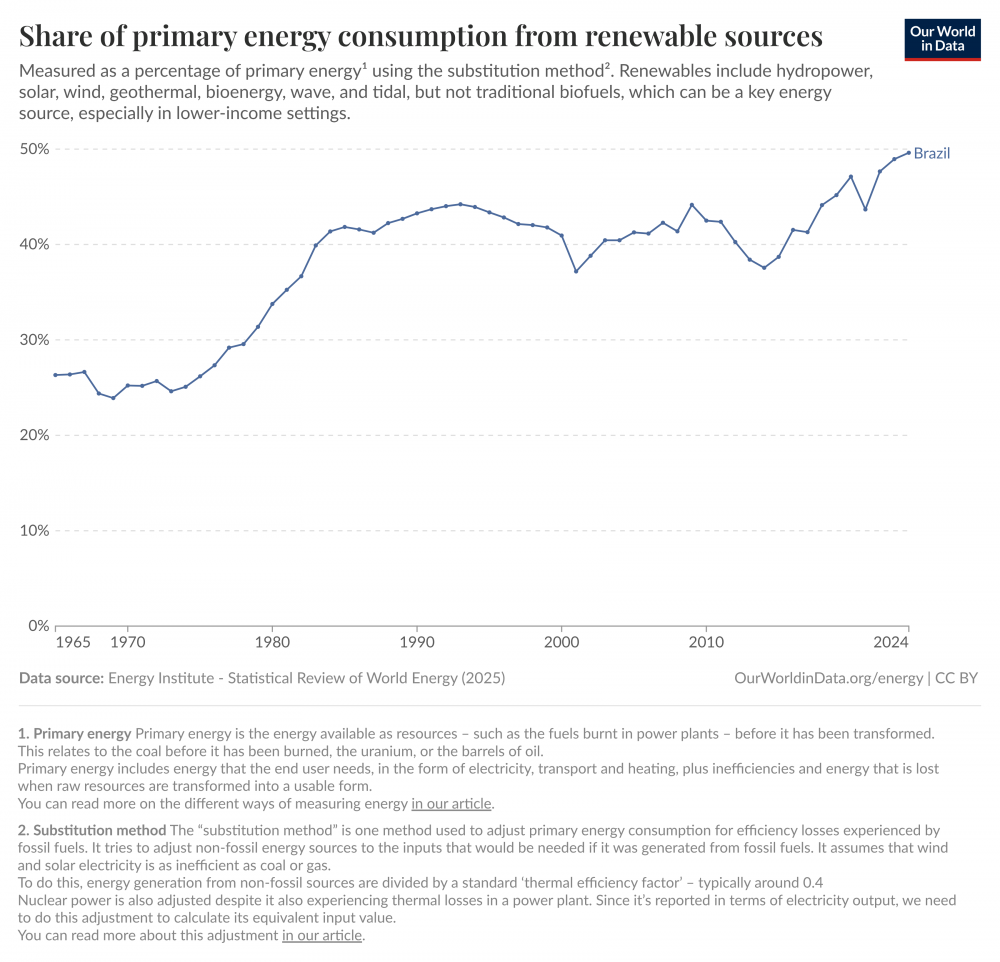
Диаграмма доли возобновляемой энергии в Бразилии. Источник: OurWorldInData.

Переизбыток электроэнергии в Бразилии

В настоящее время Бразилия сталкивается с переизбытком электроэнергии, вырабатываемой быстрорастущей отраслью возобновляемой энергетики. В августовском сообщении агентства Reuters говорилось, что правительство страны планирует провести в 2026 году два раунда тендеров на строительство гидроэлектростанций и тепловых электростанций, которые работают на ископаемом топливе, чтобы обеспечить надежное энергоснабжение и снизить зависимость от непостоянных источников энергии, таких как ветер и солнце.

Производители солнечной энергии в Бразилии сталкиваются с сокращением поставок, что ограничивает объемы энергии, которые они могут поставлять в энергосистему. По словам Рибейро, сокращение поставок - это «проблема для сектора», который рассматривает преобразование энергии в капитал посредством майнинга биткоинов как потенциальное решение.

Энергетические компании начинают заниматься майнингом

Бразилия - не единственная страна, где компании, работающие в энергетической отрасли, рассматривают майнинг криптовалют как прибыльную перспективу. Union Jack Oil, публичная британская энергетическая компания, летом объявила о планах перерабатывать природный газ со своего месторождения в Уэст-Ньютоне в электроэнергию для майнинга биткоинов в рамках проекта монетизации.

В июне канадская сельскохозяйственная компания AgriFORCE Growing Systems запустила аналогичную инициативу. Компания объявила, что будет использовать газ из неликвидов для питания 120 майнинговых установок и планирует дальнейшее расширение майнинга.

Lecturas Relacionadas

You Use Claude and Codex Every Day, but Meta Has Restricted Internal Use

In May, Meta imposed internal restrictions on its engineers regarding the use of Claude Code and Codex, two widely used AI programming tools. Despite being a major client, Meta's guidelines, still in effect, prohibit these external models from being used for specific tasks to prevent potential "escalations with partners." The core concern is "distillation"—the risk that outputs from Claude or Codex could inadvertently contaminate the training data and evaluation processes for Meta's in-house AI coding assistant, MetaCode. If MetaCode is trained or evaluated using data generated by these external models, it risks learning their capabilities rather than developing its own, blurring the line of intellectual origin. The restrictions are precise: engineers cannot use the external models to generate test questions, debug source code, or suggest test cases. AI-generated content is also barred from environments accessible to MetaCode. However, AI can still assist with peripheral tasks like workflow setup and code organization, provided all outputs are manually reviewed. This caution reflects a broader industry dilemma. While distillation is a common technique, using a competitor's model output for training raises legal and ethical questions about the ownership of derived capabilities. Contractual terms from companies like OpenAI and Anthropic explicitly forbid using their outputs to build competing products, putting enforcement power in the hands of rivals. The move is also financially motivated, as Meta seeks to reduce its hefty internal AI spending, estimated in the billions this year. Meta's policy illustrates the delicate balance companies must strike: leveraging powerful external AI tools while safeguarding the integrity and independence of their own AI development. As AI systems increasingly help build other AIs, distinguishing the origin of capabilities becomes a fundamental challenge for the entire industry.

marsbitHace 2 hora(s)

You Use Claude and Codex Every Day, but Meta Has Restricted Internal Use

marsbitHace 2 hora(s)

Why Do We Need an AI Content Perspective Today?

The article "Why Do We Need an AI Content Perspective Today?" explores the complex and often contentious integration of AI into the cultural and creative industries, particularly film and television. It begins with the cancellation of Amazon's AI-generated animation "Punky Duck," highlighting the ethical debates surrounding AI content. AI's rapid advancement is transforming video production, enabling cost-effective, full-length AI films (e.g., "RAPHAEL," "Dreams of Violets") while sparking industry resistance over issues like "synthetic actors." The core debate has shifted from whether to use AI to how to use it responsibly. The article analyzes why AI's entry into film is uniquely unsettling. It distinguishes between "cultural fast food" (short-form, fast-paced content like micro-dramas) and "cultural main courses" (traditional, long-form film/TV). AI currently excels at the former, matching its fragmented narratives, shallow emotional needs, and free-to-consumer models. However, venturing into the latter challenges the human-centric essence of storytelling—creativity, emotional depth, and the unique value of human labor and experience. While AI can generate massive volumes of content and lower costs, it risks devaluing human creativity, leading to homogenized output, and creating unfair competition through potential intellectual property infringement. Its efficiency also amplifies content safety risks, making preemptive governance crucial. To counter these risks, the article proposes establishing clear boundaries guided by a human-centered AI content perspective. It outlines four principles: 1) Amplify, rather than displace, human creative space; 2) Respect and protect human creative output; 3) Ensure human creative control and responsibility remain paramount; and 4) Guarantee transparency and traceability in AI creation. The conclusion emphasizes that humans must act as the "helmsmen" of technology, steering AI development to enhance, not replace, the core human values at the heart of cultural expression.

marsbitHace 2 hora(s)

Why Do We Need an AI Content Perspective Today?

marsbitHace 2 hora(s)

Trading

Spot
活动图片