Recently, the AI animation "Punky Duck," developed by Amazon, faced intense ethical controversy and online backlash, ultimately leading director Jorge Gutierrez to announce the halt of its production. This project, once considered a "creative breakthrough" by Amazon MGM Studios, ended as a microcosm of the current awkward predicament of AI content.
For the development of the film and television industry, 2026 is a significant milestone: AI has progressed from generating stunning video clips to directly producing complete visual stories; from enhancing efficiency in specific production stages to catalyzing entirely new short-drama production pipelines; from sporadically replacing live-action performances to driving a concentrated explosion of synthetic human content. All these rapid changes have triggered an unprecedented "internal conflict" within the global film and television industry:
On the one hand, the penetration of AI into film and television production seems unstoppable, with theatrical-level AI feature films accelerating their launch. During the recently concluded 79th Cannes Film Festival, the Korean AI film "RAPHAEL" showcased excerpts at the Cannes Marché du Film. This sci-fi feature, planned for theatrical release in 2026, was created by a team of just seven people using Kling AI 1. Another 75-minute AI film, "Dreams of Violets," completed in just three months with a cost of $2,000, has become the world's first entirely AI-generated feature film to be selected for a mainstream film festival 2. Meanwhile, China's first theatrical AI-native film, "Sanxingdui: Future Past," has officially received the "Dragon Seal" from the National Film Administration 3, marking the beginning of a new era of compliant AI application in Chinese cinema.
On the other hand, criticism and controversy surrounding AI film and television are far from over. "Replacing live-action performance" is seen as AI's final assault on the film and television domain, becoming the most contentious topic. In May, the U.S. Screen Actors Guild (SAG-AFTRA) reached a new four-year interim agreement with major Hollywood studios, requiring restrictions on the use of AI-generated "synthetic performers" unless it can be demonstrated that they provide "significant additional value" 4. Domestically, the topic of "AI actor databases" stirred up significant discussion, sparking widespread concern about the compliance of digital image licensing, the quality of AI performances, and the future shape of the film and television industry 5.
AI seems to be "dancing in shackles" within the film and television industry. Amid these conflicting voices, the focus has become clear: as technology irreversibly drives industry transformation, the core question about AI has shifted from "should it be used" to "how should it be used."
It is time to discuss the boundaries of AI in the cultural content domain. And this, perhaps, is the true starting point for confronting this AI impact.
Why Does AI's Entry into Film and Television Cause Particular Unease?
Unlike many industries, after AI entered the cultural content field, cheers for cost reduction and efficiency gains did not last long, quickly turning into skepticism, concern, and division—a rather paradoxical phenomenon.
Compared to directly impacted practitioners, the general public exhibits more complex consumption psychology: on one hand, they indulge in AI pet videos and "fruit short dramas" on short-video platforms; on the other, they resist AI feature films and AI performers on social media. In 2025, China's AI comic-drama market size reached 18.98 billion yuan 6, to some extent satisfying viewers' demand for fantasy, xuanhuan, and imaginative content. Overseas, "AI fruit short dramas" with dramatic and absurd plots swept across social platforms, with related accounts gaining over 3.1 million followers within nine days of launch. This trend quickly spread to China, where related videos garnered over 100 million views on social platforms.
This is sufficient proof that AI-generated video content has already gained a broad market foundation. However, when AI appears in traditional film and television production, it often triggers skepticism, with some AI creators even being attacked as "traitors to art who have sold out."
A core issue behind this lies in the different mental structures and psychological needs people have in different media contexts, leading to varying degrees of compatibility between AI and different types of media content.
We Naturally Need Different Levels of Spiritual Sustenance
From the perspective of social psychological structure, people have two different modes of thinking. Cognitive psychologist Daniel Kahneman pointed out that the human brain inherently has a "dual-system": System 1 operates automatically and quickly, requiring no concentrated attention, relying more on intuition and rapid judgment. System 2 requires focused attention and involves more deliberate thinking and meaning processing. During cultural consumption, these two systems correspond to different degrees of cognitive engagement, further forming differentiated consumption demands: the former typically corresponds to entertainment activities seeking superficial pleasure, while the latter corresponds more to spiritual-cultural activities seeking deep thinking and meaning construction.
In the development of modern media, different media have begun to assume different functions and satisfy different needs: for example, serious reading and film/television have become relatively deep content carriers, to some extent serving as channels for societal "meaning provision," playing roles in inspiring thought, evoking emotion, and shaping consensus. Consumption modes like short videos, short dramas, and mobile games, meanwhile, align with the reality of modern people having大量 fragmented time, serving functions of instant entertainment and fragmented leisure. The physical attributes of media have adapted to this functional division and, in turn, further shape people's different attentional states.
We might tentatively use the terms "cultural main course" and "cultural fast food" to distinguish the functions and characteristics of the two types of content. Although this distinction is not entirely rigorous—for example, feature films can also provide cultural fast food, and short videos can also carry cultural main courses—overall, different media forms tend to shape differentiated content characteristics to adapt to different consumption psychologies.
For video content products, perhaps this distinction can be understood from the media form: the larger the screen, the farther the picture, and the longer the duration the audience faces, the closer the consumed content is to a "cultural main course," and the more people need to enter a relatively engaged state; conversely, the smaller the screen, the closer the picture, and the shorter the duration, the more the content tends to be "cultural fast food," and the easier it is for people to enter a state of relatively shallow thinking and low participation.
AI is Better Suited to the Production Logic of "Cultural Fast Food"
AI's current content production capabilities are highly compatible with "cultural fast food."
Compatible with Fragmented, Fast-Paced Narratives. The media characteristics of short videos and micro-short dramas provide AI with scenarios that "play to its strengths and avoid its weaknesses." Firstly, this type of content features "modular creation," meaning fast narrative pace, short plot segments, and highly templatized character settings and scenes. This creation mode is naturally suitable for AI learning and imitation because what it requires is not complex plots and detailed character development, but the rapid recombination of mature patterns. Simultaneously, on small screens with fast-paced narratives, viewers rarely focus on a particular shot or performance detail for long periods. Minor flaws in AI-generated content or unnaturalness in synthetic performances often do not become decisive defects. The "unrealistic feel" created by AI sometimes does not disrupt the viewing experience; instead, it may even form a unique, absurd aesthetic in visual style.
Satisfies Shallow Emotional Consumption Needs. AI's advantages in creating visual spectacles and exaggerated performances are highly compatible with the consumption attributes of content like short videos and micro-short dramas. This type of content is essentially emotional consumer goods. User consumption follows a "fast food" logic: most of the time, users quickly scroll, seeking short-term emotional feedback rather than long-term emotional immersion. AI can provide this content with more novel settings and more "explosive" visual effects, further enhancing the sense of gratification and satisfying consumers' shallow emotional needs.
Aligns with Free Business Models. Most short-video and micro-short drama platforms operate on a free model. Their commercial strategy is to maximize user dwell time and complete commercial conversion through advertising and traffic distribution. Therefore,海量 supply and continuously updated information feeds are the foundation for platform revenue. Whether content can be produced quickly is more important than whether it possesses a complete and complex core expression. AI's high production efficiency provides platforms with massive content supply, and the platforms' commercial demands further drive the rapid development of AI content.
AI's Entry into Film and Television Means a Deeper Challenge to "Humanity"
Although AI has found compatible video content scenarios in terms of media form, consumption needs, and business models, this does not mean it possesses the ability to penetrate the core of film and television creation. This is not only because the film and television industry, through its long history, has provided audiences with higher artistic expectations and quality promises, but more importantly, the film and television industry demands a higher degree of "human" participation.
From the supply side, AI is impacting a more mature, rich, and firmly established industry chain and may put pressure on numerous production stages and positions, causing a transformation pain far greater than that in emerging video formats. Simultaneously, AI condenses the human creator's process "from learning to production," absorbing the achievements of outstanding directors, screenwriters, and actors from human history at an efficiency unattainable by humans, and outputting various stories and styles on demand through assembly and recombination.
On the consumption side, AI directly generating film and television works means AI will no longer be limited to providing audiences with shallow sensory stimulation but will attempt to supply humanity's "cultural main course": in terms of emotional expression, AI will no longer be confined to outputting fragmented stories and exaggerated performances but will begin attempting to portray "reality," express "emotion," and evoke "empathy," striving to make audiences believe it is real and become immersed.
Both aspects mean that AI will further challenge human uniqueness—creativity, thought, emotion—attempting to further cross the boundary between humans and AI. This is precisely what truly makes people uneasy about AI works.
In the Content Industry, Human Value is Unique
So, will AI creation really replace the value of human creation?
The unique aspect compared to other industries is that one of the core values of the cultural content industry is "communication between people." The value of content products is inseparable from human experience, emotion, and subjectivity. This particularity makes the discussion of AI creation's value complex.
Firstly, AI will certainly redefine "the value of content," or change the weight of different values, making some human-created content less important and other human-created content more scarce. Therefore, AI-generated content will meet people's expectations and replace human creation in certain genres.
This is because AI reshapes the production resources of the content industry. When the value of a content product highly depends on a standardized, replicable creative resource, it is more prone to devaluation and replacement.
A typical case is the significant reduction in the technical barrier for visual effects in film and television works, impacting genres highly reliant on audiovisual technology. Within the modern film and television industry system, the value of works largely stems from technical dimensions such as image quality, visual style, and special effects. The history of film industry development is itself a history of technological advancement. Since 2025, AI can quickly imitate lens styles and batch-generate visual spectacles. It has broken the scarcity of imaging technology and continuously raised the threshold for visual stimulation, making pure audiovisual spectacles increasingly less likely to move audiences. In the future, film and television works that rely on imaging technology as their "selling point" have a high probability of being entirely covered by automated AI creation.
Secondly, AI cannot completely replace the value of human creation. In cultural content creation, humans have at least three dimensions of value that are difficult to replace: innovative capability, labor input, and emotional interaction.
Human Innovative Capability
It is undeniable that AI, by lowering the production barrier, has greatly unleashed public creativity, nurturing infinite possibilities in narrative and aesthetics. But in reality, has AI truly enhanced the innovative capacity of the content industry?
Looking at real data: after achieving large-scale application in video, web literature, music, and other fields, AI has brought forth a few truly innovative works, catalyzing a small number of leading works in aesthetic style, content题材, narrative paradigms, etc. However, what it has simultaneously brought is massive homogenization and templatized creation. In Q1 2026, approximately 128,000 micro-short dramas were launched industry-wide, of which about 122,000 were AI micro-short dramas, accounting for over 95% 7. Yet, the题材 were highly concentrated in homogenized types like fantasy, xuanhuan, and rebirth. The most notable narrative innovations in short dramas in the first half of the year still came from human creation, such as "ENEMY," which combines "infinite flow" with traditional Chinese opera and national sentiment.
The reason is simple: AI can only reorganize within the known范畴 of work data; it cannot generate anything "new" outside its training set. Overall, AI can raise the "average quality" of content works by imitating outstanding human works, but it struggles to create groundbreaking, leading, or pioneering works.
The Fruits of Human Labor
The labor input of creators is itself an important source of the preciousness and scarcity of cultural works. The long-term polishing and deep investment in the creative process not only guarantee the work's quality but also embed value as a symbol within the work, allowing the audience to perceive "being taken seriously."
Taking TV series as an example, creators' slow production and consumers' slow appreciation constitute a value co-creation based on time investment. The TV series "Blossoms Shanghai" took 6 years of preparation and 3 years of filming; "The Leading Role" was polished over 8 years; the nearly 25-minute classic scene "Guzheng Operation" in "The Three-Body Problem" took 4 months of preparation and 27 days of filming. When people spend weeks watching a series, they are also experiencing how the creators gradually build characters and meaning. This mutual time investment between creators and consumers constitutes part of the work's unique value.
AI drastically reduces the human labor behind a work, also diminishing the sense of value brought by this "life investment." In the past, content creation relied on human creativity, time, and effort. Now, AI creation consumes computing power, electricity, and model invocation costs. Within the cost-accounting logic of technology, it will be harder for audiences to perceive the preciousness and even non-renewability brought by "life investment."
Human Life Experience and Emotional Interaction
Classic cultural works are difficult to replicate not only because of superior creative techniques but often because they condense the creator's unique life experience and personal expression. On one hand, the authentic experiences and genuine emotions conveyed by creators in content products allow audiences to establish a spiritual connection with the soul on the other end, constituting an important meaning of cultural content. On the other hand, the creator's unique choices and personality are also an inseparable part of the work. An actor's improvised performance due to emotional shifts, a painter depicting their unique dreams—these often create专属 meaning for the audience. The value of cultural works largely stems from such processes that cannot be entirely predetermined and standardized.
AI creation brings an optimal-solution logic. The text, melody, and images generated by prompts are often accurate but also conventional. Yet, culture and art always contain elements beyond instrumental rationality. With technological advancement, AI may one day generate paintings at a master's level,细腻的人物表演, and歌声 full of emotion, but it cannot mobilize its own unique "understanding" and "experience," let alone achieve personalized expression. At the industrial production level, this means efficiency gains and risk reduction; but at the artistic level, it may also allow creation to gradually slide toward boring patterns. When those originally uncertain judgments, choices, and mistakes are eliminated, those unique colors of humanity will also be erased, which may反而 make people cherish those imperfect yet authentic human expressions more.
AI Content Development Faces the Risk of "Overstepping"
Although AI creation struggles to replace all the value of human creation, it has achieved explosive growth with significant advantages in cost, production capacity, and efficiency, expanding at a pace far exceeding human-created content. AI has brought tremendous vitality to industry development but also poses challenges to the ecosystem of human creation, potentially甚至 exceeding the boundary of "human-centered" development. This "overstepping" risk is mainly manifested in three levels.
Cost Advantage: May Squeeze Out and Appropriate Human Creation
Technological impacts like the printing press, film, television, and the internet, while冲击 traditional content positions, also created大量 new jobs and provided new opportunities for平等竞争. AI is明显 different from previous media transformations. The cost advantage of AI content production is primarily built on two premises: first, the learning and imitation of existing human creative成果; second, the replacement of部分 human labor stages.
For the industry as a whole, the job contraction brought by the AI transformation in the content industry often outweighs the新增 jobs, pushing一部分从业者 towards the industry's periphery. For example, AI can "de-skill" numerous production stages in film/TV and micro-short dramas, thereby compressing positions like storyboard design and初级剪辑, while newly emerged positions like "card drawers" often feature low income, low security, and high replaceability 8. Simultaneously, "fast variables" like technology application and platform rules misalign with "slow variables" like就业再培训 and business转型, leaving many companies and practitioners来不及转型, facing operational difficulties and unemployment crises.
Among different creators, the non-compliant use of AI may allow one group's creative成果 to be appropriated by another group, becoming fodder for their rapid creation and monetization, constituting a new form of unfair competition. The capabilities of AI models come from large-scale learning of existing human works, yet some large models train on materials未经原作者授权, and original authors do not participate in利益分配, forming a "predatory" development at the expense of others' creative成果. From the accusations in February by the Motion Picture Association and Disney against国产大模型 for盗用 "Star Wars," Marvel series, and other intellectual property 9,10, to the joint protest in June by over a thousand top web novel writers against AI "plagiarism," AI infringement乱象 continues to cause震荡 in the content industry 11.
Production Surge: Triggers Challenges of Content Low-Quality
AI has ushered humanity into an era of content abundance, also bringing an unprecedented思考: when content products can be supplied无限, is more always better?
Within a certain范畴, an increase in cultural content supply signifies充分竞争 in the market, the release of niche creativity, and多元选择 for users—a sign of market繁荣. However, when content supply exceeds the承载边界 of public attention, creating a巨大剪刀差 between supply and demand, more content will no longer bring more精品 or福利 but may instead lead to a恶性循环 in the content ecosystem.
Chinese-American legal scholar Tim Wu points out in "The Attention Merchants" that in an era of无限可得 information, attention merchants constantly陷入一场无底线的竞赛 (race to a bottomless bottom) to compete for the scarce resource of attention. This means that under the premise of a basically恒定 and extremely scarce total amount of public attention, content producers, to争夺 attention resources, will continuously move towards more刺激, easier-to-consume, and more迎合 content products;精品 content, unable to receive market回报的激励, will gradually缩小生存空间; consumers' ability to接收深度内容 is反向 trained and weakened, further固化了 this恶性发展趋势.
This "bad money drives out good" mechanism is already显现 in部分 AI content domains. When AI comic-dramas are produced by the tens of thousands per month and AI web literature by hundreds of thousands of words per day, the supply side experiences巨大爆发, while the demand side remains constrained by the total 24-hour attention span of humans. The AI comic-drama industry shows signs of激增 in产量 and下降 in hit rate: in 2025, 60,000 AI comic-dramas were launched annually with a hit rate of only 0.16%; in February 2026, the number surged to over 120,000, with the hit rate further dropping to less than 0.12% 12. The web literature industry faces severe冲击 from AI-padded novels, forcing some platforms to handle over 150,000 low-quality books monthly, primarily involving AI-generated and恶意注水 content, highlighting the严峻挑战 AI content poses to平台自治能力.
Merriam-Webster and The Economist chose "slop" (AI垃圾) as their 2025 Word of the Year,集中体现ing people's普遍疲劳 with the泛滥 of low-quality AI content 13. These trends indicate that提升 in content产能 will not automatically increase福利 for the industry and users; instead, in the absence of guidance, it may strengthen the泛滥 of低质内容,侵占精品生存空间, pushing the industry into a负面循环.
Efficiency Gains: Front-Load and Amplify Security Risks
Whether in the print media, television, or internet era, content review, gatekeeping, and accountability were mainly concentrated in the dissemination stage. The reason traditional content gatekeeping could adopt a post-publication review path essentially relied on two conditions: first, production speed was lower than review speed; second, risks at the production stage could be effectively controlled at the dissemination stage. AI's极致压缩 of the content production process breaks these two prerequisites,大大提升ing the difficulty of building content security防线.
First, content risks have become front-loaded. The risk points for AI content extend to the more隐蔽 model training stage. Once issues like infringement, violence, pornography, or value bias appear in large model training data, they can cause risks the instant无数 users invoke the data to generate content. To control these issues, one must追溯 back to stages like语料来源, cleaning rules, and value alignment; otherwise, it's difficult to achieve精准把关 at the dissemination stage of each product. This means content governance needs to expand from "work compliance" to the compliance of the entire "generation流程 and system."
Second, the difficulty of risk identification and review has also显著增加ed. In the AI era, content快速ly and批量ly generated by users poses前所未有的挑战 to review mechanisms. Simultaneously, AI infringement不断演化出 new forms and手段, and in practice,认定与治理 of AI infringement faces大量困境. AI's reshaping of the content production机制正在挑战 the existing content治理体系,呼唤 a clearer and stricter权利保护机制.
How to Delimit the Boundaries of AI Content Development?
Precisely because human creation possesses irreplaceable value, and because AI differs from every previous technological transformation of the content ecosystem—potentially squeezing out human creative space overall and causing unprecedented content risks—AI has pushed humanity to a stage where boundaries must be重新厘清 and rules established.
At the end of May, the National Copyright Administration and three other departments launched the "Sword Network 2026" special campaign,首次 listing the整治 of the AI field's copyright issues as one of the four key focuses. On June 24, the National Radio and Television Administration公开征求意见 for the "Micro-Short Drama Development Management Measures (Draft for Comment)." On June 25, the NRTA's Network Audiovisual司单独发布ed AI micro-short drama分类分层 standards, lowering the平台自审门槛 for AI micro-short dramas to 300,000 yuan. China's governance of AI content has entered a more系统化,精准化 stage.
Today, we need both AI content and an AI content perspective. This means acknowledging the value of AI in creation, but also需要正视 the risks of AI "overstepping" and划出清晰的边界: in the content era where AI and humans coexist, true progress is not the骤降 of costs, the扩张 of产能, or the突进 of efficiency, but leveraging AI to amplify human creative space, protect human creative成果, enhance the quality of human creation, and safeguard the底线 of human creation.
The content perspective in the AI era should follow four basic principles:
Ensure Human Creative Space is Amplified, Not Squeezed
The low-quality倾向 brought by the产能爆炸 of AI content may become a映射 of the "bad money drives out good" mechanism in the cultural field. Preventing this trend means producers and platforms cannot只看 the "产能数据" of AI content but must also关注 the creative expression rights of humans and the可持续性 of the industrial ecosystem. The resource比例,流量倾斜, and收入分成 between human content and AI content in production and distribution should be纳入定期监测与披露范畴. Simultaneously, encourage真人 and AI混制 film/TV works, utilizing AI for提质增效 while protecting the development space for human creation.
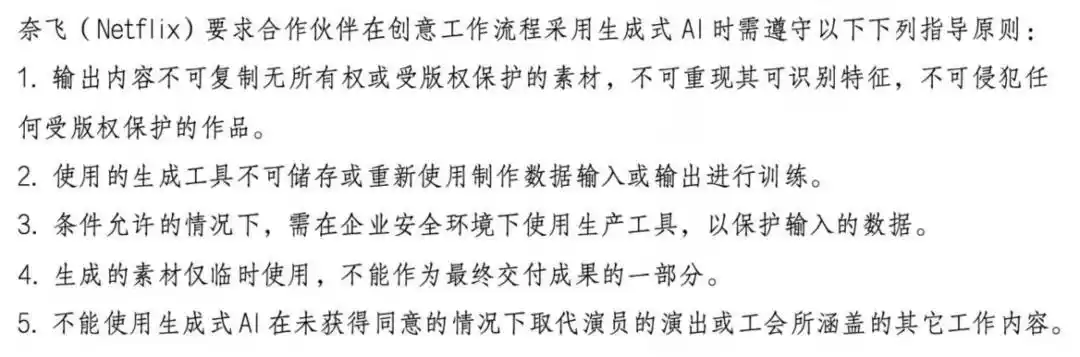
Among the five AI creation principles announced by Netflix, one states, "Generative AI cannot be used to replace the performance of actors or other work covered by the union without consent." The U.S. Screen Actors Guild (SAG-AFTRA) proposed the idea of a "Tilly Tax" 14 on film companies using思路 AI to replace真人 actors, offering a new思路 for balancing AI and human creation from an economic leverage角度.
Ensure Human Creative成果 are Respected, Not Appropriated
When the AI creation process can be simplified to "one person plus one large model tool," this隐性 production process must be纳入治理框架 to守住 the对称关系 between "contributor" and "beneficiary" and维系 the底线 of a healthy market生态. Creators should be required to披露 their production process; model tool providers' training data must obtain合法授权; content generated by creators must承担可溯源义务; and original authors should receive制度化的署名与分成 opportunities.
Industry实践 is exploring these paths. The Academy of Motion Picture Arts and Sciences, which organizes the Oscars, stipulates that评审委员会 can ask production teams to说明 the specific use of AI. Netflix requires that if no agreement is reached, actors' images, photos, voices, and personal information cannot be input into AI tools for data training;创作材料 like scripts cannot be stored by AI tools or used for data training 15.
Ensure Human Dominance and Responsibility in Creation
The particularity of the cultural content industry determines that the "author" is never just a legal身份 but also a支点 of cultural meaning. Human value judgment needs to占据主导性 in the creative process. AI can participate as an辅助工具 in production, but the work's审美取向,价值表达, and创作决策 must still be最终完成 by humans.
Global头部内容机构 have already responded to this principle. Netflix's AI creation规范明确规定: AI-generated content can only be used as临时素材, not as最终成果交付. The implication is that the creative流程 must involve人类实质性参与 and把关. The Cannes Film Festival announced that works完全由AI生成 are禁止参与 the Palme d'Or competition. The Academy of Motion Picture Arts and Sciences also clarified that only human-involved performances and screenwriting are eligible for奥斯卡奖项; for achievements beyond表演 and剧本创作,评委们 will judge a film's achievement based on "the role humans play at the core of the work" during the creative process 16. For performance awards, the Golden Globes allow the use of AI to enhance or辅助表演 with the actor's知情同意; for non-performance awards, they require "human creative guidance, artistic judgment, and creation始终占据主导地位 throughout the production process" 17.
Ensure Openness, Transparency, and Informed Consent in AI Creation
In the AI era, social psychologist Kurt Lewin's "Gatekeeper" theory needs to be延伸. As the risks of AI content have shifted forward from dissemination nodes to generation and even training nodes, AI content must achieve "平台可溯源,监管可追责,用户可识别": the industry needs to shift from结果治理 to全过程治理, establishing多行业主体协同治理机制; users have the right to know whether the content they consume involves AI creation and to decide whether to accept AI-generated content. Besides implementing an AI-generated content标识制度, it is also necessary to explore推荐限制 for AI content, such as protecting未成年人 who have not yet formed judgment能力 from the influence of AI content.
Conclusion: Humans Should Become the "Helmsmen" of Technology
The冲击 brought by AI is forcing people to重新思考 the essential value of cultural content. Global content platforms and industry机构纷纷制定 AI application规范, and the consensus of "Human-Centered AI" is beginning to浮现. We need not only rules and systems but also a new set of价值观, a social集体共识 for the AI era.
Si Xiao, Vice President of Tencent Group and Dean of Tencent Research Institute,指出 that in the AI content era, humans should become the "helmsmen" of technology. "Helmsmen" does not refer solely to a particular platform or institution but includes the "humans" at every cultural环节: human judgment力,把关力, and审美力 in production, dissemination, consumption, and other各个环节 have become more important than ever.
The future of AI content should not be a摧枯拉朽的技术海啸 but a平稳航程 helmed by humans, jointly safeguarded by humanity and technology. This concerns not only the fate of the cultural content industry but also, at this historical关口 where AI is reshaping human society, how we守住 the subjectivity of creators and the core value of culture as a载体 for human spiritual exchange. The starting point for all this will begin with each person and every instance of human-AI co-creation. Only by becoming good "helmsmen" of technology can we共同推动 AI向善 and culture向美.
This article is from the WeChat public account "Tencent Research Institute" (ID: cyberlawrc), authors: Chen Meng, Wang Minhang