LTH Cardano впервые за три месяца понесли убытки

cryptonews.ruPublicado a 2025-01-28Actualizado a 2025-10-29

Cardano (ADA) снова столкнулся с медвежьим трендом, поскольку долгосрочные держатели (LTH) впервые за три месяца начали фиксировать убытки.

Недавнее отсутствие роста цен свело на нет предыдущие достижения, что свидетельствует об ослаблении доверия инвесторов. Этот спад может снизить шансы ADA на восстановление, если усилится давление со стороны продавцов.

Держатели Cardano теряют позиции

Разница между долгосрочным и краткосрочным коэффициентами MVRV указывает на то, что долгосрочные держатели Cardano начинают терять прибыльность. Показатель, который сравнивает среднюю прибыль LTHS и краткосрочных держателей (STHs), показывает резкое снижение после недавнего отката ADA. В результате многие долгосрочные инвесторы сейчас держат акции ниже своей базовой себестоимости, что снижает их стимул оставаться на рынке.

Такая ситуация открывает возможности для краткосрочных трейдеров, которые стремятся покупать по более низким ценам. Однако их склонность к быстрому фиксированию прибыли может ограничить потенциал ADA для устойчивого восстановления. Если эти STH будут продавать при первых признаках восходящего движения, они могут усилить давление со стороны продавцов, ограничив способность Cardano отыграть утраченные позиции.
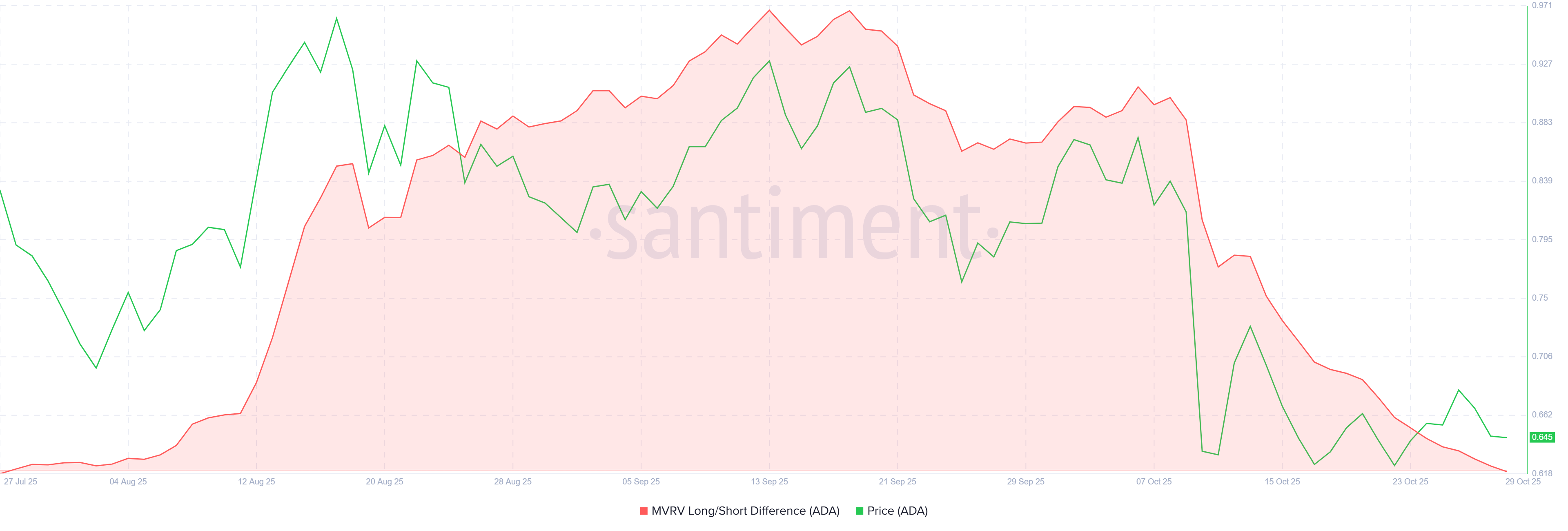
Разница между длинными и короткими позициями Cardano MVRV
Разница между длинными и короткими позициями Cardano MVRV. Источник: Santiment

Согласно индексу относительной силы (RSI), макроимпульс Cardano также является медвежьим. В настоящее время RSI находится ниже нейтральной отметки 50,0, что свидетельствует о том, что на рынке по-прежнему преобладают медвежьи настроения. Это указывает на то, что ADA с трудом привлекает достаточное количество покупателей, чтобы противостоять недавнему снижению.

Длительное пребывание в отрицательной зоне RSI часто коррелирует с продолжительными фазами консолидации или дальнейшими коррекциями. Без возобновления интереса инвесторов или увеличения объёма торгов цена Cardano может оставаться на низком уровне.
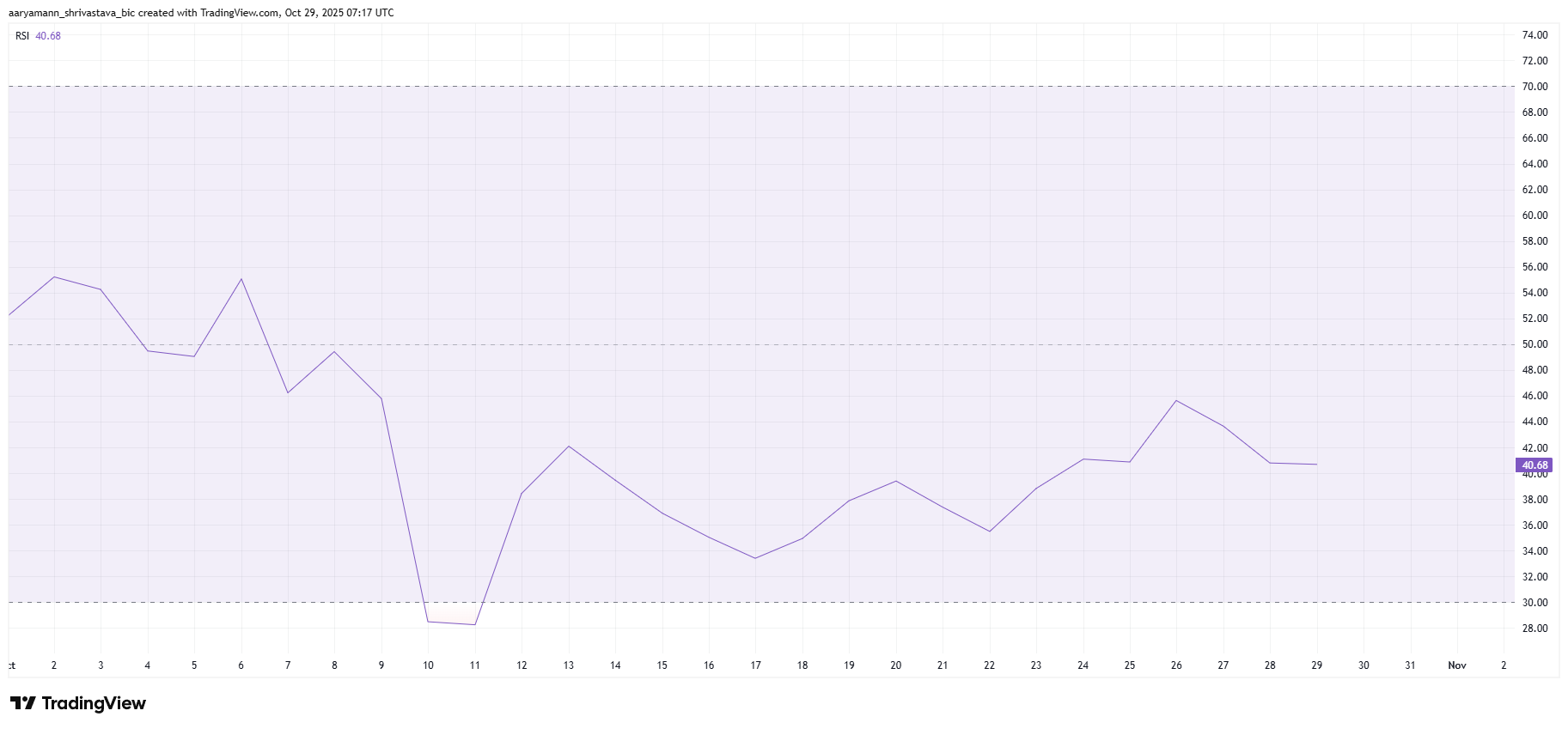
Cardano RSI
Cardano RSI. Источник: TradingView

Возможно, с ценой ADA придётся немного подождать

На момент написания статьи цена Cardano составляет 0,645 доллара США, что немного выше ключевой поддержки на уровне 0,623 доллара США. Однако альткоин по-прежнему находится ниже уровней сопротивления на отметках 0,667 и 0,699 доллара США, которые продолжают ограничивать его движение вверх.

Даже если ADA избежит падения ниже 0,623 доллара, её цена может продолжить консолидироваться. Такое движение будет означать, что Cardano находится в нейтральной или медвежьей фазе. Это не позволит ADA добиться сильного роста в краткосрочной перспективе.
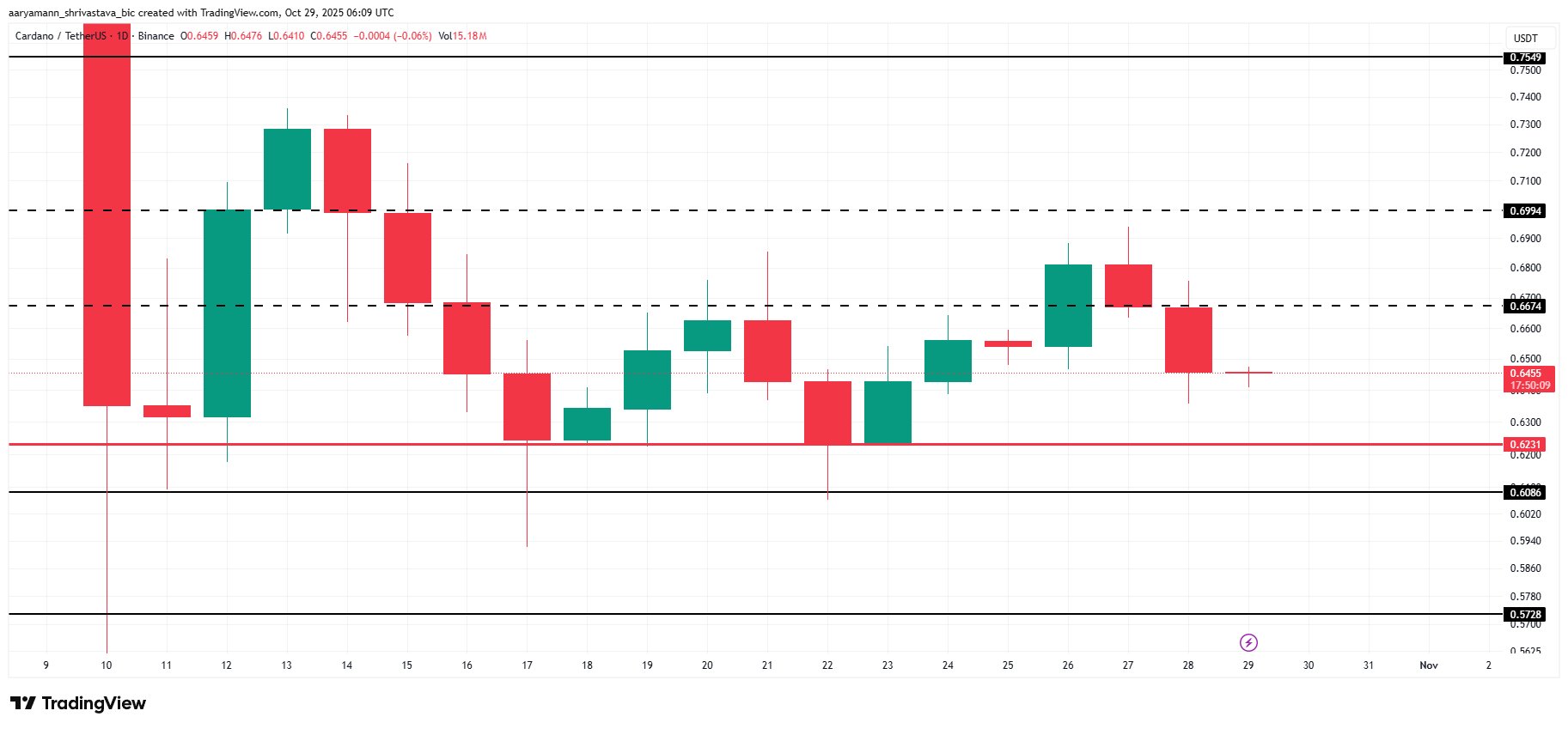
Анализ цен на Cardano.
Анализ цен на Cardano. Источник: TradingView

Единственный путь к восстановлению — это решительный прорыв выше отметки в 0,699 доллара, который потенциально может поднять ADA до 0,754 доллара. Чтобы это произошло, краткосрочные держатели должны устоять перед соблазном продать актив раньше времени, что позволит Cardano сохранить динамику и восстановить бычий настрой.

Криптовалюта Cardano LTH впервые за три месяца показала убытки, цена может пострадать.

Criptos en tendencia

Lecturas Relacionadas

In the AI Era, What's Left for Bitcoin?

As Bitcoin falls below $60,000, the author reflects on the relationship between AI and Bitcoin, seeing them as two sides of the same coin. In the AI era, the cost of generating content has plummeted, making fake text, images, and videos increasingly easy and cheap to produce. This has led to a fundamental shift: while AI dramatically lowers the cost of information production, it also undermines trust and authenticity online. What becomes truly valuable is not more content, but the ability to verify what is real—"verifiability." This perspective offers a new lens for Bitcoin. Its massive energy consumption, often criticized as wasteful, is reinterpreted. While AI burns energy to enhance "capability" and efficiency, Bitcoin burns energy to produce "verifiability." Its purpose is not to be trusted but to enable a system where no trust in intermediaries—banks, platforms, or developers—is needed. Every transaction and the entire ledger's history is secured by cryptography and a decentralized network of nodes, making it independently verifiable. AI cannot forge a transaction on the Bitcoin network because the system is designed for proof, not generation. The author draws a historical parallel to the Renaissance: the printing press drastically reduced the cost of copying knowledge, while double-entry bookkeeping reduced the cost of trust in commerce. Today, AI is the new printing press, reducing content creation costs to near zero. Blockchain, and Bitcoin as its pioneer, may be the modern equivalent of double-entry bookkeeping—a foundational technology for verifying digital asset ownership and historical records without centralized authorities. Thus, AI and blockchain are not competitors. AI lowers the cost of creation; blockchain lowers the cost of verification. In an age where AI can generate anything, true scarcity may lie not in more content, but in independently verifiable facts. Whether the market will reprice Bitcoin accordingly remains uncertain, but its core value proposition as a "machine for producing verifiability" becomes strikingly relevant.

marsbitHace 1 hora(s)

In the AI Era, What's Left for Bitcoin?

marsbitHace 1 hora(s)

In the Age of AI, What's Left for Bitcoin?

Author: Sevclub, Seven Research Amid Bitcoin's recent drop below $60k, the author reflects on a growing sense that AI and Bitcoin are two sides of the same coin. Today, encountering any content triggers a new default question: "Was this made by AI?" The cost of generating convincing text, images, and video is now negligible. While the internet lowered information *distribution* costs, AI is crashing information *production* costs to near zero. The consequence is a flood of content where truth and falsehood are increasingly indistinguishable. In this environment, what becomes truly valuable is not more information, but the ability to verify what is real—"verifiability." This reframes the common criticism that Bitcoin "wastes electricity." AI consumes power to produce "capability" (e.g., more powerful models). Bitcoin consumes power to produce something else: "verifiability." Bitcoin's core purpose isn't about belief or trust in any institution, developer, or even its creator. It's about enabling independent verification. Every bitcoin's origin, every transaction, and the integrity of the entire ledger are secured by mathematics, cryptography, and a global network of nodes. AI can fabricate convincing media, but it cannot falsify a transaction on the Bitcoin network. The expended energy makes篡改历史 (tampering with history) prohibitively expensive, purchasing a globally verifiable ledger. The author draws a historical parallel to the Renaissance. The printing press drastically reduced the cost of copying knowledge, while double-entry bookkeeping reduced the cost of trust in commerce—one enabled creation, the other verification. Today, AI is the new printing press, driving content production costs toward zero. The question becomes: what is this era's "double-entry bookkeeping"? Blockchain appears to be the leading candidate. It doesn't verify which news is true or which image is real, but it provides a foundational layer for independently verifying asset ownership and historical records in the digital realm without centralized authorities. Therefore, AI and blockchain are not in competition. AI lowers the cost of *generation*. Blockchain (and Bitcoin as a prime example) lowers the cost of *verification*. One creates, the other proves. Whether Bitcoin ultimately succeeds remains uncertain, facing potential challenges from quantum computing, regulation, and technical evolution. However, the author now sees it less as a "machine for making bitcoin" and more as a "machine for making verifiability." In an age where AI can generate anything, true scarcity may no longer be "more content," but "more independently verifiable facts." Whether the market will price this accordingly is a separate question.

链捕手Hace 1 hora(s)

In the Age of AI, What's Left for Bitcoin?

链捕手Hace 1 hora(s)

Trading

Spot

Artículos destacados

Cómo comprar ADA

¡Bienvenido a HTX.com! Hemos hecho que comprar Cardano (ADA) sea simple y conveniente. Sigue nuestra guía paso a paso para iniciar tu viaje de criptos.Paso 1: crea tu cuenta HTXUtiliza tu correo electrónico o número de teléfono para registrarte y obtener una cuenta gratuita en HTX. Experimenta un proceso de registro sin complicaciones y desbloquea todas las funciones.Obtener mi cuentaPaso 2: ve a Comprar cripto y elige tu método de pagoTarjeta de crédito/débito: usa tu Visa o Mastercard para comprar Cardano (ADA) al instante.Saldo: utiliza fondos del saldo de tu cuenta HTX para tradear sin problemas.Terceros: hemos agregado métodos de pago populares como Google Pay y Apple Pay para mejorar la comodidad.P2P: tradear directamente con otros usuarios en HTX.Over-the-Counter (OTC): ofrecemos servicios personalizados y tipos de cambio competitivos para los traders.Paso 3: guarda tu Cardano (ADA)Después de comprar tu Cardano (ADA), guárdalo en tu cuenta HTX. Alternativamente, puedes enviarlo a otro lugar mediante transferencia blockchain o utilizarlo para tradear otras criptomonedas.Paso 4: tradear Cardano (ADA)Tradear fácilmente con Cardano (ADA) en HTX's mercado spot. Simplemente accede a tu cuenta, selecciona tu par de trading, ejecuta tus trades y monitorea en tiempo real. Ofrecemos una experiencia fácil de usar tanto para principiantes como para traders experimentados.

1.5k Vistas totalesPublicado en 2024.12.10Actualizado en 2026.06.02

Cómo comprar ADA

Discusiones

Bienvenido a la comunidad de HTX. Aquí puedes mantenerte informado sobre los últimos desarrollos de la plataforma y acceder a análisis profesionales del mercado. A continuación se presentan las opiniones de los usuarios sobre el precio de ADA (ADA).

活动图片