Something ‘Very Big’ Is Coming To Cardano, Says Charles Hoskinson

bitcoinistPublicado a 2025-10-28Actualizado a 2025-10-28

Resumen

Cardano founder Charles Hoskinson says the network is on the cusp of a significant shift, reacting to news that an...

Trusted Editorial content, reviewed by leading industry experts and seasoned editors. Ad Disclosure

Cardano founder Charles Hoskinson says the network is on the cusp of a significant shift, reacting to news that an HTTP-402–based payments standard—known as “x402”—is being brought to Cardano and integrated with Masumi, an agent-to-agent protocol built atop the chain. “This is very big for Cardano,” Hoskinson wrote on X on October 27, in response to the demo announcement.

The catalyst is a proof-of-concept published by Masumi cofounder Patrick Tobler showing a live x402 “pay-to-access” flow that ends in an on-chain action: a memecoin mint on Cardano. Tobler framed it as a milestone en route to standardizing how autonomous agents and web services exchange value via APIs without log-ins or OAuth.

“x402 is coming to Cardano (and Masumi)! … The first x402 Proof-Of-Concept Memecoin Mint,” he posted, adding that users can try the demo with 2 USDM for payment and a small amount of ADA for fees—and stressing that the token itself is strictly a technical showcase with “0 future plans.”

What This Means For Cardano

In a series of follow-ups, Tobler described x402 as a revival of the web’s long-dormant HTTP 402 “Payment Required” status code, generalized for modern machine-to-machine commerce. “Built around the HTTP 402 status code, x402 enables users to pay for resources via API without registration, emails, OAuth, or complex signatures,” he wrote, noting that Coinbase developed the protocol and that it is integrated into Google’s Agent Payments Protocol (AP2).

The Masumi implementation pairs that transport-level payment primitive with smart-contract guarantees for identity, refunds, and decision logging—“turning Cardano into the financial backbone of the agent economy,” as he put it.

The demo itself makes the flow concrete. When a user hits the endpoint, the server responds with “402: Payment Required.” The front end prompts a connected Cardano wallet to construct the payment. The payment proof is then transmitted in the 402 header; the server relays it on-chain, waits for finality, and only then returns the protected resource—in this case, minting the demo memecoins. “Please note: This is NOT a real memecoin. It is ONLY a proof-of-concept intended to showcase the technology!” Tobler emphasized.

Context matters for why Hoskinson’s enthusiasm resonated. x402 has been positioned by Coinbase as an “internet-native payment protocol” for AI agents and APIs, with instant, stablecoin-settled micropayments and merchant tooling. Separately, Google introduced AP2 as an open agent-payments layer designed to support multiple rails—including stablecoins—and to standardize authorization and auditability for agentic commerce. An x402 integration at the chain and smart-contract level gives Cardano a clear line into that emerging stack.

The choice of USDM for the demo highlights another Cardano-specific ingredient: a fiat-backed USD stablecoin native to the network, launched by Moneta (formerly Mehen). USDM’s role in the x402 flow is straightforward—precise, low-friction settlement per request—while ADA remains necessary for network fees. For agent-to-agent use cases, the combination is pragmatic: deterministic fees plus dollar-denominated pricing.

Tobler said the team is now drafting the x402 standard for both Cardano and Masumi, and explicitly not limiting the spec to simple address-to-address transfers. “By not only doing Address-To-Address like most other blockchains do but actually writing the standard to work with the Masumi Smart Contract, we’re making our x402 implementation the most powerful one out there,” he wrote.

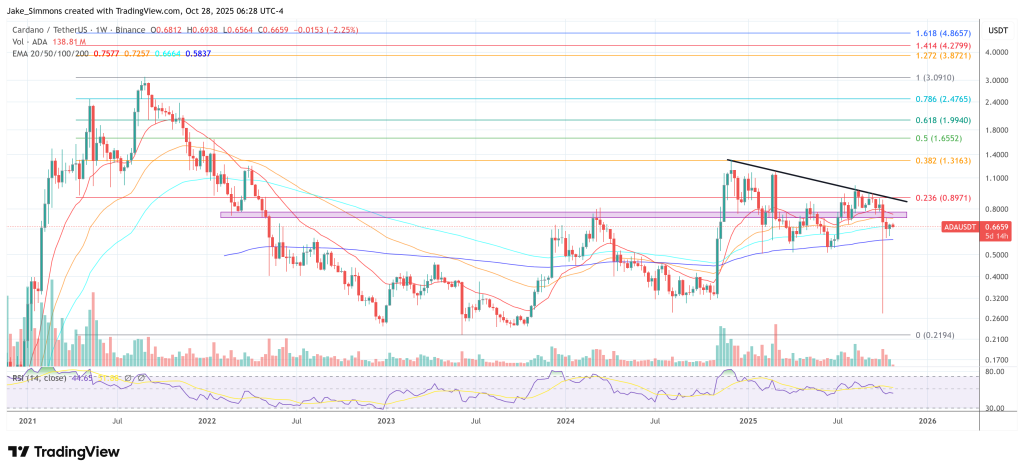
At press time, ADA traded at $0.6659.
Cardano price
ADA remains below key resistance, 1-week chart | Source: ADAUSDT on TradingView.com
Featured image created with DALL.E, chart from TradingView.com
Editorial Process for bitcoinist is centered on delivering thoroughly researched, accurate, and unbiased content. We uphold strict sourcing standards, and each page undergoes diligent review by our team of top technology experts and seasoned editors. This process ensures the integrity, relevance, and value of our content for our readers.

Jake Simmons has been a Bitcoin enthusiast since 2016. Ever since he heard about Bitcoin, he has been studying the topic every day and trying to share his knowledge with others. His goal is to contribute to Bitcoin's financial revolution, which will replace the fiat money system. Besides BTC and crypto, Jake studied Business Informatics at a university. After graduation in 2017, he has been working in the blockchain and crypto sector. You can follow Jake on Twitter at @realJakeSimmons.

Lecturas Relacionadas

On-chain Analyst: Why Are Most Zcash Transactions Still Traceable?

Title: Why Most Zcash Transactions Remain Traceable Zcash, a privacy-focused cryptocurrency launched in 2016, was designed to offer anonymity by hiding transaction details like sender, receiver, and amount using zero-knowledge proof technology (zk-SNARKs). However, in practice, a significant portion of ZEC transactions are still traceable on-chain. The key reason is Zcash's dual-address system. It features transparent addresses (t-addresses), which work like standard Bitcoin addresses with all data public, and shielded addresses (z-addresses) that encrypt transaction details. There are four transaction types with varying privacy levels: fully transparent (t→t), partially shielded (t→z and z→t), and fully private (z→z). Despite its privacy capabilities, most real-world Zcash activity involves transparent addresses, primarily because major exchanges and institutions use them for regulatory compliance. As a result, blockchain analytics platforms like Arkham can track and attribute a substantial volume of Zcash transactions. Arkham reports it has identified entities behind over $420 billion in ZEC transaction volume. Case studies highlight this traceability: the U.S. government holds seized Zcash from a dark web case, visible via its transparent wallet, and individual traders' profitable moves are trackable from purchase to exchange deposit. In conclusion, Zcash's privacy is not inherent but user-dependent. While purely shielded (z→z) transactions remain cryptographically private, the prevalence of transparent address usage makes much of the network's activity traceable. The actual privacy protection offered depends entirely on how users choose to transact.

marsbitHace 19 min(s)

On-chain Analyst: Why Are Most Zcash Transactions Still Traceable?

marsbitHace 19 min(s)

From Power Infrastructure to Token Economy: The 'Seven-Layer Cake' of the AI Industry Chain

From Power Grid to Token Economy: The AI Industry's "Seven-Layer Cake" The AI industry is shifting from a "model-centric" paradigm focused on massive training to a "token-centric" industrial era driven by inference demand. This new phase revolves around the production, distribution, scheduling, and consumption of tokens—the units of computation used by AI agents for every interaction and task. The article proposes a "seven-layer cake" framework for the AI economy: 1. **Power**: The foundational energy source, with competition shifting to securing stable, low-cost electricity. 2. **AIDC (AI Data Centers)**: Large-scale "Token factories." A trend toward smaller, modular, and regionally deployed AI Factories is emerging for efficiency and proximity to users. 3. **GPU**: The core production hardware for tokens. While NVIDIA dominates, competition exists from AMD, ASIC makers, and Chinese chipmakers, with a growing focus on inference efficiency. 4. **LLMs**: The "engines" that generate tokens. The competition is evolving beyond model size to prioritize factors like token cost, inference efficiency, and operational synergy with infrastructure. 5. **Token Distribution**: The "grid" that allocates and rents out compute resources, led by cloud giants and specialized AI-native platforms. 6. **Token Optimization & Intelligent Scheduling**: The critical "brain" layer that intelligently routes tasks (e.g., to local, cloud, or edge models) for optimal cost, latency, and privacy—maximizing the value of each token. 7. **AI Agents & Models**: The end consumers of tokens. The vision involves billions of AI agents working and interacting concurrently, consuming vast amounts of tokens. Currently, the industry faces fragmentation and inefficiencies between these layers. The true "mass adoption era" of AI will begin only when this seven-layer infrastructure is fully integrated and operates as a cohesive, intelligent network—transforming AI from a software tool into a global industrial system spanning energy, hardware, and compute logistics.

marsbitHace 40 min(s)

From Power Infrastructure to Token Economy: The 'Seven-Layer Cake' of the AI Industry Chain

marsbitHace 40 min(s)

Semiconductors up 78% annually, software down 12% annually: The 'Liquidity Siphon' is playing out within tech stocks

Semiconductor ETFs like SOXX have surged 78.5% year-to-date, while software ETFs like IGV have dropped 12.5%, creating a record performance gap exceeding 90 percentage points. This reflects a major "liquidity suction" within tech stocks, with capital flooding into semiconductors as software faces selling pressure. Driving the semiconductor boom are staggering capital expenditure plans from hyperscalers like Microsoft, Alphabet, Amazon, and Meta, whose combined 2026 capex is projected near $700 billion. This fuels demand for chips, with companies like SanDisk (up 426%), Intel (up 222%), and Micron (up 154%) leading the S&P 500. In contrast, major software firms like Microsoft, Adobe, and Salesforce are all down over 17% year-to-date. The software sector faces a dual challenge: capital is being redirected to semiconductors, and the rise of AI agents like Claude Code threatens traditional SaaS business models, triggering a narrative of AI displacement. Key unanswered questions remain: How long can hyperscalers sustain their massive capex, given potential free cash flow pressures? And will capital eventually rotate back into the deeply oversold software sector? While some analysts warn of a potential semiconductor bubble akin to the dot-com era, the sector's powerful momentum continues, making market timing exceptionally difficult.

marsbitHace 40 min(s)

Semiconductors up 78% annually, software down 12% annually: The 'Liquidity Siphon' is playing out within tech stocks

marsbitHace 40 min(s)

Trading

Spot
Futuros

Artículos destacados

Cómo comprar ADA

¡Bienvenido a HTX.com! Hemos hecho que comprar Cardano (ADA) sea simple y conveniente. Sigue nuestra guía paso a paso para iniciar tu viaje de criptos.Paso 1: crea tu cuenta HTXUtiliza tu correo electrónico o número de teléfono para registrarte y obtener una cuenta gratuita en HTX. Experimenta un proceso de registro sin complicaciones y desbloquea todas las funciones.Obtener mi cuentaPaso 2: ve a Comprar cripto y elige tu método de pagoTarjeta de crédito/débito: usa tu Visa o Mastercard para comprar Cardano (ADA) al instante.Saldo: utiliza fondos del saldo de tu cuenta HTX para tradear sin problemas.Terceros: hemos agregado métodos de pago populares como Google Pay y Apple Pay para mejorar la comodidad.P2P: tradear directamente con otros usuarios en HTX.Over-the-Counter (OTC): ofrecemos servicios personalizados y tipos de cambio competitivos para los traders.Paso 3: guarda tu Cardano (ADA)Después de comprar tu Cardano (ADA), guárdalo en tu cuenta HTX. Alternativamente, puedes enviarlo a otro lugar mediante transferencia blockchain o utilizarlo para tradear otras criptomonedas.Paso 4: tradear Cardano (ADA)Tradear fácilmente con Cardano (ADA) en HTX's mercado spot. Simplemente accede a tu cuenta, selecciona tu par de trading, ejecuta tus trades y monitorea en tiempo real. Ofrecemos una experiencia fácil de usar tanto para principiantes como para traders experimentados.

1.4k Vistas totalesPublicado en 2024.12.10Actualizado en 2025.03.21

Cómo comprar ADA

Discusiones

Bienvenido a la comunidad de HTX. Aquí puedes mantenerte informado sobre los últimos desarrollos de la plataforma y acceder a análisis profesionales del mercado. A continuación se presentan las opiniones de los usuarios sobre el precio de ADA (ADA).

活动图片