Криптовалюта, которая обошла рыночный крах — что стоит за ростом TAO

cryptonews.ruPublicado a 2025-03-20Actualizado a 2025-10-21

Bittensor (TAO) стал одним из лидеров рынка. Монете удалось быстро восстановиться от недавнего краха на Черную пятницу. Результатам криптовалюты могут позавидовать даже такие лидеры рынка, как биткоин (BTC) и Ethereum (ETH)

Рост объемов торгов, усиление институционального интереса и сокращение предложения на фоне первого халвинга делают прогнозы для TAO все более благоприятными.

Что стоит за ростом Bittensor (TAO)

Согласно данным BeInCrypto Markets, большинство ведущих криптовалют дешевели на протяжении двух недель. В отличие от них, Bittensor (TAO) пошел против тренда, показав рост на 35,7% за тот же период.

Криптовалюта не только смогла восстановиться после октябрьского краха рынка, но и поднялась до многомесячных максимумов. Только за последний день стоимость альткоина увеличилась на 5,95% — до $435,65.
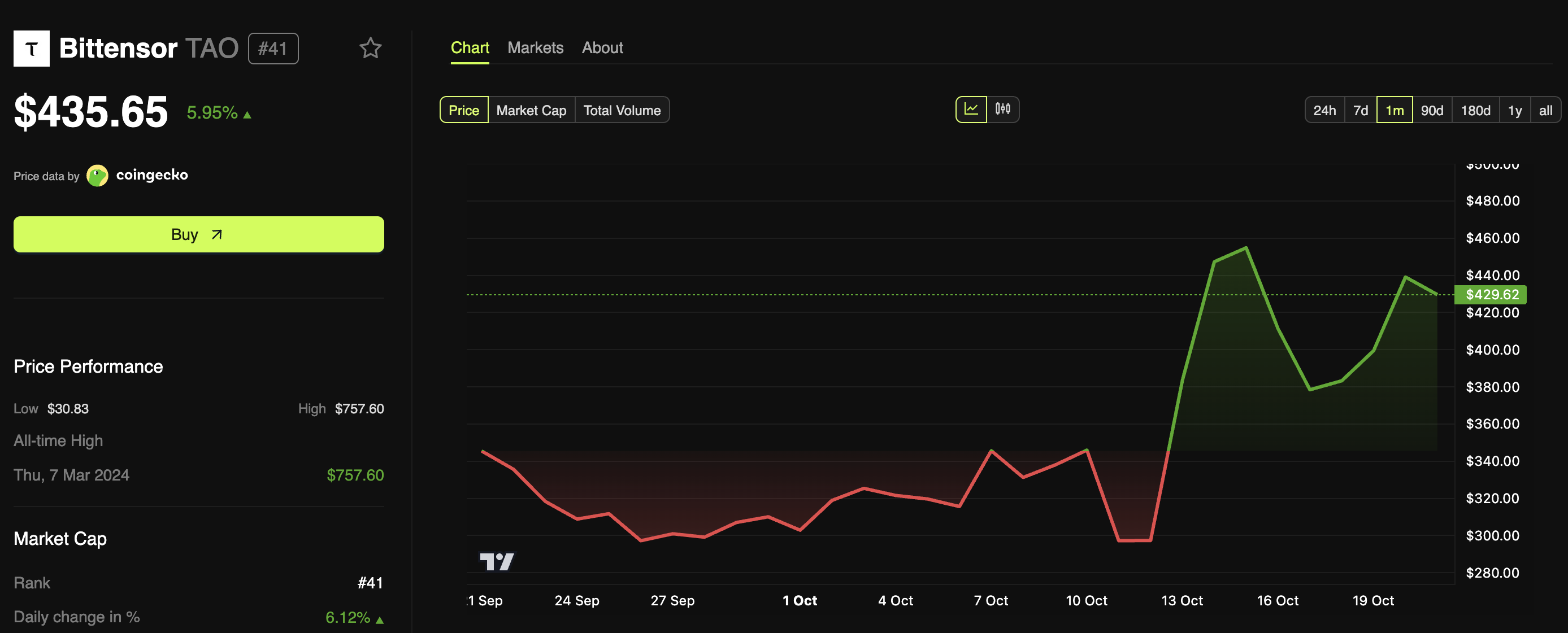
Динамика цены Bittensor (TAO). Источник: BeInCrypto Markets

Несколько факторов способствуют сильным показателям TAO. Данные CoinGecko показывают, что токен сохранял дневные объемы торгов выше $400 млн на протяжении последней недели. 15 октября объем достиг $943 млн, что свидетельствует о высоком интересе трейдеров к проекту.

Рост TAO также поддерживает интерес к стейкингу криптовалюты. Данные Taostats показывают, что более 70% монет TAO в обращении находятся в стейкинге. Такое положение ограничивает доступное для торговли предложение и поддерживает цену.

Институциональный интерес ускоряет динамику

Институциональное принятие расширило охват Bittensor. Децентрализованный AI фонд от Grayscale выделил более трети своих активов на TAO, что свидетельствует о возросшем доверии к монете как к ключевому игроку на децентрализованном рынке AI.

Кроме того, компания недавно подала заявку для Grayscale Bittensor Trust в SEC. Шаг может открыть путь для появления биржевых продуктов, аналогичных тем, что уже существуют для других крупных криптовалют, таких как BTC и ETH.

Запуск ETF может дополнительно повысить ликвидность, привлечь институциональных участников и улучшить положение TAO на рынке.

Bittensor в преддверии халвинга

Текущие катализаторы способствуют краткосрочным бычьим движениям. Дополнительные факторы могут стимулировать долгосрочный рост TAO. Декабрь 2025 года станет важной вехой для инвесторов Bittensor: в сети криптовалюты пройдет первый халвинг.

Как указано в официальной документации, халвинг Bittensor не следует хронологии блоков, как у биткоина. Вместо этого, триггером служит установленный порог. Планируемое сокращение нового предложения токенов может привести к росту цен, особенно когда стейкинг ограничивает ликвидность.

Хотя сроки халвинга могут немного измениться из-за переработки токенов, эффект сохранится — увеличение дефицита. Грядущее событие может вызвать повышенный спрос на монету.

Актив заручился поддержкой рыночных экспертов. Аналитик Квентин Франсуа недавно заявил, что TAO может стать активом стоимостью триллион долларов к 2030-2031 годам:

«Самое захватывающее в TAO то, что его путь должен следовать Закону Рида, а не Закону Меткалфа, как у биткоина. Биткоин достиг рыночной капитализации в триллион долларов в 2021 году. Это всего лишь через 12 лет после его создания. Теоретически, TAO должен сделать это менее чем за 12 лет».

Франсуа отметил конкурентную модель субсетей проекта и токеномику, схожую с биткоином, как ключевые сильные стороны. Он также описал модель TAO как «блестяще продуманную».

Таким образом, с высокими объемами, стейкингом и институциональным интересом TAO хорошо подготовлен к приближению декабря. Предстоящие месяцы станут испытанием для устойчивости Bittensor, поскольку он переходит в фазу сокращенного предложения.


Lecturas Relacionadas

How to Detect AI-Generated Videos? A Review of Dynamic, Traceable, and Explainable Detection Systems

**How to Detect AI-Generated Videos: A Survey on Dynamic, Traceable, and Explainable Detection Systems** With rapid advances in AI video generation (e.g., Sora, Veo), creating highly realistic, multi-minute videos is now possible, widening the gap with detection research. Current AI video detection, often limited to unreliable binary classifications, is insufficient. This survey, accepted at ACL 2026, reframes the goal as **"factual fidelity verification"**—checking if a video's content (who, when, where, what) aligns with the real world perceptually and cognitively. It categorizes AI-generated videos into three paradigms: **Local Manipulation Videos (LMV**, e.g., face swaps), **Audio-Visual Editing (AVE**, e.g., lip-syncing), and **Generative Video Synthesis (GVS**, fully synthetic videos like Sora's). Detection challenges evolve from visual artifacts in LMV to multi-modal inconsistencies in AVE and higher-level world knowledge violations in GVS. The core proposal is a **Vision-Language Dual-View framework** with four hierarchical layers: 1. **Layer 1 (Intrinsic Visual Cues):** Analyzes low-level signal statistics, noise patterns, and physiological signals. 2. **Layer 2 (Spatiotemporal Consistency):** Checks for temporal coherence in object motion and scene dynamics. 3. **Layer 3 (Cross-Modal Consistency):** Verifies alignment between video, audio, and text within the video. 4. **Layer 4 (Language-Guided World-Level Reasoning):** Uses external knowledge, facts, and physical laws to judge semantic plausibility and factual correctness. The survey traces a shift in detection focus from lower layers (1 & 2) toward higher, language-involved layers (3 & 4). It also reviews evolving evaluation metrics and datasets tailored for each video paradigm. The conclusion advocates for a **dynamic, evidence-first detection system** that moves beyond simple classification. Future trustworthy detection requires combining visual evidence (from CV) with semantic reasoning and explanation (from NLP & multimodal AI), ultimately creating traceable and explainable judgments about a video's adherence to real-world constraints.

marsbitHace 25 min(s)

How to Detect AI-Generated Videos? A Review of Dynamic, Traceable, and Explainable Detection Systems

marsbitHace 25 min(s)

It Turns Out the First Real-World Application of AI x Crypto is in Security Auditing

The article explores the surprising trend where AI's first major impact on crypto has been in security auditing, not in areas like trading or analytics. It details how AI-powered tools are dramatically lowering the barrier to finding smart contract vulnerabilities, enabling attackers to scan thousands of contracts and execute exploits within minutes. This has rendered traditional, manually-produced audit reports with their month-long validity periods increasingly obsolete, creating a critical "structural crack" in the old security model. Cases like Drift Protocol and KelpDAO show that even extensively audited protocols can be hacked through social engineering, operational flaws, or infrastructure misconfigurations beyond pure code review. Attackers are also using AI to find and exploit vulnerabilities in years-old, deployed contracts. Notably, OpenZeppelin's co-founder has expressed a grim view that "all DeFi is insecure" due to AI's asymmetric advantage. In response, the audit industry is undergoing a fundamental shift. While there's a short-term spike in defensive re-audits, the long-term business model is changing. Firms are developing AI-assisted systems and moving from one-time report deliveries towards embedded, continuous services like real-time monitoring and formal verification. Examples include AI tools uncovering critical, previously missed vulnerabilities in heavily audited protocols like Curve Finance and Zcash. The conclusion is that security must become a continuous investment, not a one-time checkbox, and audit firms must rapidly evolve their tools and service models to survive.

marsbitHace 32 min(s)

It Turns Out the First Real-World Application of AI x Crypto is in Security Auditing

marsbitHace 32 min(s)

Never expected that the first tangible application of AI x Crypto is in security auditing

Unexpectedly, the initial major application of AI in the Crypto sphere has turned out to be security auditing. In 2026, DeFi has faced significant security challenges, with 121 hacking incidents resulting in approximately $942 million in losses. While AI was expected to first impact areas like quantitative trading, its initial breakthrough has instead transformed security auditing by drastically lowering the cost and skill barrier for finding smart contract vulnerabilities. The traditional audit model is facing obsolescence. Advanced AI models, such as Claude Mythos, enable attackers to scan thousands of contracts and identify vulnerability patterns at scale, compressing the time from discovery to execution to mere minutes. This renders the month-long validity of traditional audit reports ineffective. Notably, attacks now frequently target well-audited, established protocols by exploiting business logic flaws, operational security weaknesses, and even years-old historical contracts, demonstrating that old audit reports offer zero protection. This pressure is forcing a fundamental shift in the industry. In the short term, a wave of defensive re-auditing is occurring, driven by projects seeking to meet new AI-era security standards and regulatory requirements. In the long run, audit firms' business models are diverging. The one-time report delivery model is declining in value, as evidenced by platforms like Code4rena shutting down. Leading firms are now pivoting towards AI-powered defense, integrating continuous monitoring, real-time on-chain risk detection, and embedding security directly into the development phase, as seen with tools like OpenZeppelin's Skills system. Ultimately, the era of "audit once, secure forever" is over. Security must become a continuous, embedded infrastructure investment for projects. For audit companies, survival depends on proactively transforming from traditional service providers into platforms offering AI-native, ongoing security solutions.

链捕手Hace 39 min(s)

Never expected that the first tangible application of AI x Crypto is in security auditing

链捕手Hace 39 min(s)

Trading

Spot
活动图片