NVIDIA's New Open-Source MoE: One Line of Import, Fine-Tuning Accelerated by 3.7x

marsbitPublicado a 2026-06-26Actualizado a 2026-06-26

Resumen

NVIDIA has open-sourced NeMo AutoModel, a tool designed to significantly accelerate the fine-tuning of Mixture-of-Experts (MoE) large language models. By adding just one import line to existing code based on Hugging Face Transformers v5, users can achieve a 3.4x to 3.7x increase in training throughput and reduce GPU memory usage by 29% to 32% without altering their API. The key innovations include Expert Parallelism (EP) to distribute expert weights across GPUs, lowering memory pressure; DeepEP to fuse computation and communication; and TransformerEngine kernels for accelerated core operations. Benchmarks on models like Qwen3-30B-A3B show training throughput per GPU jumping from 3075 to 11340 tokens per second. The solution also enables the fine-tuning of very large models, such as the 550B parameter Nemotron 3 Ultra, which would exceed memory limits with the standard Transformers v5. Code and benchmarks are available on GitHub.

One line of import, fine-tuning of MoE large models accelerated by 3.7x.

NVIDIA's latest research is now open source: NeMo AutoModel, designed specifically for large-scale building and fine-tuning of generative AI models.

Built on top of Hugging Face Transformers v5, NeMo AutoModel achieves faster fine-tuning of MoE models without changing the code API—just by adding one line of import.
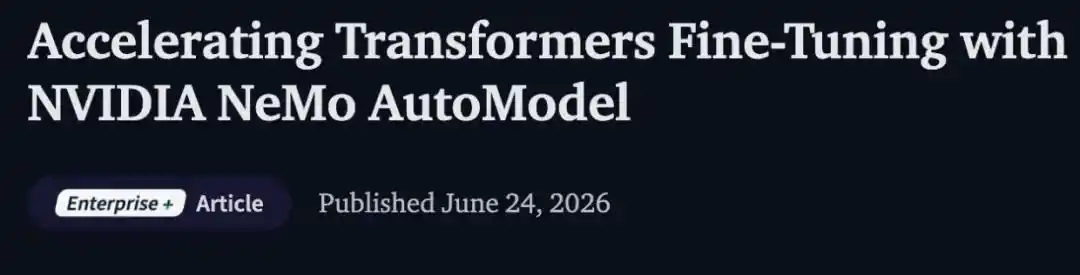
Experiments show that, compared to the original Hugging Face Transformers v5, NVIDIA's NeMo AutoModel can achieve a 3.4-3.7x increase in training throughput and reduce GPU memory usage by 29%-32% during MoE fine-tuning.

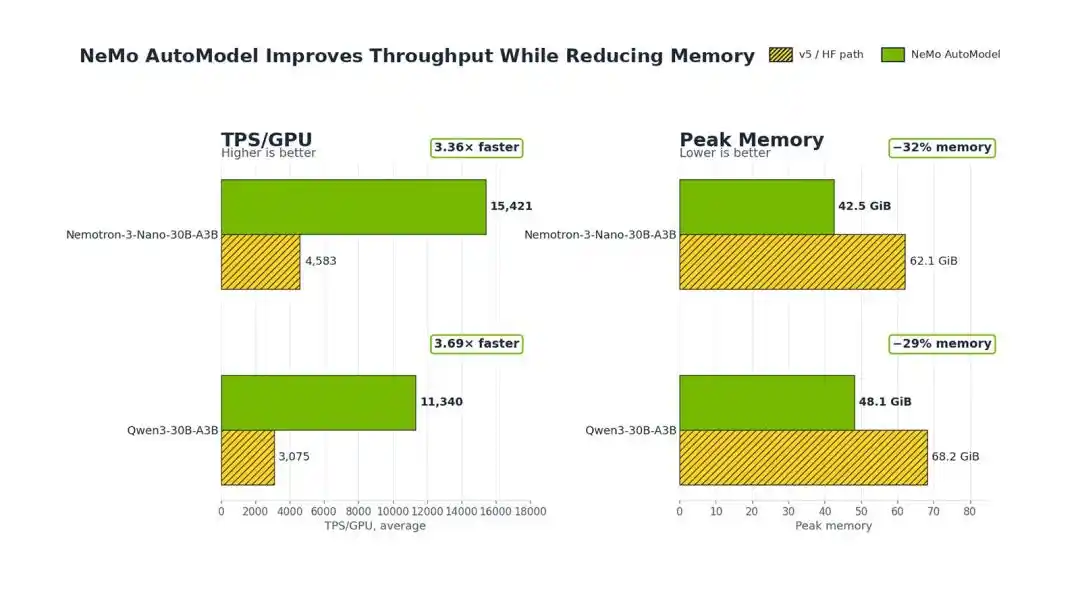
On a single node with 8x H100 80GB GPUs, using Qwen3-30B-A3B as an example, NeMo AutoModel directly increased the TPS/GPU (tokens per second per GPU) from 3075 to 11340, achieving a 3.69x improvement.

Core Technology Explained

MoE has become the mainstream architecture for cutting-edge models, but MoE also introduces new challenges for efficient training:

Expert parallelism, communication fusion, kernel optimization... these complex engineering tasks require supporting infrastructure.

HuggingFace's Transformers v5 is currently a widely used "universal base" for MoE training. V5 enhanced native support for MoE, introducing MoE foundational capabilities such as expert backends, dynamic weight loading, and distributed execution.
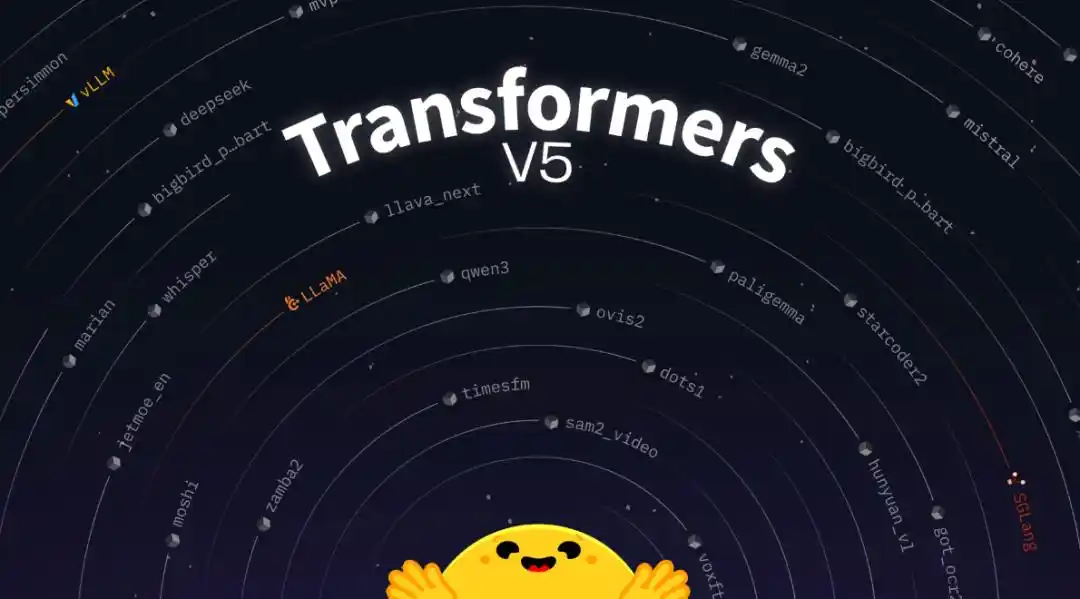
This time, NVIDIA's approach is to build on the shoulders of predecessors, maintaining compatibility with the HuggingFace Transformers API, allowing users to achieve higher training throughput and lower memory usage in MoE fine-tuning without significant code changes.

Specifically, NeMo AutoModel adds Expert Parallelism (EP), DeepEP, and TransformerEngine on top of Transformers v5.

Expert Parallelism

Expert Parallelism technology is primarily used to reduce memory pressure.

EP distributes expert weights across multiple GPUs; each GPU no longer holds all expert parameters entirely, but only holds a portion of them.

For example, with ep_size=8 across 8 GPUs, expert weights are distributed across 8 GPUs, reducing the MoE memory footprint on each GPU to 1/8 of the original.

Experimental results show that for Qwen3, this technology can reduce peak memory from 68.2 GiB to 48.1 GiB, a 29% reduction.

For the Nemotron Nanomo model, memory usage dropped from 62.1 GiB to 42.5 GiB, a 32% reduction.

The freed-up space can be used to support larger batch sizes and longer sequences.
DeepEP

DeepEP achieves the fusion of computation and communication.

In the traditional approach, there is significant communication cost between token distribution and expert computation. DeepEP integrates the token distribution and composition operations into optimized GPU kernels, overlapping the communication process with expert computation.

TransformerEngine

The TransformerEngine kernel provides acceleration for various core operations.

This technology offers implementations for fused attention mechanisms, linear layers, RMSNorm, etc., accelerating not only MoE layers but also regular Transformer layers.

One Line of Import, 3x Speed Boost

In summary, for those already using Transformers v5, NVIDIA's NeMo AutoModel offers a seamless upgrade path:

Just add one line of import code to achieve a 3x speed boost in MoE fine-tuning.
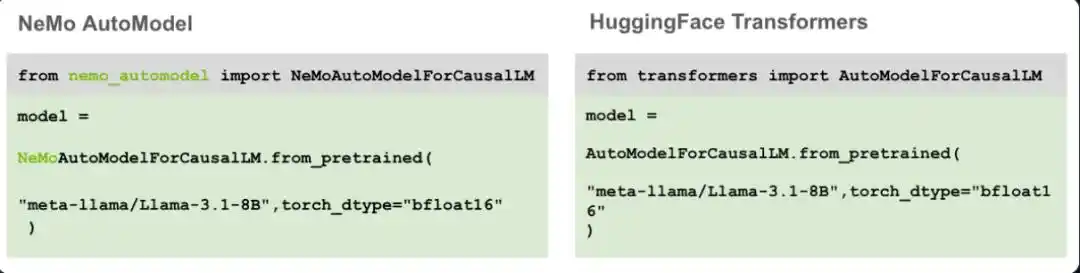
On Qwen3-30B-A3B and Nemotron 3 Nano 30B-A3B, compared to Transformers v5, this solution achieves a 3.4-3.7x increase in training throughput while reducing memory consumption by 29%-32%.

NVIDIA also demonstrated the results of full-parameter fine-tuning for Nemotron 3 Ultra 550B A55B on 16 H100 nodes with 128 GPUs.
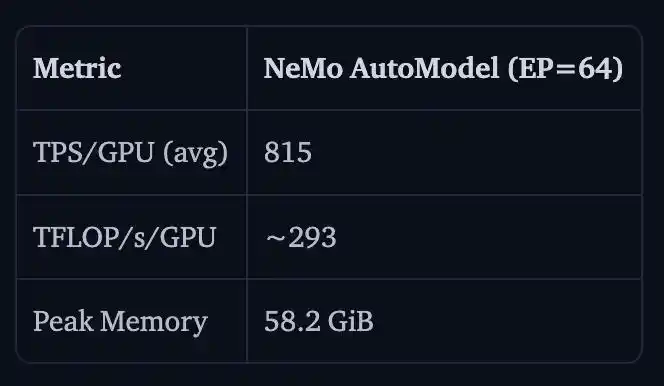
The TPS/GPU was 815, TFLOP/s/GPU was about 293, and peak memory was 58.2 GiB.

The reason for not comparing it with v5 here is that Transformers v5 would simply run out of memory at this scale ̄_(ツ)_/ ̄

If you're interested, NVIDIA has already placed the code, configurations, and benchmark scripts on GitHub: https://github.com/NVIDIA-NeMo/Automodel/tree/blog/transformers-v5-automodel/blog_experiments

The detailed usage guide is here: https://docs.nvidia.com/nemo/automodel/latest/get-started/hf-compatibility

This article is from the WeChat public account "Qubit," author: Yu Yang

Criptos en tendencia

Preguntas relacionadas

QWhat is the key benefit of NVIDIA's newly open-sourced NeMo AutoModel for MoE model fine-tuning?

AThe key benefit is a significant performance improvement. NeMo AutoModel enables a 3.4-3.7x increase in training throughput and reduces GPU memory usage by 29-32% for MoE model fine-tuning, compared to the standard Hugging Face Transformers v5.

QHow does NeMo AutoModel achieve compatibility with existing Hugging Face Transformers v5 code?

ANeMo AutoModel achieves compatibility by maintaining the same API as Hugging Face Transformers v5. Users can integrate it into their existing code with minimal changes, often requiring only the addition of a single import statement to gain the performance benefits.

QWhat is Expert Parallelism (EP), and what problem does it solve?

AExpert Parallelism (EP) is a core technique in NeMo AutoModel that distributes the expert weights of a Mixture-of-Experts (MoE) model across multiple GPUs. This reduces the memory pressure on each individual GPU, as it no longer needs to hold all expert parameters. For example, on 8 GPUs, it can reduce MoE memory usage per GPU to about 1/8th of the original.

QWhat role does DeepEP play in the NeMo AutoModel architecture?

ADeepEP fuses computation with communication. It optimizes performance by integrating the token routing (distribution and combination) operations into optimized GPU kernels. This allows the communication process to overlap with expert computation, reducing traditional communication overhead and improving overall training efficiency.

QWhat results were demonstrated for the large-scale Nemotron 3 Ultra 550B model fine-tuning with NeMo AutoModel?

AFor the Nemotron 3 Ultra 550B A55B model fine-tuning on 128 H100 GPUs, NeMo AutoModel achieved a throughput of 815 tokens per second per GPU (TPS/GPU) and a peak memory usage of 58.2 GiB. The article notes that Transformers v5 could not handle this scale, as it would run out of memory.

Lecturas Relacionadas

$2 Trillion: Countdown to AI's Largest IPO in History

The countdown for the largest IPO in AI history, a potential $2 trillion listing for Anthropic, is underway for October. The staggering valuation, reportedly projected by several investors, contrasts with the company's own internal restraint on setting a public target. Founded five years ago by former OpenAI core members, Anthropic's growth has been meteoric. Annual recurring revenue (ARR) surged from ~$9B in late 2025 to $47B by May 2026, with Q2 2026 revenue of $11.5B marking a 14x year-over-year increase. Bank valuations are even based on internal 2028 revenue forecasts of $190-200B. A key growth driver is Claude Code, its AI coding assistant. Its ARR quintupled in five months to $2.5B by February 2026, now constituting nearly 20% of total revenue. Surveys indicate Anthropic commands roughly 40% of enterprise LLM spending, doubling OpenAI's share in programming-specific use. However, alongside this explosive growth, reports detail significant internal cultural strife. Critics describe a divisive "priesthood" of PhD executives, led by CEO Dario Amodei, who promote a "save humanity" narrative that some employees find cult-like and alienating. This has reportedly created a demoralized workforce and a covert "underground network" of dissent among engineers torn between lucrative pre-IPO equity and a toxic work environment. Anthropic now faces a pivotal paradox: pursuing its mission of "safe" AI requires immense capital for compute, yet that capital demands relentless commercial growth. As it approaches its historic IPO, the company must navigate intense regulatory scrutiny, soaring operational costs, and internal tensions—any of which could destabilize its post-listing trajectory, much like SpaceX's significant post-IPO stock drop. The stage is set for a defining moment in tech history.

marsbitHace 3 hora(s)

$2 Trillion: Countdown to AI's Largest IPO in History

marsbitHace 3 hora(s)

Trading

Spot

Artículos destacados

Cómo comprar ONE

¡Bienvenido a HTX.com! Hemos hecho que comprar Harmony (ONE) sea simple y conveniente. Sigue nuestra guía paso a paso para iniciar tu viaje de criptos.Paso 1: crea tu cuenta HTXUtiliza tu correo electrónico o número de teléfono para registrarte y obtener una cuenta gratuita en HTX. Experimenta un proceso de registro sin complicaciones y desbloquea todas las funciones.Obtener mi cuentaPaso 2: ve a Comprar cripto y elige tu método de pagoTarjeta de crédito/débito: usa tu Visa o Mastercard para comprar Harmony (ONE) al instante.Saldo: utiliza fondos del saldo de tu cuenta HTX para tradear sin problemas.Terceros: hemos agregado métodos de pago populares como Google Pay y Apple Pay para mejorar la comodidad.P2P: tradear directamente con otros usuarios en HTX.Over-the-Counter (OTC): ofrecemos servicios personalizados y tipos de cambio competitivos para los traders.Paso 3: guarda tu Harmony (ONE)Después de comprar tu Harmony (ONE), guárdalo en tu cuenta HTX. Alternativamente, puedes enviarlo a otro lugar mediante transferencia blockchain o utilizarlo para tradear otras criptomonedas.Paso 4: tradear Harmony (ONE)Tradear fácilmente con Harmony (ONE) en HTX's mercado spot. Simplemente accede a tu cuenta, selecciona tu par de trading, ejecuta tus trades y monitorea en tiempo real. Ofrecemos una experiencia fácil de usar tanto para principiantes como para traders experimentados.

561 Vistas totalesPublicado en 2024.12.12Actualizado en 2026.06.02

Cómo comprar ONE

Discusiones

Bienvenido a la comunidad de HTX. Aquí puedes mantenerte informado sobre los últimos desarrollos de la plataforma y acceder a análisis profesionales del mercado. A continuación se presentan las opiniones de los usuarios sobre el precio de ONE (ONE).

活动图片