Венчурный инвестор предупредил о рисках частных стейблкоинов

cryptonews.ruPublicado a 2025-03-19Actualizado a 2025-10-20

По словам Джереми Кранца, основателя и управляющего партнера венчурной компании Sentinel Global, инвесторам следует проявлять проницательность при рассмотрении частных стейблкоинов. Эти активы несут в себе все риски, присущие цифровым валютам центральных банков, а также свои собственные уникальные риски.

Кранц назвал частные стейблкоины «центральными бизнес-цифровыми валютами», которые обладают всеми теми же функциями наблюдения, бэкдорами, программируемостью и контролем, что и CBDC.

«Центральные бизнес-цифровые валюты на самом деле не так уж сильно отличаются. Так что, если JP Morgan выпустит долларовый стейблкоин и будет контролировать его через Патриотический акт или что-то еще, что появится в будущем, они смогут заморозить ваши деньги и лишить вас банковских счетов», — сказал он.

Эмитенты стейблкоинов с избыточным обеспечением, которые обеспечивают свои блокчейн-токены денежными средствами и краткосрочными государственными ценными бумагами, могут столкнуться с аналогом банковского набега. Это произойдет, если слишком много держателей попытаются выкупить токены одновременно, добавил Кранц.

Алгоритмические и синтетические стейблкоины, которые используют программное обеспечение или сложные транзакции для поддержания своей привязки к доллару, также подвержены собственным контрагентским рискам и зависимостям. Например, они могут потерять привязку из-за волатильности или внезапных обвалов на рынках криптовалютных деривативов, отметил он.

Кранц подчеркнул, что технология является нейтральным инструментом, который можно использовать для построения лучшего финансового будущего человечества или применять не по назначению. Результаты зависят от того, насколько внимательно инвесторы читают мелкий шрифт, понимают риски и делают осознанный выбор финансовых инструментов. Множество возможностей и рисков ждут нас впереди.

Быстрые темпы инноваций в сфере стейблкоинов, криптовалют и технологий токенизации можно сравнить с десятью черными лебедями, заявил Кранц. Он подчеркнул, что быстрый и революционный технологический прогресс создаст как возможности, так и риски.

Согласно данным DefiLlama, в октябре капитализация рынка стейблкоинов превысила рубеж в $300 млрд.
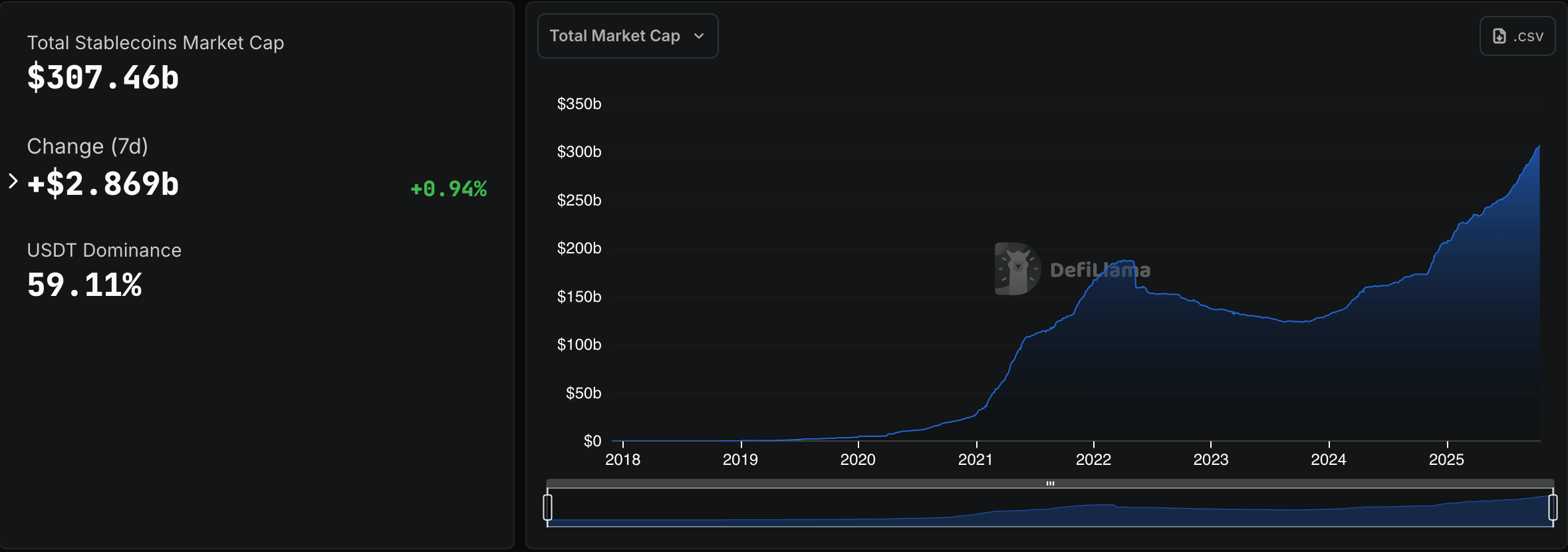

На момент написания статьи капитализация рынка стейблкоинов превышает $307 млрд. Источник: DeFiLlama

Интерес к стейблкоинам возрос после принятия в США законопроекта о стейблкоинах GENIUS, который вызвал неоднозначную реакцию законодателей.

Марджори Тейлор Грин, представительница США от штата Джорджия, назвала этот законопроект троянским конем для CBDC.

«Этот законопроект регулирует стейблкоины и создает скрытую цифровую валюту центрального банка», — написала она в публикации от 15 июля.

«Федеральная резервная система уже много лет планирует запуск CBDC, и это откроет путь к безналичному обществу и цифровой валюте, которую авторитарное правительство, контролирующее вашу способность покупать и продавать, может использовать против вас», — добавила она.


Lecturas Relacionadas

Hackers Steal Nearly $17 Million in 40 Days as 'Zombie Contracts' Become Their ATMs

According to an analysis published by ZeroDrift on June 22, 2026, attackers have stolen approximately $16.9 million over 40 days from five deprecated but still operational smart contracts across various blockchains. The primary issue is not a specific vulnerability but the incomplete decommissioning of legacy contracts. These "zombie contracts" often retain economic value, operational permissions, and callable functions, making them prime targets long after teams cease active development. The most significant loss occurred at DxSale, where an old locker contract lost about $7.3 million due to a forgotten control path becoming accessible again. Other affected projects include TrustedVolumes (~$5.87M), Raydium's legacy AMM pool (~$1.34M), Aztec Connect (~$2.28M), and Huma Finance V1 pool (~$101k). These incidents involved diverse systems—RFQ settlement, credit pools, liquidity lockers, AMMs—demonstrating the widespread nature of the risk. The analysis highlights that automated tools are lowering the cost for attackers to systematically scan for these long-tail targets, which have public code and weaker monitoring. In contrast, defensive practices for contract retirement remain underdeveloped. While the DeFi industry has mature audit processes for new deployments, it lacks strict protocols for securely sunsetting old contracts, which only become truly "retired" after all funds, permissions, authorizations, and trust assumptions are removed.

marsbitHace 45 min(s)

Hackers Steal Nearly $17 Million in 40 Days as 'Zombie Contracts' Become Their ATMs

marsbitHace 45 min(s)

Valuation Rout of Old Titans: The Demise of a Generation's Asset Valuation Framework

"The Old Titans' Valuation Collapse: The Death of an Era's Valuation Framework" Between Alibaba's 2014 NYSE debut at $93.89 and its 2026 price of ~$95, twelve years have passed with zero price appreciation. This stagnation symbolizes a wholesale valuation reset for an entire generation of Chinese internet assets. Companies like Tencent, Pinduoduo, Meituan, Bilibili, and Kuaishou have seen catastrophic declines of 80-98% from their peaks. The core question arises: what framework now prices these companies, or has the framework itself expired? The valuation logic for Chinese internet stocks followed a clear "anchor-setting and anchor-removing" process. From 2014-2017, the dominant narrative was "US comparable discounting" – applying a growth premium and governance discount to US peers' multiples. This anchor loosened with the 2018 US-China trade war and the VIE structure risk, then was violently uprooted by the 2020-2021 regulatory crackdowns (Ant Group, Didi, anti-monopoly fines). The 2022 delisting panic and subsequent 2025-2026 geopolitical shocks (US military lists, AI espionage accusations) completed the demolition. The old "US对标打折" model is dead. However, this is not solely a China story. A structural mirror exists in US "old titan" stocks ("老登股"). In 2026, even Microsoft – with robust fundamentals – saw its PE compress from a 34x median to 22x, its worst performer status among the "Magnificent Seven" driven by a $190 billion annual AI capex crushing free cash flow. The core dilemma is universal: legacy platform giants, whether Alibaba or Microsoft, are spending colossal sums to chase an AI paradigm that may颠覆 their own high-margin, user/subscription-based business models. They have shifted from "companies defining the future" to "companies needing to prove they won't be淘汰ed by the future." This phenomenon of a dying valuation坐标系 has a historical precedent: post-1989 Japan. After its bubble burst, the "Japan premium" narrative ("most efficient manufacturing + perpetual growth") collapsed. A 25-year valuation vacuum ensued until Warren Buffett provided a new language in the 2010s: "low valuation + high dividend + governance reform." China's internet sector is now in a similar vacuum six years into its reset. While different from Japan's deflationary context, the parallel is clear: the old macro assumption of "deep integration with global capital" is falsified, but a new pricing framework is absent. Potential "new languages" for Chinese internet valuations are contradictory. AI transformation requires gutting profitable core businesses (e.g., Alibaba's ad-driven e-commerce) for an unproven consumption-based model, risking a Microsoft-like cash flow crunch. Alternatively, shareholder returns (buybacks/dividends) could build a floor, following Buffett's Japanese playbook, but current scales are insufficient to form a standalone anchor. The current state mirrors mid-1990s Japan: the old framework is dead, the new one unborn. The market waits in a vacuum for a重新定义ing force – a person, event, or proven business model shift – to answer "why buy." This may only be the middle phase of a prolonged re-rating.

marsbitHace 52 min(s)

Valuation Rout of Old Titans: The Demise of a Generation's Asset Valuation Framework

marsbitHace 52 min(s)

STRC Trading at Significant Discount, mNAV Falls Below Break-Even, Strategy's Valuation Logic Has Been Rewritten

Title: STRC Deeply Discounted, mNAV Falls Below Break-even, Strategy's Valuation Logic Redefined The recent volatility in MSTR and STRC highlights the need to reassess the core business model of Bitcoin reserve companies. These entities function more like leveraged, single-asset banks rather than software/tech firms. Consequently, they should be valued using banking metrics, not based on their total Bitcoin holdings. The key valuation metric is mNAV (market net asset value), akin to a price-to-book ratio. It compares the company's market capitalization to the equity value of its Bitcoin holdings after deducting all senior debt and preferred equity (like STRC). As of June 24, Strategy's mNAV was 1.10x. The focus should be on "net Bitcoin per share" (the Bitcoin claim per share after senior claims) and its growth rate, equivalent to a bank's book value and return on assets. Given STRC's 19% discount to its $100 par value (yielding 14.2%), issuing new MSTR equity at the current price to buy more Bitcoin is inefficient. It slightly dilutes the widely watched "total Bitcoin per share" metric while providing minimal improvement to the more critical "net Bitcoin per share." The article analyzes four potential uses for $1 billion in new equity: 1. **Buy Bitcoin:** Least effective. Improves net Bitcoin per share only marginally while diluting total Bitcoin per share. 2. **Repurchase STRC:** Most effective for balance sheet repair. The discount creates immediate value, increasing net Bitcoin per share by 1.0%, reducing debt burden, and lowering future dividend obligations. 3. **Boost Cash Reserves:** Dramatically improves the "cash coverage ratio" for STRC dividends from 9.8 months to 16.8 months, a crucial liquidity metric in a tightening funding environment. 4. **50/50 Split (STRC buyback & cash):** A balanced approach improving all key metrics. Strategy's own Q1 report indicates its internal break-even mNAV for profitable equity issuance to buy Bitcoin is 1.22x. With the current mNAV at 1.10x, such a move would be value-destructive. The core assumptions of its previous expansion model—issuing STRC at par and maintaining ample dividend coverage—have broken down. The recommended path is to use new capital to optimize core financial health: repurchasing discounted STRC and/or bolstering cash reserves. This would repair the balance sheet, signal liquidity strength, support STRC's price, lower its yield, and potentially reopen the par-value issuance channel. The current STRC discount represents a low-cost capital opportunity to restart this positive cycle. Bitcoin reserve companies must be evaluated as banks, focusing on book value, leverage, and liquidity resilience.

Foresight NewsHace 54 min(s)

STRC Trading at Significant Discount, mNAV Falls Below Break-Even, Strategy's Valuation Logic Has Been Rewritten

Foresight NewsHace 54 min(s)

Trading

Spot
活动图片