Cardano (ADA) Consolidates Near $0.70 as Analysts See $1 Recovery Fueled by Whale Buying

bitcoinistPublicado a 2025-10-17Actualizado a 2025-10-17

Resumen

Cardano (ADA) is holding steady below $0.70 after a volatile start to October, as mixed whale activity and shifting ETF...

Trusted Editorial content, reviewed by leading industry experts and seasoned editors. Ad Disclosure

Cardano (ADA) is holding steady below $0.70 after a volatile start to October, as mixed whale activity and shifting ETF sentiment shape the near-term outlook.

Despite reports of major holders unloading hundreds of millions of ADA, other large investors appear to be buying the dip, signaling renewed confidence ahead of the October 23 Grayscale ADA ETF decision and next month’s Cardano Summit in Berlin.

Whales Return as Analysts Target $1 Recovery

After falling from $0.80 during the broader crypto correction, ADA has entered a consolidation range between $0.65 and $0.70.

On-chain data reveals conflicting whale behavior, some large holders sold over 350 million ADA in a week, while others accumulated 140–200 million tokens worth roughly $100–$140 million. The renewed buying helped ADA rebound by more than 2% in 24 hours, lifting it back toward the key $0.70 level.

Crypto analyst MMBTrader said ADA continues to defend higher-timeframe support and could be “ready for its next leg up past $1.”

Similarly, market strategist Javon Marks projected that once ADA breaks through near-term resistance at $0.74–$0.80, momentum could accelerate toward $1.20–$1.60, with extensions to $2 possible if sentiment strengthens.

$0.74 Cardano (ADA) Resistance in Focus

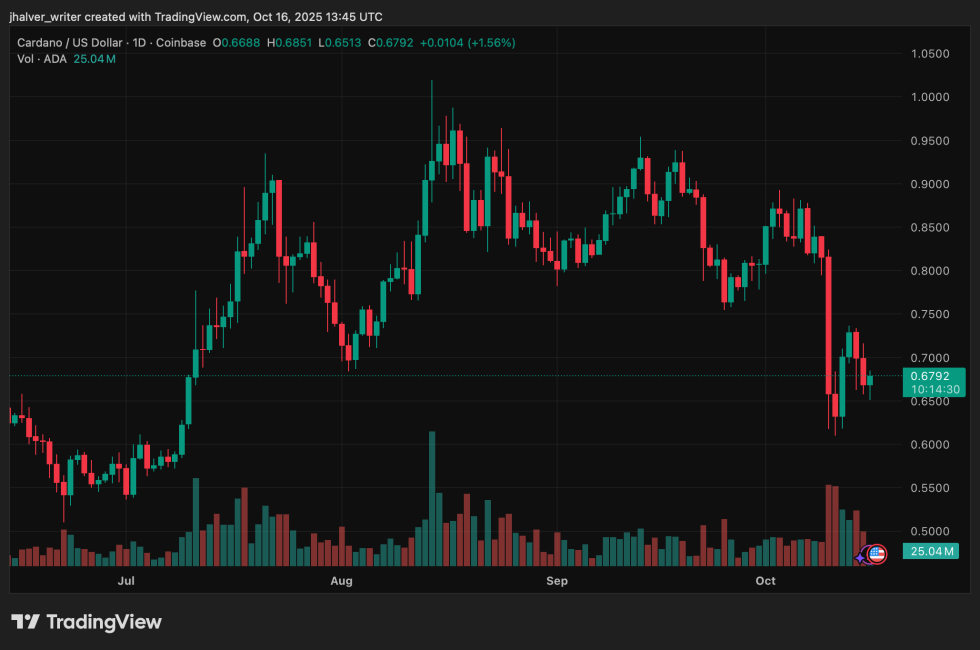
On the 4-hour chart, Cardano is shaping a falling wedge pattern, a structure often preceding bullish reversals. Immediate support rests at $0.65, while $0.74 acts as the first major resistance. A decisive breakout above $0.74 could trigger moves toward $0.80–$0.86, aligning with the 50-day exponential moving average.
cardano ada adausd

ADA's price trends to the downside on the daily chart. Source: ADAUSD on Tradingview

Technical indicators show mixed signals as the RSI at 37 suggests ADA is approaching oversold territory, while Chaikin Money Flow (CMF) at over 0.13 hints at light inflows returning. Analysts warn that failure to hold $0.65 may open a retest of $0.60–$0.62, last seen during June’s correction.

Ecosystem Growth and Institutional Watch

Beyond ADA price action, Cardano’s fundamentals continue to develop. The network’s DeFi TVL remains subdued at $288 million, but new staking options through eToro’s U.S. launch and ongoing ecosystem projects like Midnight and Leios have drawn optimism from long-term investors.

With ETF speculation, whale accumulation, and growing institutional accessibility, analysts argue that ADA may be building a base for recovery into Q4. A clear move above $0.74 could confirm a bullish reversal and set the stage for a test of the $1 mark, while failure to defend $0.65 would extend consolidation.

Cover image from ChatGPT, ADAUSD chart from Tradingview

Editorial Process for bitcoinist is centered on delivering thoroughly researched, accurate, and unbiased content. We uphold strict sourcing standards, and each page undergoes diligent review by our team of top technology experts and seasoned editors. This process ensures the integrity, relevance, and value of our content for our readers.

Lecturas Relacionadas

End of the 'Gray Era' for Hong Kong and US Stock Trading Accounts: Where Can Your Money Go Now?

Hong Kong and US stock “grey account opening era” ends, where can your money go? In a coordinated regulatory crackdown starting May 22nd, Hong Kong's SFC and China's securities regulator have targeted the previously common but legally ambiguous practice of mainland Chinese investors opening accounts with Hong Kong brokers to trade Hong Kong and US stocks. The SFC issued a stern circular after a review of 12 brokerages, citing major deficiencies including inadequate due diligence, acceptance of suspicious or forged documents, and weak management of cross-border relationships. New requirements mandate mainland clients to submit a written declaration confirming their investment funds originate from *outside* mainland China, the account has never been closed for using suspicious documents, and agreeing to information disclosure. Brokers must immediately close accounts opened with suspicious documents and dormant accounts. Simultaneously, Chinese authorities launched a two-year campaign to rectify illegal cross-border securities activities. Key internet brokers like Futu, Tiger Brokers, and Longbridge are facing penalties, with existing accounts allowed only to sell/withdraw funds, not add new ones. The impact is immediate. Reports from social media and financial news outlets confirm that individuals traveling to Hong Kong to open accounts are now required to sign the new declaration. However, even after signing, applications are frequently rejected. The declaration shifts compliance responsibility to the client and acts as a filter, as most mainland investors' funds do not legally meet the "from outside China" criterion. Major brokers like Futu and Tiger have stopped accepting new mainland clients. A few, such as uSmart Securities, Fosun Wealth, and Cheerful Investment, still offer limited channels, but approvals have tightened significantly. Crucially, funding must now come exclusively from the investor's own bank account in Hong Kong or a qualified jurisdiction, blocking previous workarounds like using money changers or stablecoins. For mainland investors, compliant pathways still exist but are narrower. Individuals with overseas status (students, work visa holders) and verifiable offshore funds may still qualify. Official channels like Stock Connect, QDII, and the Cross-boundary Wealth Management Connect remain fully compliant options, albeit with product and quota limitations. On-chain alternatives exist but carry their own regulatory uncertainties and often exclude mainland users. The crackdown signals the end of the lax expansion period for Hong Kong brokers targeting mainland clients. While investment opportunities persist, the era of easy, low-compliance access is over. Investors must now carefully assess their eligibility and understand that signing the new declaration carries personal legal liability.

Odaily星球日报Hace 45 min(s)

End of the 'Gray Era' for Hong Kong and US Stock Trading Accounts: Where Can Your Money Go Now?

Odaily星球日报Hace 45 min(s)

SpaceX's $1.75 Trillion IPO: A Quick Guide to 17 Related Stocks

**Title: SpaceX's $1.75 Trillion IPO: Analysis of 17 Related Stocks** SpaceX is set to IPO on Nasdaq with a $1.75 trillion valuation. The real value driver is Starlink, contributing 61% of Q1 revenue with high margins. Its valuation heavily depends on future execution, including user growth despite falling ARPU. Key stocks have already surged pre-IPO. Tesla (TSLA, +10%) is a primary beneficiary due to deep integration with SpaceX in chip design and AI. Rocket Lab (RKLB, +89%) is seen as a "mini-SpaceX," but faces risk from potential Neutron rocket delays. AST SpaceMobile (ASTS) competes in the same satellite-to-phone market as Starlink. Firefly (FLY, +70%) is a strong government contractor in lunar services. Partners like EchoStar (SATS), Planet Labs (PL), and T-Mobile (TMUS) will see revaluation. Suppliers like Qualcomm (QCOM, +57%) are critical ecosystem "picks and shovels." Investment vehicles like DXYZ (+80%) hold significant SpaceX stakes but trade at high premiums, which may collapse post-IPO. Redwire (RDW) is highlighted as an under-the-radar "pick and shovel" play in space components, with growth in defense contracts and microgravity pharmaceuticals. The article warns that much of the positive news is already priced in, and a post-IPO sell-off is possible. Large IPOs often underperform initially. Key risks include Starship delays, ARPU decline, and unforeseen black swan events affecting Elon Musk or space operations. Investors are advised to focus on companies with solid fundamentals and manage overall sector exposure carefully.

marsbitHace 48 min(s)

SpaceX's $1.75 Trillion IPO: A Quick Guide to 17 Related Stocks

marsbitHace 48 min(s)

Conversation with VanEck CEO: Memory Chip Stocks Are a Bubble, Bitcoin Will Stay but Token Ecosystems Will Disappear

In this podcast, VanEck CEO Jan van Eck discusses his investment outlook centered on three key long-term ("10-year macro") themes: AI-driven compute demand, India's economic rise, and excessive government debt in developed nations. Regarding AI and semiconductors, van Eck believes Nvidia has transformed into a foundational "host" for AI infrastructure, possessing deep moats in software, scale, and power efficiency, making it a core holding. However, he views the recent surge in memory chip stocks as a bubble driven by temporary supply-demand imbalances and pricing power, lacking Nvidia's competitive durability. On asset management, he emphasizes that while ETFs are scale-driven tools, the decisions on which ETFs to own and how to allocate remain highly active. He expresses greatest concern over fixed-income market illiquidity and the risk of a loss of confidence in government debt sustainability. Van Eck is bullish on gold's long-term role as a global monetary alternative and highlights the dramatic policy-driven growth in nuclear energy investment. He is strongly positive on India due to its demographic trends and pro-business reforms. Discussing crypto, he labels 2026 the "year of the corporate-controlled chain," where traditional finance adopts blockchain's best features (like 24/7 operation and programmability) but retains control. He predicts a permanent "crypto winter" for many projects, with only Bitcoin, stablecoins, and the core blockchain concept surviving long-term. He sees the U.S. stablecoin bill as marginally impactful, enabling tech firms to compete with, but not replace, banks. Finally, he views the upcoming SpaceX IPO as a significant, positive liquidity event for markets and advises investors to maintain a long-term, macro perspective when making asset allocation decisions.

marsbitHace 59 min(s)

Conversation with VanEck CEO: Memory Chip Stocks Are a Bubble, Bitcoin Will Stay but Token Ecosystems Will Disappear

marsbitHace 59 min(s)

Trading

Spot
Futuros

Artículos destacados

Cómo comprar ADA

¡Bienvenido a HTX.com! Hemos hecho que comprar Cardano (ADA) sea simple y conveniente. Sigue nuestra guía paso a paso para iniciar tu viaje de criptos.Paso 1: crea tu cuenta HTXUtiliza tu correo electrónico o número de teléfono para registrarte y obtener una cuenta gratuita en HTX. Experimenta un proceso de registro sin complicaciones y desbloquea todas las funciones.Obtener mi cuentaPaso 2: ve a Comprar cripto y elige tu método de pagoTarjeta de crédito/débito: usa tu Visa o Mastercard para comprar Cardano (ADA) al instante.Saldo: utiliza fondos del saldo de tu cuenta HTX para tradear sin problemas.Terceros: hemos agregado métodos de pago populares como Google Pay y Apple Pay para mejorar la comodidad.P2P: tradear directamente con otros usuarios en HTX.Over-the-Counter (OTC): ofrecemos servicios personalizados y tipos de cambio competitivos para los traders.Paso 3: guarda tu Cardano (ADA)Después de comprar tu Cardano (ADA), guárdalo en tu cuenta HTX. Alternativamente, puedes enviarlo a otro lugar mediante transferencia blockchain o utilizarlo para tradear otras criptomonedas.Paso 4: tradear Cardano (ADA)Tradear fácilmente con Cardano (ADA) en HTX's mercado spot. Simplemente accede a tu cuenta, selecciona tu par de trading, ejecuta tus trades y monitorea en tiempo real. Ofrecemos una experiencia fácil de usar tanto para principiantes como para traders experimentados.

1.4k Vistas totalesPublicado en 2024.12.10Actualizado en 2025.03.21

Cómo comprar ADA

Discusiones

Bienvenido a la comunidad de HTX. Aquí puedes mantenerte informado sobre los últimos desarrollos de la plataforma y acceder a análisis profesionales del mercado. A continuación se presentan las opiniones de los usuarios sobre el precio de ADA (ADA).

活动图片