Золото на рекордах, биткоин падает: почему «цифровое золото» не сработало в кризис

cryptonews.ruPublicado a 2025-05-16Actualizado a 2025-10-17

Резкий обвал на крипторынке 10 октября, уничтоживший более $19 млрд, поставил под сомнение один из главных инвестиционных тезисов последних лет

Золото штурмовало новые рекорды выше $4000, а биткоин рухнул вместе с другими рисковыми активами. Это расхождение возобновило дебаты о том, можно ли по-прежнему считать BTC надежным активом-убежищем.

Что такое «ставка на обесценивание»

Идея, объединявшая инвесторов в золото и биткоин, проста: на фоне роста госдолга, инфляции и геополитической напряженности фиатные валюты теряют свою ценность. В этих условиях инвесторы ищут «твердые активы» для защиты капитала. Этот тренд аналитики JPMorgan даже назвали «ставкой на обесценивание» (debasement trade).

Тест на прочность, который биткоин не прошел

События 10 октября стали для этой теории серьезной проверкой. На фоне растущей глобальной напряженности, включая обострение торговой войны между Китаем и США, инвесторы действительно бросились в защитные активы. Но их выбор был однозначным.

  • Золото взлетело до рекордных высот, показав рост почти на 6% за неделю и 60% с начала года.
  • Биткоин, напротив, рухнул, потеряв 8% за неделю и торгуясь на уровне $111 207 на момент написания.

«Биткоин следует за другими рисковыми активами… он не является активом-убежищем, как золото. Мир отказывается от долларового стандарта и возвращается к золотому», — заявил давний критик биткоина Питер Шифф.

Его мнение разделяют многие трейдеры, которые теперь видят биткоин более связанным с акциями технологических компаний, чем с защитой от инфляции. «„Ставка на обесценивание“ больше похожа на мем, чем на реальное движение», — отметил один из них в X.
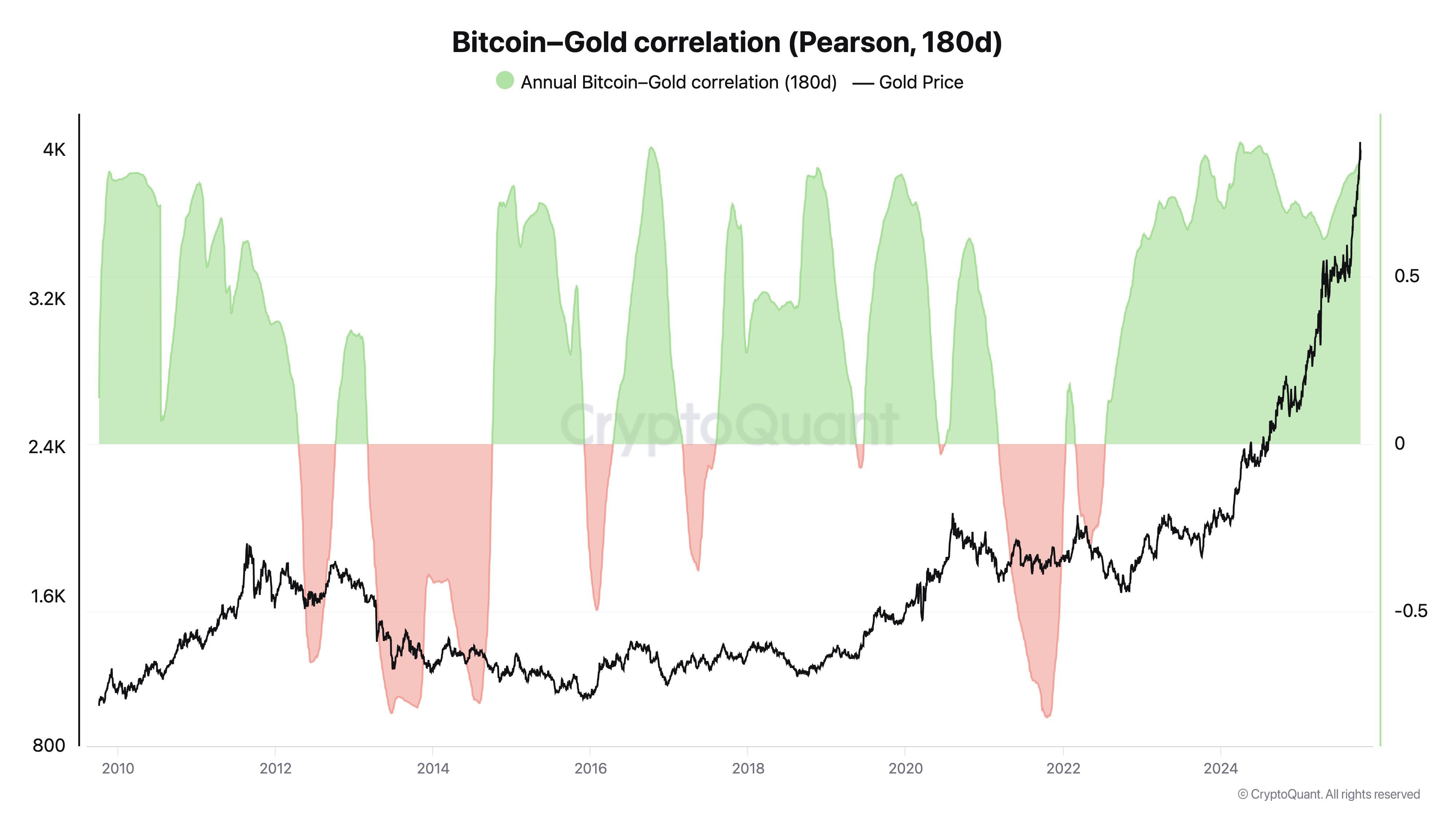
Корреляция биткоина и золота. Источник: Ки Янг Джу на X

Сторонники BTC не сдаются

Однако сторонники биткоина считают, что делать выводы по одной распродаже преждевременно.

Паоло Ардоино, CEO компании Tether, утверждает, что и золото, и биткоин остаются актуальными как долгосрочные средства сбережения.

«Биткоин и золото переживут любую другую валюту», — написал он, подчеркивая, что оба актива играют взаимодополняющие роли.

Эту идею подтверждают и ончейн-данные. Ки Янг Джу, CEO CryptoQuant, отметил, что корреляция между BTC и золотом остается высокой.

«Связь BTC и золота высока; идея цифрового золота все еще жива. Спрос на защиту от инфляции не исчез», — заявил он.

Таким образом, рынок разделился. Для краткосрочных инвесторов и скептиков недавний обвал доказал, что биткоин остается волатильным рисковым активом. Для долгосрочных сторонников — это лишь временное расхождение, не отменяющее фундаментальной ценности BTC как средства сбережения с ограниченной эмиссией.

Будет ли спрос на активы вне фиатной системы проявляться через биткоин, золото или оба варианта, зависит от временного горизонта и склонности инвестора к риску. Золото предлагает вековую легитимность, а биткоин — цифровую мобильность, но и гораздо большую волатильность.

Lecturas Relacionadas

Robotic GPT-3 Moment Shakes Silicon Valley: Zero Lines of Code, Learns Instantly, with Investments from Jensen Huang and Fei-Fei Li

Generalist AI's newly released robot foundation model GEN-1.5 is being hailed as the "GPT-3 moment" for embodied AI. The model demonstrates remarkable one-shot and few-shot learning capabilities in physical manipulation tasks. By watching a single 3-12 second demonstration video (physical prompting) without any training or code, the robot can attempt the task with a 59% average success rate across 10 tasks. With just 5 minutes of demonstration data and minimal fine-tuning (10 gradient steps), the success rate jumps to 83%. The most significant breakthrough is the emergence of spontaneous, improvisational problem-solving abilities not present in the training data. For instance, after learning to sweep blocks with a brush, the robot can adapt to use a banana similarly or switch to a completely new "scoop-and-pour" strategy when given a dustpan. Other emergent behaviors include removing obstacles, correcting errors, and spontaneously sorting objects. These capabilities stem from over 8 months of large-scale pre-training on physical interaction data, suggesting the existence of a Scaling Law for embodied intelligence—where model generalization improves with more data and training time. This approach drastically reduces the cost and expertise needed to teach robots new skills, potentially democratizing robot programming. The release coincides with a surge in the humanoid robotics sector, marked by events like the World Robot Conference and significant investments. While the demonstrated tasks are still relatively simple, the scaling trend and emergent behaviors point toward a future where general-purpose robot "brains" could be easily adapted to various hardware "bodies," reshaping the industry's competitive landscape.

marsbitHace 34 min(s)

Robotic GPT-3 Moment Shakes Silicon Valley: Zero Lines of Code, Learns Instantly, with Investments from Jensen Huang and Fei-Fei Li

marsbitHace 34 min(s)

Semiconductor Industry Sees a New Wave of Price Hikes, with STMicroelectronics, Maxscend and Others Increasing Prices Intensively

The semiconductor industry is experiencing a new wave of price increases driven by supply-demand dynamics and rising costs. Throughout August, multiple international and domestic semiconductor companies have issued price adjustment notices to clients, with a focus on analog and RF chips. Key companies adjusting prices include STMicroelectronics, which is implementing its third price hike in 2026 effective August 23, citing sustained demand pressure and rising costs across the supply chain. Analog Devices, Inc. (ADI) has also announced a second price increase for 2026, effective September 13, due to "unprecedented" demand growth and escalating manufacturing costs. In China, RF chip leader Zhuosheng Microelectronics issued a price adjustment notice for its full RF product line, effective September 1, its first hike this year, attributing it to rising raw material and foundry costs. Additionally, Chinese MCU manufacturer Nations Technologies announced a 10-20% price increase for some products from October 1. This new round of price hikes has shifted its focus to mature process nodes (e.g., analog, RF, power, MCUs), partly due to AI computing demand consuming 8-inch wafer capacity. This contrasts with the first half of 2026, when the surge was led by AI memory chips like HBM and server DRAM. Analysts note that the long lead time for expanding analog/power semiconductor capacity (18-24 months) may sustain price resilience in the short term. However, downstream manufacturers' cost tolerance and fluctuating global demand could become constraints, potentially limiting further significant price increases. Companies have linked the hikes to ensuring future supply stability by funding capacity expansion.

marsbitHace 38 min(s)

Semiconductor Industry Sees a New Wave of Price Hikes, with STMicroelectronics, Maxscend and Others Increasing Prices Intensively

marsbitHace 38 min(s)

Trading

Spot
活动图片