Global Watchdog FSB To Address Stablecoin-Related Risks With Surveillance Overhaul – Report

bitcoinistPublicado a 2025-10-14Actualizado a 2025-10-14

Resumen

Financial Stability Board (FSB), an international body that monitors and makes recommendations about the global financial system, has reportedly vowed...

Trusted Editorial content, reviewed by leading industry experts and seasoned editors. Ad Disclosure

Financial Stability Board (FSB), an international body that monitors and makes recommendations about the global financial system, has reportedly vowed to address the evolving threats from private finance and the growing use of stablecoins.

Global Watchdog Plans Surveillance Overhaul

On Monday, Bank of England (BoE) Governor and FSB Chairman Andrew Bailey promised to increase the global watchdog’s policy response to the emerging risks related to the private finance sector and stablecoins.

According to Bloomberg, Bailey pledged to overhaul the FSB’s surveillance in a letter delivered ahead of this week’s Group of 20 (G20) meetings, seeking to make it “more flexible and quicker to recognise, and respond to, emerging vulnerabilities.”

“Whether it is the rise of private finance, the implications of geopolitical tensions, or the increasing role of stablecoins for payment and settlement purposes, our ability to detect and address emerging risks is critical,” he wrote in the letter.

In June, the Financial Action Task Force (FATF) raised concerns about the “increasing risks” associated with the adoption of stablecoins, noting that the growing use of these digital assets by illicit parties poses a challenge to global financial security.

The FATF emphasized that mass adoption of stablecoins could increase these risks given the “inconsistent application” of its standards across various jurisdictions. Similarly, Bailey considers there is potential for “regulatory arbitrage” due to gaps in addressing financial stability risks and the low number of finalized regulatory frameworks for global stablecoin arrangements.

He affirmed that the FSB will have “open and frank discussions among members” about the next steps for the international watchdog, and will “increase outreach to the private sector to benefit from their expertise and perspectives on risks and vulnerabilities.”

The FSB chair also warned that the global deregulatory trend has “raised concerns that reform efforts may be weakening.” Notably, Bailey has previously shared a skeptical perspective on the sector, cautioning that stablecoins threaten to destabilize the public’s trust in money.

However, he has recently shared a seemingly softer approach, affirming that it would be “wrong to be against stablecoins as a matter of principle,” which could suggest a shift from his highly criticized approach.

Stablecoin Regulation Faces Challenges

Amid stablecoin’s growing momentum, driven by the US regulatory efforts, Europe’s top financial stability watchdog is reportedly pushing for stricter regulations for the sector, which could impact how issuers like Circle and Paxos operate across borders.

As reported by Bitcoinist, the European Central Bank (ECB) has called for a ban on multi-issuance stablecoins in the bloc and other jurisdictions, following a recently passed recommendation by the European Systemic Risk Board (ESRB) to ban jointly issued stablecoins.

Despite being supported by a high-powered board of central bank governors and European Union (EU) officials, the ESRB guidance is not legally binding. However, it will likely pressure authorities to “implement the restrictions or explain how financial stability can be preserved in their absence.”

Meanwhile, the EU is reportedly planning to shift oversight power of key financial market areas, like crypto, from national authorities to a centralized supervisory authority, aiming to boost the bloc’s capital markets and address the continued fragmentation in markets.

The Chair of the European Securities and Markets Authority (ESMA), Verena Ross, affirmed that the European Commission is preparing new rules that would shift the supervision of stock exchanges, crypto companies, and clearing houses from local authorities to ESMA to “create more of a single market for capital in Europe.”

Nonetheless, smaller EU nations, such as Luxembourg, Ireland, and Malta, have criticized the proposal, arguing that a single financial regulator would become a “monster” and questioning the watchdog’s ability to oversee the rapidly growing crypto market.
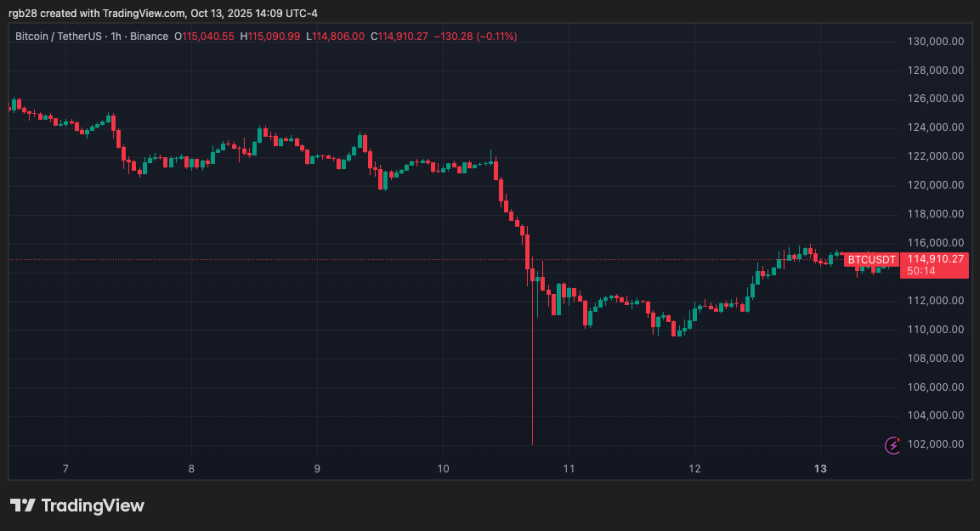
stablecoin, btc, btcusdt, bitcoin

Bitcoin (BTC) trades at $114,910 in the one-week chart. Source: BTCUSDT on TradingView
Featured Image from Unsplash.com, Chart from TradingView.com
Editorial Process for bitcoinist is centered on delivering thoroughly researched, accurate, and unbiased content. We uphold strict sourcing standards, and each page undergoes diligent review by our team of top technology experts and seasoned editors. This process ensures the integrity, relevance, and value of our content for our readers.

Rubmar is a crypto enthusiast who likes learning and improving constantly. She enjoys reporting on the latest news and developments in the crypto industry. Rubmar also enjoys scrapbooking, crafting, simulation games, and watching football.

Lecturas Relacionadas

A 25% Weekly Surge: Bitcoin Breaks $79,000 Amid Mass Short Liquidation

Bitcoin surged above $79,000 on August 21, marking a 25% weekly gain. This rally was accompanied by massive liquidations of short positions exceeding $1.2 billion in 24 hours, catching bearish traders off guard. Several analysts provided technical perspectives. Crypto Candy noted Bitcoin quickly hit targets of $70,700 and $75,000 after breaking consolidation. While a short-term pullback is possible, maintaining momentum above $70,000 could drive prices toward $77,000 and $83,000. Trader Roman confirmed a prior forecast for a $75,000 move, citing bullish signals and a decade-long uptrend, though a minor correction is possible. Daan Crypto Trades highlighted Bitcoin's attempt to hold above key support and the weekly 200EMA. He emphasized the $73,000-$74,000 resistance zone; a sustained break above it would boost confidence for a move toward May's highs, pending a weekly close at or above current levels. Key levels identified are: $70,000 (bullish scenario support), $73,000-$74,000 (critical resistance), $79,000 (current peak), and $83,000 (next target). Analysts agree the $73K-$74K zone is crucial for further upside toward $80K-$83K, acknowledging potential for a short-term correction but noting the overall chart structure remains bullish. An AI-driven analysis compares the current surge to past events, suggesting such short-squeeze rallies can be short-lived impulses rather than definitive trend reversals. It questions whether the move reflects genuine spot demand or a cascade of derivative liquidations, with sustainability to be tested after the weekly close.

cryptonews.ruHace 3 min(s)

A 25% Weekly Surge: Bitcoin Breaks $79,000 Amid Mass Short Liquidation

cryptonews.ruHace 3 min(s)

Bitcoin, Ethereum, and Solana Rise as Another $1 Billion Short Position is Liquidated

Bitcoin, Ethereum, and Solana have seen significant gains as over $1 billion in short positions were liquidated. Bitcoin surged past $76,000, rising over 9% in 24 hours and 21% for the week, after trading around $64,100 just days prior. Short sellers incurred major losses, with roughly $1.2 billion in short positions liquidated over the past day, contributing to a two-day total exceeding $4 billion. This followed a record $3 billion in liquidations on Thursday, the largest single-day amount since 2021. The liquidations, triggered when leveraged bets move against traders, force buybacks that propel prices upward in a cascading effect. This rally distinguishes between demand-driven growth and mechanics-driven volatility, as forced buying does not reflect a belief in higher intrinsic value. Other major cryptocurrencies also advanced. Ethereum rose nearly 5% to $2,350, Solana gained over 5% to just under $90, and Dogecoin increased almost 9%. The rally was spurred by the U.S. Treasury doubling its long-term bond buyback to $4 billion, easing conditions in the $30 trillion Treasury market and boosting risk appetite. Additionally, Bitcoin broke past key resistance around $66,600, setting $76,000 as the next target. Political support also played a role, with President Trump urging Congress to advance the Digital Asset Market Clarity Act at a White House event attended by crypto industry leaders. Bitcoin's market cap now stands at $1.5 trillion, still about 40% below its October all-time high of over $126,000.

cryptonews.ruHace 33 min(s)

Bitcoin, Ethereum, and Solana Rise as Another $1 Billion Short Position is Liquidated

cryptonews.ruHace 33 min(s)

Trading

Spot
活动图片