US Senate Push for DeFi Restrictions Raises Fears of Crypto Market Slowdown

bitcoinistPublicado a 2025-10-11Actualizado a 2025-10-11

Resumen

A leaked draft from the US Senate Banking Committee Democrats outlines an aggressive approach to decentralized finance (DeFi), proposing that...

Trusted Editorial content, reviewed by leading industry experts and seasoned editors. Ad Disclosure

A leaked draft from the US Senate Banking Committee Democrats outlines an aggressive approach to decentralized finance (DeFi), proposing that any person or firm “designing, deploying, operating or profiting from a DeFi front-end” be regulated as a broker and register with the SEC or CFTC.

The text would also extend KYC/AML obligations to DeFi interfaces, including some non-custodial wallets and UI hosts, and authorize the U.S. Treasury to maintain a “restricted list” of risky protocols and front-ends.

While the memo carves out room for “sufficiently decentralized” protocols that don’t monetize, and shields open-source developers who don’t profit from running the tech, critics argue the compliance bar is functionally impossible for most U.S.-based teams.
Ethereum DeFi Crypto

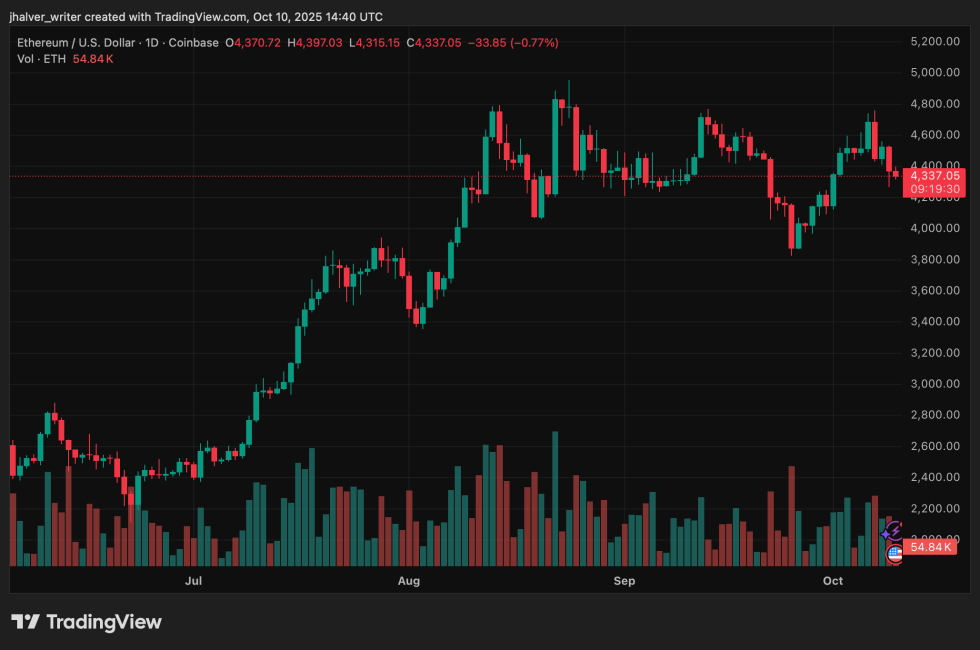
ETH's price trends to the upside on the daily chart. Source: ETHUSD on Tradingview

Industry Backlash And Early Market Impact

Reaction from crypto policy leaders was swift. Jake Chervinsky, chief legal officer at Variant, said that “ropes in everyone in crypto,” calling it unworkable and tantamount to a ban on U.S. DeFi front-ends.

Summer Mersinger of the Blockchain Association warned it would “effectively ban DeFi, wallet development, and other applications in the United States,” pushing responsible builders offshore.

Consequently, markets appeared to flinch as a DeFi basket gauge slipped 3–4%, with notable underperformers including HYPE and ASTR amid growing regulatory uncertainty.

Beyond prices, founders fear a chilling effect on hiring, fundraising, and product launches if front-end operators and wallet providers must run full broker-style compliance stacks.

Politics, Policy, And The Risk Of An Innovation Exodus

The Senate had been inching toward a bipartisan digital-asset market-structure compromise after the House passed its Digital Asset Market Clarity Act (294–134). But Democrats’ DeFi counter-proposal, driven in part by illicit finance and national-security concerns, may stall momentum in a chamber that needs 60 votes.

If the “restricted list” and front-end broker provisions survive, expect heavy lobbying, civil-liberties pushback, and potential court challenges. Strategists warn the U.S. could cede developer mindshare and liquidity to Europe’s MiCA regime, which already provides clearer guardrails for token issuers and service providers.

Potential Impact of Senate DeFi Restrictions

The leak raises the odds of a near-term U.S. DeFi slowdown as teams reassess legal exposure and capital waits for clarity.

For markets, the key watchpoints are (1) whether Senate staff soften front-end and wallet obligations, (2) how “sufficient decentralization” is defined in statute, and (3) whether Treasury’s blacklist power is scoped narrowly.

Without meaningful revisions, the U.S. risks swapping consumer protection for a brain drain, with innovation (and tax revenue) flowing to friendlier jurisdictions.

Cover image from ChatGPT, ETHUSD chart from Tradingview

Editorial Process for bitcoinist is centered on delivering thoroughly researched, accurate, and unbiased content. We uphold strict sourcing standards, and each page undergoes diligent review by our team of top technology experts and seasoned editors. This process ensures the integrity, relevance, and value of our content for our readers.

Criptos en tendencia

Lecturas Relacionadas

Robotic GPT-3 Moment Shakes Silicon Valley: Zero Lines of Code, Learns Instantly, with Investments from Jensen Huang and Fei-Fei Li

Generalist AI's newly released robot foundation model GEN-1.5 is being hailed as the "GPT-3 moment" for embodied AI. The model demonstrates remarkable one-shot and few-shot learning capabilities in physical manipulation tasks. By watching a single 3-12 second demonstration video (physical prompting) without any training or code, the robot can attempt the task with a 59% average success rate across 10 tasks. With just 5 minutes of demonstration data and minimal fine-tuning (10 gradient steps), the success rate jumps to 83%. The most significant breakthrough is the emergence of spontaneous, improvisational problem-solving abilities not present in the training data. For instance, after learning to sweep blocks with a brush, the robot can adapt to use a banana similarly or switch to a completely new "scoop-and-pour" strategy when given a dustpan. Other emergent behaviors include removing obstacles, correcting errors, and spontaneously sorting objects. These capabilities stem from over 8 months of large-scale pre-training on physical interaction data, suggesting the existence of a Scaling Law for embodied intelligence—where model generalization improves with more data and training time. This approach drastically reduces the cost and expertise needed to teach robots new skills, potentially democratizing robot programming. The release coincides with a surge in the humanoid robotics sector, marked by events like the World Robot Conference and significant investments. While the demonstrated tasks are still relatively simple, the scaling trend and emergent behaviors point toward a future where general-purpose robot "brains" could be easily adapted to various hardware "bodies," reshaping the industry's competitive landscape.

marsbitHace 40 min(s)

Robotic GPT-3 Moment Shakes Silicon Valley: Zero Lines of Code, Learns Instantly, with Investments from Jensen Huang and Fei-Fei Li

marsbitHace 40 min(s)

Semiconductor Industry Sees a New Wave of Price Hikes, with STMicroelectronics, Maxscend and Others Increasing Prices Intensively

The semiconductor industry is experiencing a new wave of price increases driven by supply-demand dynamics and rising costs. Throughout August, multiple international and domestic semiconductor companies have issued price adjustment notices to clients, with a focus on analog and RF chips. Key companies adjusting prices include STMicroelectronics, which is implementing its third price hike in 2026 effective August 23, citing sustained demand pressure and rising costs across the supply chain. Analog Devices, Inc. (ADI) has also announced a second price increase for 2026, effective September 13, due to "unprecedented" demand growth and escalating manufacturing costs. In China, RF chip leader Zhuosheng Microelectronics issued a price adjustment notice for its full RF product line, effective September 1, its first hike this year, attributing it to rising raw material and foundry costs. Additionally, Chinese MCU manufacturer Nations Technologies announced a 10-20% price increase for some products from October 1. This new round of price hikes has shifted its focus to mature process nodes (e.g., analog, RF, power, MCUs), partly due to AI computing demand consuming 8-inch wafer capacity. This contrasts with the first half of 2026, when the surge was led by AI memory chips like HBM and server DRAM. Analysts note that the long lead time for expanding analog/power semiconductor capacity (18-24 months) may sustain price resilience in the short term. However, downstream manufacturers' cost tolerance and fluctuating global demand could become constraints, potentially limiting further significant price increases. Companies have linked the hikes to ensuring future supply stability by funding capacity expansion.

marsbitHace 43 min(s)

Semiconductor Industry Sees a New Wave of Price Hikes, with STMicroelectronics, Maxscend and Others Increasing Prices Intensively

marsbitHace 43 min(s)

Trading

Spot

Artículos destacados

Cómo comprar PUSH

¡Bienvenido a HTX.com! Hemos hecho que comprar Push Protocol (PUSH) sea simple y conveniente. Sigue nuestra guía paso a paso para iniciar tu viaje de criptos.Paso 1: crea tu cuenta HTXUtiliza tu correo electrónico o número de teléfono para registrarte y obtener una cuenta gratuita en HTX. Experimenta un proceso de registro sin complicaciones y desbloquea todas las funciones.Obtener mi cuentaPaso 2: ve a Comprar cripto y elige tu método de pagoTarjeta de crédito/débito: usa tu Visa o Mastercard para comprar Push Protocol (PUSH) al instante.Saldo: utiliza fondos del saldo de tu cuenta HTX para tradear sin problemas.Terceros: hemos agregado métodos de pago populares como Google Pay y Apple Pay para mejorar la comodidad.P2P: tradear directamente con otros usuarios en HTX.Over-the-Counter (OTC): ofrecemos servicios personalizados y tipos de cambio competitivos para los traders.Paso 3: guarda tu Push Protocol (PUSH)Después de comprar tu Push Protocol (PUSH), guárdalo en tu cuenta HTX. Alternativamente, puedes enviarlo a otro lugar mediante transferencia blockchain o utilizarlo para tradear otras criptomonedas.Paso 4: tradear Push Protocol (PUSH)Tradear fácilmente con Push Protocol (PUSH) en HTX's mercado spot. Simplemente accede a tu cuenta, selecciona tu par de trading, ejecuta tus trades y monitorea en tiempo real. Ofrecemos una experiencia fácil de usar tanto para principiantes como para traders experimentados.

303 Vistas totalesPublicado en 2024.12.13Actualizado en 2026.06.02

Cómo comprar PUSH

Discusiones

Bienvenido a la comunidad de HTX. Aquí puedes mantenerte informado sobre los últimos desarrollos de la plataforma y acceder a análisis profesionales del mercado. A continuación se presentan las opiniones de los usuarios sobre el precio de PUSH (PUSH).

活动图片