Bitcoin Whale Balances Stabilize As Price Hits $125K ATH: Signs of Re-Accumulation?

bitcoinistPublicado a 2025-10-06Actualizado a 2025-10-07

Resumen

Bitcoin is now trading just below its $125,000 all-time high, following a powerful 15% rally from the $109,000 level that...

Trusted Editorial content, reviewed by leading industry experts and seasoned editors. Ad Disclosure

Bitcoin is now trading just below its $125,000 all-time high, following a powerful 15% rally from the $109,000 level that reignited bullish momentum across the market. After weeks of sideways movement, bulls have reclaimed control, pushing BTC into a critical zone where a clean breakout above $125K could mark the start of a new price discovery phase.

However, not all signals are equally bullish. A recent report from CryptoQuant sheds light on growing caution among large holders. The firm’s Total Whale Holdings metric tracks the 30-day percentage change in Bitcoin held by whales, offering a direct view into their accumulation or distribution activity. Currently, the indicator is showing negative values, signaling that whales have been actively reducing their positions throughout September 2025.

This decline in whale balances suggests that while retail and institutional inflows have driven price gains, smart money is locking in profits after months of upward momentum. The combination of strong technical structure and shifting onchain data presents a pivotal moment for Bitcoin. Bulls must sustain pressure above key resistance levels to invalidate the risk of a deeper correction — and confirm that this rally is more than just a temporary spike in optimism.

Whales Show Signs of Exhaustion

Top analyst Burak Kesmeci shared new insights on Bitcoin’s current onchain dynamics, pointing to a potential shift in whale behavior that could shape the market’s next major move. According to Kesmeci, the red zone on the chart clearly illustrates a 30-day downtrend in whale holdings, confirming that large investors have sold a significant amount of Bitcoin over the past month. This sustained selling pressure coincided with Bitcoin’s earlier struggles to hold above $120,000, contributing to volatility and short-term uncertainty.

Bitcoin Total Whale Holdings | Source: CryptoQuant

However, despite this wave of distribution, one key observation stands out: as prices have stabilized near record highs, whales have noticeably slowed their selling pace. The narrowing purple area in the indicator marks a gradual recovery from the negative zone, signaling that the most intense phase of selling may now be behind us.

Kesmeci concludes that whales have been net sellers for nearly a month, but in the first days of October, this trend has clearly eased. This behavior could suggest the beginning of a re-accumulation phase, where large holders start building positions again at slightly lower levels. In short, Bitcoin’s biggest investors appear to be approaching selling exhaustion, which may support a short-term uptrend as long as the data remains stable.

If this pattern continues, it would strengthen the bullish outlook and potentially pave the way for a clean breakout above $125,000, confirming Bitcoin’s next leg higher into uncharted territory.

Bitcoin Faces Key Resistance: Price Tests All-Time Highs

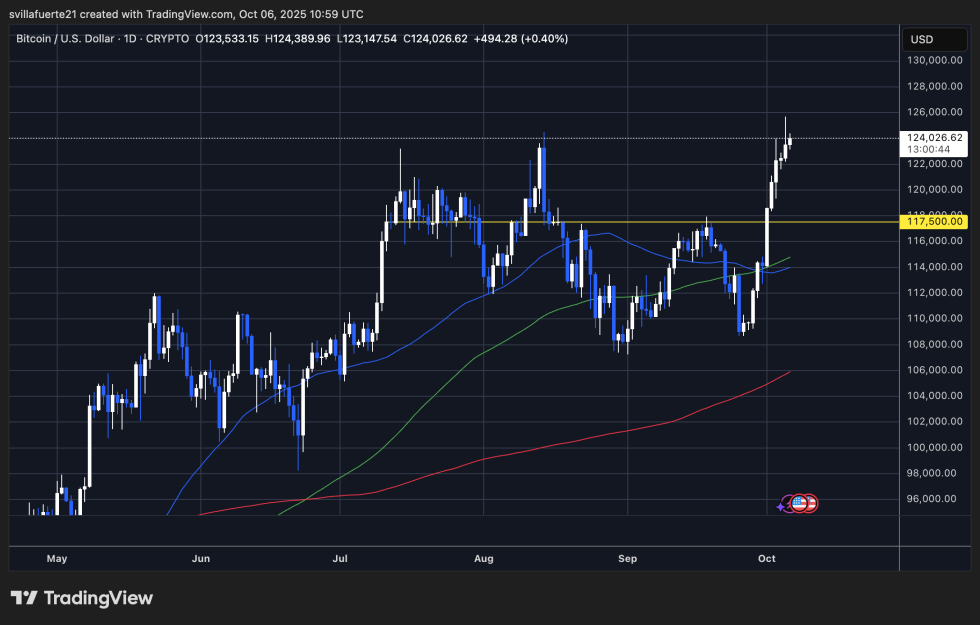
Bitcoin continues to show remarkable strength after reclaiming the $120,000 level and now trades around $124,000, just below its all-time high near $125,000. The chart reveals a clear breakout above the $117,500 resistance, which has now flipped into strong support — a pivotal level that has capped price advances multiple times since mid-August.

BTC testing new ATH | Source: BTCUSDT chart on TradingView

The 50-day moving average (blue line) has crossed above the 200-day (red line), confirming a bullish structure. Momentum remains in favor of the bulls, supported by higher lows since late September. However, Bitcoin is currently consolidating near its previous peak, signaling a potential short-term pause before the next move.

If BTC manages to close above $125,000 with strong volume, it would likely confirm a breakout into price discovery, potentially opening the door to the $130,000–$135,000 range. On the downside, failure to hold above $122,000 could trigger a pullback toward $118,000, where buyers previously stepped in aggressively.

The market structure remains healthy, and with bulls firmly in control, the next few sessions will be critical in determining whether Bitcoin can sustain its parabolic advance or faces a temporary correction before resuming its upward trend.

Featured image from ChatGPT, chart from TradingView.com

Editorial Process for bitcoinist is centered on delivering thoroughly researched, accurate, and unbiased content. We uphold strict sourcing standards, and each page undergoes diligent review by our team of top technology experts and seasoned editors. This process ensures the integrity, relevance, and value of our content for our readers.

Sebastian's journey into the world of crypto began four years ago, driven by a fascination with the potential of blockchain technology to revolutionize financial systems. His initial exploration focused on understanding the intricacies of various crypto projects, particularly those focused on building innovative financial solutions. Through countless hours of research and learning, Sebastian developed a deep understanding of the underlying technologies, market dynamics, and potential applications of cryptocurrencies. As his knowledge grew, Sebastian felt compelled to share his insights with others. He began actively contributing to online discussions on platforms like X and LinkedIn, focusing on fintech and crypto-related content. His goal was to expose valuable trends and insights to a wider audience, fostering a deeper understanding of the rapidly evolving crypto landscape. Sebastian's contributions quickly gained recognition, and he became a trusted voice in the online crypto community. To further enhance his expertise, Sebastian pursued a UC Berkeley Fintech: Frameworks, Applications, and Strategies certification. This rigorous program equipped him with valuable skills and knowledge regarding Financial Technology, bridging the gap between traditional finance (TradFi) and decentralized finance (DeFi). The certification deepened his understanding of the broader financial landscape and its intersection with blockchain technology. Sebastian's passion for finance and writing is evident in his work. He enjoys delving into financial research, analyzing market trends, and exploring the latest developments in the crypto space. In his spare time, Sebastian can often be found immersed in charts, studying 10-K forms, or engaging in thought-provoking discussions about the future of finance. Sebastian's journey as a crypto analyst and investor has been marked by a relentless pursuit of knowledge and a dedication to sharing his insights. His ability to navigate the complex world of crypto, combined with his passion for financial research and communication, makes him a valuable asset to the industry. As the crypto landscape continues to evolve, Sebastian remains at the forefront, providing valuable insights and contributing to the growth of this revolutionary technology.

Lecturas Relacionadas

How to View the Divergence Between Gold and Oil Prices?

The article analyzes the divergence between gold and oil prices following the outbreak of the U.S.-Iran war. While oil prices surged significantly, gold experienced a decline, contrary to expectations given its traditional role as a safe-haven asset during geopolitical crises. Gold serves three primary hedging functions: against geopolitical risk, inflation risk, and U.S. dollar risk. Since late 2023, gold had been in a strong bull market, rising from $1,800 to over $5,000, driven by simultaneous geopolitical tensions (e.g., Russia-Ukraine war, Middle East conflicts), inflationary pressures, and a weakening dollar due to the Fed's premature rate cuts. However, after the U.S. "decapitation" strike on Iran, gold prices fell sharply. This was attributed to two main factors: a shift of capital from gold to oil, as investors repositioned portfolios to capitalize on rising oil prices, and a liquidity crisis in U.S. financial markets that forced large-scale sell-offs of gold—a highly liquid asset—to meet redemption demands. More critically, growing pessimism about a prolonged U.S.-Iran conflict raised fears of sustained high oil prices, potential global economic disruption, and a possible reversal of Fed monetary policy (delayed cuts or even renewed hikes). This expectation of tighter policy caused gold’s dollar-related hedging function to reverse, overwhelming its geopolitical and inflation hedging roles and leading to a severe correction. Oil prices also experienced volatility. They initially spiked to nearly $120 per barrel post-strike, then fell by 30% on Trump’s hints of a quick resolution, but rebounded as market expectations corrected when the conflict persisted and the Strait of Hormuz remained threatened. The outlook for both commodities depends on the evolution of the U.S.-Iran conflict. If it becomes a prolonged war like Ukraine, gold may lack short-term value as monetary fears prevail, while oil and energy assets may benefit. A critical factor will be whether the Strait of Hormuz is reopened, which hinges on geopolitical decisions ahead.

marsbitHace 1 hora(s)

How to View the Divergence Between Gold and Oil Prices?

marsbitHace 1 hora(s)

The Stablecoin Yield Debate: How It's Stalling U.S. Crypto Regulatory Legislation?

The debate over stablecoin yields has become a central obstacle to U.S. cryptocurrency regulatory legislation, stalling the Senate’s proposed CLARITY Act. The conflict centers on whether dollar-pegged stablecoins should function solely as payment tools or also offer yield-bearing features that compete with traditional bank deposits and money market funds. Banks argue that yield offerings could drain deposits—potentially up to $500 billion by 2028—undermining their lending capacity and harming local economies. They are pushing Congress to explicitly prohibit such returns. In contrast, crypto firms contend that limited incentives could help digital dollars compete with traditional payment systems and drive mainstream adoption. A Congressional Research Service report highlighted legal ambiguities in the earlier GENIUS bill, which banned direct issuer-yield payments but left room for intermediaries to distribute benefits. This regulatory gap has intensified the legislative standoff. With political deadlines tightening ahead of elections, the window for passing the bill is narrow—likely closing by late April or early May. If Congress fails to act, regulators may impose rules independently, such as the OCC’s proposed restrictions on indirect yield mechanisms. The outcome will shape not only the future of stablecoin yields but also broader crypto market structure, including asset classification and regulatory clarity. Failure could delay legal certainty, forcing the industry to rely on organic adoption rather than legislative support.

marsbitHace 1 hora(s)

The Stablecoin Yield Debate: How It's Stalling U.S. Crypto Regulatory Legislation?

marsbitHace 1 hora(s)

Trading

Spot
Futuros

Artículos destacados

Cómo comprar ATH

¡Bienvenido a HTX.com! Hemos hecho que comprar Aethir (ATH) sea simple y conveniente. Sigue nuestra guía paso a paso para iniciar tu viaje de criptos.Paso 1: crea tu cuenta HTXUtiliza tu correo electrónico o número de teléfono para registrarte y obtener una cuenta gratuita en HTX. Experimenta un proceso de registro sin complicaciones y desbloquea todas las funciones.Obtener mi cuentaPaso 2: ve a Comprar cripto y elige tu método de pagoTarjeta de crédito/débito: usa tu Visa o Mastercard para comprar Aethir (ATH) al instante.Saldo: utiliza fondos del saldo de tu cuenta HTX para tradear sin problemas.Terceros: hemos agregado métodos de pago populares como Google Pay y Apple Pay para mejorar la comodidad.P2P: tradear directamente con otros usuarios en HTX.Over-the-Counter (OTC): ofrecemos servicios personalizados y tipos de cambio competitivos para los traders.Paso 3: guarda tu Aethir (ATH)Después de comprar tu Aethir (ATH), guárdalo en tu cuenta HTX. Alternativamente, puedes enviarlo a otro lugar mediante transferencia blockchain o utilizarlo para tradear otras criptomonedas.Paso 4: tradear Aethir (ATH)Tradear fácilmente con Aethir (ATH) en HTX's mercado spot. Simplemente accede a tu cuenta, selecciona tu par de trading, ejecuta tus trades y monitorea en tiempo real. Ofrecemos una experiencia fácil de usar tanto para principiantes como para traders experimentados.

336 Vistas totalesPublicado en 2024.12.11Actualizado en 2025.03.21

Cómo comprar ATH

Discusiones

Bienvenido a la comunidad de HTX. Aquí puedes mantenerte informado sobre los últimos desarrollos de la plataforma y acceder a análisis profesionales del mercado. A continuación se presentan las opiniones de los usuarios sobre el precio de ATH (ATH).

活动图片