Ethereum Accumulation Addresses Pin $2.9K Realized Price – Strong Support Ahead?

bitcoinistPublicado a 2025-09-24Actualizado a 2025-09-24

Resumen

Ethereum is navigating a critical phase in the market after shedding more than 14% of its value since September 13....

Trusted Editorial content, reviewed by leading industry experts and seasoned editors. Ad Disclosure

Ethereum is navigating a critical phase in the market after shedding more than 14% of its value since September 13. The second-largest cryptocurrency has entered a corrective stage following weeks of strong price surges that carried it to multi-month highs. Despite the recent downturn, sentiment among analysts and investors remains cautiously optimistic, with many expecting ETH to rebound once bullish momentum resurfaces.

One of the most important signals supporting this view comes from CryptoQuant, which reports that the average realized price of Ethereum accumulation addresses is around $2.9K. This level has become a key reference point for traders, as it suggests that long-term holders and accumulation wallets are positioned at a much higher cost basis compared to past cycles. In practical terms, this could act as a strong support zone, reducing downside risk and strengthening confidence in Ethereum’s ability to hold ground.

The corrective phase also fits within the broader narrative of market consolidation, where temporary pullbacks often reset overheated indicators before the next rally. While volatility may persist in the short term, ETH’s fundamentals, combined with resilient onchain signals, continue to fuel expectations of a recovery and renewed strength in the weeks ahead.

Ethereum Accumulation Levels Signal Critical Support

According to top analyst Burak Kesmeci, Ethereum’s realized price for accumulation addresses has become one of the most important signals in the current market environment. With the ETH ETF rally, this metric surged significantly, rising from $1.7K to $2.9K in a relatively short period. Such a sharp increase underscores the aggressive positioning of long-term holders who accumulated ETH at higher valuations, effectively raising the overall cost basis of this critical cohort.
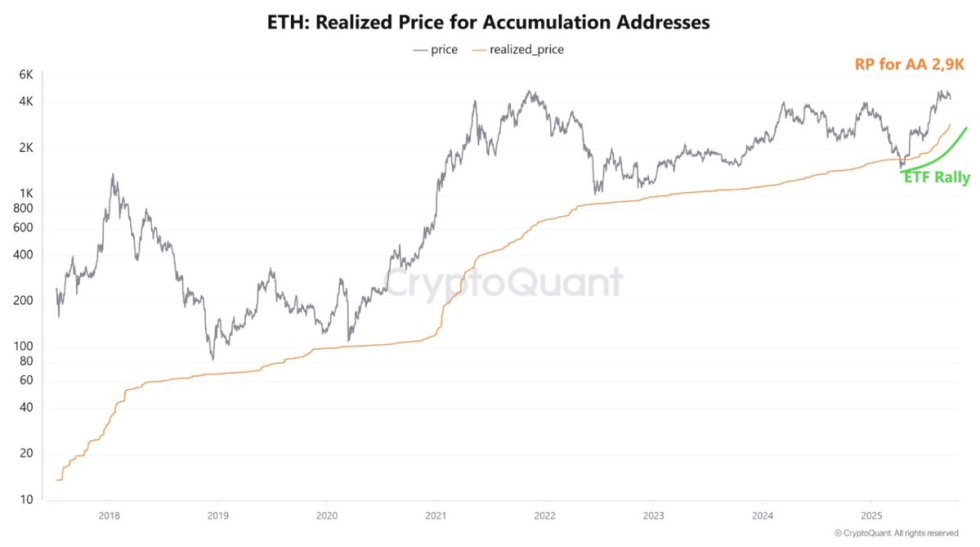
Ethereum Realized Price For Accumulation Addresses | Source: CryptoQuant

At the same time, the total balance in these addresses has climbed to 27.6 million ETH, a staggering amount that highlights the scale of conviction among accumulation wallets. This suggests that a large portion of the supply is now held by investors with strong hands, reducing the likelihood of panic selling and providing a stabilizing effect on the market.

Kesmeci notes that, in the worst-case scenario, the $2.9K realized price could act as a robust support zone, offering a defensive line against further downside. However, the coming days will serve as a crucial test for ETH bulls. Holding above current levels will be essential to avoid a deeper correction that could undermine the bullish momentum built up in recent months.

Testing Critical Support

Ethereum (ETH) is showing weakness after its recent decline, with the chart reflecting a sharp selloff from local highs above $4,600 down to the $4,100 area. Currently, ETH is trading around $4,173, sitting just above the 200 EMA at $4,106, which now acts as critical support. A sustained defense of this level is key to preventing a deeper correction.
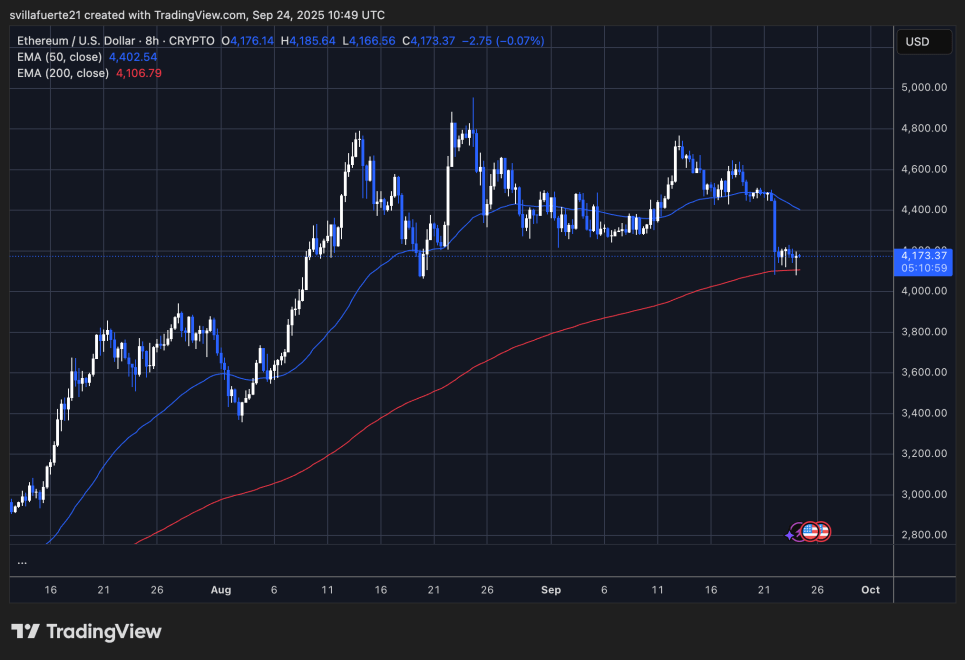
ETH testing the 8H 200 EMA | Source: ETHUSDT chart on TradingView

The 50 EMA at $4,402 has turned downward, highlighting short-term bearish momentum and reinforcing the idea that sellers are in control. Unless ETH can reclaim the 50 EMA decisively, pressure may continue. That said, the fact that the 200 EMA is still sloping upward suggests the long-term trend remains intact, even if the market is entering a corrective phase.

From a technical perspective, the rejection near $4,600 created a lower high, a sign of caution for bulls. However, if ETH manages to stabilize above $4,100 and form a base, a rebound toward $4,400 remains possible; conversely, a break below the 200 EMA could expose the $3,800–$3,900 zone as the next major support.

Featured image from Dall-E, chart from TradingView

Editorial Process for bitcoinist is centered on delivering thoroughly researched, accurate, and unbiased content. We uphold strict sourcing standards, and each page undergoes diligent review by our team of top technology experts and seasoned editors. This process ensures the integrity, relevance, and value of our content for our readers.

Sebastian's journey into the world of crypto began four years ago, driven by a fascination with the potential of blockchain technology to revolutionize financial systems. His initial exploration focused on understanding the intricacies of various crypto projects, particularly those focused on building innovative financial solutions. Through countless hours of research and learning, Sebastian developed a deep understanding of the underlying technologies, market dynamics, and potential applications of cryptocurrencies. As his knowledge grew, Sebastian felt compelled to share his insights with others. He began actively contributing to online discussions on platforms like X and LinkedIn, focusing on fintech and crypto-related content. His goal was to expose valuable trends and insights to a wider audience, fostering a deeper understanding of the rapidly evolving crypto landscape. Sebastian's contributions quickly gained recognition, and he became a trusted voice in the online crypto community. To further enhance his expertise, Sebastian pursued a UC Berkeley Fintech: Frameworks, Applications, and Strategies certification. This rigorous program equipped him with valuable skills and knowledge regarding Financial Technology, bridging the gap between traditional finance (TradFi) and decentralized finance (DeFi). The certification deepened his understanding of the broader financial landscape and its intersection with blockchain technology. Sebastian's passion for finance and writing is evident in his work. He enjoys delving into financial research, analyzing market trends, and exploring the latest developments in the crypto space. In his spare time, Sebastian can often be found immersed in charts, studying 10-K forms, or engaging in thought-provoking discussions about the future of finance. Sebastian's journey as a crypto analyst and investor has been marked by a relentless pursuit of knowledge and a dedication to sharing his insights. His ability to navigate the complex world of crypto, combined with his passion for financial research and communication, makes him a valuable asset to the industry. As the crypto landscape continues to evolve, Sebastian remains at the forefront, providing valuable insights and contributing to the growth of this revolutionary technology.

Criptos en tendencia

Lecturas Relacionadas

Semiconductor Stock Rebound: Is the Technical Correction Over or a Trend Reversal?

The core of recent semiconductor stock volatility is not about daily price swings, but rather the market questioning whether AI-driven semiconductor pricing has entered a new phase. Following a sharp sell-off in Korean stocks on June 23rd, led by Samsung and SK Hynix, a subsequent rebound is seen more as a technical positioning adjustment rather than a confirmed trend reversal. The key variable is HBM (High Bandwidth Memory), essential for AI chips. Its supply-demand imbalance granted memory makers significant pricing power. The current market focus is on whether this dynamic remains strong enough to justify elevated valuations. All eyes are on Micron's upcoming earnings report. The critical factor is not whether results meet already high expectations, but whether the company's guidance confirms that AI memory pricing power, order visibility, and future margins are still expanding. Micron's outlook will serve as a crucial test for the broader AI semiconductor chain, including Samsung, SK Hynix, and other infrastructure players. The recent bounce appears to be a pre-earnings positioning repair. For it to evolve into a sustained uptrend, concrete evidence is needed that the AI infrastructure expansion cycle's fundamentals—particularly for high-end memory—remain robust and can continue to surpass elevated market expectations. The risk is that strong demand alone may not be sufficient if future guidance hints at peaking momentum or increasing supply-side pressures.

marsbitHace 28 min(s)

Semiconductor Stock Rebound: Is the Technical Correction Over or a Trend Reversal?

marsbitHace 28 min(s)

Global Tech Stocks Plunge: Another Stress Test for the AI Bull Market

Global tech stocks plummeted in a sharp selloff on June 23, with South Korea's KOSPI index crashing nearly 10%, triggering a trading halt. The plunge was led by semiconductor giants Samsung and SK Hynix, dragging down major Asian and US tech indexes and levered ETFs. The immediate trigger was a confluence of three signals within 24 hours: 1) reports that SK Hynix was slowing HBM4 expansion, raising doubts about a key AI chip bottleneck; 2) profit-taking ahead of Micron's earnings report after its massive year-to-date rally; and 3) a warning from Korean regulators about the risks of single-stock leveraged ETFs. The selloff's severity was amplified by Korea's uniquely leveraged market structure: record-high retail margin debt, over $30 billion in volatile single-stock leveraged ETFs requiring daily rebalancing (which creates selling pressure during declines), and the surprising shift of the National Pension Service from a net buyer to a net seller. The event reignited debates about an AI bubble. Analysts differed on timing—some warned of imminent rupture, others saw a temporary liquidity-driven correction—but agreed that sky-high valuations, a shift to retail/leveraged buying, and rising rates created a fragile setup. The parallel steep drop in SpaceX's stock, alongside its massive debt raise for AI infrastructure, underscored a broader market shift from narrative-driven "infinite imagination" to a "return on investment" calculation phase. All eyes are now on Micron's upcoming earnings report, seen as a key test for the AI hardware trade's fundamental logic. A strong report could stabilize markets, while a miss could validate deeper fears. The episode serves as a stark warning: when a bull run becomes dependent on leveraged bets on a single narrative, a violent and rapid correction should not be a surprise. The core question for investors is how much drawdown they are willing to tolerate to stay invested.

marsbitHace 29 min(s)

Global Tech Stocks Plunge: Another Stress Test for the AI Bull Market

marsbitHace 29 min(s)

Ethereum Foundation Cuts 20% of Staff, 54 Depart: The Survival Logic Behind the Restructuring

The Ethereum Foundation (EF) has announced a major restructuring, resulting in the departure of 54 staff members, representing approximately 20% of its workforce. This reorganization is not merely a cost-cutting measure but a strategic refocusing. The EF will now concentrate its resources on what it deems critical and unique tasks, structured around five new operational clusters. The new structure comprises clusters dedicated to: the Protocol Layer (ensuring Ethereum's core properties like censorship resistance and security); the Access Layer (enabling trusted, non-intermediated user interactions); the User Layer (grounding decisions in real user needs and constraints); the Community Layer (representing EF's stance and building alliances); and the Institutional Layer (engaging with enterprises, governments, and academia to promote principled adoption). The foundation stated that the layoffs were a difficult but necessary step to align its organization and spending with its long-term mandate, insulating its core work from short-term market fluctuations. Affected employees were offered a severance package and transition support. The restructured EF emerges as a leaner and more focused organization, poised to prioritize the development and preservation of Ethereum's foundational promise of self-sovereignty. Further details on the new operational model are expected in the coming weeks.

marsbitHace 32 min(s)

Ethereum Foundation Cuts 20% of Staff, 54 Depart: The Survival Logic Behind the Restructuring

marsbitHace 32 min(s)

Talking About Returns But Not Collection? Goldfinch's Liquidation Sounds the Alarm for RWA Credit

Goldfinch, a crypto lending platform connecting investors with real-world borrowers, has proposed a full wind-down via governance proposal GIP-87. The plan would halt all new development, shut down its flagship Goldfinch Prime product, and allocate 150,000 USDC to manage the collection of outstanding loans. While the proposal is under community vote, it highlights a critical shift for the RWA (Real World Asset) lending sector: the transition from a growth phase focused on yields to a difficult recovery phase focused on collections. The proposal reveals that while the protocol's on-chain TVL is low, it still holds tens of millions in active, non-performing loans off-chain. This gap underscores that tokenizing debt makes tracking exposure transparent but does not simplify the offline, labor-intensive, and legally complex process of loan recovery. The case of the Lend East pool, where only an estimated 42% of a $10.15 million loan may be recovered, exemplifies the potential for significant investor losses. The wind-down plan forces token holders to govern not expansion but the maintenance of a debt collection system, including funding legal trust structures and preserving user access for repayments. This move starkly contrasts with the sector's typical narrative of rapid, AI-powered underwriting and high yields, exposing the often-overlooked necessity for robust borrower vetting, standardized disclosure, and sustainable collection mechanisms. Ultimately, Goldfinch's situation serves as a crucial stress test for the entire RWA lending space. It demonstrates that a platform's true resilience is tested not during capital deployment but during the protracted, costly, and uncertain process of recovering defaulted loans from real-world borrowers, a challenge blockchain transparency alone cannot solve.

Foresight NewsHace 37 min(s)

Talking About Returns But Not Collection? Goldfinch's Liquidation Sounds the Alarm for RWA Credit

Foresight NewsHace 37 min(s)

Meta Launches Prediction Market, Code-Named "Arena": Not Using Real Money, 3.56 Billion Daily Active Users Are Its Biggest Bargaining Chip

Meta, under the codename "Arena," is developing a standalone prediction market application, according to a June 23 report by The New York Times. Initially, the app will operate on a points-based system rather than real-money betting, though future integration of financial transactions is not ruled out. Meta plans to leverage its vast ecosystem of apps, boasting 3.56 billion daily active users, to distribute the product. The strategy aims to lower user acquisition costs and navigate regulatory complexities associated with real-money prediction markets, which are overseen by bodies like the CFTC. News of Meta's entry caused stock dips for established players like DraftKings and Robinhood, reflecting market concerns over Meta's potential to disrupt incumbents like Polymarket and Kalshi with its massive scale. The prediction market sector has seen explosive growth, with monthly trading volume on major platforms surging to approximately $24 billion as of April 2026. This marks Meta's second foray into the space, having launched and later shut down a similar virtual-points app called Forecast in 2020. While Arena poses a competitive threat to crypto-based platforms like Polymarket, its mainstream reach could also significantly expand the overall user base and awareness for prediction markets. The project remains in development with no public launch timeline, but its announcement has already impacted market sentiment.

marsbitHace 42 min(s)

Meta Launches Prediction Market, Code-Named "Arena": Not Using Real Money, 3.56 Billion Daily Active Users Are Its Biggest Bargaining Chip

marsbitHace 42 min(s)

Trading

Spot
Futuros

Artículos destacados

Qué es ETH 2.0

ETH 2.0: Una Nueva Era para Ethereum Introducción ETH 2.0, conocido ampliamente como Ethereum 2.0, marca una actualización monumental para la blockchain de Ethereum. Esta transición no es solo una mejora superficial; busca mejorar fundamentalmente la escalabilidad, seguridad y sostenibilidad de la red. Con un cambio del mecanismo de consenso intensivo en energía Prueba de Trabajo (PoW) a una Prueba de Participación (PoS) más eficiente, ETH 2.0 promete un enfoque transformador para el ecosistema blockchain. ¿Qué es ETH 2.0? ETH 2.0 es un conjunto de actualizaciones interconectadas y distintivas centradas en optimizar las capacidades y el rendimiento de Ethereum. La reestructuración está diseñada para abordar desafíos críticos que el mecanismo actual de Ethereum ha enfrentado, particularmente en lo que respecta a la velocidad de transacción y la congestión de la red. Objetivos de ETH 2.0 Los objetivos principales de ETH 2.0 giran en torno a mejorar tres aspectos clave: Escalabilidad: Con el objetivo de aumentar significativamente el número de transacciones que la red puede manejar por segundo, ETH 2.0 busca superar la limitación actual de aproximadamente 15 transacciones por segundo, potencialmente alcanzando miles. Seguridad: Las medidas de seguridad mejoradas son fundamentales para ETH 2.0, particularmente a través de una mejor resistencia contra ciberataques y la preservación del ethos descentralizado de Ethereum. Sostenibilidad: El nuevo mecanismo PoS está diseñado no solo para mejorar la eficiencia, sino también para reducir drásticamente el consumo de energía, alineando el marco operativo de Ethereum con consideraciones ambientales. ¿Quién es el Creador de ETH 2.0? La creación de ETH 2.0 se puede atribuir a la Fundación Ethereum. Esta organización sin fines de lucro, que desempeña un papel crucial en el apoyo al desarrollo de Ethereum, es liderada por el notable cofundador Vitalik Buterin. Su visión de un Ethereum más escalable y sostenible ha sido la fuerza motriz detrás de esta actualización, involucrando contribuciones de una comunidad global de desarrolladores y entusiastas dedicados a mejorar el protocolo. ¿Quiénes son los Inversores de ETH 2.0? Si bien los detalles sobre los inversores de ETH 2.0 no se han hecho públicos, se sabe que la Fundación Ethereum recibe apoyo de varias organizaciones e individuos en el ámbito de blockchain y tecnología. Estos socios incluyen firmas de capital de riesgo, compañías tecnológicas y organizaciones filantrópicas que comparten un interés mutuo en apoyar el desarrollo de tecnologías descentralizadas e infraestructura blockchain. ¿Cómo Funciona ETH 2.0? ETH 2.0 se distingue por introducir una serie de características clave que lo diferencian de su predecesor. Prueba de Participación (PoS) La transición a un mecanismo de consenso PoS es uno de los cambios más destacados de ETH 2.0. A diferencia de PoW, que se basa en la minería intensiva en energía para la verificación de transacciones, PoS permite a los usuarios validar transacciones y crear nuevos bloques de acuerdo con la cantidad de ETH que apuestan en la red. Esto conduce a una mayor eficiencia energética, reduciendo el consumo en aproximadamente un 99.95%, convirtiendo a Ethereum 2.0 en una alternativa considerablemente más verde. Cadenas Shard Las cadenas shard son otra innovación crítica de ETH 2.0. Estas cadenas más pequeñas operan en paralelo con la cadena principal de Ethereum, lo que permite que múltiples transacciones sean procesadas simultáneamente. Este enfoque mejora la capacidad general de la red, abordando las preocupaciones de escalabilidad que han afectado a Ethereum. Cadena Beacon En el núcleo de ETH 2.0 se encuentra la Cadena Beacon, que coordina la red y gestiona el protocolo PoS. Funciona como un organizador de cierta manera: supervisa a los validadores, asegura que los shards permanezcan conectados a la red y monitorea la salud general del ecosistema blockchain. Cronología de ETH 2.0 El viaje de ETH 2.0 ha estado marcado por varios hitos clave que trazan la evolución de esta importante actualización: Diciembre 2020: El lanzamiento de la Cadena Beacon marcó la introducción de PoS, preparándose para la migración hacia ETH 2.0. Septiembre 2022: La finalización de “La Fusión” representa un momento crucial en el que la red Ethereum se trasladó exitosamente de un marco PoW a uno PoS, anunciando una nueva era para Ethereum. 2023: El lanzamiento esperado de cadenas shard tiene como objetivo mejorar aún más la escalabilidad de la red Ethereum, consolidando a ETH 2.0 como una plataforma robusta para aplicaciones y servicios descentralizados. Características Clave y Beneficios Escalabilidad Mejorada Una de las ventajas más significativas de ETH 2.0 es su escalabilidad mejorada. La combinación de PoS y cadenas shard permite que la red expanda su capacidad, permitiendo acomodar un volumen mucho mayor de transacciones en comparación con el sistema heredado. Eficiencia Energética La implementación de PoS representa un gran paso hacia la eficiencia energética en la tecnología blockchain. Al reducir drásticamente el consumo de energía, ETH 2.0 no solo disminuye los costos operativos, sino que también se alinea más estrechamente con los objetivos de sostenibilidad global. Seguridad Mejorada Los mecanismos actualizados de ETH 2.0 contribuyen a mejorar la seguridad en toda la red. El despliegue de PoS, junto con las medidas de control innovadoras establecidas a través de cadenas shard y la Cadena Beacon, asegura un mayor grado de protección contra posibles amenazas. Costos Más Bajos para los Usuarios A medida que la escalabilidad mejora, los efectos sobre los costos de transacción también serán evidentes. Se espera que una mayor capacidad y una menor congestión se traduzcan en tarifas más bajas para los usuarios, haciendo que Ethereum sea más accesible para transacciones cotidianas. Conclusión ETH 2.0 marca una evolución significativa en el ecosistema blockchain de Ethereum. A medida que aborda problemas fundamentales como la escalabilidad, el consumo de energía, la eficiencia en las transacciones y la seguridad general, la importancia de esta actualización no puede ser subestimada. La transición a la Prueba de Participación, la introducción de cadenas shard y el trabajo fundamental de la Cadena Beacon son indicativos de un futuro donde Ethereum puede satisfacer las crecientes demandas del mercado descentralizado. En una industria impulsada por la innovación y el progreso, ETH 2.0 se erige como un testimonio de las capacidades de la tecnología blockchain para allanar el camino hacia una economía digital más sostenible y eficiente.

173 Vistas totalesPublicado en 2024.04.04Actualizado en 2024.12.03

Qué es ETH 2.0

Qué es ETH 3.0

ETH3.0 y $eth 3.0: Un Examen Profundo del Futuro de Ethereum Introducción En el paisaje en rápida evolución de las criptomonedas y la tecnología blockchain, ETH3.0, a menudo denotado como $eth 3.0, ha surgido como un tema de considerable interés y especulación. El término abarca dos conceptos principales que merecen aclaración: Ethereum 3.0: Esto representa una posible actualización futura destinada a aumentar las capacidades de la blockchain existente de Ethereum, enfocándose particularmente en mejorar la escalabilidad y el rendimiento. ETH3.0 Meme Token: Este proyecto de criptomoneda distinto busca aprovechar la blockchain de Ethereum para crear un ecosistema centrado en memes, promoviendo la participación dentro de la comunidad de criptomonedas. Comprender estos aspectos de ETH3.0 es esencial no solo para los entusiastas de las criptomonedas, sino también para aquellos que observan tendencias tecnológicas más amplias en el espacio digital. ¿Qué es ETH3.0? Ethereum 3.0 Ethereum 3.0 se presenta como una actualización propuesta para la red de Ethereum ya establecida, que ha sido la columna vertebral de muchas aplicaciones descentralizadas (dApps) y contratos inteligentes desde su inicio. Las mejoras previstas se concentran principalmente en la escalabilidad, integrando tecnologías avanzadas como sharding y pruebas de conocimiento cero (zk-proofs). Estas innovaciones tecnológicas tienen como objetivo facilitar un número sin precedentes de transacciones por segundo (TPS), potencialmente alcanzando millones, abordando así una de las limitaciones más significativas que enfrenta la tecnología blockchain actual. La mejora no es meramente técnica, sino también estratégica; está destinada a preparar la red de Ethereum para su adopción generalizada y utilidad en un futuro marcado por una mayor demanda de soluciones descentralizadas. ETH3.0 Meme Token En contraste con Ethereum 3.0, el ETH3.0 Meme Token se aventura en un ámbito más ligero y juguetón al combinar la cultura de memes de internet con la dinámica de las criptomonedas. Este proyecto permite a los usuarios comprar, vender e intercambiar memes en la blockchain de Ethereum, proporcionando una plataforma que fomenta la participación comunitaria a través de la creatividad y los intereses compartidos. El ETH3.0 Meme Token tiene como objetivo demostrar cómo la tecnología blockchain puede intersectarse con la cultura digital, creando casos de uso que son tanto entretenidos como financieramente viables. ¿Quién es el Creador de ETH3.0? Ethereum 3.0 La iniciativa hacia Ethereum 3.0 es impulsada principalmente por un consorcio de desarrolladores e investigadores dentro de la comunidad de Ethereum, incluyendo notablemente a Justin Drake. Conocido por sus ideas y contribuciones a la evolución de Ethereum, Drake ha sido una figura prominente en las discusiones sobre la transición de Ethereum a una nueva capa de consenso, denominada “Beam Chain.” Este enfoque colaborativo para el desarrollo significa que Ethereum 3.0 no es el producto de un creador singular, sino más bien una manifestación de ingenio colectivo centrado en avanzar la tecnología blockchain. ETH3.0 Meme Token Los detalles sobre el creador del ETH3.0 Meme Token son actualmente inidentificables. La naturaleza de los tokens de memes a menudo conduce a una estructura más descentralizada y dirigida por la comunidad, lo que podría explicar la falta de atribución específica. Esto se alinea con la ética de la comunidad cripto más amplia, donde la innovación a menudo surge de esfuerzos colaborativos en lugar de individuales. ¿Quiénes son los Inversores de ETH3.0? Ethereum 3.0 El apoyo a Ethereum 3.0 proviene principalmente de la Fundación Ethereum junto con una entusiasta comunidad de desarrolladores e inversores. Esta asociación fundamental proporciona un grado significativo de legitimidad y mejora la perspectiva de una implementación exitosa, ya que aprovecha la confianza y credibilidad construidas a lo largo de años de operaciones en la red. En el clima cambiando rápidamente de las criptomonedas, el apoyo de la comunidad juega un papel crucial en impulsar el desarrollo y la adopción, posicionando a Ethereum 3.0 como un contendiente serio para futuros avances en blockchain. ETH3.0 Meme Token Si bien las fuentes actualmente disponibles no proporcionan información explícita sobre las fundaciones o organizaciones de inversión que respaldan el ETH3.0 Meme Token, es indicativo del modelo de financiamiento típico para tokens de memes, que a menudo depende del apoyo de base y la participación comunitaria. Los inversores en tales proyectos suelen consistir en individuos motivados por el potencial de innovación impulsada por la comunidad y el espíritu de cooperación que se encuentra dentro de la comunidad cripto. ¿Cómo Funciona ETH3.0? Ethereum 3.0 Las características distintivas de Ethereum 3.0 radican en su implementación propuesta de sharding y tecnología zk-proof. Sharding es un método de particionamiento de la blockchain en piezas más pequeñas y manejables o “shards,” que pueden procesar transacciones de manera concurrente en lugar de secuencial. Esta descentralización del procesamiento ayuda a prevenir la congestión y asegura que la red permanezca receptiva incluso bajo una carga pesada. La tecnología de prueba de conocimiento cero (zk-proof) contribuye con otra capa de sofisticación al permitir la validación de transacciones sin revelar los datos subyacentes involucrados. Este aspecto no solo mejora la privacidad, sino que también aumenta la eficiencia general de la red. También se habla de incorporar una Máquina Virtual de Ethereum de conocimiento cero (zkEVM) en esta actualización, amplificando aún más las capacidades y utilidad de la red. ETH3.0 Meme Token El ETH3.0 Meme Token se distingue al capitalizar la popularidad de la cultura de memes. Establece un mercado para que los usuarios participen en el comercio de memes, no solo por entretenimiento sino también por el posible beneficio económico. Al integrar características como staking, provisión de liquidez y mecanismos de gobernanza, el proyecto fomenta un entorno que incentiva la interacción y participación de la comunidad. Al ofrecer una mezcla única de entretenimiento y oportunidad económica, el ETH3.0 Meme Token tiene como objetivo atraer a una audiencia diversa, que abarca desde entusiastas de las criptomonedas hasta conocedores casuales de memes. Línea de Tiempo de ETH3.0 Ethereum 3.0 11 de noviembre de 2024: Justin Drake insinúa la próxima actualización de ETH 3.0, centrada en mejoras de escalabilidad. Este anuncio significa el comienzo de las discusiones formales sobre la futura arquitectura de Ethereum. 12 de noviembre de 2024: Se espera que la propuesta anticipada para Ethereum 3.0 se desvele en Devcon en Bangkok, preparando el escenario para una mayor retroalimentación de la comunidad y posibles próximos pasos en el desarrollo. ETH3.0 Meme Token 21 de marzo de 2024: El ETH3.0 Meme Token se lista oficialmente en CoinMarketCap, marcando su incursión en el dominio público de las criptomonedas y mejorando la visibilidad de su ecosistema basado en memes. Puntos Clave En conclusión, Ethereum 3.0 representa una evolución significativa dentro de la red de Ethereum, enfocándose en superar las limitaciones en términos de escalabilidad y rendimiento a través de tecnologías avanzadas. Sus actualizaciones propuestas reflejan un enfoque proactivo hacia las demandas y la usabilidad futura. Por otro lado, el ETH3.0 Meme Token encapsula la esencia de la cultura impulsada por la comunidad en el espacio de las criptomonedas, aprovechando la cultura de memes para crear plataformas atractivas que fomentan la creatividad y participación del usuario. Comprender los distintos propósitos y funcionalidades de ETH3.0 y $eth 3.0 es fundamental para cualquiera interesado en los desarrollos en curso dentro del espacio cripto. Con ambas iniciativas abriendo caminos únicos, subrayan colectivamente la naturaleza dinámica y multifacética de la innovación en blockchain.

192 Vistas totalesPublicado en 2024.04.04Actualizado en 2024.12.03

Qué es ETH 3.0

Cómo comprar ETH

¡Bienvenido a HTX.com! Hemos hecho que comprar Ethereum (ETH) sea simple y conveniente. Sigue nuestra guía paso a paso para iniciar tu viaje de criptos.Paso 1: crea tu cuenta HTXUtiliza tu correo electrónico o número de teléfono para registrarte y obtener una cuenta gratuita en HTX. Experimenta un proceso de registro sin complicaciones y desbloquea todas las funciones.Obtener mi cuentaPaso 2: ve a Comprar cripto y elige tu método de pagoTarjeta de crédito/débito: usa tu Visa o Mastercard para comprar Ethereum (ETH) al instante.Saldo: utiliza fondos del saldo de tu cuenta HTX para tradear sin problemas.Terceros: hemos agregado métodos de pago populares como Google Pay y Apple Pay para mejorar la comodidad.P2P: tradear directamente con otros usuarios en HTX.Over-the-Counter (OTC): ofrecemos servicios personalizados y tipos de cambio competitivos para los traders.Paso 3: guarda tu Ethereum (ETH)Después de comprar tu Ethereum (ETH), guárdalo en tu cuenta HTX. Alternativamente, puedes enviarlo a otro lugar mediante transferencia blockchain o utilizarlo para tradear otras criptomonedas.Paso 4: tradear Ethereum (ETH)Tradear fácilmente con Ethereum (ETH) en HTX's mercado spot. Simplemente accede a tu cuenta, selecciona tu par de trading, ejecuta tus trades y monitorea en tiempo real. Ofrecemos una experiencia fácil de usar tanto para principiantes como para traders experimentados.

4.2k Vistas totalesPublicado en 2024.12.10Actualizado en 2026.06.02

Cómo comprar ETH

Discusiones

Bienvenido a la comunidad de HTX. Aquí puedes mantenerte informado sobre los últimos desarrollos de la plataforma y acceder a análisis profesionales del mercado. A continuación se presentan las opiniones de los usuarios sobre el precio de ETH (ETH).

活动图片