Research Flags Bitcoin Nation-State FOMO—27 In, 13 About To Join

bitcoinistPublicado a 2025-09-24Actualizado a 2025-09-24

Resumen

A new Bitcoin Policy Institute (BPI) report argues that nation-state engagement with Bitcoin has moved beyond legal-tender experiments into a...

Trusted Editorial content, reviewed by leading industry experts and seasoned editors. Ad Disclosure

A new Bitcoin Policy Institute (BPI) report argues that nation-state engagement with Bitcoin has moved beyond legal-tender experiments into a broader set of “exposure” pathways—from strategic reserves and sovereign mining to pensions, sovereign wealth funds and tax acceptance—marking what the authors describe as a game-theoretic race among governments.

Nation-State Bitcoin Adoption Accelerates

The study, authored by Jake Langenkamp and Renee Sorchik and on September 22, 2025, concludes that “27 countries currently have some measure of exposure to bitcoin—approximately one in seven worldwide,” with a further “13 countries [that] have proposed adoption measures through legislation or policy initiatives.”

The report is explicit about scope and definitions. “Exposure was defined as any official path a government may take to own, earn, or generally benefit from bitcoin,” a framework that deliberately looks beyond the narrow question of legal tender to capture the diversity of sovereign approaches now evident across regions and political systems.
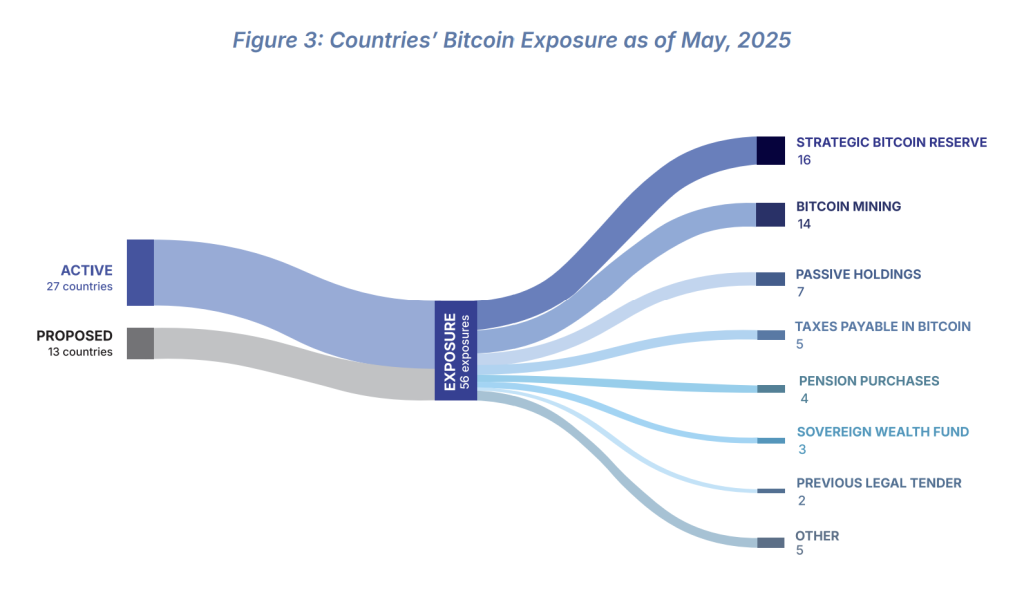
Countries’ Bitcoin Exposure as of May, 2025
Countries’ Bitcoin Exposure as of May, 2025 | Source: BPI

The authors treat sub-national pilots—such as state-level reserves or municipal tax programs—as valid instances of nation-state exposure because they can scale into national policy. Data collection closed on June 6, 2025, with first-half 2025 events aggregated as a single period to reflect the late-quarter cadence of announcements.

The topline counts underpin a larger narrative of acceleration. As of end-May 2025, the dataset covers “32 countries—roughly one out of every six nations on Earth—[that] either already had bitcoin exposure or was actively pursuing it through legislation or policy,” subdivided into 27 active and 13 proposed. The authors caution that categories can overlap, with individual countries appearing in multiple modalities; the United Arab Emirates, for example, is noted as combining government-backed mining, sovereign wealth fund ETF purchases, and tax acceptance.

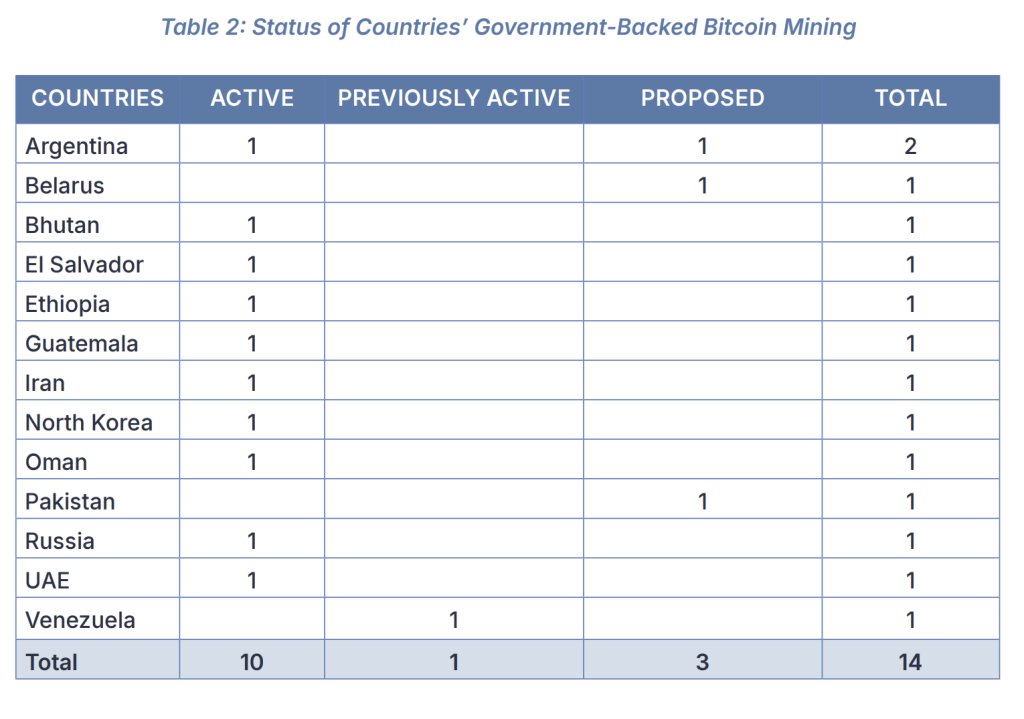
Modalities cluster around a few dominant channels. Counting both active and proposed, the most common is a Strategic Bitcoin Reserve (SBR), identified in 16 countries, followed by government-backed mining (14).
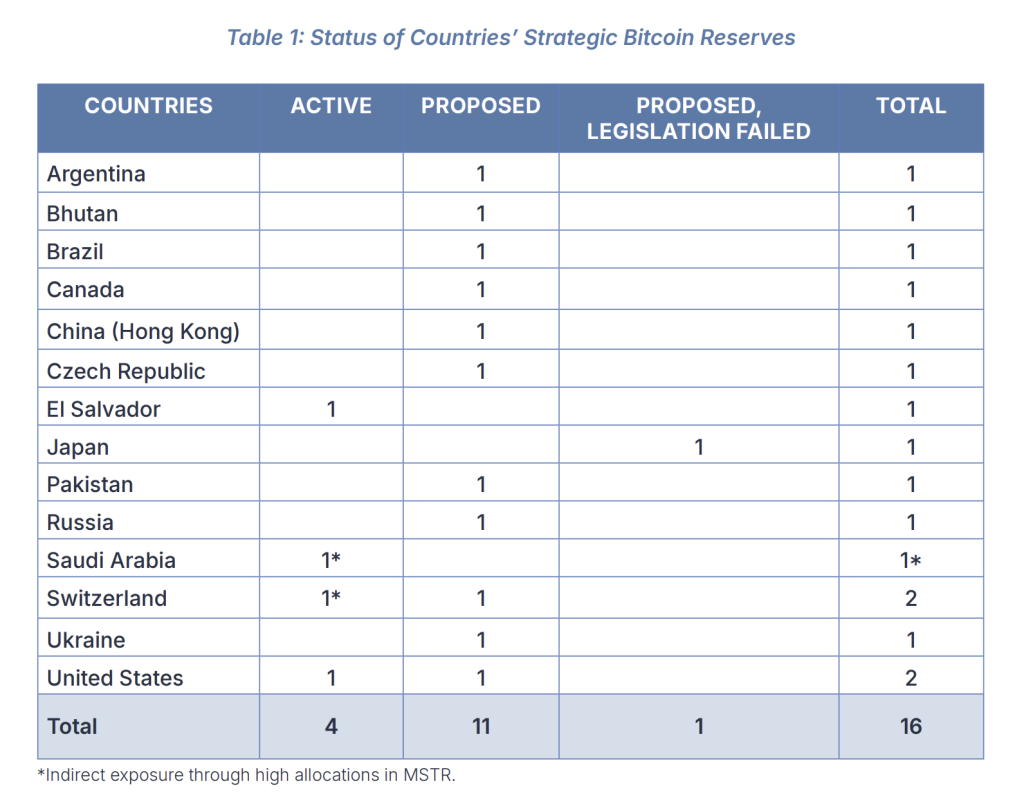
Status of Countries’ Strategic Bitcoin Reserves
Status of Countries’ Strategic Bitcoin Reserves | Source: BPI
Status of Countries’ Government-Backed Bitcoin Mining
Status of Countries’ Government-Backed Bitcoin Mining Source: BPI

Passive holdings—typically seized assets that authorities have elected not to sell—are recorded in seven countries, while five countries accept certain taxes in bitcoin. Government money managers appear on both sides of the balance sheet: four pension systems and three sovereign wealth funds show direct or indirect exposure, including via equity in BTC-treasury companies.
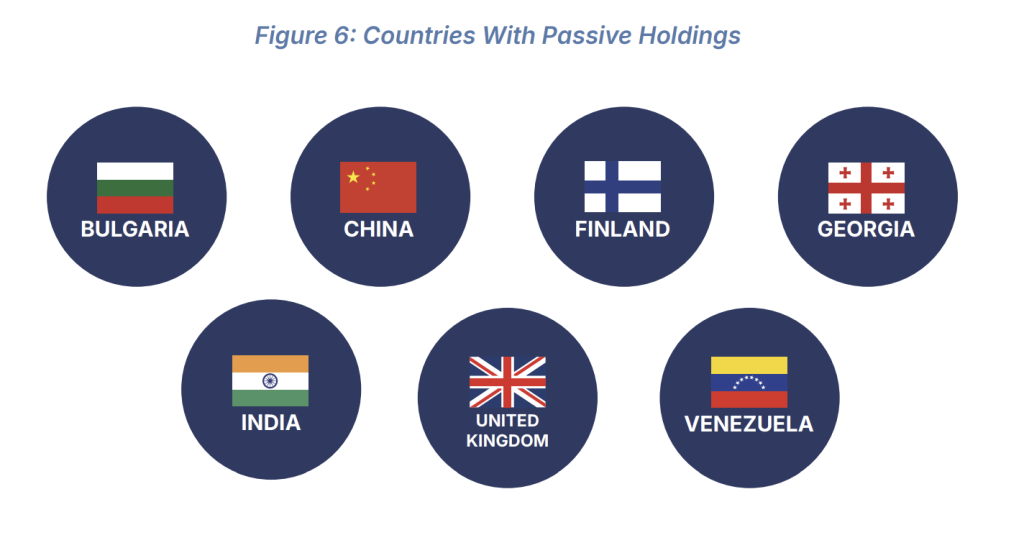
Countries With Passive Holdings
Countries With Passive Holdings | Source: BPI

Two countries are recorded for prior legal-tender status (El Salvador and the Central African Republic), and a handful of country-specific outliers include a government-backed crypto exchange pilot (Russia), a special economic zone recognizing bitcoin as a unit of account (Honduras), and the use of seized BTC for public debt (North Korea).

Different Options For Bitcoin Exposure

The authors disaggregate what is active today versus what remains on the drawing board. Among active exposures, they identify 11 countries with government-backed mining, seven with passive holdings, four with SBRs, four taking tax payments in bitcoin, and sovereign wealth funds or pensions in a smaller but notable role. Proposed measures skew even more heavily toward SBRs: “12 of the 13 countries” with proposals target a reserve model, alongside limited proposals for mining, pensions and tax acceptance.

A short list illustrates the reserve spectrum the report captures. “Four countries were classified as having active strategic bitcoin reserves.” In the United States and El Salvador, reserves are “more traditional,” with direct holding and/or accumulation. By contrast, the central banks of Switzerland and Saudi Arabia are classified as having indirect reserves through “large positions in MSTR,” reflecting the authors’ broader definition of indirect exposure via equity in bitcoin-treasury companies.

The study situates El Salvador as an early legal-tender mover that subsequently emphasized balance-sheet accumulation. It recounts that El Salvador “has amassed approximately 6,100 BTC,” and notes policy adjustments around merchant acceptance, underscoring the authors’ point that legal tender is only one, and not necessarily the most durable, channel for national adoption. “As these examples show, legal tender status is not the only route for nation state adoption. Sovereign custody, institutional purchasing, and strategic program design may prove more durable paths.”

The United States anchors a separate thread in the dataset. The authors describe US President Donald Trump’s Executive Order that “differentiated bitcoin from other cryptocurrencies and set a policy of retaining, rather than selling, bitcoin holdings,” framing an SBR architecture and, per the report’s executive summary, catalyzing copy-cat proposals abroad. They add that “sixteen nations have now proposed or enacted legislation for SBRs in a similar context to the US,” and that multiple North American municipalities and international cities have moved to accept taxes in BTC.

Passive holdings, while not proactive policy, are treated as policy-relevant because non-liquidation signals an evolving treasury stance. The report lists Bulgaria, China, Finland, Georgia, India, the United Kingdom and Venezuela as countries with seized BTC presumed to remain on government books. “While accumulation through seizure is not a proactive strategy, the noteworthy aspect of passive holdings is that they have yet sold the bitcoin,” the authors write.

The taxonomy is complemented by a methodological note on inclusions and exclusions. Rumors and campaign-only promises are filtered out, and the study introduces a direct versus indirect exposure lens: direct holdings, ETFs or mining on one side; on the other, exposures “such as equity positions in bitcoin-treasury companies like MicroStrategy (MSTR).” This framework allows Switzerland and Saudi Arabia to appear as reserve holders despite the route being portfolio equity rather than on-chain coins.

The report’s conclusion elevates the macro implications. Bitcoin, it argues, is “a new macroeconomic asset, the first of its kind in more than a century.” Early adopters may reap portfolio and financing advantages: the authors discuss “Bit-Bonds,” in which BTC functions as partial collateral to attract institutional demand and potentially lower sovereign borrowing costs, and posit that bitcoin-based settlement bridges could reduce cross-border frictions. The underlying thesis is that momentum in 2024–2025—captured in the study’s timeline and counts—makes a wholesale reversal improbable as more jurisdictions institutionalize bitcoin in public-finance workflows.

At press time, BTC traded at $112,490.
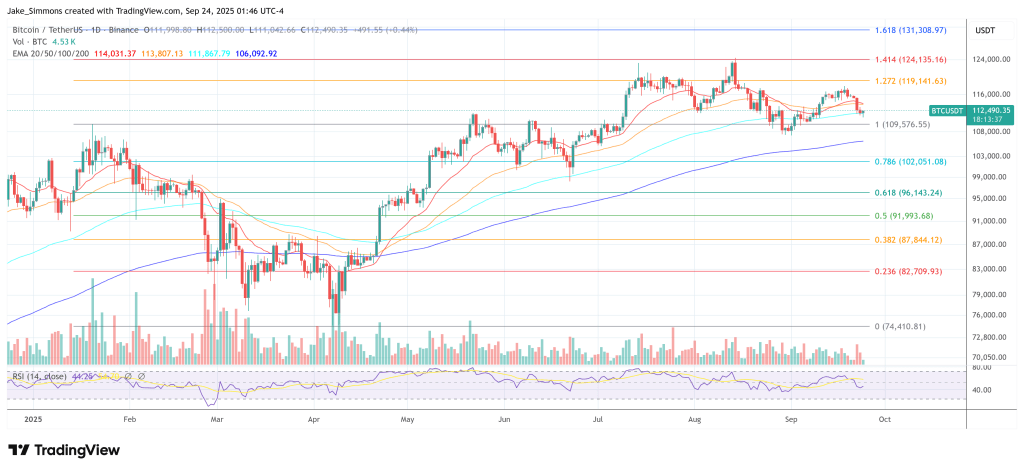
Bitcoin price
BTC hovers above $112,000, 1-day chart | Source: BTCUSDT on TradingView.com
Featured image created with DALL.E, chart from TradingView.com
Editorial Process for bitcoinist is centered on delivering thoroughly researched, accurate, and unbiased content. We uphold strict sourcing standards, and each page undergoes diligent review by our team of top technology experts and seasoned editors. This process ensures the integrity, relevance, and value of our content for our readers.

Jake Simmons has been a Bitcoin enthusiast since 2016. Ever since he heard about Bitcoin, he has been studying the topic every day and trying to share his knowledge with others. His goal is to contribute to Bitcoin's financial revolution, which will replace the fiat money system. Besides BTC and crypto, Jake studied Business Informatics at a university. After graduation in 2017, he has been working in the blockchain and crypto sector. You can follow Jake on Twitter at @realJakeSimmons.

Lecturas Relacionadas

Don't Just Focus on Layoffs, The New Structure of the Ethereum Foundation is More Worthy of Appreciation

The Ethereum Foundation (EF) has undergone a significant organizational restructuring, with the most notable change being a strategic refocusing of its priorities rather than just a 20% staff reduction (approximately 54 people). The new structure clearly prioritizes the Protocol and Access layers, which now comprise the largest teams (57 and 34 people, respectively). This signals EF's intent to concentrate its core resources on fundamental, hard-to-outsource aspects of Ethereum: protocol evolution, security, privacy, client development, and the foundational access layer. Key areas within the Protocol layer, led by an architecture group including Vitalik Buterin and Justin Drake, receive heightened emphasis. These include post-quantum security, zkEVM, formal verification, and long-term roadmap development ("Strawmap"). This reflects a shift towards tackling complex, interdependent challenges like scalability, privacy, and future-proofing the protocol, potentially moving from a pure "redundant security" multi-client model towards more specialized clients aided by AI-assisted formal verification. Financially, EF's budget is being reduced by approximately 40%. The goal is to transition from spending about 15% of its remaining funds annually to a more sustainable 5% rate, akin to a long-term endowment, ensuring its longevity. Concurrently, the restructuring involves pushing certain responsibilities—such as application development, adoption, and ecosystem coordination—to external organizations like EthLabs, the Ethereum Apps Guild, and others. This "multi-node" model aims to increase ecosystem resilience by decentralizing functions beyond the EF, though it introduces new coordination challenges. In essence, the reorganization represents EF consciously narrowing its scope to focus on the hardest, most critical protocol-level problems while fostering a more distributed and sustainable ecosystem structure for Ethereum's future growth.

Foresight NewsHace 29 min(s)

Don't Just Focus on Layoffs, The New Structure of the Ethereum Foundation is More Worthy of Appreciation

Foresight NewsHace 29 min(s)

Report Analysis: What Is Coherent Planning as CPO Booms?

Title: Report Interpretation: What Moves Is Coherent Making Amid the CPO Boom? Summary: JP Morgan analyst Samik Chatterjee reiterates an Overweight rating on Coherent (COHR), citing undervalued growth potential across three core areas: data center optical transceivers, co-packaged optics (CPO) chips, and industrial lasers/thermal management. COHR's 1.6T data center transceivers are in high demand, with pricing remaining firm. The rise of CPO is seen not as a threat but as a catalyst, creating higher demand for sophisticated optical components, an area where COHR holds a competitive edge with its comprehensive portfolio (lasers, isolators, VCSELs, thermoelectric coolers). Each CPO chip offers significantly greater revenue potential than traditional transceivers. Furthermore, its Optical Circuit Switch (OCS) technology targets a potential $4B market with reliability and power advantages. The company is expanding its InP (Indium Phosphide) device capacity fourfold within two years, securing substrate supply and transitioning to more cost-effective 6-inch wafers. As one of only two major suppliers of high-quality pump lasers—currently in severe shortage—COHR can now move up the value chain from components to complete line cards/systems, boosting ASP over tenfold. Gross margin targets (>42%) may be revised upward due to high-end product premiums, cost improvements from the wafer transition, and contributions from new high-margin products like CPO and OCS. Its efficient thermadite thermal material also offers long-term growth. Industrial segment revenue grows at a steady 5-10%, supported by semiconductor equipment orders. Changes in Apple's Face ID protocol present a re-competition opportunity for 3D sensing. Overall, Coherent is positioned as a key infrastructure provider, with AI-driven compute demand fueling the need for high-speed optical interconnectivity. Growth from CPO/OCS, stable industrial performance, and margin improvement support the bullish thesis. *Disclaimer: This summary interprets a third-party analyst report from JP Morgan. It does not constitute investment advice.*

marsbitHace 52 min(s)

Report Analysis: What Is Coherent Planning as CPO Booms?

marsbitHace 52 min(s)

Dan Koe's New Article: Escape the Fate of the Wage Slave, How to Survive in the Tide of AI Replacement?

Dan Koe's article argues that the real threat in the AI era is not technology itself, but financial dependency on employers. He critiques the "wage slavery" of unfulfilling work and identifies five core skills for resilience: agency, taste, persuasion, persistence, and iteration. These are developed not by consuming content, but by starting your own venture. The key to escaping the "employee mindset" is a radical identity shift. This requires: 1) Drastically changing your environment and daily inputs, 2) Choosing a creative medium (like content or code) that provides real-world feedback through trial and error, and 3) Using that feedback to learn and adapt. Koe strongly advocates for content creation over coding for beginners, as it builds irreplaceable subjective taste and audience connection. The practical starting point is a 15-minute self-inquiry to define your "life's work." Answer: What do you know deeply? What innate abilities do you have? What childhood interests were suppressed? Then, identify your contrarian beliefs—what does the mainstream get wrong in your area? The overlap is your unique direction. The final, non-negotiable step is to publish your first piece of content tomorrow. Embrace that it will be bad; the goal is to enter the feedback loop of creation, learning, and iteration, which is the true path to independence.

marsbitHace 1 hora(s)

Dan Koe's New Article: Escape the Fate of the Wage Slave, How to Survive in the Tide of AI Replacement?

marsbitHace 1 hora(s)

After Laying Off 20% of Staff, What Are the Key Points of EF's New Structure?

Following the completion of a months-long organizational restructuring, the Ethereum Foundation (EF) announced a 20% workforce reduction (approximately 54 employees) on June 23rd. It reorganized its teams into five new core clusters: Protocol, Access, User, Community, and Institutional (plus Operations/Management support units). Officially, this move implements the EF's 2026 Mandate and 2025 Treasury Management Policy, aiming to create a more focused and "self-sovereign" organization. The restructuring prioritizes the CROPS principles—Censorship Resistance, Openness & Freedom, Privacy, and Security—as foundational organizational tenets. The Protocol cluster will focus on core protocol R&D, including MEV reduction and zkEVM. The Access cluster emphasizes preserving user "zero option" for non-custodial, permissionless interaction. The User, Community, and Institutional clusters will manage external engagement, with the latter handling institutional and regulatory matters. While offering enhanced severance and transition support for affected employees, the EF did not disclose budget allocations or specific KPIs for the new clusters. This has led to market uncertainty about the impact on project funding and development priorities. Analysts note the announcement's positive tone of mission focus contrasts with a backdrop of recent EF leadership changes and broader ecosystem pressures. The true impact—whether this signifies strategic realignment or reactive contraction—will become clearer as the new structure's resource allocation and project prioritization are revealed in the coming months.

marsbitHace 1 hora(s)

After Laying Off 20% of Staff, What Are the Key Points of EF's New Structure?

marsbitHace 1 hora(s)

Top-Tier MEV Bot Loses $7.5 Million: Is 'Approval' the Most Overlooked Fatal Risk On-Chain?

The article discusses a sophisticated attack on a prominent Ethereum MEV (Miner Extractable Value) bot, Jaredfromsubway.eth, resulting in a loss exceeding $7.5 million. Unlike typical exploits involving key leaks or smart contract bugs, this attack was a carefully orchestrated "reverse hunt." The attacker spent weeks deploying fake tokens and liquidity pools that mimicked legitimate assets like WETH and USDC. These pools were designed to appear as profitable arbitrage opportunities, tricking the automated bot's trading logic. During its normal operation, the bot was induced to grant ERC-20 token approvals to the malicious contracts. Once sufficient permissions were accumulated, the attacker drained the bot's funds by calling these pre-approved allowances. This incident highlights the often-underestimated risks associated with token approvals in Web3. The article explains that approvals are a fundamental mechanism, allowing smart contracts (like DEXs) to move a user's tokens on their behalf. However, risks arise from practices like granting infinite approvals, the persistence of approvals even after disconnecting from a dApp, and the potential for a once-trusted contract to become compromised later. The piece concludes with advice for managing approval risks: users should adopt the principle of least privilege (approving only the needed amount), use separate wallets for storage versus interactions, and regularly audit and revoke unnecessary approvals using tools like Revoke.cash. It also emphasizes the role of wallets like imToken in providing proactive defenses, such as risk warnings and clear, readable transaction signing interfaces, to help users make informed decisions. Ultimately, wallet security must extend beyond private key protection to include active management of token approvals.

marsbitHace 1 hora(s)

Top-Tier MEV Bot Loses $7.5 Million: Is 'Approval' the Most Overlooked Fatal Risk On-Chain?

marsbitHace 1 hora(s)

Trading

Spot
Futuros
活动图片