四美分的野心:DeFi 如何通过垂直化颠覆稳定币市场?

深潮Publicado a 2025-09-22Actualizado a 2025-09-23

一股利息流从美国政府债务中流出,通过协议转向代币、DAO 和区块链。

撰文:Prathik Desai

编译:Block unicorn

数十亿美元的资金正在争夺中,但最终的回报大约只有四美分。这就是每一美元美国国债每年产生的回报。

近十年来,去中心化金融(DeFi)协议一直依赖 USDT 和 USDC 作为其产品的支柱,同时允许 Tether 和 Circle 捕获其储备的收益。这些公司通过世界上最简单的收益方式赚取了数十亿美元的利润。但现在,DeFi 协议希望自己获得这部分收益。

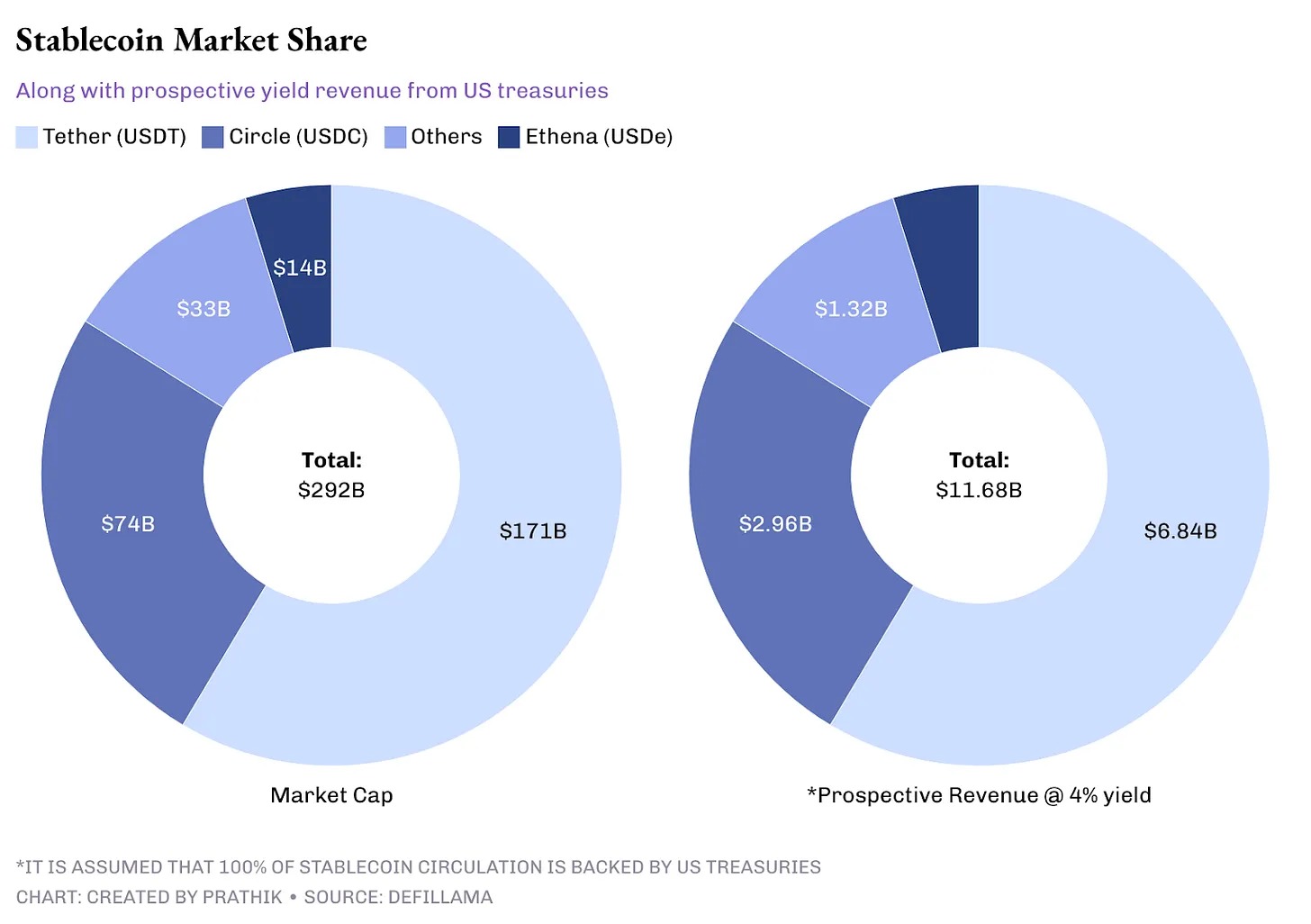
稳定币领导者 Tether 目前持有超过 1000 亿美元的储备,产生超过 40 亿美元的利息收入。这比星巴克上一财年在全球范围内销售咖啡的总利润 37.61 亿美元还要多。而 USDT 发行方仅通过将其储备投资于美国国债就实现了这一点。Circle 在去年上市时也采用了同样的方法,强调其浮动资金是其核心收入来源。

目前,流通中的稳定币总值超过 2900 亿美元,每年产生约 120 亿美元的收入。这是一笔不容忽视的巨额资金。这在 DeFi 中引发了一场新的战争,协议不再满足于让发行方捕获这些收益。他们现在希望拥有产品及其基础设施。

本月初,Hyperliquid 启动了其原生稳定币 USDH 的竞标,竞标要求获胜者必须返还收益。Native Markets、Paxos、Frax、Agora 和 Ethena 均参与竞标。最终获胜者 Native Markets 承诺,USDH 的金库收入将 100% 回流至区块链:一半用于 HYPE 代币回购,另一半用于生态系统资助。

目前,Hyperliquid 的 Layer-1 上持有 60 亿美元的 USDC,可能产生 2.4 亿美元的收入。这些收入原本由 Circle 持有,现在可能会被重新用于销毁代币和激励开发者。作为参考,Hyperliquid 在 6 月、7 月和 8 月通过交易费用产生了 2.6 亿美元的净收入。

Ethena 的发展速度更快,规模也更大。

在短短两个月内,其合成稳定币 USDe 的流通量从 50 亿美元跃升至近 140 亿美元,超过 Maker 的 DAI,成为仅次于 USDT 和 USDC 的第三大美元挂钩稳定币。

8 月份,Ethena 的收入达到 5400 万美元,创下 2025 年迄今的最高纪录。如今,随着其期待已久的费用转换机制正式启动,每年最多可有 5 亿美元资金被转用于 ENA 的回购,从而将 ENA 代币的命运与系统产生的现金流紧密联系在一起。

Ethena 的模式包括做多现货加密货币、做空永续合约,并分配国债和质押收益。因此,sUSDe 质押者在大多数月份享受了超过 5% 的年化收益率(APY)。
经验丰富的 Maker 是首批利用美国债券作为稳定币储备的公司之一。

它一度持有超过 10 亿美元的短期国债,这使得它能够提供 8% 的 DAI 储蓄利率,一度高于美国垃圾债券的平均收益率。多余的资金被汇入其盈余缓冲区,然后用于回购,销毁了数千万个 MKR 代币。对于代币持有者来说,这让 MKR 从单纯的治理徽章变成了实际收入的索取权。

而 Frax 的规模较小,但方法更为专注。

其供应量徘徊在 5 亿美元以下,仅为 Tether 的 1100 亿美元的一小部分,但它仍然是一台赚钱机器。创始人 Sam Kazemian 设计了 FRAX,旨在将每一美元的储备收入重新投资到系统中。这些收入一部分被销毁,一部分与质押者分享,其余部分则被存入 sFRAX,这是一个跟踪美联储利率的金库。即使以目前的规模,该系统每年也能产生数千万美元的收入。

Aave 的 GHO 稳定币在构建时就考虑到了垂直化。

该稳定币于 2023 年上线,目前发行量达 3.5 亿美元。其原理很简单:每位借款人直接向 DAO 支付利息,而不是向外部贷款机构支付。借款利率为 6-7%,这将产生约 2000 万美元的收入,其中一半与 AAVE 质押者分享,其余部分则进入金库。新的 sGHO 模块将为储户提供高达 10% 的年利率(由储备金补贴),从而进一步提升交易的吸引力。实际上,DAO 愿意动用自有资金,使其稳定币看起来像一个储蓄账户。

还有一些网络将稳定币收益用作原始基础设施。

MegaETH 的 USDm 由代币化的国债支持,但其收入并非支付给持有者,而是用于支付 rollup 的排序器费用。在规模化后,这可能意味着每年有数百万美元用于支付 gas 费,从而有效地将国债票息转化为公共产品。

所有这些举措的共同点都是垂直化。

每个协议都不再满足于依赖别人的美元轨道。它们正在铸造自己的货币,获取原本属于发行方的利息,并将其重新用于回购、国债、用户激励,甚至补贴区块链的建设。

虽然国债的收益率看似平淡,但在 DeFi 中,它已成为构建自给自足生态系统的火花。
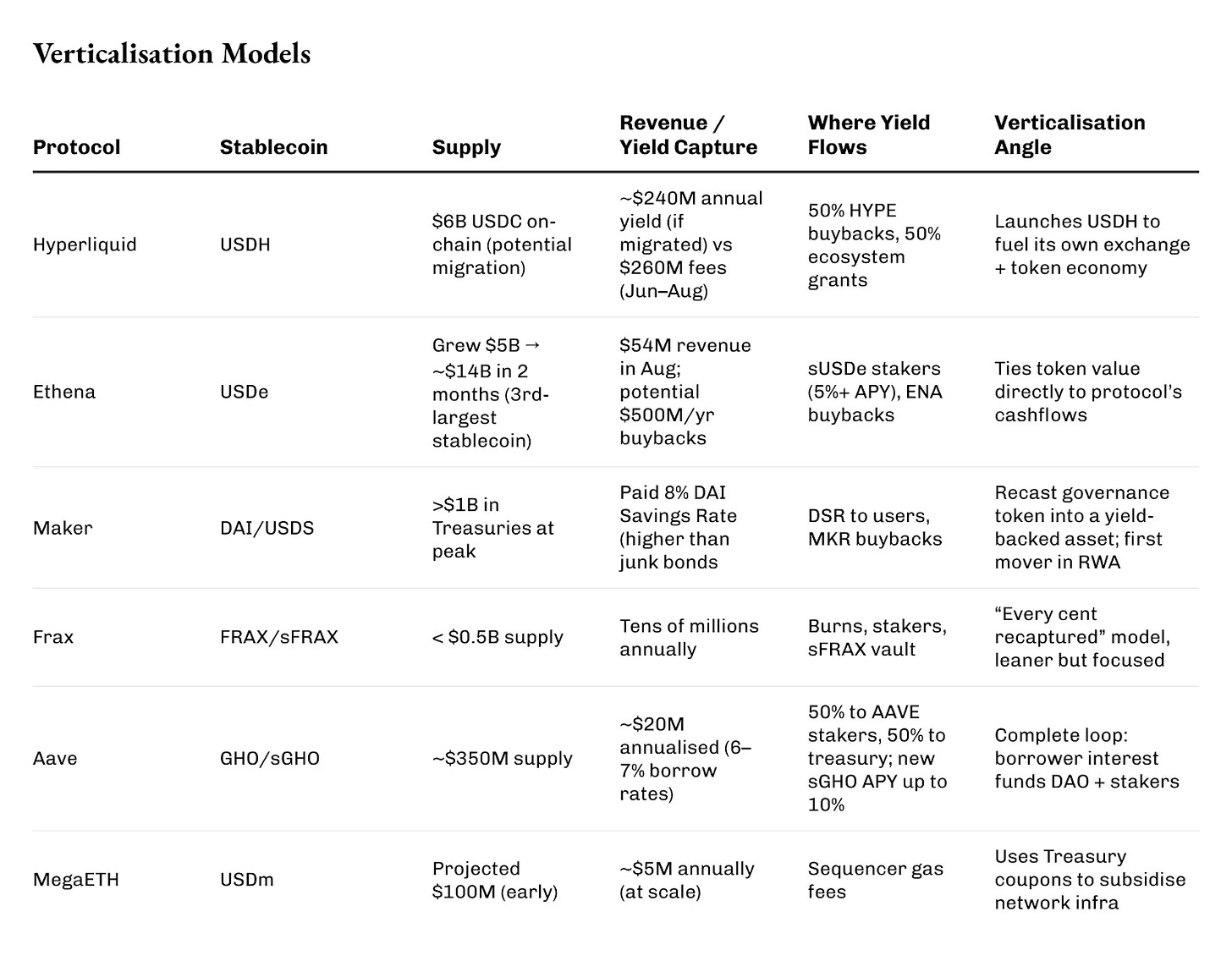
当你比较这些模型时,你会发现每个协议都在设置不同的阀门,以接入这 4% 的收益流。回购、DAO、排序器和用户。

收益是被动收入。它让每个人都变得鲁莽。每种模式都有各自的瓶颈。

Ethena 的挂钩机制依赖于永续融资保持正值。Maker 曾经历过现实世界的贷款违约,不得不弥补损失。在 Terra 倒闭后,Frax 撤资,缩减发行量以证明自己不会是下一个。所有这些机构都依赖于一件事:由贝莱德等托管机构持有的美国国债。这些是围绕高度中心化资产的去中心化包装。而中心化也带来了崩盘的风险。

同时,新法规也带来了挑战。

美国的《GENIUS 法案》彻底禁止了有息稳定币。欧洲的 MiCA 法案设定了限制和许可要求。DeFi 找到了一种变通方法,将收益标记为“回购”或“排序器补贴”,但其经济原理是一样的。如果监管机构选择采取行动,他们完全有能力。

然而,这种方法有助于构建可持续的商业模式——而这正是加密领域长期以来一直苦苦挣扎的。如此众多的模式正在运作,展现了 DeFi 协议如今拥有的巨大潜力。如今人们争夺的是世界上最无聊的收益率。然而,风险很高。Hyperliquid 将其与代币销毁挂钩,Ethena 将其与储蓄账户和回购挂钩,Maker 将其与央行式的缓冲挂钩,MegaETH 则将其与 rollup 的运营成本挂钩。

我想知道这场运动是否会蚕食巨头的市场份额,从 USDC 和 USDT 中抽走流动性。如果不会,它肯定会扩大市场规模,创造出一个与零收益稳定币并驾齐驱的收益型稳定币层。

目前尚无人知晓。但战争已经开始,战场广阔:一股利息流从美国政府债务中流出,通过协议转向代币、DAO 和区块链。

曾经属于发行方的四分多钱的收益,如今正推动着 DeFi 的最新发展。

Lecturas Relacionadas

Report on the State of the Crypto Industry by 2026, Featuring Sumsub Vice President for North America, Danielle LaBarbera

The cryptocurrency industry is entering an era of regulated maturity, driven by frameworks like the CLARITY Act and the $GENIUS Act in the US. These provide clearer rules but also raise operational standards, requiring platforms to effectively demonstrate compliance. Simultaneously, fraud is evolving into sophisticated, AI-powered, lifecycle-based attacks, moving beyond simple onboarding scams. According to Daniel LaBarbera, VP of Sumsub for North America, companies must shift from one-time KYC checks to continuous, risk-based verification. This involves integrating identity, behavioral, device, and transaction data into a unified risk view. The 2026 State of Crypto Industry report highlights that while 55% of crypto firms faced fraud last year, effective strategies now combine AI-driven detection, continuous monitoring, and behavioral analytics. Key compliance challenges persist, particularly with the Travel Rule. Only 23% of companies are fully compliant, with high implementation costs, data security concerns, and regulatory fragmentation being major hurdles. Meanwhile, stablecoins are gaining traction, accounting for 36% of all crypto transactions in 2025, and evolving from trading tools into financial infrastructure for payments and settlements. The path forward lies in risk-based approaches that balance security, speed, and user experience. This includes adopting documentless verification, reusable KYC, and breaking down silos between compliance functions to create a holistic, lifecycle view of customer risk and trust.

cryptonews.ruHace 1 min(s)

Report on the State of the Crypto Industry by 2026, Featuring Sumsub Vice President for North America, Danielle LaBarbera

cryptonews.ruHace 1 min(s)

U.S. National Debt Approaches $40 Trillion in 5 Months, Bitcoin Debate Gains Momentum

The US national debt has surged to nearly $40 trillion in just five months, the fastest trillion-dollar increase on record. The debt's growth has accelerated dramatically over time, from taking 192 years to reach the first $1 trillion in 1981 to adding the latest $1 trillion in only five months. The federal budget deficit for the fiscal year is already over $1.8 trillion, exceeding last year's total, and net interest payments on the debt have surpassed $1 trillion, now exceeding defense or Medicare spending. This rapid debt accumulation is fueling arguments within the cryptocurrency industry that Bitcoin serves as a hedge against government-backed currencies and fiscal irresponsibility. Proponents, including some lawmakers and industry leaders, argue Bitcoin could act as a "hard currency" fiscal control mechanism. Legislation has even been proposed for the Treasury to acquire Bitcoin to help reduce the national debt. The International Monetary Fund has warned that global public debt could hit 100% of world GDP by 2029 if current trends continue, with the US and China as primary drivers. Some analyses suggest a sovereign debt crisis could drive capital into alternative assets like Bitcoin, similar to past regional banking crises. However, skeptics point out that both Bitcoin and gold have fallen in price at times during 2026 despite record debt, indicating the depreciation hedge theory may operate over a much longer timeframe than short-term price action.

cryptonews.ruHace 11 min(s)

U.S. National Debt Approaches $40 Trillion in 5 Months, Bitcoin Debate Gains Momentum

cryptonews.ruHace 11 min(s)

Technological Self-Reliance in China: A War from Lithography Machines to ABF Films

"China's Tech Independence: A Battle from Lithography Machines to ABF Film" In August 2026, Japan's Ajinomoto announced a 30% supply cut of ABF film to Chinese mainland clients, causing industry-wide shock and fears of price hikes and shortages in the semiconductor supply chain. That same year, Chinese company Lotus Holdings, known for its MSG business, acquired a small domestic ABF film startup for 103 million yuan, aiming to change this passive situation. ABF film is a core insulating material for advanced CPU, GPU, and AI chip packages. Ajinomoto, originally a food flavoring company, has monopolized over 95% of the global ABF film market for nearly 30 years, deriving its technology from byproducts of monosodium glutamate production. With AI chips consuming 5-10 times more ABF film than traditional chips, the supply-demand gap is widening. Ajinomoto's supply cut to China, where domestic ABF film production accounts for less than 5%, directly threatens the production of domestic high-end AI chips and their substrates. This incident highlights a crucial but often overlooked truth: the vulnerabilities in China's quest for technological self-reliance extend beyond headline areas like lithography machines to critical but seemingly minor components—insulating films, photoresists, electronic specialty gases, etc. The article frames China's tech independence as a multi-front war. While major breakthroughs have been achieved in chip design (e.g., Huawei's HiSilicon), foundry (e.g., SMIC), and memory chips (e.g., YMTC), countless smaller "Ajinomoto-style" chokepoints remain. Lotus Holdings' acquisition represents a significant shift: the battle is no longer fought only by tech giants but has become a collective, industry-wide effort involving companies from diverse backgrounds. Historically, external blockades have often spurred China's technological breakthroughs, as seen with Huawei's Kirin chips and YMTC's 3D NAND flash memory. Ajinomoto's supply cut, while a short-term challenge, may similarly catalyze domestic innovation in ABF film and other critical materials. The path to technological sovereignty is long and arduous, requiring sustained patience and investment to fill every gap in the complex supply chain. Lotus's move is not an immediate solution but a step towards that future, symbolizing a broader, relentless march toward independence.

marsbitHace 31 min(s)

Technological Self-Reliance in China: A War from Lithography Machines to ABF Films

marsbitHace 31 min(s)

The Great Ethereum "Rate Cut" Debate: Is Now the Golden Window for Staking with the Unconventional EIP-8363?

Ethereon's economic policy is under review as a new proposal, EIP-8363, sparks debate over potential "interest rate cuts" for staking. The unconventional proposal suggests gradually increasing the proportion of newly issued ETH rewards that are burned as the total staked ETH ratio rises, with issuance fully offset by burns once the ratio nears 50%. This would drive the protocol-level staking APR towards 0%, though validators would still earn transaction fees and MEV. This discussion emerges as staked ETH approaches 35% of supply, with the current protocol APR at ~2.6%. The core question is whether Ethereum needs to continue paying high issuance costs for marginal gains in security once sufficient participation is achieved. EIP-8363 aims to optimize security spending, but critics warn it could disproportionately impact solo stakers and potentially increase centralization among large, resilient operators. Paradoxically, this debate coincides with the Pectra upgrade (EIP-7251), which introduces native compounding for staking rewards, significantly improving capital efficiency for long-term holders. This creates a dual narrative: the protocol is making staking more efficient while reconsidering the economic incentive to stake. For long-term ETH holders, this environment may present a "time window" rather than a fixed-rate opportunity. While future APRs are expected to trend downward, starting staking earlier maximizes the compounding effect over time. The decision to stake depends on individual factors like investment horizon, liquidity needs, and risk tolerance regarding options like native validation, staking services, or liquid staking tokens (LSTs). The evolution from encouraging staking to managing its economic cost marks a new, mature phase for Ethereum's tokenomics, where the true value of staking may increasingly lie in the long-term power of compounding time.

marsbitHace 39 min(s)

The Great Ethereum "Rate Cut" Debate: Is Now the Golden Window for Staking with the Unconventional EIP-8363?

marsbitHace 39 min(s)

Trading

Spot
活动图片