While the Federal Reserve remains undecided on "rate hikes or cuts," Ethereum staking, the "on-chain financial benchmark rate," has already started discussing a "rate cut."
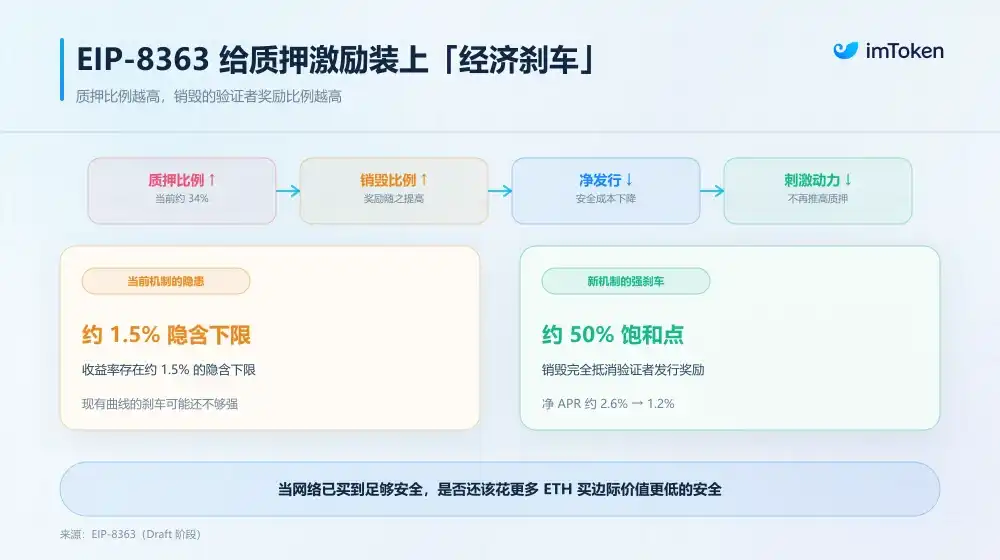
The recently widely debated EIP-8363 proposes a rather counter-intuitive new issuance mechanism: as the proportion of ETH staked increases, gradually raise the burn ratio in validator rewards. When the network-wide staking ratio nears 50%, the burn would completely offset the issuance rewards.
In other words, when the network-wide ETH staking ratio reaches 50%, the annualized staking yield will drop to nearly 0!
Of course, this does not mean total staking returns will be strictly zero at that point, as validators could still earn other incomes like execution layer transaction fees and MEV. However, for the issuance reward, which currently constitutes the vast majority of staking returns, this would undoubtedly be like "pulling the firewood from under the cauldron."
This single stone has stirred up a thousand waves.
Consider this: as of writing, over 40 million ETH have been staked, nearing about 35% of the total supply, and the protocol-level APR has already dropped to around 2.6%. Thus, a question that once seemed distant is suddenly before Ethereum:
As more and more ETH are willing to participate in staking, does Ethereum still need to incentivize more ETH into staking through new issuance?
I. Is Ethereum Starting to Worry About "Too Much Staking"?
To understand this, we first need to review the different stages Ethereum staking has undergone.
As is well known, when the PoS mechanism first launched, its primary goal was singular: to get enough ETH willing to enter the Beacon Chain, establishing sufficient economic security for the entire network.
To achieve this, the protocol rewarded validators with new issuance, while designing a dynamic yield curve: early participants could obtain higher yields per validator; in the future, as more ETH enters staking, the yield would gradually decline.
This is why Ethereum's early staking APR was once far higher than today's, now reduced to about 2.6%. Theoretically, this mechanism itself comes with an "automatic brake."
After all, as yields get lower, some will inevitably find it no longer worthwhile, eventually allowing the entire staking market to find an equilibrium at a certain level. However, the core premise of EIP-8363 is precisely that this brake might not be strong enough.
According to the current issuance curve, even as more ETH enters staking, there remains an implied floor of about 1.5% for validators' consensus layer yield. Thus, a situation could theoretically arise where substantial funds remain willing to enter even with yields just over 1%.
And as an increasingly larger proportion of ETH is entrusted to exchanges, custodians, LST protocols, and professional operators, the marginal contribution of additional staking to economic security diminishes, while risks like staking centralization, governance capture, and control of massive ETH by few entities may increase.
Simultaneously, staking rewards essentially come from new ETH issuance. The higher the staking ratio, the greater the issuance cost the protocol pays for network security; ETH holders not participating in staking bear the corresponding dilution.
So the problem EIP-8363 aims to address is: when the network has already bought sufficient security, is it necessary to keep spending more ETH to purchase additional security of diminishing marginal value?
Of course, its proposal is not yet a confirmed Ethereum monetary policy to be implemented, and community controversy is significant. One very realistic counter-argument is that if yields are pushed too low, the first to find it "unprofitable" and exit might precisely be the Solo Stakers who bear hardware, electricity, and operational costs.
Large institutions, due to economies of scale, MEV income, or product demands, might be better equipped to stay. The result could then be "staking ratio decreases, but those remaining become more concentrated," which clearly conflicts with the proposal's original intention of improving decentralization and anti-capture capabilities.
Community discussion continues on this point. Whether EIP-8363 will ultimately be implemented, and in what form, remains undecided.
But it at least sends a clear signal: Ethereum has begun rethinking a problem it rarely needed to consider before—is the staking reward too generous?
II. Preparing for a "Rate Cut," While Staking Just Entered the Compound Interest Era
Interestingly, while Ethereum discusses reducing long-term staking yields, the capital efficiency of staking itself just received a significant upgrade.
This is EIP-7251, brought by the Pectra upgrade (Further reading: "When 8 Million ETH Start 'Moving': Post-Pectra Era, Is Staking Facing Structural Upheaval?").
Simply put, Ethereum's native staking previously did not compound automatically; only the principal (32 ETH) earned, but interest did not automatically accrue into the principal to continue earning. EIP-7251 makes native staking truly form a compound interest loop: "principal generates ETH → rewards enter principal → more ETH then generates new ETH."
From a one- or two-year perspective, the numerical difference between compounding or not on a ~2% yield isn't dramatic.
Where it truly matters is time.
Assuming a user plans to hold ETH for three, five years, or even longer, starting staking from day one with generated ETH continuously rejoining the principal—the longer the period, the more the gap between the two can be amplified.
For ordinary users using LSTs, "compound interest" isn't a new concept; many LSD/LST products already allowed users to indirectly benefit from staking reward accumulation. But the Pectra upgrade makes auto-compounding a capability natively supported by the protocol for the first time, rather than relying on external products, undoubtedly further enhancing the capital efficiency of the entire staking infrastructure.
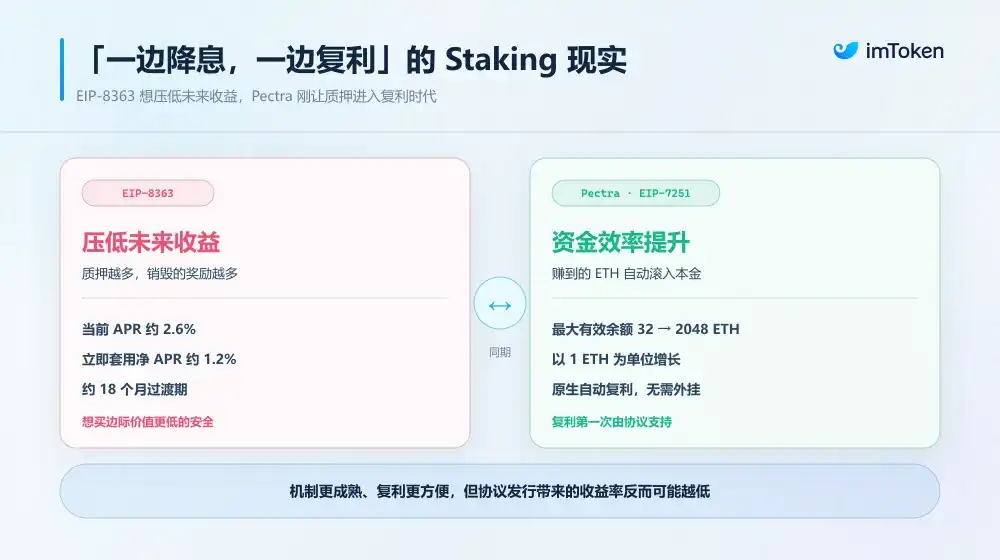
So viewing EIP-8363 and Pectra together forms a seemingly contradictory yet actually quite reasonable combination: Ethereum is striving to make "how to stake" more efficient, but that doesn't mean it still wants to use increasing ETH issuance to continuously raise the economic incentive for "why to stake."
The former addresses capital efficiency, the latter addresses how much the protocol should pay for security.
Precisely because of this, future Ethereum staking will likely see an increasingly obvious trend: mechanisms become more mature, compounding becomes more convenient, but yields derived purely from protocol issuance become lower.
This protocol-level change is also gradually transmitting to ordinary users' product experience. For instance, imToken plans to further support "auto-compounding" for native ETH staking, ensuring Pectra's new capabilities aren't limited to validators and large staking institutions but gradually enter wallet gateways directly usable by ordinary long-term holders.
III. Is Now Instead the Golden Window for Staking?
This brings us to the question ordinary ETH holders genuinely care about.
If future Staking APR may continue to decline, does it mean we should "get in quickly while yields are still high"?
We must first dispel a common misconception: staking now does not lock in today's ~2.6-3% yield.
Because Ethereum staking is not a long-term bond with a fixed coupon rate upon purchase. Even if EIP-8363 is implemented, or Ethereum modifies the issuance curve by other means in the future, validator yields will change accordingly.
Therefore, the so-called "window" is not about rushing before an Ethereum "rate cut" to grab a long-term deposit certificate at 2.6%.
The real value lies in the time cost.
Assume a user holds a sum of ETH, originally planning to hold for five years. Not staking in year one but deciding to start in year two won't make year two's yield higher, nor can they recover the missed ETH rewards from year one. More importantly, the rewards that could have been earned in year one lose the opportunity to compound over the subsequent four years.
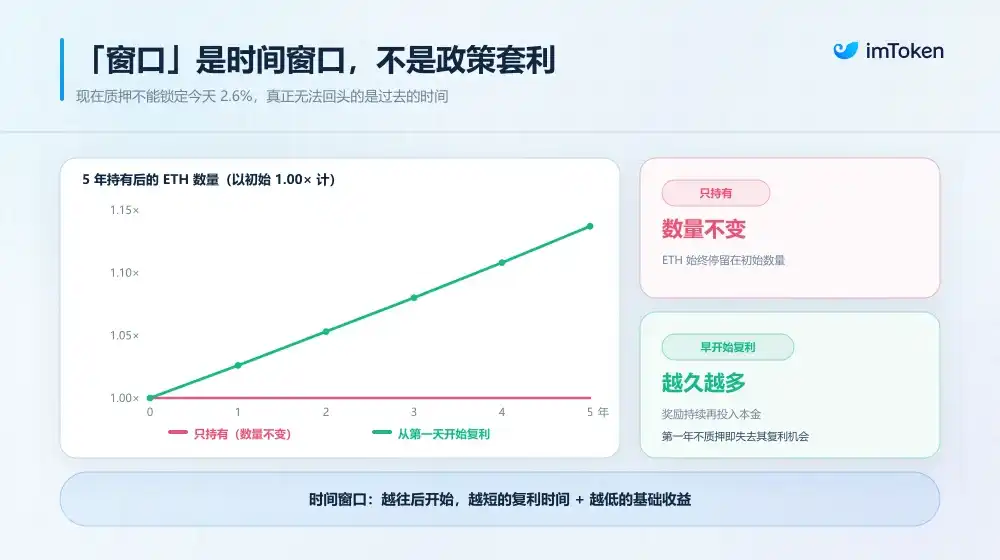
If the long-term direction for Ethereum staking is indeed a gradual increase in staking ratio and a gradual decrease in yield, this issue becomes more pronounced. Starting later means potentially enjoying not only a shorter compounding period but also a lower base yield.
This is where "now might be a window" truly holds water—in other words, it's a window of time.
Especially for users already planning to hold ETH long-term with no imminent liquidity needs, the decision-making process for staking might also need to change.
Moreover, the author personally believes EIP-8363 is a trial balloon. Regardless of future community consensus, the macro trend of Ethereum's token economics is destined to shift from extensive incentives towards more refined, more restrained issuance design.
Of course, this does not mean all ETH should be staked, as any return corresponds to costs and risks:
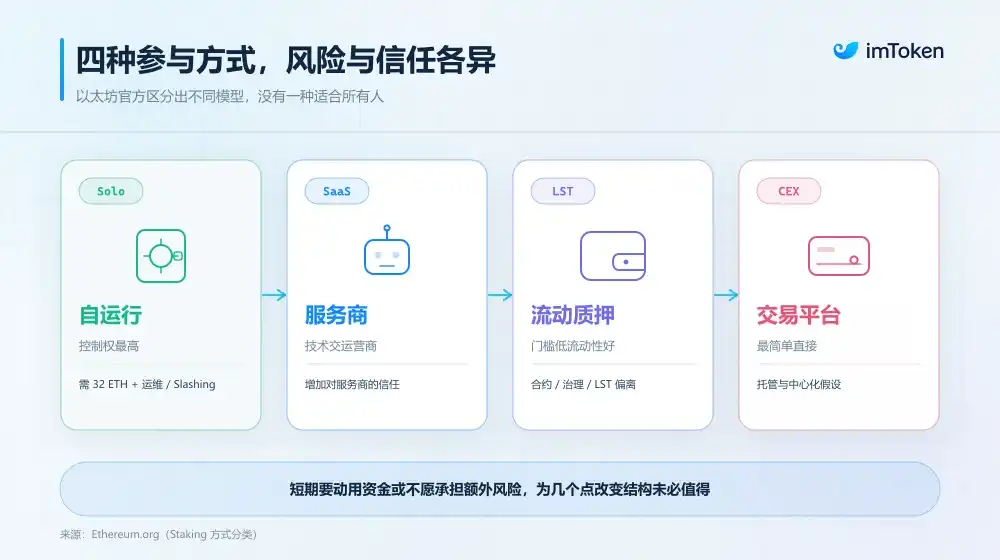
- Running a native validator oneself maximizes control and protocol-native rewards but requires at least 32 ETH and entails costs like node operation, offline penalties, slashing risks, and daily maintenance.
- Staking-as-a-Service can delegate technical work to professional operators but adds trust in the service provider.
- Liquid staking has lower capital barriers and better liquidity. For example, users can directly access services like Lido via self-custody wallets like imToken, managing their wallet while participating in ETH staking. However, it adds extra risks like smart contracts, governance, and LST price deviation.
- Centralized exchanges are simpler but entail higher custodial and centralization assumptions.
Thus, for users who might sell ETH short-term, need frequent fund movement, or are unwilling to bear these additional risks, altering their asset structure for a few percentage points of yield may not be worthwhile.
But if the premise becomes "this ETH is intended to be held long-term anyway," then the answer might start to differ.
In Conclusion
Looking back at Ethereum staking's changes over recent years is quite interesting.
The Beacon Chain and The Merge completed the underlying transition from PoW to PoS. Shapella solved the problem of "can staked ETH be withdrawn," clearing a key obstacle for the liquid staking market's further development. By Pectra, native validators began to possess auto-compounding and higher capital efficiency.
Today's EIP-8363 discusses the question further: when enough people are already staking, how much new ETH should Ethereum actually pay for staking?
The shift from "figuring out how to get more people to stake" to "starting to worry if too much is staked" itself indicates the stage Ethereum Staking is in has changed.
Seas change into mulberry fields, progress is made step by step. This is also a question a market transitioning from early expansion to maturity must inevitably answer.
Future staking may become more convenient, more mature, increasingly resembling a standardized ETH base-layer yield infrastructure—but not necessarily more profitable. And for those truly preparing to hold ETH long-term, this might be another insight EIP-8363 offers:
When the yield itself becomes increasingly scarce, what's truly precious about compounding is time.